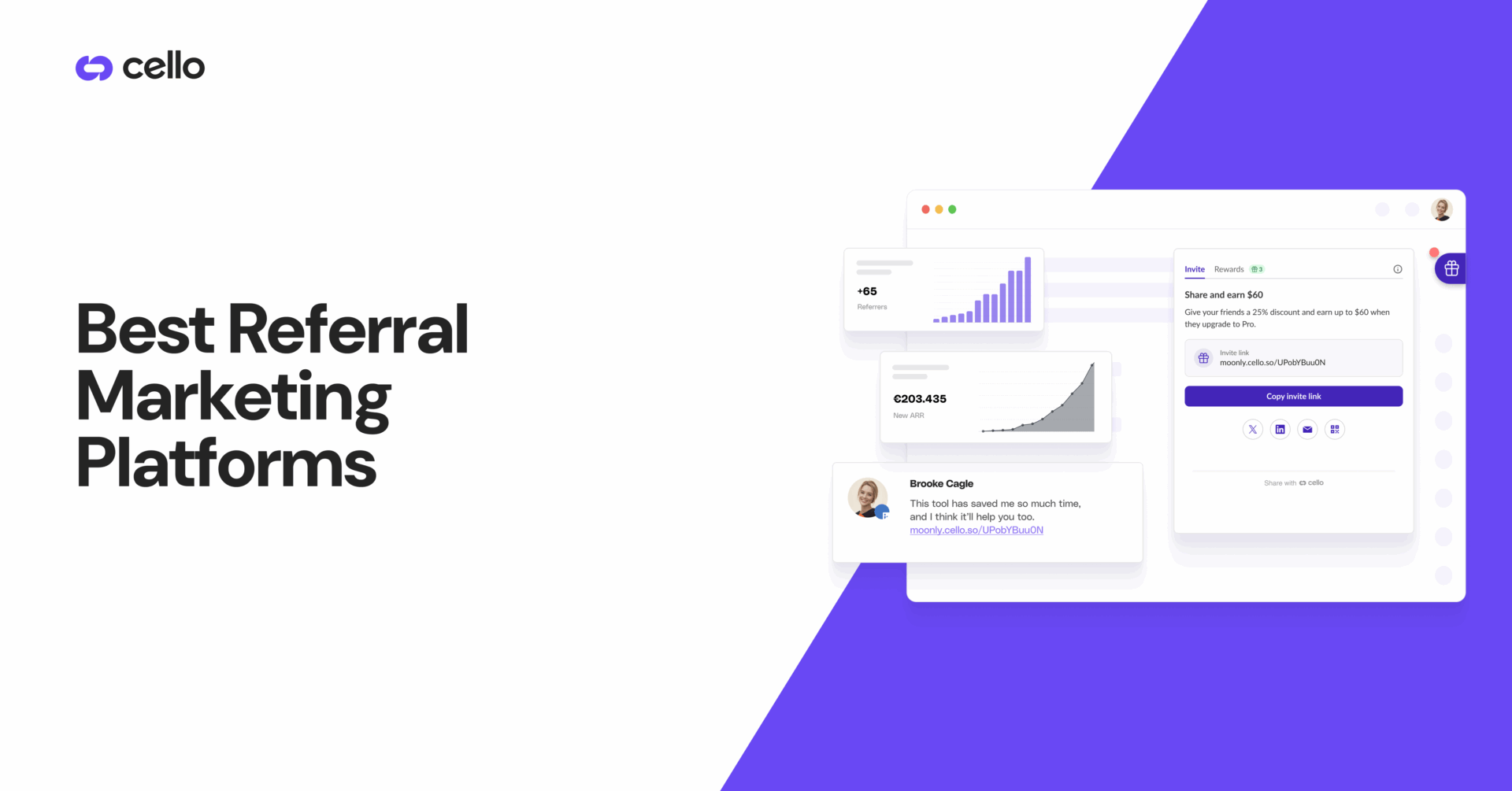
TL;DR: Native mobile integration is essential for SaaS referral programs. This guide evaluates the top referral software platforms based on mobile SDKs, automation capabilities, and operational efficiency. Cello leads for product-led growth companies, while GrowSurf excels for sales-led organizations and PartnerStack dominates partner ecosystem management.
- Why Mobile-Native Referral Programs Matter for SaaS
- Key Features to Look For in Mobile-Ready Referral Software
- Top Referral Software for SaaS with Native Mobile Integration (2025)
- Detailed Comparison Table
- Best Choice by SaaS Type
- Implementation Roadmap for Mobile Referral Programs
- How to Measure ROI and Retention Impact
- Common Pitfalls to Avoid
- Frequently Asked Questions
- Unlocking User-Led Growth
For SaaS companies pursuing efficient growth, user referrals deliver measurable results: 50-70% lower customer acquisition costs, 16% higher lifetime value, and 30% better conversion rates than other channels. However, these benefits only materialize when the referral experience integrates seamlessly into your product; especially on mobile.
This guide evaluates the leading referral software platforms for SaaS companies, with particular focus on native mobile integration, automation capabilities, and operational efficiency.
Why Mobile-Native Referral Programs Matter for SaaS
The primary interface for many SaaS products is now the native mobile application. A referral program that redirects users to an external webpage creates friction at the critical moment when satisfied users are most likely to share.
The Difference Between Mobile-Friendly and Mobile-Native
- Mobile-Friendly: A responsive web portal accessed from the app. This creates a disjointed user journey that interrupts the product experience.
- Mobile-Native: Built using dedicated iOS or Android SDKs. The referral functionality embeds directly within the app's interface, making sharing a natural extension of product usage.
Native integration eliminates what can be called the "Mobile Trust Deficit": when users are forced out of a polished native app into a clunky browser experience, it signals low quality and erodes trust in both the referral program and the core product.
Technical Challenges Requiring Specialized Software
Mobile referral programs face unique technical hurdles:
Cross-Device Tracking: A user shares from their mobile app, but their friend signs up on desktop. Simple cookie-based tracking fails to connect these events, resulting in lost attribution and unpaid referrals.
The App Store Black Box: App stores don't pass referral data through the installation process. Advanced deferred deep linking technology is required to match a user to their referrer after app installation.
Privacy Compliance: With Apple's App Tracking Transparency (ATT) and similar initiatives, modern platforms must use deterministic, first-party data and transparent attribution methods.
Key Features to Look For in Mobile-Ready Referral Software
When evaluating referral platforms, assess these five critical capabilities:
1. Native In-Product Experience
The platform must provide dedicated SDKs for iOS, Android, and React Native, not just API access that requires custom development. Native components allow referral functionality to embed seamlessly within your app's UI, meeting users at their moment of highest satisfaction.
2. Automated & Flexible Rewards Engine
A scalable referral program requires complete automation. The platform should handle reward calculation, multi-currency global payouts, and all associated tax and legal compliance (including KYC checks) without manual intervention. For SaaS businesses, support for recurring rewards tied to Monthly Recurring Revenue (MRR) is essential.
3. Seamless User & Developer Experience
The end-user experience must be frictionless: simple sharing, transparent tracking, and clear reward visibility. For developers, look for clear documentation, logical APIs, and quick implementation. Platforms requiring minimal development time (ideally one hour or less) allow growth teams to launch and validate quickly.
4. Robust Analytics & Fraud Prevention
Comprehensive analytics dashboards are essential for measuring ROI and optimizing performance. Equally important are automated fraud prevention tools that detect and flag suspicious activity like self-referrals, protecting program budgets from abuse.
5. Unified Platform Architecture
Many SaaS companies run parallel programs for user referrals, affiliates, and partners. A unified platform managing all word-of-mouth channels from a single dashboard eliminates operational complexity, data silos, and redundant work.
Top Referral Software for SaaS with Native Mobile Integration (2025)
Cello
Best for: B2B and B2C SaaS companies with significant web and mobile user bases
Cello provides native SDKs for web, iOS, Android, and React Native, enabling fully embedded referral experiences. The platform automates the entire rewards lifecycle, including global multi-currency payouts with integrated tax and KYC compliance. Implementation takes approximately one hour of developer time.
Key Strengths:
- Complete native mobile support across all major platforms
- Fully automated global payouts with compliance management
- Revenue-aligned pricing
- Unified platform for user, affiliate, and partner programs
- Real-time analytics with automated fraud detection
Ideal Use Case: SaaS companies where the product drives acquisition and retention, requiring seamless in-app referral experiences.
GrowSurf
Best for: Sales-led B2B SaaS companies using Salesforce
GrowSurf focuses on web-based referral programs with deep Salesforce integration, allowing sales teams to track referred leads through the entire funnel. Mobile integration requires custom API implementation rather than native SDKs.
Key Strengths:
- Native Salesforce integration for sales-led motions
- Automated reward fulfillment via Zapier and Tango Card
- Robust fraud prevention with IP blacklisting and reCAPTCHA
- Comprehensive analytics dashboard
Limitation: Primarily web-focused; mobile requires additional development work.
Best for: Enterprise SaaS companies with complex marketing automation
SaaSquatch offers native iOS and Android SDKs with integration to mobile measurement partners like Branch and AppsFlyer for sophisticated attribution. The platform excels in marketing-led organizations requiring deep HubSpot integration.
Key Strengths:
- Native mobile SDKs for iOS and Android
- Advanced deferred deep linking capabilities
- Flexible reward structures including recurring commissions
- Strong HubSpot and Salesforce integrations
Consideration: High customizability can increase implementation complexity.
Best for: B2B SaaS companies building partner ecosystems
PartnerStack is the market leader in Partner Relationship Management (PRM), designed to manage affiliates, resellers, and strategic partners. The platform uses an external partner portal model rather than in-app integration.
Key Strengths:
- Best-in-class partner commission management
- Robust partner portal and reporting
- Enterprise-grade partner ecosystem tools
Important Note: Not designed for product-led, in-app user referrals.
Best for: Early-stage startups on Stripe seeking simple affiliate tracking
Rewardful provides streamlined affiliate program management with no-code Stripe integration. The platform uses an external portal and requires manual reward payouts.
Key Strengths:
- Extremely fast, no-code setup for Stripe users
- Simple affiliate tracking
- Basic fraud detection
Limitations: Manual payouts, no native mobile experience, not built for sophisticated user referral programs.
Referral Rock
Best for: Companies seeking versatile web-first referral management
Referral Rock offers comprehensive referral program management with flexible reward options and automated payouts. The platform is web-centric, with mobile capabilities available via API.
Key Strengths:
- Flexible reward structures
- User-friendly program management
- Strong fraud detection features
Consideration: Mobile capabilities are extensions rather than core architecture.
Detailed Comparison Table
| Platform | Native iOS SDK | Native Android SDK | React Native SDK | Automated Global Payouts | Tax/KYC Compliance | Primary Use Case |
|---|---|---|---|---|---|---|
| Cello | ✅ | ✅ | ✅ | ✅ | ✅ | Product-led growth |
| GrowSurf | Via API | Via API | Via API | Via integrations | ❌ | Sales-led (Salesforce) |
| SaaSquatch | ✅ | ✅ | ❌ | Via integrations | ❌ | Marketing-led (HubSpot) |
| PartnerStack | ❌ | ❌ | ❌ | ✅ | ✅ | Partner ecosystems |
| Rewardful | ❌ | ❌ | ❌ | Manual | ❌ | Simple affiliate tracking |
| Referral Rock | Via API | Via API | Via API | ✅ | Partial | Versatile web-first |
Best Choice by SaaS Type
Product-Led Growth Companies
Recommended: Cello
Companies where users discover, adopt, and expand product usage independently require native in-app referral experiences. Cello's mobile SDKs, automated operational infrastructure, and revenue-aligned pricing align perfectly with PLG economics.
Sales-Led Organizations
Recommended: GrowSurf
When a sales team drives customer acquisition through a CRM-centric process, tracking referred leads through the sales funnel is critical. GrowSurf's native Salesforce integration provides this visibility.
Marketing-Led Companies
Recommended: SaaSquatch
Organizations orchestrating growth through sophisticated marketing campaigns benefit from deep marketing automation integration. SaaSquatch's HubSpot connectivity streamlines campaign management.
Partner-Focused Businesses
Recommended: PartnerStack
Companies building networks of external affiliates, resellers, and strategic partners need dedicated PRM capabilities. PartnerStack is purpose-built for this use case.
Implementation Roadmap for Mobile Referral Programs
Phase 1: Technical Setup (Day 0-4)
- Integrate the platform's SDK into your mobile app
- Configure reward structures and payout mechanisms
- Set up fraud prevention rules
- Test cross-device attribution flows
Phase 2: User Experience Design (Day 2-3)
- Design native UI components matching your app's style
- Place referral CTAs at high-satisfaction moments
- Create clear reward tracking interfaces
- Implement share functionality leveraging native OS capabilities
Phase 3: Launch & Promotion (Days 5-7)
- Soft launch to a small user segment
- Promote the program via in-app messaging
- Send email announcements to existing users
- Monitor initial performance and user feedback
Phase 4: Optimization (Ongoing)
- Analyze which reward structures drive highest participation
- Test different CTA placements and messaging
- Refine fraud detection rules based on patterns
- Scale successful tactics across your user base
How to Measure ROI and Retention Impact
Track these metrics to evaluate referral program performance:
Acquisition Metrics
- Referral Conversion Rate: Percentage of referred users who sign up
- Cost Per Referral: Total program cost divided by new referred customers
- CAC Comparison: Referral CAC versus paid channel CAC
Quality Metrics
- Referred User LTV: Lifetime value of referred customers versus other channels
- Retention Rate Comparison: Churn rates for referred versus non-referred users
- Time to First Value: How quickly referred users reach activation milestones
Program Health Metrics
- Participation Rate: Percentage of eligible users making referrals
- Shares Per Participant: Average number of referrals sent per active referrer
- Fraud Rate: Percentage of referrals flagged as suspicious
Revenue Impact
- Referral-Driven ARR: Annual recurring revenue from referred customers
- Revenue Per Referrer: Average revenue generated by each referring user
- Viral Coefficient: Number of new users generated per existing user
Common Pitfalls to Avoid
1. Choosing Web-Only Solutions for Mobile-First Products
External web portals create friction for mobile users. If your primary user interface is a native mobile app, invest in a platform with dedicated mobile SDKs.
2. Manual Reward Fulfillment
Manual payouts don't scale and create delays that erode trust. Automated reward systems ensure timely fulfillment and reduce operational burden.
3. Ignoring Fraud Prevention
Referral programs without robust fraud detection waste budget on fake referrals and self-signups. Automated fraud prevention is non-negotiable.
4. Poor Attribution Tracking
Inaccurate attribution leads to unpaid referrers and program distrust. Cross-device tracking and deferred deep linking are essential for mobile programs.
5. Misaligning Platform with Growth Motion
A partner ecosystem platform won't effectively drive user-to-user referrals. Match your platform choice to your primary go-to-market strategy.
Frequently Asked Questions
How long does it take to implement a mobile referral program?
With native SDKs, implementation takes 1-2 weeks for most companies. Platforms like Cello estimate approximately one hour of developer time for basic integration, with additional time for UI customization and testing.
What's the difference between a mobile SDK and API-based integration?
An SDK provides pre-built components that embed directly into your app's UI, creating a native experience. API-based integration requires your developers to build the entire interface from scratch, significantly increasing development time and ongoing maintenance.
How do mobile referral programs handle app store installations?
Advanced platforms use deferred deep linking to "fingerprint" the initial referral click, then match that fingerprint to the user after they install and open the app, re-establishing attribution post-install.
What reward structures work best for SaaS referral programs?
Dual-sided incentives (rewarding both referrer and referee) drive highest participation. For subscription businesses, recurring rewards tied to a percentage of MRR align the referral program with your business model.
How can I prevent referral fraud?
Automated fraud detection systems flag suspicious patterns like self-referrals, multiple signups from the same IP, or unusual geographic clustering. Manual review of flagged referrals provides an additional verification layer.
Do I need different platforms for user referrals and partner programs?
Unified platforms managing both user referrals and partner programs from a single dashboard reduce operational complexity. However, if partner management is your primary focus, a dedicated PRM like PartnerStack may be optimal.
Unlocking User-Led Growth
User referral programs powered by the right technology represent one of the most effective levers for efficient, scalable SaaS growth. For modern companies with significant mobile user engagement, native integration is not optional—it's the foundation of program success.
The platform you select must align with your core growth motion. Product-led companies require seamless in-app experiences. Sales-led organizations need deep CRM integration. Marketing-led businesses benefit from marketing automation connectivity. Partner-focused companies require dedicated PRM capabilities.
By prioritizing native mobile experiences, automating operational complexity, and matching platform architecture to your strategic objectives, you transform satisfied users into a self-sustaining growth engine—creating a durable competitive advantage in an increasingly crowded market.
We are debating building this in-house versus buying software. Since we have a strong engineering team, why shouldn't we just build our own SDK?
While your team is certainly capable, the hidden cost of "building" is actually maintenance, not just the initial build. Beyond the core referral logic, you would need to build and maintain a global payout infrastructure, tax compliance engines for every jurisdiction, fraud detection algorithms that evolve with new threats, and deep linking systems that survive iOS/Android OS updates. With Cello, you aren't just buying software; you are offloading the legal and operational burden of global money movement and compliance, allowing your engineers to focus on your core product.
We have a web app and a mobile app. If a user refers a friend via the mobile app, but the friend signs up on their desktop, does the attribution break?
This is a classic "cross-device" problem that simple cookie tracking fails to solve. Cello solves this by unifying the user identity across platforms. When a user shares a link from your mobile app, and their friend clicks it on a desktop, we track that unique referral token. Once the friend signs up (on web) or installs (on mobile), we match the event back to the referrer using a combination of deterministic data and fingerprinting, ensuring the reward is triggered regardless of where the transaction concludes.
Our finance team is worried about tax implications. If we send $500 to a user in Germany and $300 to a user in Brazil, do we have to collect tax forms?
If you were doing this manually, yes, you would be liable for collecting W-9s (US) or dealing with VAT/local tax laws globally. However, Cello acts as the Merchant of Record for these rewards. We automatically handle the collection of necessary tax documents and KYC (Know Your Customer) checks before a payout is released. Your finance team receives a single invoice from Cello, and we handle the regulatory complexity of distributing funds to individuals worldwide.
We want to offer "account credits" for our SaaS product instead of cash. Is that possible with a native SDK?
Absolutely. While cash is a strong motivator, account credits are excellent for retention and preserving your margins. Cello’s SDK can trigger a webhook to your billing provider (like Stripe or Chargebee) to apply a credit balance to the referrer’s account automatically. We support hybrid models, too—for example, giving the new user a discount (credit) and the referrer a cash reward, or vice versa.
Will adding a referral SDK cause our app to be flagged or rejected during the Apple App Store review process?
This is a common concern regarding "App Tracking Transparency" (ATT). Cello is designed to be privacy-first and compliant with Apple's guidelines. Because we use first-party data (users explicitly engaging with a sharing action) and deferred deep linking for the purpose of functionality (referrals) rather than advertising tracking, we fit within Apple’s acceptable use cases. We provide specific documentation to help you answer Apple's privacy questionnaire during submission.
What exactly does the "1 hour implementation" entail? Is it just a wrapper?
It is a true native integration, but we’ve abstracted the complexity. The "1 hour" covers installing the Cello SDK package (via CocoaPods, Gradle, or npm), initializing the SDK with your API key, and adding the Cello.show() method to the button or menu item where you want the referral widget to appear. The UI is pre-built but themable, so you don't have to code the screens from scratch, but you get the performance and feel of a native feature.
How does "Deferred Deep Linking" work if the user doesn't install the app immediately?
When a user clicks a Cello referral link, we capture a "fingerprint" of that device/browser session. If they are redirected to the App Store and install the app, that fingerprint is preserved for a configurable attribution window (e.g., up to 30 days). When they finally open the app, our SDK checks for that match. If found, we automatically present the onboarding offer or apply the referral code, even if the installation happened days after the click.
We are currently using a different affiliate tool (e.g., Rewardful). Can we migrate our existing data to Cello?
Yes. We understand that you don't want to lose historical data or break existing referral links. We offer migration support where we can import your existing referrers and their unique codes into Cello. This allows your "power referrers" to keep using the links they have already shared on blogs or social media, while you transition the backend management and payout processing to our platform.
Can we customize the UI of the referral screen, or are we stuck with a Cello-branded template?
You have control. While our SDK comes with a high-converting, polished default UI to speed up launch, you can customize the colors, fonts, and copy to match your brand guidelines directly from the dashboard—no code changes required. For teams that need 100% control, you can even use our headless API to build your own UI entirely while still using Cello’s tracking and reward engine in the background.