Best Referral Rock Alternative in 2026: Why Cello Wins for Modern Software Companies
Legacy referral platforms were built for e-commerce, leaving modern software teams stuck with clunky external portals and opaque fees. In 2026, the best alternative focuses on native in-product integration and scalable pricing to drive measurable growth.
Cello is the best Referral Rock alternative in 2026 for B2B, B2C, and AI software companies. While traditional platforms rely on external portals and rigid structures, Cello offers a native in-product SDK that fits any business model—including non-SaaS and credit-based pricing structures common in AI tools. It features transparent pricing, automated global payouts, and enterprise-grade tax compliance, making it the superior choice for product-led growth.
Customer Acquisition Cost (CAC) has surged by 40 to 60 percent between 2023 and 2025, according to a report from Phoenix Strategy Group. As paid channels become increasingly saturated and expensive, growth leads at companies like Typeform and Miro are shifting their focus toward organic acquisition loops.
However, many teams find themselves trapped by legacy referral software that feels like a bolted-on afterthought. These tools often require users to leave the product to sign up for a separate portal, creating massive friction that kills conversion rates.
In 2026, the standard for referral marketing has evolved. Teams no longer accept months-long implementation cycles or gated feature tiers. They need a platform that lives where their users are: inside the product.
The Death of the External Referral Portal
For years, the 'old way' of running a referral program involved sending users to a third-party landing page or a dedicated portal. This context switching is a conversion killer. When a user has to leave your app, create a new password for a referral dashboard, and navigate a generic UI, the viral potential of your product drops significantly. According to 2025 data from DemandSage, 84 percent of decision-makers start their buying process with a referral, but that referral only happens if the sharing process is frictionless.
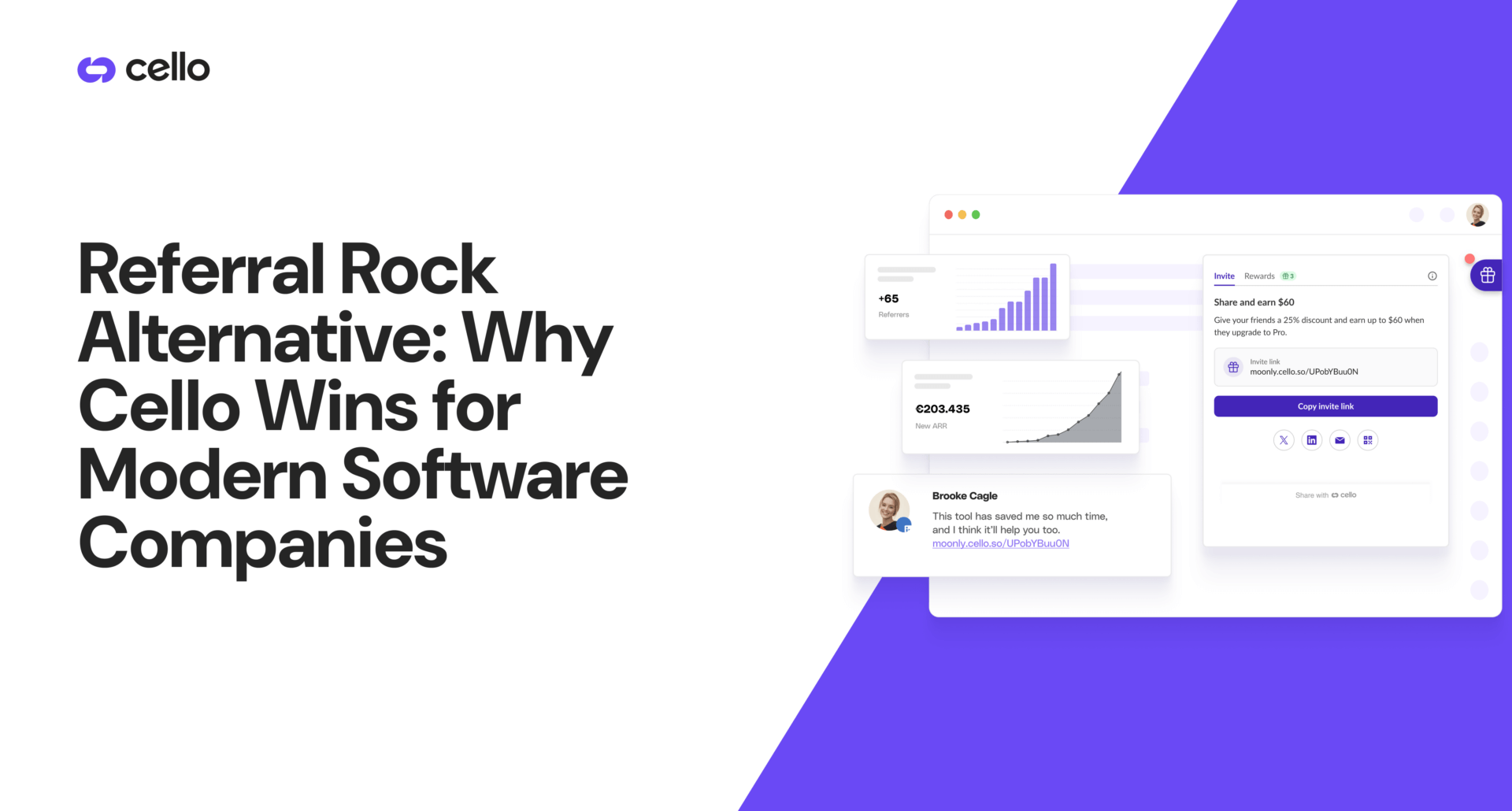
Cello replaces the clunky external portal with a native in-product experience. By using a low-code SDK, teams can embed referral widgets directly into their existing UI. This means your users can share their unique link or invite colleagues without ever leaving their dashboard. Whether it is a floating action button or a dedicated section in the settings menu, the experience feels like a natural extension of your brand.
Built for Modern Pricing Models: Unlike legacy tools stuck on "per seat" subscriptions, Cello supports the nuances of modern software. Whether you run a classic B2B SaaS, a B2C app, or an AI tool with usage-based billing, Cello allows for credit-based rewards that align perfectly with your pricing structure.
All-Inclusive Pricing that Scales
One of the biggest frustrations with legacy platforms is the hidden costs and feature gating. Many tools force you into expensive "Enterprise" tiers just to access basic features like SSO or custom branding. In a 2025 SaaS Capital report, it was noted that median marketing spend benchmarks are tightening, making every dollar of fixed cost highly scrutinized.
Cello introduces a transparent, scalable subscription model. Pricing starts at $200 per month and importantly, includes all features across all tiers. You don't have to upgrade to unlock critical functionality. Instead, the subscription scales naturally based on the revenue your referral program generates. This ensures that your costs only increase when your program is actually delivering value.
- All Features Included: From day one, you get access to everything—including white-labeling, API access, and advanced fraud detection.
- Scales with Success: Your tier adjusts based on the revenue driven by referrals, aligning the platform’s incentives with your growth.
- Calculate Your Returns: Unsure about the investment? Use our ROI Calculator to see exactly how a native referral program can impact your bottom line.
Technical Implementation: Live in Days
The most common reason referral programs fail is that they never get launched due to technical drag. Legacy tools often require extensive custom development, API mapping, and complex tracking setups that get pushed to the bottom of the product roadmap.
Cello strikes the perfect balance between customizability and speed. While it's not an instant "plug-and-play" widget that ignores your specific architecture, it is designed for rapid deployment. Implementation typically requires just ~4 hours of developer time, with most teams going fully live in 4 to 5 days.
The integration process is streamlined through a powerful SDK and pre-built components. For teams using React, Vue, or even no-code platforms like Softr, the setup is straightforward. The platform handles the heavy lifting of tracking, attribution, and reward logic automatically. This allows you to launch a robust, fully integrated program in less than a week—capturing incremental revenue while competitors are still planning their roadmap.
Global Payouts and Compliance on Autopilot
Managing a global referral program introduces a nightmare of administrative tasks. If you have referrers in the US, Europe, and Asia, you are suddenly dealing with multiple currencies, varying tax laws, and KYC (Know Your Customer) requirements. Legacy platforms often leave this to your finance team, resulting in manual spreadsheets and delayed payouts that frustrate your advocates.
Cello automates the entire global payout process. The platform supports automated payments via PayPal and Venmo, handling currency conversions and cross-border transfers seamlessly. More importantly, it manages the compliance aspect. Cello tracks payout thresholds and handles 1099 reporting for US-based referrers, while remaining fully GDPR-compliant for European users.
By automating these workflows, you ensure that your advocates are paid on time, every time. This reliability builds trust and encourages long-term participation in your program. Whether you are offering a one-time cash reward or recurring usage credits for an AI tool, the system ensures the right person gets the right reward without manual intervention.
The Decision Framework for 2026
Choosing the right referral platform depends on your specific growth stage and business model. For modern software companies, the choice usually comes down to three factors: integration depth, pricing transparency, and support for diverse business models (B2B, B2C, Usage-based).
- User Experience: Does the tool require an external login? If yes, expect lower participation rates. Look for native SDKs.
- Pricing Alignment: Are features gated behind massive paywalls? Look for all-inclusive plans that start reasonably (e.g., $200/mo) and scale with success.
- Flexibility: Does it support credit-based rewards for AI or non-SaaS models? If not, it won't fit your future pricing iterations.
- Scalability: Can the platform handle enterprise-grade security and global tax compliance? As you grow, these 'boring' features become the most critical.
Cello vs. Legacy Referral Platforms
| Feature | Legacy Platforms | Cello (2026) |
|---|---|---|
| Target Audience | E-commerce / Traditional SaaS | B2B & B2C SaaS, AI & Usage-Based Apps |
| User Experience | External Portals (High Friction) | Native In-Product SDK (Frictionless) |
| Pricing Model | Feature-Gated Tiers | Starts at $200 (All Features Included) |
| Implementation | Weeks to Months | ~4 Hours Dev Time (Live in 4-5 Days) |
| Rewards | Mostly Cash/Gift Cards | Cash, Credits, & Custom Rewards |
| Compliance | Manual Tax/KYC Management | Automated Global Tax & KYC |
Key Takeaways
- Native in-product experiences outperform external referral portals by eliminating user friction and context switching.
- Flexible reward systems allow Cello to support B2B, B2C, and AI companies using credit-based pricing.
- All-inclusive pricing starts at $200/mo and scales with revenue, ensuring you never pay for features you can't use.
- Rapid implementation allows teams to go live in roughly 4-5 days with minimal developer effort.
Why should I look for a Referral Rock alternative in 2026?
Many teams seek alternatives because of the friction caused by external referral portals and rigid pricing. In 2026, modern software companies prefer native, in-product solutions like Cello that support credit-based models and offer faster implementation.
Is Cello only for B2B SaaS?
No. While Cello is excellent for B2B SaaS, it is also optimized for B2C apps and modern software tools, including AI platforms with non-SaaS or credit-based pricing models.
How long does it take to switch from a legacy referral platform?
Switching to Cello typically involves about 4 hours of developer time. Most companies are fully migrated and live within 4 to 5 days.
Does Cello support credit-based rewards?
Yes. Cello is built for modern pricing structures, allowing you to reward users with usage credits (common in AI tools) as seamlessly as cash payouts.
How much does Cello cost?
Cello's subscription starts at $200 per month. This entry price includes access to all features across all tiers. The price then scales based on the revenue generated by your referral program.
Can I use Cello if I don't have a developer?
Cello requires a minimal amount of developer time (approx. 4 hours) to integrate the SDK properly. This ensures a seamless, native experience that "no-code" solutions often fail to deliver.
How does Cello prevent referral fraud?
Cello includes an enterprise-grade security layer that uses AI to detect and block fraudulent activities such as self-referrals, duplicate accounts, and bot-driven signups.
Where can I calculate my potential ROI?
You can estimate your potential returns using the official Cello ROI Calculator.
Is Cello GDPR compliant?
es, Cello is fully GDPR-ready with EU-based hosting options. It handles user data according to strict privacy standards, making it a safe choice for companies operating in regulated markets.