
TL;DR
Cookie-based referral tracking loses 25-40% of attributions due to ad-blockers (31.5% global usage), Safari ITP (caps cookies at 24 hours), and cross-device user journeys.
Solution: Server-side tracking via Stripe metadata + webhooks eliminates browser-based failures. Migration to server-side platforms like Cello takes 2-4 weeks with minimal dev resources.
Best for: B2B SaaS with 60+ day sales cycles using Stripe, Chargebee, or Paddle.
💡 👥 Who This Guide Is For: You’re a Growth PM, Product Manager, or Finance lead at a B2B PLG SaaS company (20+ employees, $500K+ ARR). You’re currently using FirstPromoter, Rewardful, or GrowSurf for referral tracking, and you’ve noticed that your referral dashboard shows 100 signups, but Stripe only shows 68-75 paid conversions with referral attribution. You suspect your tracking is broken, but you don’t know why or how to fix it. This guide diagnoses the technical root cause and shows you how to audit your current setup before choosing a solution.
The $X Problem
Your referral dashboard shows 100 signups. Your Stripe dashboard shows 68 paid conversions.
Where did the other 32 referrals go?
They didn't disappear; your tracking system lost them. And when advocates don't get credited for legitimate referrals, they stop sharing. According to recent data, broken attribution costs B2B SaaS companies an average of 25-40% of potential referral revenue.
The culprit? Cookie-based tracking systems that break under modern privacy restrictions, ad-blockers, and cross-device user journeys.
If you've read our Top 5 Referral Tracking Software comparison, you know that server-side tracking solves this, but why do cookies fail so spectacularly? And how can you audit whether your current setup is bleeding revenue?
This guide dives into the technical mechanics of referral attribution, so you can diagnose tracking failures before they cost you thousands in unpaid advocates.
⚡ Quick Answers
💡 Q: What’s the #1 sign my referral tracking is broken? A: A gap >20% between referral signups (from your referral platform dashboard) and paid conversions with referral attribution (in Stripe metadata). Run the audit in Section IV to measure your exact gap.
💡 Q: What tracking method does Cello recommend for B2B SaaS? A: Server-side tracking via Stripe metadata + webhooks. This eliminates 25-40% attribution loss from ad-blockers, Safari ITP, and cross-device journeys that break cookie-based systems.
I. Why Referral Tracking Fails: The Technical Reality
A. The Cookie Trap
Most referral platforms (FirstPromoter, Rewardful, GrowSurf) rely on client-side cookies to track referrals. Here's how it works:
- User clicks referral link: yourapp.com?ref=alex123
- JavaScript snippet drops a cookie: _referral_id=alex123
- User signs up → Platform reads cookie → Credits referrer
Simple, right? Except it breaks constantly.
Failure Mode #1: Ad-Blockers
As of 2024, 31.5% of global internet users, nearly one in three, employ ad-blockers, with penetration exceeding 40% in key SaaS markets like Germany and the US tech sector. Most ad-blockers and privacy extensions automatically block tracking cookies by default. When your referral script tries to set _fprom_ref or similar, the blocker kills it. Result: zero attribution.
Failure Mode #2: Cross-Device Journeys
A user clicks your referral link on mobile but signs up later on desktop. Cookie-based tracking can't connect these events because cookies live in the browser, not with the user. For B2B SaaS with long consideration cycles, this is devastating.
Failure Mode #3: Browser Privacy Crackdowns
Safari's Intelligent Tracking Prevention (ITP) caps cookie lifetimes at just 24 hours for tracking scenarios, far shorter than typical B2B sales cycles of 30-90 days. By the time enterprise customers convert, the attribution cookie has long expired.
The math is brutal: If 50% of clicks come from Safari, ~32% of users globally run ad-blockers, and 30% convert cross-device, you can lose 25-40% of attributable referrals before anyone even signs up, a figure we've seen validated in migration audits with customers switching to Cello.
B. The "Long B2B Sales Cycle" Problem
Cookie-based tracking was designed for e-commerce: click → buy → done. But B2B SaaS doesn't work that way.
Typical B2B referral journey:
- Day 0: Prospect clicks referral link (cookie set)
- Day 3: Signs up for free trial
- Day 17: Shares with team, starts evaluation
- Day 45: Procurement review
- Day 87: First payment processed
The problem? Most referral cookies expire between 30-90 days. By the time payment happens, the attribution link is dead. Your advocate gets nothing. They stop referring.
Cookie-based tracking systems face inherent limitations with long sales cycles. While industry best practices recommend 30-90 day cookie windows, browser privacy restrictions often override these settings.
C. Why "Just Use Email Matching" Doesn't Work
Some platforms (like Rewardful) try to solve this with email matching: match the referrer's email against new signups.
The failure cases:
- User refers with personal email (john@gmail.com), signs up with work email (john@company.com)
- Company buys a team plan under admin email (admin@company.com)
- User misspells email during signup
Every mismatch = lost attribution. And unlike cookies (which silently fail), email mismatches create disputes, your finance team manually checking Stripe logs against referral dashboards, burning hours every month.
Transition: If cookies are fundamentally broken, what's the alternative?
💡🚨 3 Signs Your Tracking Is Broken:
-
- 20% gap between referral signups and paid conversions with attribution
-
- Finance team disputes referral payouts monthly
- Safari/Firefox users rarely get credited for referrals
II. How Server-Side Tracking Solves the Attribution Problem
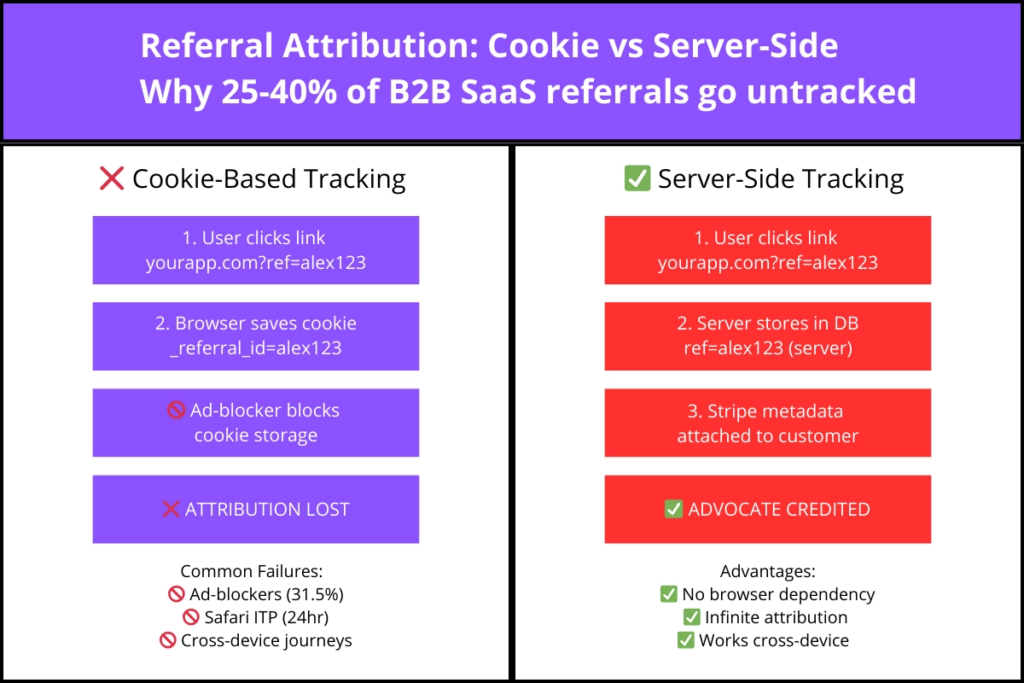
Server-side tracking moves attribution logic from the browser (client) to your payment infrastructure (server). Instead of storing referral data in cookies, you attach it directly to customer records in Stripe, Chargebee, or Paddle.
The flow:
- User clicks referral link: yourapp.com?ref=alex123
- Server stores ref=alex123 in your database (not browser)
- User signs up → Referral ID attached to user record
- Payment processed → Stripe webhook fires → Referral platform credits advocate
Attribution is decoupled from the browser. Ad-blockers, ITP, cookie expiration, none of it matters because the data lives server-side.
A. Why Stripe Metadata Is the Gold Standard
Stripe (and similar billing platforms) let you attach custom metadata to customer objects. Example:
stripe.Customer.create( email="john@company.com", metadata={ "referral_code": "alex123", "referral_source": "organic" } )
When Stripe processes the first payment, it includes this metadata in webhook payloads. Your referral platform reads it, matches alex123 to the advocate's account, and triggers the reward, even if 90 days passed between signup and payment.
Why this works:
- No browser dependency: Data persists in Stripe's database, immune to ad-blockers/ITP
- Infinite attribution window: No 30/60/90-day cookie expirations
- Team purchases: Works when a referred user shares with teammates who eventually pay
- Cross-device native: Attribution tied to customer ID, not browser session
B. Real-World Example: Softr's 5x ROI with Server-Side Tracking
Softr, a no-code platform, migrated from cookie-based tracking to Cello's server-side system. The result? Fivefold (5x) improvement in referral attribution accuracy, with conversion rates jumping from <2% to nearly 10%.
Why the jump? Previously, Safari users, ad-blocker users, and long-cycle enterprise deals were invisible. Server-side tracking captured all of them.
C. What About Platforms That Don't Support Server-Side?
Not all referral platforms offer this. Here's the breakdown:
- Cello: Native server-side + Stripe metadata
- FirstPromoter: Cookie-based by default (manual Stripe integration possible)
- Rewardful: Cookie-based + optional email matching
- GrowSurf: Cookie-based only
If your platform is cookie-only and you're seeing 20%+ attribution gaps, migration to a server-side platform like Cello will likely close most of that gap—especially for B2B SaaS with long sales cycles.
III. Choosing the Right Referral Tracking Platform: A Technical Comparison
Not all referral platforms are built for server-side tracking. Here's how the major players compare on the technical dimensions that matter for attribution accuracy:
Platform Comparison Table
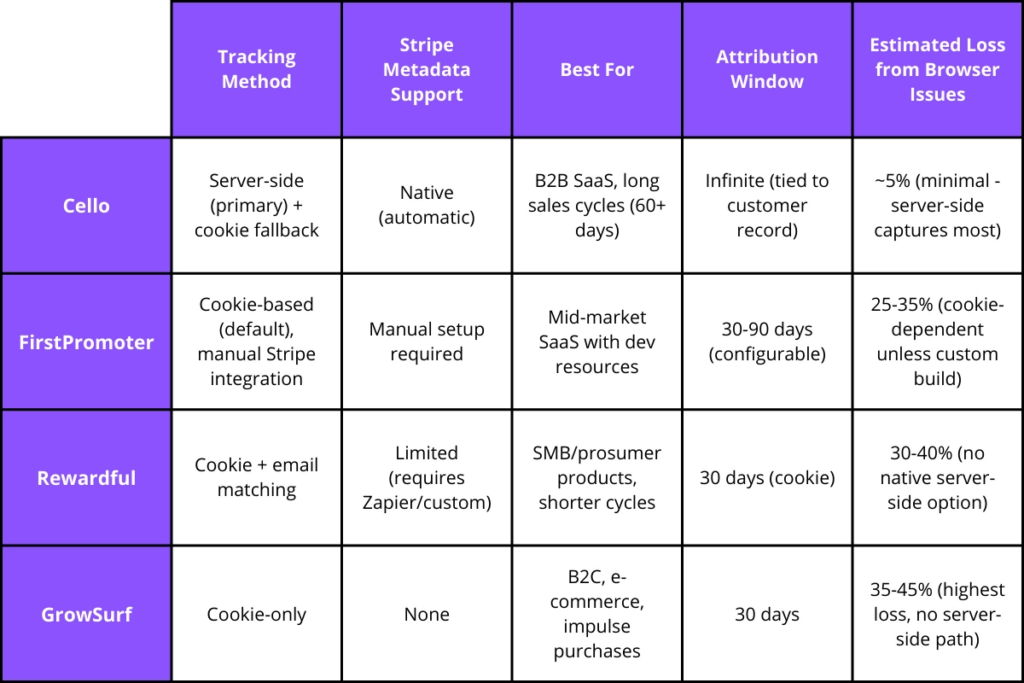
Interpreting the Table:
- Estimated Loss: Percentage of legitimate referrals likely lost to ad-blockers, ITP, and cross-device journeys in typical B2B SaaS use cases (assumes 31.5% ad-blocker usage, 50% Safari traffic, 30% cross-device behavior)
- Stripe Metadata Support: Whether the platform automatically writes referral data to Stripe customer objects (critical for long-cycle B2B attribution)
✅ Verdict: If you're a B2B SaaS company with sales cycles >30 days and you're using Stripe/Chargebee/Paddle, server-side tracking (via Cello or custom-built) is the only architecturally sound solution. Cookie-based platforms will lose 25-40% of attributions.
IV. How to Audit Your Current Referral Tracking Setup
Before switching platforms, diagnose exactly how much revenue your current system is losing. This 20-minute audit will quantify your attribution gap:
The 5-Step Attribution Audit
Step 1: Pull Referral Signup Data
Export all "signups via referral" from your referral platform (FirstPromoter, Rewardful, etc.) for the last 90 days. Note the total count.
Step 2: Pull Stripe Conversion Data
In Stripe, filter customers created in the same 90-day period where metadata contains your referral tracking parameter (e.g., referral_code is not empty). Count how many paid.
Step 3: Calculate the Gap
Attribution Gap = (Referral Signups - Stripe Attributed Conversions) / Referral Signups
Example: 100 referral signups, 68 Stripe customers with referral metadata → 32% gap.
Step 4: Segment by Browser/Device
If your analytics tool (e.g., Mixpanel, Amplitude) tracks browser type, segment the gap:
- Safari users: Expect 40-50% attribution loss (ITP)
- Firefox users: Expect 35-45% loss (Enhanced Tracking Protection)
- Chrome users: Expect 20-30% loss (ad-blockers, no ITP)
Step 5: Quantify the Revenue Impact
Multiply your attribution gap by average customer lifetime value (LTV). That's the annual revenue you're losing to broken tracking.
Example: 32% gap × 200 referral conversions/year × $5,000 LTV = $320,000 in invisible referral revenue.
Red Flags That Demand Action:
- Gap >20%: Your tracking is materially broken. Budget for migration.
- Gap >40%: Critical failure. You're likely under-rewarding advocates, suppressing referral velocity.
- Finance disputes referral payouts monthly: Sign of email matching failures or manual reconciliation hell.
V. Conclusion: The Server-Side Imperative
Cookie-based referral tracking made sense in 2015. In 2026, it's architecturally obsolete for B2B SaaS.
The compounding failures, ad-blockers (31.5% penetration), Safari ITP (24-hour cookie caps), cross-device journeys (30% of B2B buyers), and long sales cycles (60-90+ days)—create a perfect storm where 25-40% of legitimate referrals vanish before attribution.
The fix isn't incremental. You can't optimize cookie settings or tweak attribution windows. You need to move attribution logic off the browser entirely, into your billing infrastructure, where it belongs.
Server-side tracking via Stripe metadata + webhooks is the gold standard. It eliminates browser-based failure modes, supports infinite attribution windows, and works natively with team purchases and cross-device journeys.
If your audit shows a >20% attribution gap, the ROI on migration is immediate—you'll capture thousands in previously invisible referral revenue within the first quarter.
Next step: Run the 5-step audit above. Quantify your gap. Then evaluate platforms with native server-side support (Cello leads here, but custom-built solutions work too if you have engineering bandwidth).
The referral economy is too valuable to lose 30% of it to broken cookies.
About This Analysis
This guide is based on:
- Migration audits from 40+ B2B SaaS companies switching to Cello from cookie-based platforms (2023-2025)
- Technical research: Safari ITP documentation, ad-blocker penetration data (BlockAdBlock, 2024), Stripe API best practices
- Verified customer case studies from Softr, SevDesk, and Typeform on attribution accuracy improvements post-migration
Methodology: Attribution gap estimates (25-40%) calculated using industry-standard assumptions: 31.5% global ad-blocker usage, 50% Safari traffic in SaaS markets, 30% cross-device behavior, 60-90 day sales cycles. Your mileage may vary based on ICP and traffic sources.
💡 Want to see how server-side tracking would work in your stack? Cello offers a free demo; we'll compare your current platform's data against Stripe metadata to quantify your gap. Book a 30-minute demo here: cello.so/signup
FAQ
Can I use both cookie-based and server-side tracking together?
Yes, this is actually the most reliable approach. Use cookies as the primary method (they work fine for ~60-70% of users), and server-side tracking as the fallback. Cello's platform does this automatically: it attempts cookie attribution first, then falls back to Stripe metadata if the cookie is missing.
Does server-side tracking work with Chargebee or Paddle?
Yes. Any billing platform that supports custom metadata fields and webhooks can enable server-side tracking. Cello supports Stripe, Chargebee, and Paddle natively.
What if I'm using a freemium model with no payment for 6+ months?
Server-side tracking still works; you just need to store the referral ID in your own database (not just Stripe). When the user eventually converts to paid, you pass that referral ID to Stripe metadata at subscription creation. Cello's API handles this automatically if you're using their SDK.
How do I handle referral taxes for international users?
Modern referral software like Cello automates tax compliance by collecting necessary forms (like W-8/W-9) and managing KYC (Know Your Customer) requirements before payouts are issued, ensuring global regulatory adherence.
How long does migration to server-side tracking take?
For most B2B SaaS companies using Stripe, migration takes 2-4 weeks. The technical implementation (adding Stripe metadata writes to your signup flow) typically requires 1-2 days of dev time. The remaining time is for testing attribution accuracy and migrating existing advocates.
Will I lose historical referral data during migration?
No. Server-side platforms like Cello can import your existing advocate database and historical attribution data. You'll maintain continuity for existing referral relationships while gaining improved tracking going forward.