
Whether a European fintech referral program runs on legitimate interest or requires explicit consent comes down to what you track and when. Server-side attribution reading referral code, landing destination and anonymous click ID at the click qualifies for legitimate interest, but personal data only enters at conversion. Add behavioral profiling before signup or inject third-party cookies and you’re in consent territory under Article 6(1)(a) and ePrivacy. Cash rewards above €3,000 per recipient pull in customer due diligence, above €10,000 require source-of-funds documentation and every payout generates a five-year retention obligation. VAT applies if the reward is structured as payment for services, withholding triggers vary by member state and the DPA with any referral vendor must cover all eight Article 28(3) clauses or both parties are in breach before the first euro clears.
- TLDR:
- GDPR requirements for referral program tracking in fintech
- KYC and AML obligations when paying referral rewards in fintech
- Multi-currency payout compliance and tax handling for EU fintech rewards
- Data processor agreements for referral platforms under GDPR Article 28
- Consent requirements for referred users under ePrivacy Directive
- How Cello handles GDPR compliance for European fintech referral programs
- Final thoughts on referral program compliance in European fintech SaaS
TLDR:
- Server-side attribution runs on legitimate interest under GDPR; cookie-based tracking loses a material share of clicks to ITP and needs consent.
- EU AML directives set concrete KYC thresholds: €3,000 triggers standard CDD, €10,000 requires enhanced due diligence.
- Multi-currency payouts cover VAT treatment, withholding tax and local reporting per jurisdiction; discount-structured rewards sit outside VAT scope.
- Article 28 DPAs must cover eight required clauses; subprocessor lists demand 30-day change notice and location disclosure.
- Cello attributes server-side with no browser fingerprinting, ships Article 28 DPAs and handles VAT plus credit notes across 60+ countries.
GDPR requirements for referral program tracking in fintech
For European fintech SaaS, referral link tracking strictly limited to attribution and reward issuance can run on legitimate interest under GDPR Article 6(1)(f), provided you document a balancing test. The moment tracking expands into behavioural profiling or cross-site identifiers, you cross into consent territory under Article 6(1)(a) and the ePrivacy Directive.
Lawful basis: legitimate interest vs consent
Attribution data needed to credit a referrer (referral code, timestamp, converted user ID) typically qualifies for legitimate interest. Anything broader, like profiling a referred lead pre-signup, fails the necessity test in Article 6 guidance.
Data minimization and retention
At the click, capture only what attribution requires: referral code, landing destination, anonymous click ID. No IP profiling, no fingerprinting, no third-party pixels. Personal data enters at conversion. Under Article 5(1)(e), most fintech programs retain reward-linked events for 24 to 36 months and shorter windows for unconverted clicks.
Server-side vs cookie-based attribution
Cookie-based attribution reads full browser chains and third-party IDs, requires explicit opt-in consent banners, and loses a material share of clicks to ITP. Server-side attribution forwards the referral signal backend-to-backend over an authenticated call with minimal first-party signals, often avoids consent requirements, and survives ITP completely. Nothing third-party lands in the browser, ePrivacy thresholds drop, and the consent banner stops gating revenue attribution. For fintech, where KYC flows demand trust signals from the first click, that distinction separates a measurable channel from a leaky one.
KYC and AML obligations when paying referral rewards in fintech
Cash rewards to referrers sit inside the EU’s anti-money-laundering perimeter the moment your fintech entity, or its payment partner, moves funds. The thresholds are concrete: €3,000 triggers CDD on a risk-based reading and €10,000 requires enhanced due diligence, source-of-funds documentation, and ongoing monitoring.
CDD thresholds that drive verification design
Under the EU AML directives, customer due diligence kicks in at defined points. Payouts of €10,000 or more per recipient require enhanced CDD, including source-of-funds documentation and ongoing monitoring. Cash-equivalent transactions at €3,000 or more can trigger CDD on a risk-based reading. Low-risk, low-value rewards qualify for simplified due diligence (SDD).
A common tiering structure for fintech referral programs is:
- Under €3,000 annually per recipient: SDD, email plus basic identifiers
- €3,000 to €10,000 annually: standard CDD, government ID and residence proof
- Above €10,000 cumulative: enhanced CDD, source-of-funds, periodic re-verification
EBA scrutiny on payout-heavy models
The European Banking Authority’s 2024 ML/TF risk guidelines flag affiliate networks, marketplaces, and gig payout flows as elevated-risk. Fintech referral programs inherit that classification by default, which is why per-payout audit trails (recipient ID, timestamp, attributed conversion, KYC tier) matter more here than in generic B2B SaaS.
Vendor-handled vs in-house KYC
When a payout provider acts as merchant of record, it runs KYC, holds AML liability contractually, and launches in days. In-house payouts require your compliance team to run KYC, place AML liability with your fintech entity, and carry a significantly longer build timeline.
Vendor-handled KYC moves most of the compliance work off your team, but only if the DPA, sub-processor list, and vendor due diligence file hold up under regulator review.
Multi-currency payout compliance and tax handling for EU fintech rewards
Paying referrers across the EU means covering three regimes per payout: VAT treatment, withholding tax, and local reporting. Each country sets its own standard VAT rate (minimum 15% under EU rules), and reward classification dictates whether VAT applies at all.

VAT: discount vs payment for services
A reward structured as a discount on the referrer’s own subscription sits outside VAT scope. A cash payout in exchange for introducing customers can be treated as consideration for a service, triggering VAT registration thresholds and reverse-charge mechanics on cross-border B2B payouts.
Withholding and documentation by jurisdiction
Germany requires Rechnung or Gutschrift for self-employed, VAT-registered referrers. France requires Facture and BIC reporting at annual payout thresholds. Spain triggers Modelo 347 at €3,005.06 annual aggregate. Italy requires Certificazione Unica for any payment to individuals.
Under Directive (EU) 2015/849, payout records (recipient ID, KYC tier, transaction, currency conversion) must be retained for five years after the relationship ends. Automated payout providers handle FX conversion, local credit note issuance and per-country reporting feeds, but the retention obligation stays with the fintech as data controller.
Data processor agreements for referral platforms under GDPR Article 28
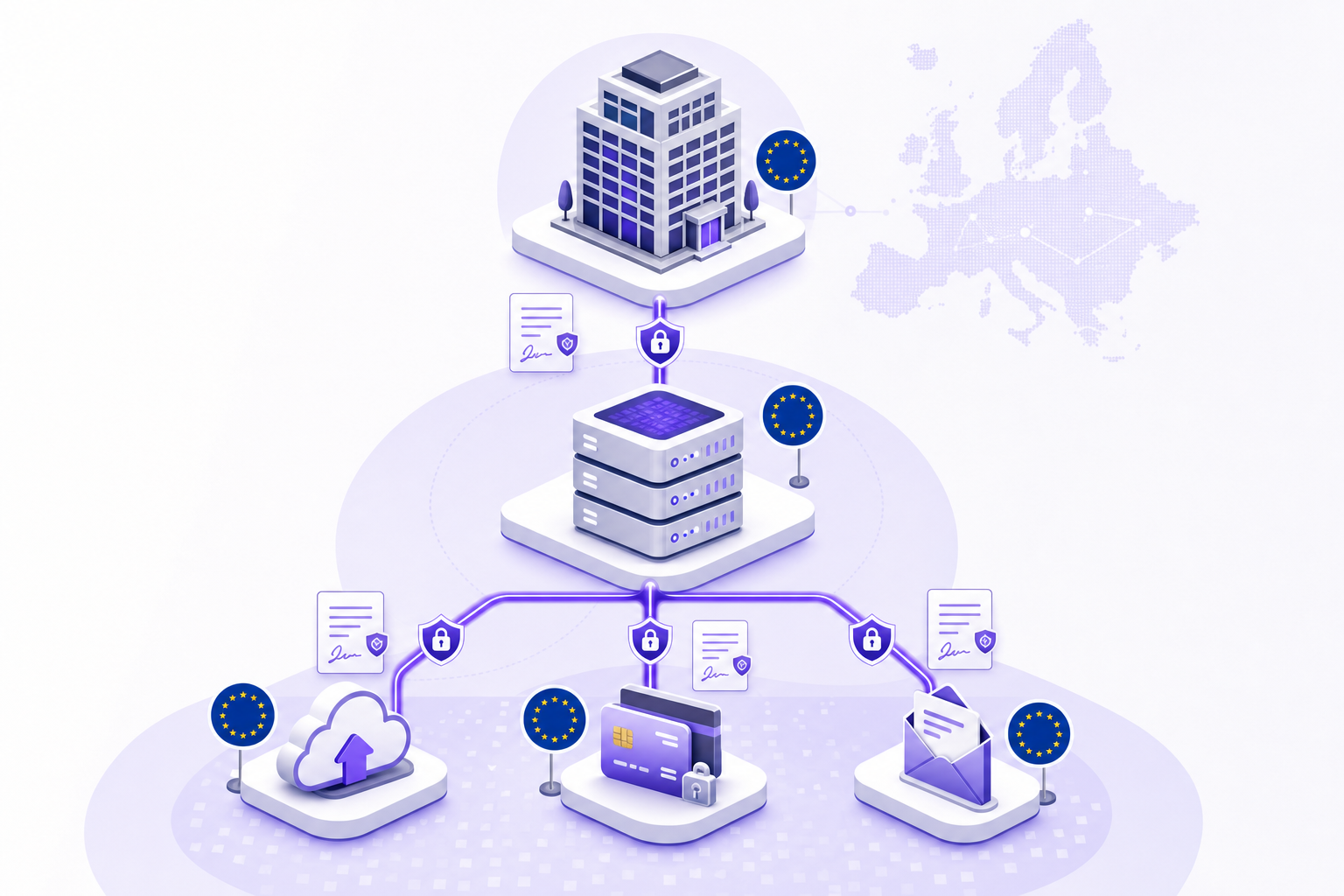
A referral vendor that touches end-user data is a processor under GDPR, and the fintech entity remains the controller. Article 28(3) sets the contractual perimeter, and skipping any required clause puts both parties in breach before a single payout clears.
The eight clauses Article 28(3) requires
Every DPA between a fintech controller and a referral processor must specify:
- Subject matter, duration, nature, and purpose of processing
- Types of personal data and categories of data subjects
- Processing only on documented controller instructions
- Confidentiality commitments from processor staff
- Security measures meeting Article 32 standards
- Subprocessor engagement rules
- Assistance with data subject rights requests
- Audit and inspection rights plus end-of-contract data return or deletion
EU data residency and breach windows
Fintech procurement teams typically tighten Article 28 with a residency clause keeping all personal data and backups inside the EEA. The DPA should pin breach notification well under the 72-hour Article 33 window, with most fintechs requiring 24 to 48 hours from the processor.
Subprocessor management
Referral vendors route data through payout providers, cloud hosting, email infrastructure, and analytics. Each is a subprocessor under Article 28(4) and inherits the same obligations.
Standard practice requires a published, versioned subprocessor list accessible to the controller. Change notification must provide 30 days written notice with a right to object. Flow-down obligations impose the same DPA terms on every subprocessor. Location disclosure must state the country of processing for every subprocessor.
A vendor that cannot produce a current subprocessor register on request has already failed the audit rights clause in practice.
Consent requirements for referred users under ePrivacy Directive
Under the ePrivacy Directive, a fintech needs prior explicit consent from a referred user before sending any referral email from its own domain. The exception: if the referrer sends the message themselves through their own email client via mailto, it counts as peer-to-peer communication and falls outside Article 13’s scope.
When ePrivacy treats a referral as commercial
A referral email sent from your fintech’s infrastructure to a non-customer is a commercial electronic communication. Article 13 of the ePrivacy Directive requires opt-in consent for unsolicited messages to individuals. Legitimate interest does not apply, since the recipient has no prior relationship with the sender.
Platform-sent vs user-sent: the structural difference
Auto-email to invitees makes the fintech entity the sender of record, requires pre-send consent, and carries high compliance risk. Mailto handoff from the referrer makes the referring user the sender of record, requires no consent, and is safe.
The safer referral marketing structure has the referrer drafting and sending from their own client. The product issues the link and tracks the click; the human owns the outreach.
How Cello handles GDPR compliance for European fintech referral programs
We built Cello EU-first, with GDPR as a design constraint, not a retrofit. For European fintech SaaS, that posture changes what your compliance team has to absorb.
|
Compliance requirement |
In-house referral build |
Cello referral infrastructure |
|---|---|---|
|
GDPR data residency |
Configure EU hosting, manage backup jurisdiction, audit cloud provider per Article 28 |
EU-hosted AWS environment, customer content stays in the EEA |
|
Attribution method |
Cookie-based tracking loses a material share of clicks to ITP, requires consent banner gating attribution |
Server-side attribution from Stripe/Chargebee metadata, no browser fingerprinting, survives ITP |
|
KYC/AML handling |
Build verification flows for three CDD tiers, maintain five-year retention, file suspicious activity reports |
Vendor acts as merchant of record, handles CDD at €3k and €10k thresholds per EU AML directives |
|
Multi-currency payouts |
Integrate payment rails per country, calculate FX, generate local tax documents, track withholding by jurisdiction |
Automated payouts across 63 countries via PayPal, VAT handling and credit note issuance included |
|
Article 28 DPA |
Draft eight-clause processor agreement, maintain subprocessor register, implement 24-hour breach notification |
Ships Article 28-compliant DPA, published subprocessor list with 30-day change notice |
|
Time to launch |
Six to nine months for compliance build, ongoing legal review |
Two days (Hera case study), SDK install under five hours |
Server-side attribution that respects data minimization
Our attribution reads conversion signals from metadata on the Stripe or Chargebee customer object (cello_ucc, new_user_id, new_user_organization_id) plus webhook events. No browser fingerprinting, no third-party cookies in the critical path. Personal data only enters the pipeline at signup, keeping the Article 5 minimization argument intact.
DPA, residency, and AI posture
Cello acts as processor with the fintech as controller, ships an Article 28-compliant DPA, and runs the AI Assistant inside an EU-hosted AWS environment. Customer content is not used to train foundation models.
Payouts, tax, and fraud
Automated payouts cover 63 countries via PayPal, with VAT handling and credit note issuance outside the SDK code. The native fraud module excludes self-referrals from program trends and exposes a 30-day review window on flagged cases.
Moss grew Referral ARR 650% YoY on Cello. Hera’s two-day launch case study and now sees 15.8% of ARR growth come from referrals.
Final thoughts on referral program compliance in European fintech SaaS
Referral programs in fintech can run under legitimate interest if you limit tracking to attribution, tier KYC by payout threshold and keep browser fingerprinting out of the path. GDPR compliant referral programs need server-side attribution, Article 28 DPAs with full subprocessor disclosure and multi-currency tax handling that doesn’t turn every reward into a manual compliance review. Your procurement team will ask for EU data residency and 24-hour breach windows; your growth team needs attribution that survives ITP and consent banners that don’t gate revenue.
When does a fintech referral program require enhanced customer due diligence instead of simplified due diligence?
Enhanced customer due diligence kicks in at €10,000 or more cumulative per recipient under EU AML directives, requiring source-of-funds documentation, periodic re-verification and ongoing monitoring. Between €3,000 and €10,000 annually, standard CDD applies (government ID plus address proof). Below €3,000 annually, most jurisdictions accept simplified due diligence, so most fintech referral programs tier verification to the payout volume per recipient
Can a European fintech referral program run on legitimate interest under GDPR, or does it always need consent?
Server-side attribution that reads only referral code, landing destination and anonymous click ID at the click qualifies for legitimate interest under Article 6(1)(f). Personal data enters the pipeline at conversion, not before. The moment tracking expands into behavioral profiling, third-party cookies or pre-signup fingerprinting, you cross into Article 6(1)(a) consent territory and the ePrivacy Directive applies.
How do I structure referral payouts in Germany, France and Spain without triggering a VAT or withholding mess across each jurisdiction?
Structure the reward as a discount on the referrer's own subscription to sit outside VAT scope entirely. Cash payments to VAT-registered referrers trigger reverse-charge mechanics and per-country documentation: Rechnung or Gutschrift in Germany, Facture with BIC reporting in France, Modelo 347 in Spain above €3,005.06 annually. An automated payout provider reconciles VAT treatment, withholding and local credit note issuance per jurisdiction rather than requiring your finance team to maintain per-country workflows.
What's the fastest way to launch a GDPR-compliant referral program for a European fintech without building in-house payout infrastructure?
Use a vendor that acts as merchant of record and runs KYC at the €3,000 and €10,000 thresholds. You skip the consent banner gating revenue attribution, avoid building payout rails per country and shift most AML operational burden contractually. Cello's server-side attribution reads conversion signals from Stripe or Chargebee metadata with no browser fingerprinting, ships an Article 28-compliant DPA and covers compliant payouts with VAT handling and credit note issuance included. Hera went live in two days.
What must a GDPR Article 28 DPA with a referral vendor cover to avoid both parties being in breach?
All eight clauses Article 28(3) requires: subject matter, duration, nature and purpose of processing; data types and subject categories; processing only on documented controller instructions; confidentiality commitments from processor staff; Article 32 security measures; subprocessor engagement rules; assistance with data subject rights requests; and audit rights plus end-of-contract data return or deletion. The subprocessor list must be published and versioned, with 30-day written change notice, right to object, flow-down obligations and country-of-processing disclosure for every subprocessor. A vendor that cannot produce a current register on request has already failed the audit rights clause in practice.