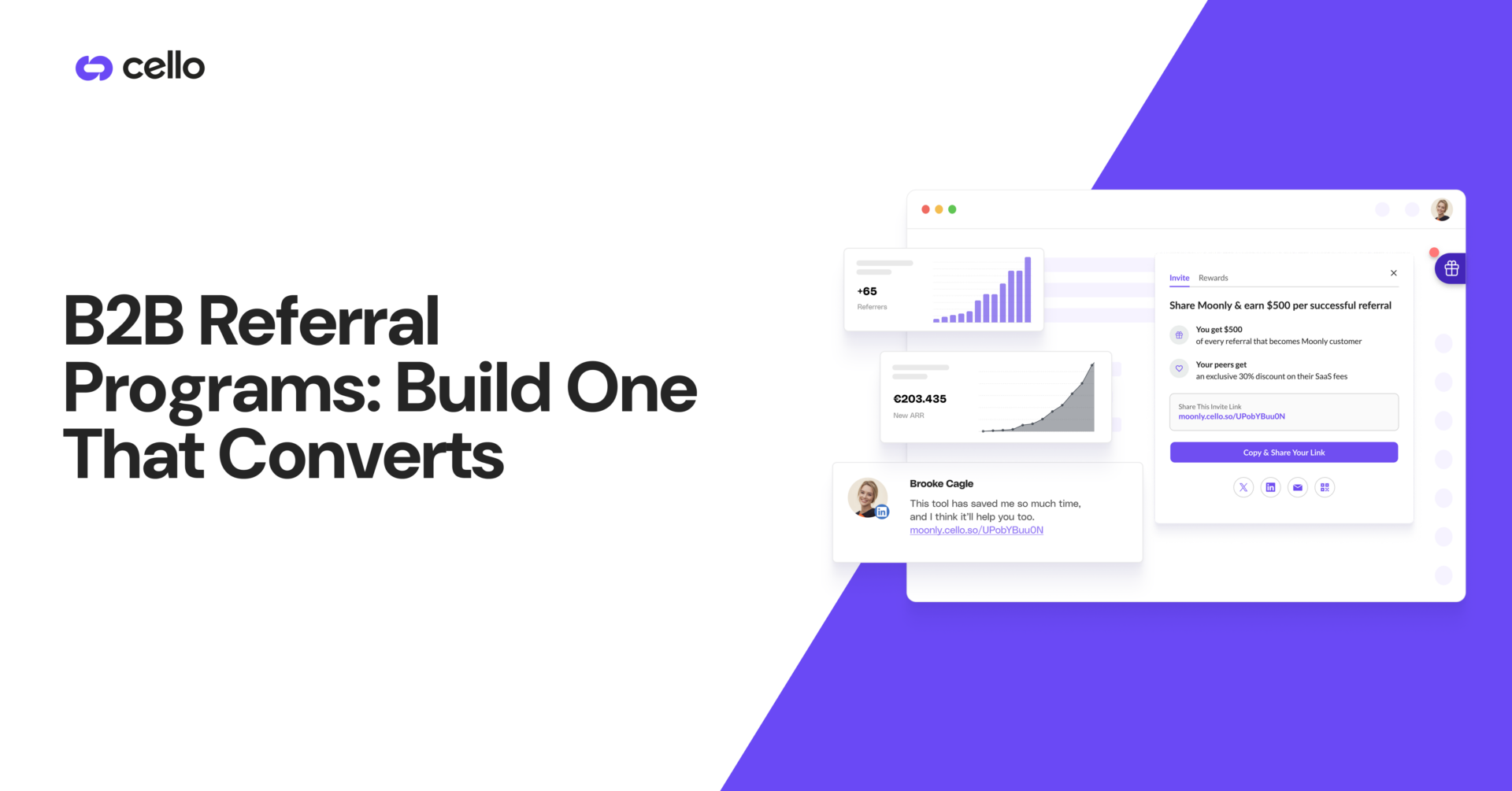

B2B referral programs have a conversion problem, and it's almost never the reward amount. It's where the prompt fires, how the attribution holds across a six-week sales cycle, and whether anyone on your team owns the program after week one. If you're building a B2B referral program or trying to fix one that stalled, the gap between a program that looks active and one that actually converts comes down to a handful of structural decisions. This post covers all of them.
- What a B2B referral program is
- The business case for B2B referral programs
- Prerequisites: when a referral program makes sense
- Types of B2B referral programs
- How to design the right incentive structure
- Embedding the referral program in the user journey
- How to launch a B2B referral program
- Compliance and legal requirements for B2B referral programs
- How to measure B2B referral program success
- Common mistakes that kill referral program conversion
- How Cello helps B2B SaaS teams put referrals on autopilot
- Final thoughts on building B2B referral programs that scale
TLDR:
- 84% of B2B decision-makers start buying with a referral, and referred deals close 25% faster than non-referred leads.
- Cash outperforms discounts as a referral reward because the user sharing the link rarely controls the budget that pays for the product.
- Prompt placement drives conversion more than reward size; in-product triggers tied to milestones outperform standalone microsites.
- Most programs stall after launch because they run as campaigns instead of recurring channels with behavioral triggers and sales team activation.
- Cello runs launcher placement, server-side attribution, reward fulfillment and tax handling for B2B SaaS teams, with VEED cutting customer acquisition cost by 90.4% versus paid acquisition.
What a B2B referral program is
A B2B referral program is a structured, incentivized system that turns existing customers into a measurable acquisition channel. A user shares a tracked link, a referred company signs up, and the program attributes the conversion back to the referrer and triggers a reward.
The B2B context reshapes the mechanics. Sales cycles run weeks to quarters. Purchase decisions sit with a buying committee of three to seven people. Trust flows through professional networks, where a peer recommendation carries weight a consumer coupon never could.
A B2B program tracks attribution across longer windows, ties rewards to verified revenue events and accommodates referrers who introduce an account, not a single user.
The business case for B2B referral programs
The pipeline math favors referrals before creative work begins. 84% of B2B decision-makers start their buying process with a referral, placing the channel ahead of paid search, content, and outbound in how deals actually form.
Velocity reinforces the cost case. Referred B2B clients close with a 25% shorter sales cycle than non-referred leads, compressing sales capacity requirements and raising win rates before deals lose internal sponsorship.
Paid channels do not compound. Rising auction prices and AI search compression push CAC up with every cycle. A referral program inverts the curve: each new customer expands the referrer pool, and cost per acquisition trends down as the base grows. The channel becomes more efficient with scale.
Owned channels carry more weight heading into the second half of 2026. Zero-click search now affects most Google queries, with AI Overviews and instant answers cutting into the organic traffic B2B teams used to count on for pipeline. A referral program does not sit on top of search visibility. It runs on peer trust already inside the customer base, which keeps it working as search-driven traffic erodes.
Prerequisites: when a referral program makes sense
Referral programs amplify what already exists. They do not manufacture demand where none lives.
Three readiness signals matter before you build:
- An active user base finding value. If weekly active usage is thin or NPS sits flat, a reward will not change the sentiment behind a recommendation. Fix retention first.
- A network your users can credibly tap. Referrers need peers in similar roles or adjacent companies. Lone-wolf personas with no professional graph cannot carry the channel.
- A product worth mentioning at work. Putting a colleague's name on a recommendation carries professional risk. The product has to clear that bar.
Incentives shape behavior at the margin. They do not patch over weak fit.
Types of B2B referral programs
Three structures share the "referral" label and get conflated constantly. The mechanics differ enough that picking the wrong one wastes the build.
User referrals
Existing customers introduce new accounts from inside the product they already use. The referrer is a paying user, the share happens at a moment of product engagement, and attribution ties back to a verified billing event. The default starting point for most B2B SaaS referral marketing.
Partner programs
Non-user intermediaries (agencies, consultants, resellers) earn commissions for routing accounts they do not personally use. Participants live in a standalone portal, rewards skew toward flat fees or recurring percentages, and onboarding involves contracts, tax forms and partner enablement.
Affiliate programs
External publishers, creators and review sites drive traffic through tracked links to their own audiences. The referrer has no product relationship, attribution runs on click and conversion windows, and payout terms resemble performance media more than peer recommendation.
Most teams sequence these: user referrals first, partner programs once a defined ICP can absorb intermediary pipeline, affiliate networks last.
How to design the right incentive structure
The referrer in B2B is rarely the buyer. The product user shares the link; finance signs the contract. That split changes what a reward should be.

Cash and gift cards outperform discounts here. A 20% discount on a line item the referrer's company already pays for has no personal pull. For a deeper look at B2B SaaS referral incentives, the options go well beyond cash. A direct payout does. For compliance-sensitive accounts, swap to non-cash structures: training vouchers, conference tickets, or product credits routed to the referrer's organization.
Reward type | Best fit | Watch out for |
|---|---|---|
Fixed fee per conversion | Flat-priced SaaS, predictable LTV | Misaligns when deal sizes vary |
Percentage of revenue | Variable contract value, sales-led | Requires billing-event integration |
Tiered or escalating | Repeat referrers, partner programs | Caps and clawbacks must be explicit |
Non-cash (credits, vouchers) | Compliance-restricted enterprise | Lower perceived value if poorly chosen |
Dual-sided rewards lift conversion on the referee side, where a credit reduces vendor-switching friction. Understanding what a referral program is and how to build one shapes every structural choice that follows. For most B2B SaaS, the right shape is asymmetric: cash to the referrer, a credit or trial extension to the referred account.
Tiered structures pay off when a small group of power referrers drives most volume. Escalating payouts after the third or fifth successful referral reward consistency over luck.
Embedding the referral program in the user journey
Where the prompt fires changes conversion more than what the reward pays. A launcher buried in a settings menu collects clicks from users already hunting for it. A prompt anchored to a moment of proven value reaches users at peak willingness to vouch.
Map the prompt against lifecycle events that signal earned trust:
- Onboarding completion: after the first workflow finishes, not before the user has anything to recommend.
- Product milestones: a successful export, a closed-won deal logged, a project shipped.
- Positive support signals: a CSAT score of 4 or 5, or a thank-you reply.
- Renewal or expansion: an invoice paid on time, a seat added, a tier upgraded.
In-product placement carries a structural advantage over standalone microsites. The user is already authenticated, already in context, and one click from sharing. A separate page forces a tab switch, breaks referral tracking when cookies are stripped, and competes with the work the user came to do.
How to launch a B2B referral program
Run the launch in three phases, not one flip.

- Pilot with a whitelisted cohort of 20 to 50 active users. Validate the reward fires, attribution lands, and share rate clears a working target before opening the gate.
- Roll out to the full base with a go-live email tied to the in-product launcher, plus an onboarding step that surfaces the program after a user finishes their first workflow. A complete B2B referral program guide covers each rollout phase in detail.
- Keep the channel active with behavioral triggers, quarterly A/B tests on reward amount and copy, and monthly nudges to dormant referrers. Brief sales and CS to raise the program at QBRs and renewals.
Compliance and legal requirements for B2B referral programs
Referral rewards count as taxable income for the recipient in most jurisdictions, putting the filing obligation on the company cutting the check. In the US that means W-9 collection for domestic referrers, W-8BEN for non-US individuals and 1099-NEC filing past the threshold. In the EU, DAC7 reporting and VAT treatment shift the burden again.
Documented terms are the second line of defense. Eligibility rules, payout conditions, fraud clauses, clawback language on refunds, and a stated reward window all belong in a published T&C the referrer accepts on enrollment.
Spreadsheet payout management compounds the exposure. Manual reconciliation drops tax forms, misses sanctions screening (OFAC, EU consolidated list), and leaves no audit trail when finance asks who paid whom and why.
How to measure B2B referral program success
Four metrics tell you whether the program is working.
- Active rate: the share of enrolled users who participate at least once. Low active rate points at launcher visibility, not reward generosity.
- Sharing rate: active users who send at least one invite. Many B2B SaaS programs aim for a 5 to 15 percent range as a working target.
- Signup-to-paid conversion on referred traffic: a healthy program clears 25 percent on invite-to-paid.
- Referral-attributed ARR: revenue tied to verified billing events, not click counts.
Calculate referral CAC by dividing reward spend plus program overhead by paid conversions in the period. Set it next to paid search and outbound CAC on the same dashboard. The comparison decides budget at the next planning cycle.
Common mistakes that kill referral program conversion
Most programs do not fail at launch. They stall in the months after, when launch energy fades and no execution rhythm replaces it.
- Treating the program as a campaign. A launch email, a slack post, then silence. Reviewing B2B referral program examples shows what a consistent execution rhythm looks like in practice. Referral channels need a recurring review cadence, not a one-time announcement.
- Misreading what motivates the referrer. A 10 percent discount on the company plan does nothing for the IC who shared the link. Mismatch the reward to the actual sharer and active rate flatlines.
- Leaving referrers in the dark. A user who shared a link three weeks ago and never heard back assumes nothing happened. Status updates on signups, deal stages and payouts keep them sharing again.
- Relying on organic widget discovery. A surface tucked behind a settings menu collects participation only from users hunting for it.
- Hope marketing. The program never enters a renewal call, QBR agenda, onboarding email or in-product milestone trigger. If share rate has stalled, see how to fix a referral program converting under 3%. The channel decays quietly while the dashboard stays green.
How Cello helps B2B SaaS teams put referrals on autopilot
Cello absorbs the jobs flagged above: launcher placement, attribution that survives cookie loss, reward fulfillment and tax handling. Built for B2B SaaS, not retrofitted from e-commerce affiliate tooling. The referral surface embeds inside the authenticated product via SDK. Attribution runs server-side off Stripe and Chargebee billing events, so tracking holds when cookies do not. Payouts, tax forms and fraud review run automatically.
Customer outcomes track the model:
- VEED cut CAC by 90.4% versus paid acquisition. Teams looking to prove referred customers have higher LTV can use a similar attribution methodology.
- Moss grew Referral ARR by 650% year-over-year using in-product referrals.
- Softr saw a 5x conversion lift after migrating from an external portal.
- Hera went live in two days. Butter went live in under five hours.
Final thoughts on building B2B referral programs that scale
The gap between a referral program that scales and one that stalls is almost never the reward size. It comes down to where the prompt lives, whether attribution holds across a long B2B sales cycle and whether someone owns the channel past the launch email. Your users already have the peer relationships. A well-designed program just gives them a reason and a frictionless path to act on them. Start building with Cello and go live in days, not quarters.
What's the difference between user referrals, partner programs and affiliate programs in B2B?
User referrals come from existing customers sharing inside the product they already use — attribution ties to a verified billing event. Partner programs bring in non-user intermediaries (agencies, consultants, resellers) who earn commissions through a standalone portal. Affiliate programs use external publishers with no product relationship, tracked on click and conversion windows. Most B2B SaaS teams sequence these: user referrals first, partner programs once pipeline volume justifies it, affiliate networks last.
How do I know if my B2B SaaS product is ready to launch a referral program?
Three signals matter before you build: weekly active usage is solid, NPS reflects genuine product satisfaction, and your users have professional networks they can credibly tap. Referral programs amplify existing word-of-mouth — they do not manufacture demand where engagement is thin or retention is broken. Fix those first, then add the referral layer.
Should I use cash rewards or discounts for B2B referrers?
Cash or direct payouts outperform discounts for most B2B referrers. A 20% discount on a plan the referrer's company already pays has no personal pull for the individual who shared the link. For compliance-restricted accounts — enterprise buyers where personal financial incentives raise procurement concerns — swap to non-cash structures: training vouchers, conference tickets or product credits routed to the referrer's organization. For referred accounts (the referee side), a credit or trial extension reduces vendor-switching friction better than a cash payment.
What's the best way to measure whether a B2B referral program is actually working?
Four metrics tell the story: active rate (share of enabled users who participate at least once), sharing rate (active users who send at least one invite), signup-to-paid conversion on referred traffic, and referral-attributed ARR tied to verified billing events — not click counts. Calculate referral CAC by dividing reward spend plus program overhead by paid conversions in the period, then set it next to paid search and outbound CAC on the same dashboard. Low active rate points at launcher visibility before it points at reward generosity.
Why do most B2B referral programs stall after launch?
Most programs do not fail at launch — they decay in the months after when the launch email fades and no operational rhythm replaces it. The recurring failure patterns are: treating the program as a one-time campaign rather than a standing channel, mismatching the reward to the actual sharer (a discount on the company plan means nothing to the individual contributor who shared the link), and leaving referrers without status updates on signups or payouts. Programs that compound run behavioral triggers, quarterly reward tests and brief their sales and CS teams to raise referrals at renewals and QBRs.
Does referral link attribution still hold when a referred user signs up weeks after clicking the link?
Yes — Cello stores the referral code in first-party cookies with a three-month lifetime, so attribution persists across sessions and return visits. For B2B sales cycles where a prospect clicks a referral link in week one and signs a contract in week eight, server-side attribution tied to the billing event (Stripe invoice.paid or Chargebee payment_succeeded) captures the conversion regardless of how much time has passed since the original click.
Do ad blockers or tracking prevention tools break referral attribution for B2B SaaS users?
No — Cello's primary attribution path is server-side, reading metadata fields on Stripe and Chargebee customer objects rather than relying on browser cookies. Even when Safari's Intelligent Tracking Prevention (ITP) strips cookies or a user runs an ad blocker, the referral code travels with the billing record and the conversion is attributed correctly at the server layer.
How does a B2B referral program work when the person paying is different from the person who shared the referral link?
Attribution maps to organizational identifiers rather than individual user IDs, so the referrer earns the reward even when procurement or finance completes the transaction. Cello reads the new_user_organization_id metadata field on Stripe or Chargebee customer objects to tie the billing event back to the original referrer, covering enterprise sales motions where an end user introduces the product but a separate buyer signs the contract.
What's the fastest way to get a B2B referral program live without a long engineering project?
Cello installs via a few lines of SDK code for web or mobile, with server-side attribution configured through Stripe or Chargebee webhooks — Hera went live in two days and Butter went live in under five hours. For teams that want to move even faster, the Partner Programs module deploys without any in-product embed, letting you run a partner or affiliate program through a standalone portal before the engineering work is scoped.
Can I manage both in-product user referrals and external affiliate partners in the same referral program software?
Yes — Cello runs user referrals and partner programs on a single platform with shared attribution, fraud detection, analytics and payout infrastructure. The in-product Referral Component handles peer-to-peer user sharing inside the authenticated product, while the standalone Partner Portal gives external affiliates, agencies and influencers their own dashboard without requiring a product account.
How should I structure referral rewards differently for a sales-led enterprise deal versus a self-service monthly subscription?
The two motions need different trigger logic: self-service monthly subscriptions tie rewards to Stripe invoice.paid events and suit percentage-based recurring commissions, while enterprise deals route through CRM deal closure (Salesforce closed-won or HubSpot deal stages) and suit flat-fee or tiered payouts. Cello's multi-campaign architecture lets you run both structures in parallel within the same account, so the reward logic matches the actual revenue event rather than applying a single formula across deal types.
At what company stage does it make sense to switch from a custom-built referral system to dedicated B2B referral program software?
The switch makes sense once the recurring maintenance burden — fraud rule updates, payout retry logic, tax-form collection, attribution fixes — exceeds the cost of a purpose-built tool, which typically surfaces between $1M and $5M ARR. sevDesk replaced their custom-built program with Cello and saw a 30% performance lift in month one while eliminating the ongoing engineering maintenance; the break-even on build versus buy shifts decisively toward buying once cross-border payouts, tax filing and fraud detection enter scope.
How do I improve the visibility of the referral program inside my product to increase activation rates?
Launcher placement is a first-order activation driver: a widget buried in a settings menu produces activation rates as low as 2%, while prompts anchored to product milestones (a completed workflow, a closed deal, a successful export) reach users at peak sharing intent. Beyond placement, Cello supports behavioral milestone triggers, in-app announcement messages and deep-linking via URL parameters (?cello-open=true) from email campaigns, so the referral surface reaches users at the right moment rather than waiting for organic discovery.
How does referral program conversion change when rewards go to the referring individual versus the referring company?
Individual cash rewards (PayPal payouts, gift cards) drive stronger personal motivation because the referring user captures the value directly, rather than it flowing to a company budget they do not control. For enterprise accounts where personal financial incentives raise procurement concerns, organizational rewards — subscription credits, feature unlocks, service extensions — preserve conversion intent while satisfying compliance requirements; the two structures can run as separate campaigns within the same program, targeted by account size or segment.
What tax and compliance obligations does a B2B referral program create for the company running it?
Referral rewards are taxable income for the recipient in most jurisdictions, placing the collection and filing obligation on the company issuing the payout — W-9 for US-based referrers, W-8BEN for non-US individuals, and 1099-NEC filing past the IRS threshold, with DAC7 reporting and VAT treatment applying in the EU. Cello handles tax-form collection, payout initiation and compliance reporting automatically as part of its reward infrastructure, removing the manual reconciliation and sanctions screening (OFAC, EU consolidated list) that spreadsheet-managed programs typically miss.