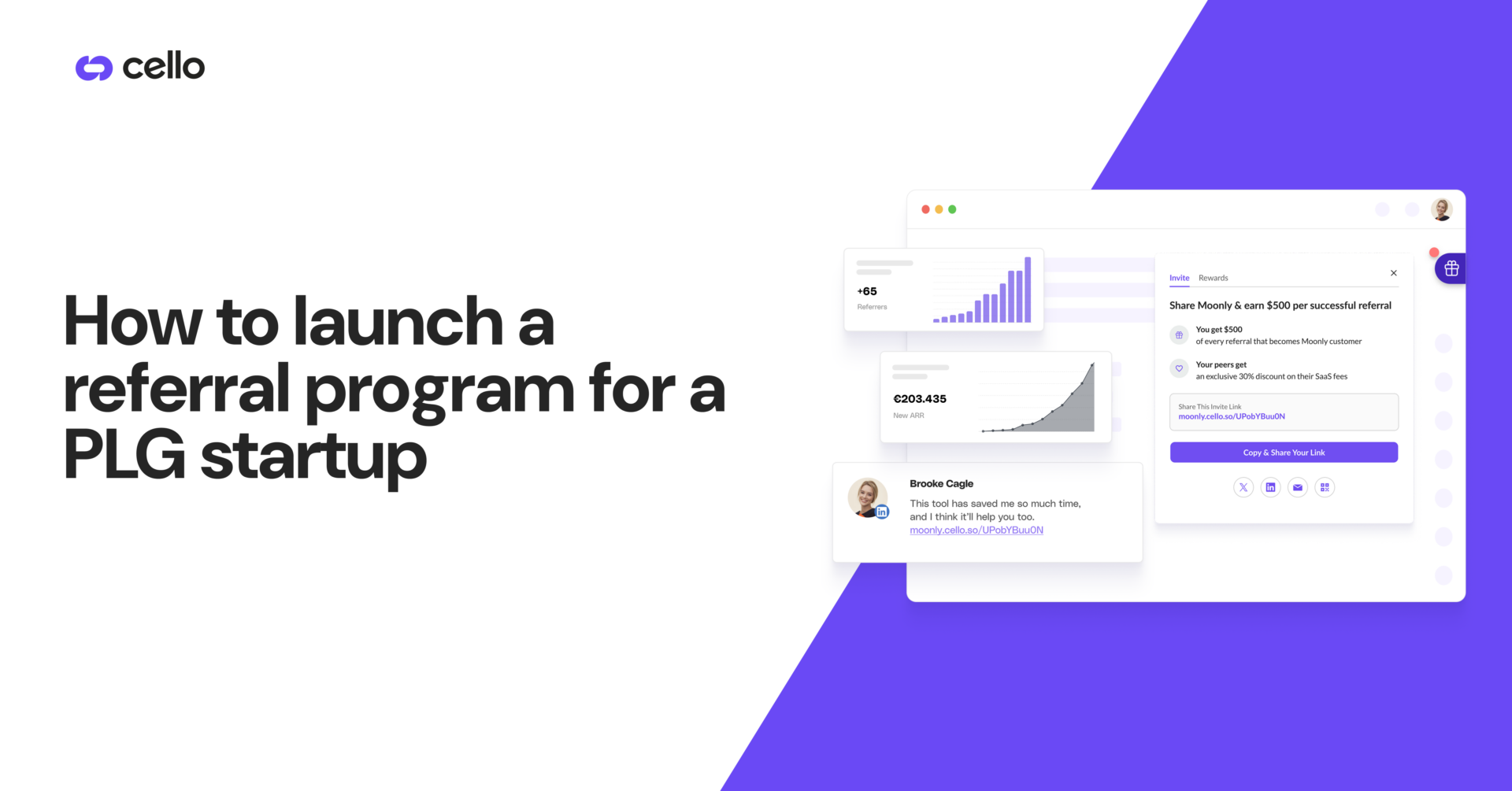

Paid acquisition costs are up, and your runway isn't getting longer. If you're running a PLG product with real activation, you already have something most teams pay heavily for: users who've hit a wow moment and talk about it. A well-built referral program for early stage SaaS turns those conversations into a channel you can actually measure, one that looks good in a Series A data room and costs a fraction of what you're spending on search.
- Why referral programs are a natural fit for PLG startups
- When a PLG startup is ready to launch a referral program
- Setting goals before you build anything
- Choosing an incentive structure that fits your business model
- Designing the referral flow your users will actually complete
- Where to place the referral program inside your product
- Technical implementation for a lean engineering team
- Keeping your referral program clean: fraud prevention basics
- Metrics to track in your first 90 days
- How Cello helps PLG startups run referral programs before their Series A
- Final thoughts on launching a referral program for early stage SaaS
TLDR:
- Referral customer acquisition cost runs around $150 in B2B SaaS vs $802 for paid search, per Phoenix Strategy Group's 2025 CAC benchmarks.
- Launch only after you have stable activation and consistent paid conversions; referrals scale whatever already exists in your funnel, leak included.
- Tie rewards to
invoice.paid, not signup and use server-side attribution so tracking survives cookie-blocking browsers. - Track four rates in the first 90 days: activation, share, signup and paid conversion; referred customers retain at higher rates than non-referred ones per Amplifinity research.
- Cello's referral surface lives inside your authenticated product via SDK, with VEED running 90.4% lower CAC than paid acquisition through the same in-product embed.
Why referral programs are a natural fit for PLG startups
PLG startups have a structural advantage in referral acquisition that sales-led companies do not: activated users who already reached a wow moment, a self-serve product new visitors can try in minutes and a satisfaction loop tight enough to make peer recommendations credible.
The channel economics back it up. Referral programs produce a customer acquisition cost of around $150 in B2B SaaS, compared to $802 for paid search, per Phoenix Strategy Group's 2025 CAC benchmarks. Yet most pre-Series A teams pour budget into paid channels and leave the cheapest one running as a Slack thread and a coupon code.
For a startup burning runway, that gap is the point. Every activated user is a distribution node. You do not buy them; you give them a way to share.
When a PLG startup is ready to launch a referral program
A referral program amplifies whatever already exists in your funnel. If activation is shaky or retention leaks, referrals will scale the leak, not the loop.
Three readiness signals matter before launch:
- A stable base of activated users who return week after week, not signup spikes from a campaign.
- Consistent positive signals: unprompted shares, NPS trending up, low support volume relative to usage.
- Enough paid conversions monthly to fund rewards without eating margin, and sample size to read program metrics accurately.
PLG investors reviewing a Series A look hard at signup-to-activation-to-paid conversion as the clearest evidence of product-market fit, per OpenView's PLG Series A guide. Launch before those numbers hold, and you circulate users who have not experienced the product's value, corrupting the metrics your next round depends on.
Setting goals before you build anything
Before you configure a single reward, write down what you want the program to move. Activity metrics like links generated or shares initiated tell you the widget loads. They do not tell you the program works.
Tie goals to outcomes a Series A investor will ask about:
- Referral ARR as a share of new ARR (start with a 10 to 15 percent target by month six).
- CAC reduction versus paid channels, measured against the same conversion window.
- Activation rate of referred users relative to non-referred signups.
Pick one as your North Star. For most pre-Series A PLG teams, Referral ARR is the cleanest choice because it forces you to instrument attribution end to end from day one. Reward size, placement and messaging become levers you tune against that number.
Choosing an incentive structure that fits your business model
Reward design is where most early programs quietly break their own unit economics. Pick the wrong structure and you either underpay for the effort of sharing or overpay for referred users who churn in month two.
Three axes matter pre-Series A: cash versus non-cash, flat versus percentage, one-sided versus two-sided.
|
Structure |
Best fit |
Watch out for |
|---|---|---|
|
Flat cash per conversion |
Predictable subscription pricing |
Weak alignment when plan values vary |
|
Percentage of revenue |
Higher ACV plans, sales-assisted funnels |
Requires clean billing metadata |
|
Account credits or free months |
Usage-based pricing, compliance-sensitive buyers |
Only rewards active users |
|
Feature unlocks |
Pre-payout-infra stage |
Ceiling on referrer motivation |
Two-sided incentives reliably lift participation over one-sided programs because the sharer has something concrete to offer. On freemium, tie the referrer payout to invoice.paid, not signup, so you never fund a reward for a trial that never converts.
Designing the referral flow your users will actually complete
Friction in the sharing flow is the most common reason PLG referral programs underperform. Every extra click or buried launcher shaves points off activation before the first link gets copied.
Four elements decide whether a user finishes the share:
- Benefit messaging that names the reward for both sides in one sentence, visible before the share action.
- A default link-copy mechanism with email and social as one-tap alternatives, not a modal maze.
- A referred-visitor landing state that greets the newcomer by referrer name and shows the incentive above the fold.
- A claim path where the incentive applies automatically at signup, no code entry required.
Sharing intent peaks inside the product, so the launcher has to open where the user already is. Attach it to a completed action, a project shipped, a document exported, a positive in-app rating, and the share sheet lands at peak satisfaction in two taps.
Where to place the referral program inside your product
Placement decides whether the program runs or sits dormant. A referral surface buried in a settings submenu gets found by users who least need to share.
The split worth naming is passive versus active placement. Passive means the link waits in an account menu for curiosity. Active means the program surfaces itself right after the user experiences value.
Three placements do most of the work pre-Series A:
- An in-product launcher pinned to the main navigation, visible every session, with a small unread indicator when a reward is available.
- A post-activation prompt that fires the first time a user completes the action tied to your aha moment, then again after their third or fourth successful use.
- An announcement anchored to the launcher after positive events: a plan upgrade, a milestone hit, a support conversation resolved with a thumbs-up.
Contextual timing beats visual polish at this stage. Instrument product events first, then attach the referral surface to the ones that track with satisfaction.
Technical implementation for a lean engineering team
Three technical decisions define whether a pre-Series A referral program works: how you attribute conversions, when you fire rewards, and how you catch abuse.
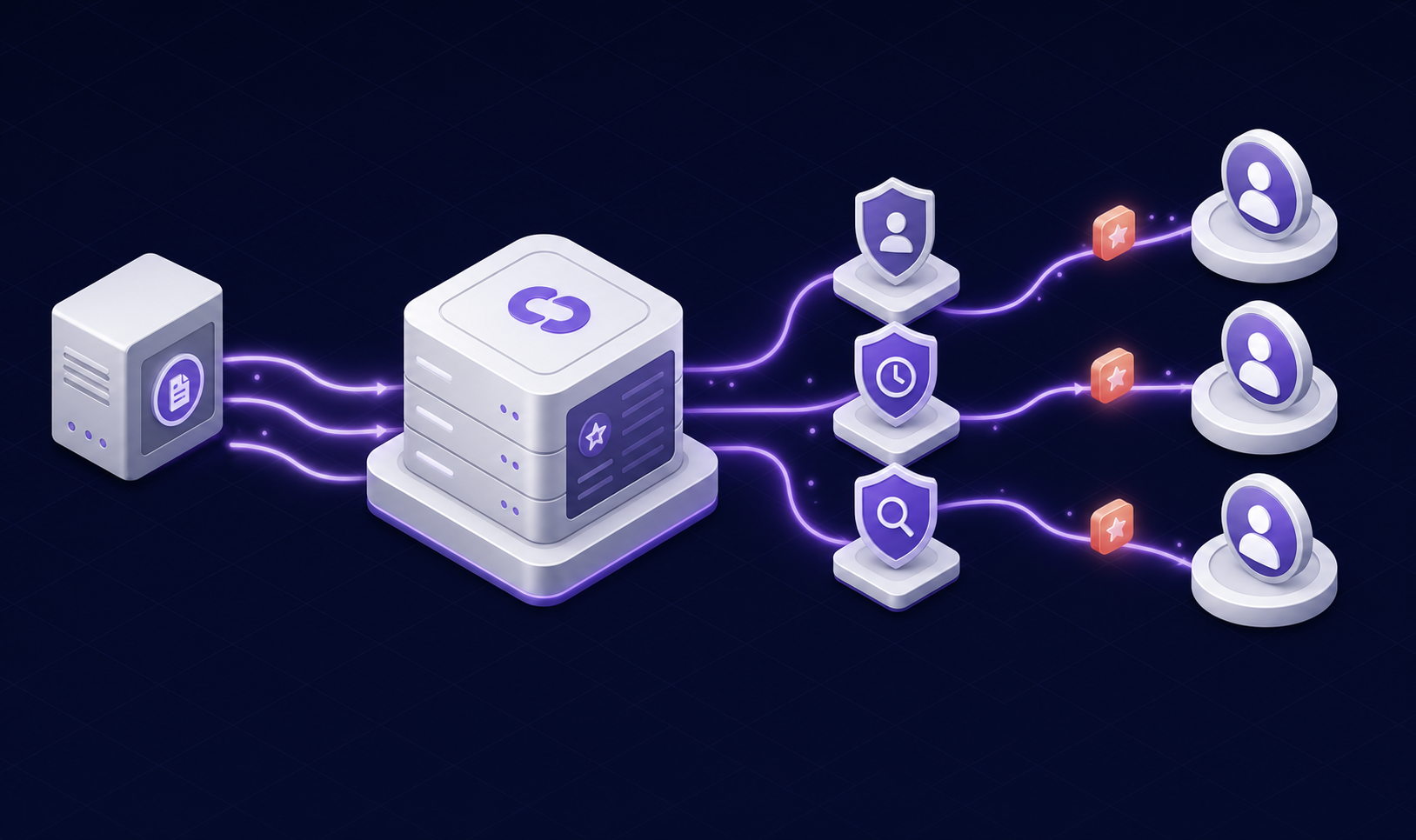
Attribution has to survive the browser. Cookie-only tracking breaks under Safari ITP and ad blockers. Server-side attribution reads a referrer code from a signup payload or billing metadata and closes the loop at the server layer. On Stripe, write a cello_ucc parameter onto the Customer object at signup and let invoice.paid trigger reward calculation. Chargebee follows the same pattern, passing cello_ucc on the Customer meta_data attribute or as a cf_ custom field, with the payment_succeeded event triggering reward calculation.
Fire rewards on verified billing events, not signup. Tie payouts to invoice.paid, add a delay matching your refund window, and cancel pending rewards on charge.refunded. Exclude self-referrals by comparing IDs and hold rewards for a review window.
Build or buy
A minimum viable custom build is a UCC generator, cookie handler, Stripe webhook listener, reward math, a payout provider integration, fraud rules and an admin UI. Every one is a maintenance surface. The build vs. buy decision for SaaS referral programs compresses time-to-live to days and moves the work from infrastructure to placement and reward tuning.
Keeping your referral program clean: fraud prevention basics
Fraud at pre-Series A stage is rarely sophisticated. The three patterns worth defending against are self-referrals from a second email, throwaway accounts that convert on a trial promo and cancel and users chaining referrals across shell workspaces before churn.
Three controls cover most of the risk without a fraud team:
- Compare referrer and new-user identifiers on every conversion and auto-exclude matches.
- Delay payouts by a window that matches your refund policy, and cancel pending rewards on
charge.refunded. - Hold flagged conversions in a review queue for chargebacks, quick cancels, and unusual usage patterns before the payout fires.
One botched payout to an obvious self-referrer signals to legitimate sharers that the rules are optional.
Metrics to track in your first 90 days
Track the funnel in layers. Aggregate signup counts hide where the program breaks.
Four rates matter in the first 90 days:
- Activation rate: eligible users who opened the launcher at least once.
- Share rate: activated users who sent at least one link.
- Signup rate: referred visitors who created an account.
- Paid conversion rate: referred signups who hit
invoice.paid.
Activation and share are leading indicators; paid conversion and Referral ARR are lagging. Read them in weekly cohorts so a good week does not get buried under a slow month.
Volume alone will mislead you. Amplifinity research shows referred SaaS customers deliver higher lifetime value and higher retention than non-referred ones. Segment LTV and retention curves by acquisition source from week one, before the wrong-user problem gets big enough to hide. VEED's referral program shows what this looks like in practice at scale.
How Cello helps PLG startups run referral programs before their Series A
Cello is built for this stage. The referral surface lives inside your authenticated product via SDK, not an external portal, which is the structural difference between a program users find and one that stays dormant. Hera went live in two days. Butter shipped in under five hours and converts 17.4% of referred signups to paid. VEED's 90.4% lower CAC through the same in-product embed.
The first $5,000 in referral-generated ARR is free, so pre-Series A teams can validate the channel without a procurement conversation. Server-side attribution, automated payouts, fraud checks and tax handling run without a growth engineer babysitting them.
Final thoughts on launching a referral program for early stage SaaS
Most pre-Series A teams leave their cheapest acquisition channel running as a Slack thread and a coupon code. A referral program built on server-side attribution, billing-triggered rewards and in-product placement changes that without adding headcount. Your users do the sharing. You just have to make it easy. Get started with Cello and run the channel before your next funding round.
What's a realistic Referral ARR target for a PLG startup in the first six months before Series A?
A 10 to 15 percent share of new ARR within six months is a practical starting target for most pre-Series A PLG teams. That range is specific enough to force end-to-end attribution instrumentation from day one while remaining achievable without a dedicated partnerships team.
Should I tie referral rewards to signup or to invoice.paid on Stripe?
Tie rewards to `invoice.paid`, not signup. Firing payouts at signup means you fund rewards for free trials that never convert — a direct hit to unit economics at exactly the stage where margin matters most. A payout delay matching your refund window, with pending rewards cancelled on `charge.refunded`, closes the remaining exposure.
How do I build a referral program for an early stage SaaS without a fraud team?
Three controls cover most pre-Series A risk without dedicated headcount: compare referrer and new-user identifiers on every conversion and auto-exclude matches; delay payouts by a window that mirrors your refund policy; and hold conversions flagged by quick cancels or chargebacks in a review queue before any reward fires. Risk-factor monitoring for unusual usage patterns catches the patterns that matter — self-referrals, throwaway accounts and shell-workspace chaining — without requiring a specialist to run it.
When is a PLG startup ready to launch a referral program, and what breaks if you go too early?
Three signals indicate readiness: a stable base of users who return week after week, consistent positive signals like unprompted shares and low support volume relative to usage, and enough monthly paid conversions to fund rewards without eating margin. Launch before activation and retention hold, and referrals scale the leak in your funnel rather than the growth loop — corrupting the signup-to-activation-to-paid conversion metrics that Series A investors scrutinise most closely.
Build vs buy for a pre-Series A referral program: what does a custom build actually require?
A minimum viable custom build requires a UCC generator, cookie handler, Stripe webhook listener, reward calculation logic, a payout provider integration, fraud rules and an admin UI — each a separate maintenance surface. Buying compresses time-to-live from months to days and shifts engineering work from infrastructure to placement and reward tuning, which is where the compounding program value actually lives.
Does referral attribution still work when a referred user signs up weeks after clicking the referral link?
Yes — Cello stores the referral code in first-party cookies with a three-month lifetime, so attribution persists across sessions well beyond the initial click. For PLG products where free trial periods run weeks before a purchase decision, this means the referrer still gets credit when the invoice fires at conversion.
What is User-Led Growth (ULG) and how is it different from PLG?
User-Led Growth is an acquisition motion where existing users introduce new users through structured, automated referrals — making the user base itself the channel. PLG drives acquisition through the product experience (free trials, freemium); ULG sits on top of that motion and multiplies it, turning already-activated PLG users into a measurable referral channel rather than replacing any existing motion.
What's the difference between a user referral program and a partner or affiliate program, and when should an early stage SaaS use each?
User referral programs run inside the product via an embedded widget, targeting your existing logged-in users who share links with peers in exchange for rewards tied to verified conversions. Partner and affiliate programs run through a standalone portal for external parties — influencers, agencies, investors — who are not product users. For a pre-Series A PLG team, start with in-product user referrals to compound activation; add a partner program when you have non-user advocates worth instrumenting separately.
Do ad blockers or Safari's Intelligent Tracking Prevention break referral link attribution?
Cookie-only attribution breaks under Safari's Intelligent Tracking Prevention (ITP) and most ad blockers, which is why server-side attribution is the primary path. Writing a referral code onto the Stripe Customer object at signup and triggering reward calculation from the `invoice.paid` event closes the attribution loop at the server layer, independent of what happens in the browser.
How should a referral program for early stage SaaS handle subscription tiers with different pricing — should reward amounts vary by plan?
Yes, tiered reward structures make economic sense when plan values differ materially. A flat-fee payout per conversion works when pricing is uniform, but when a business customer pays ten times more than a basic user, tying reward amounts to plan tier (via Stripe Customer metadata) aligns referral economics with actual customer value and avoids overpaying on low-ACV conversions.
What metrics should a PLG startup show in its Series A data room to prove a referral channel is working?
Investors evaluating a PLG Series A look for Referral ARR as a share of new ARR, CAC for referred customers measured against the same conversion window as paid channels, and the activation-to-paid conversion rate for referred signups versus non-referred ones. Segmenting lifetime value and retention by acquisition source from week one produces the cleaner comparison that makes the channel case credible.
How does referral attribution work when the person who pays is different from the person who shared the referral link?
Attribution can be wired at the organization level rather than the individual user level by passing a `new_user_organization_id` field on the Stripe or Chargebee Customer object, so the referrer earns credit even when a procurement contact or finance team completes the payment. For sales-led deals processed through a CRM, Salesforce Apex Triggers or HubSpot deal stage pass-backs can tie the contract closure event back to the original referral source.
Can partners self-serve to retrieve their referral links, or does every new partner require manual admin setup?
Partners can be provisioned automatically via a webhook integration between an application form (Typeform, HubSpot Forms or a custom web form) and the Partner Portal, so approved applicants receive portal access and a working referral link immediately on form submission without any manual admin action. This self-serve path is configured per program and works for high-volume partner acquisition strategies where manual per-partner approval would create a bottleneck.
At what ARR or activation level does it make sense to switch from a custom-built referral system to a dedicated referral program for early stage SaaS?
The inflection point is when maintenance cost on the custom build starts competing with growth-team bandwidth — typically when a program spans more than one market, requires multi-currency payouts, or needs fraud detection beyond a simple ID-match check. Teams at $1M to $3M ARR with stable activation often find that a custom build ships in weeks but accumulates months of ongoing engineering debt; the build-vs-buy math shifts sharply once attribution, payout compliance and fraud rules each require a dedicated maintenance surface.
How does a referral program work for an API or infrastructure product where users rarely return to the dashboard after initial setup?
For low-session-frequency products, in-product launcher placement is less effective because users are not logging in to see it — email-based referral distribution and sales-team-distributed links become the primary activation paths. Referral links can be embedded in onboarding sequences, milestone emails or CRM workflows so the share opportunity reaches users at the moment they experience value, without requiring a dashboard visit.