
Compare FirstPromoter alternatives against a defined referral workflow: where sharing starts, how a referral code reaches your customer record, which payout methods recipients can use and who handles each operational task. FirstPromoter’s embedded dashboard and managed payout options are plan-dependent, so evaluate the required plan rather than treating either capability as absent.
TLDR:
- FirstPromoter supports automatic-login dashboard embedding on Business and Enterprise, and Enterprise Managed Auto Payouts for approved SaaS companies. Include those plan conditions in your shortlist.
- Test referral-code capture, signup and billing conversion together. Backend conversion events do not recover an identifier that was never captured or mapped.
- Compare the configured sharing flow: launcher placement, automatic login, link access and reward visibility determine whether participants need to leave the product.
- For each shortlisted tool, request a demonstration of the required participant journey instead of treating portal-based and embedded experiences as interchangeable.
- Cello offers an embedded referral component and lists tax/compliance handling and automated payouts. Verify recipient markets, methods and each party’s responsibilities for your program.
What is FirstPromoter and how does it work?
FirstPromoter is an affiliate and referral tracking tool for SaaS programs. It generates tracking links, records conversions and calculates commissions. Distinguish billing-event tracking from reward distribution: the payout methods and Enterprise managed distribution option have separate conditions.
FirstPromoter supports tracking, commission management and a promoter dashboard. Business and Enterprise include embedding with automatic login, so an external portal is not the only available participant experience. Its pricing also lists tracking APIs and webhooks; implementation should be assessed against your signup and billing workflow.
The shortlist question is whether an embedded affiliate dashboard meets your user-referral requirements or whether you need a dedicated referral component. Test how participants open it, share a link, see earned rewards and reach payout settings. Do not rule out FirstPromoter on the premise that it has no in-product option.
Use the same test account and tasks across vendors. A portal, an automatic-login embed and a referral component can produce different experiences, but product labels do not establish which configured flow will convert better.
Why consider FirstPromoter alternatives?
Compare alternatives when your required sharing, tracking or payout workflow is not covered by your current FirstPromoter setup or plan.
Here are the most common reasons teams start looking elsewhere:

- In-product experience: FirstPromoter offers automatic-login dashboard embedding on Business and Enterprise. Compare its sharing and rewards tasks with a dedicated referral component before deciding that you need a different tool.
- Attribution handoff: verify where the referral code is captured, how it reaches your customer record and which billing events confirm conversion. Test cookie loss and device changes explicitly rather than assuming backend events guarantee continuity.
- Participant fit: define whether existing product users, external affiliates or both need to share. Evaluate the configured experience for each group instead of assuming an affiliate dashboard cannot serve user referrals.
- Payout operations: FirstPromoter lists several mass-payout methods and Enterprise Managed Auto Payouts for approved SaaS companies. Separate scheduling, distribution, recipient eligibility and tax responsibilities when comparing plans.
- Scaling requirements: document payout approval work, available methods, country eligibility and exception handling at your expected volume. Confirm which tasks remain with your team under each plan.
Retain FirstPromoter on the shortlist if its configured workflow meets your requirements. Compare alternatives when a tested requirement remains unmet, not simply because one product is described as affiliate software.
Best FirstPromoter alternatives in August 2026
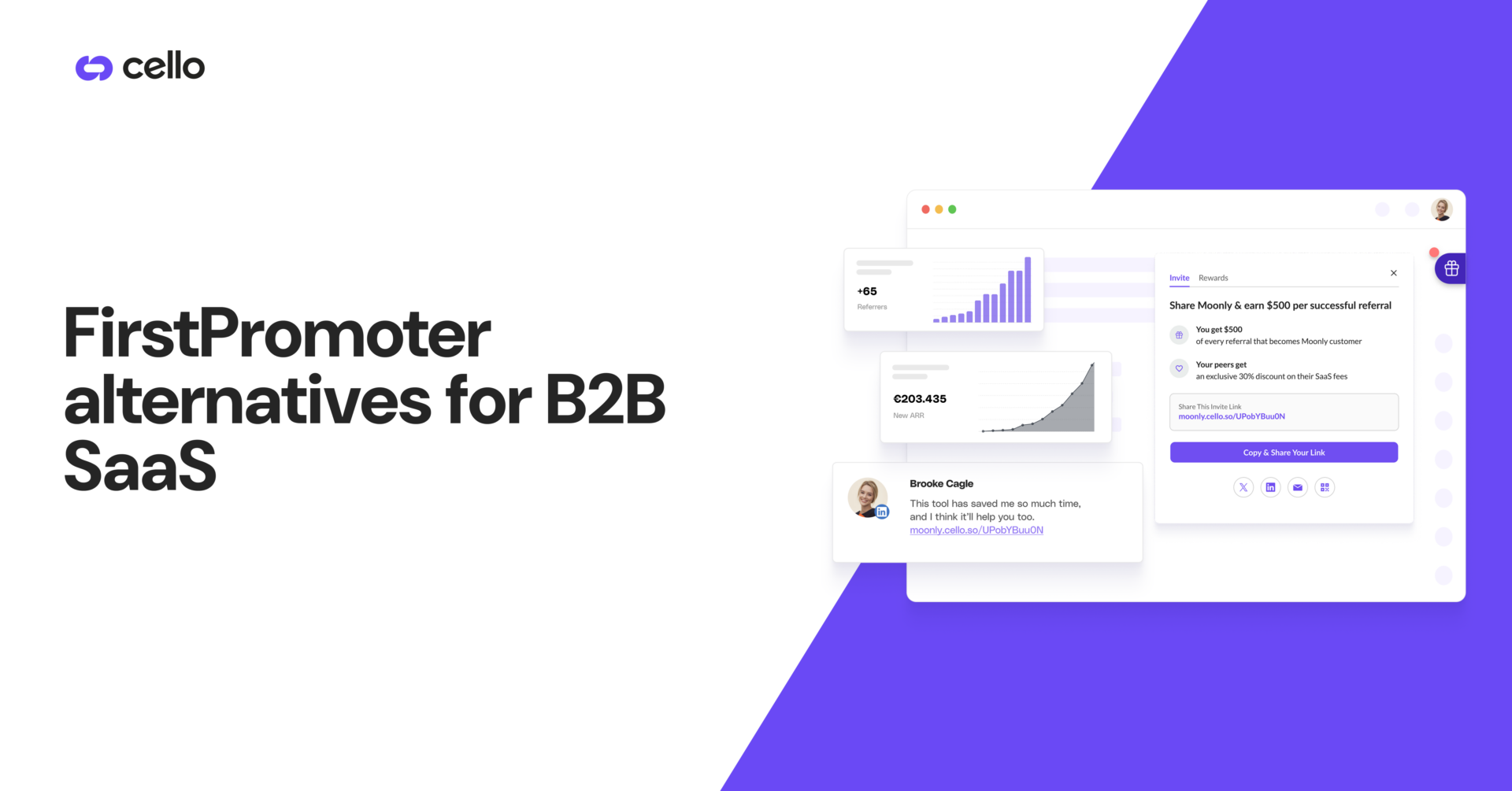
Cello provides a referral component inside the logged-in product and connects conversion tracking through billing integrations or its API. Evaluate the full capture-to-purchase handoff alongside the user experience; server-side billing events do not guarantee attribution through every browser restriction or device change.
What makes Cello different from FirstPromoter
Compare Cello’s referral component with FirstPromoter’s hosted or embedded affiliate dashboard. FirstPromoter’s automatic-login embed is available on Business and Enterprise, so the useful distinction is the configured referral workflow, not a mandatory redirect.
The structural differences are worth naming directly:
- Cello’s Stripe flow captures the referral code in the browser and passes it into Customer metadata when the customer is created; webhooks then connect billing events to the identifier.
- Cello’s embedded component lets existing users share and review rewards inside the product. FirstPromoter’s Business and Enterprise dashboard embed also supports an in-product experience.
- Cello lists tax/compliance handling and automated payouts. Confirm the contracted scope, supported recipient markets and the operator’s remaining duties; do not infer a blanket transfer of legal responsibility.
- Risk-factor monitoring flags self-referrals, duplicate signups and reward-threshold manipulation before a payout clears.
Cello’s Softr case study reports referral conversion rising from fewer than 2% to nearly 10%, described as a fivefold increase. The story includes incentive and placement changes, so it is not a controlled test of widget placement or a guarantee of results for another program.
Good for: PLG and product-led SaaS teams at the $1M to $20M ARR range who want referrals to run as infrastructure, not a side project.
Limitation: Cello is not a traditional external affiliate network. If your motion is purely outbound partner recruitment with no in-product surface, it is not the right fit.
Bottom line: for B2B SaaS teams where the referral surface belongs inside the product, Cello is the purpose-built choice.
Feature comparison: FirstPromoter vs top alternatives
|
Feature |
Cello |
FirstPromoter |
Rewardful |
PartnerStack |
Referral Factory |
|---|---|---|---|---|---|
|
In-product referral widget |
Yes |
Embedded affiliate dashboard on Business/Enterprise; assess against the required referral widget. |
No |
No |
Limited |
|
Server-side attribution |
Browser capture plus Customer metadata and billing webhooks. |
Tracking APIs and webhooks listed; validate the selected integration. |
No |
No |
No |
|
Fraud detection |
Yes |
Basic |
Basic |
No |
Basic |
|
Compliant multi-country payouts |
Tax/compliance handling listed; confirm contractual scope and recipient markets. |
Enterprise managed distribution for approved SaaS companies; verify compliance scope separately. |
Optional Managed Payouts on all plans; verify compliance scope separately. |
No |
No |
|
B2B SaaS-native |
Yes |
Partial |
Partial |
Yes |
No |
|
Days to go live |
2 to 7 days |
1 to 3 days |
1 to 3 days |
Weeks |
Days |
|
Pricing model |
User Referrals tiered by Referral ARR thresholds. |
Subscription tiers based on monthly affiliate-generated revenue. |
Flat monthly |
Revenue share |
Flat monthly |
The table above covers the capabilities that matter most to a B2B SaaS growth team assessing referral infrastructure. A few gaps are worth calling out directly.

Attribution and tracking
Compare attribution as a chain, not a binary feature. In Cello’s documented Stripe setup, browser capture supplies the referral code, your integration adds it to Customer metadata, and webhooks report billing events. FirstPromoter lists tracking APIs and webhooks alongside browser tracking. Ask each vendor to demonstrate your signup-to-purchase path, including missing identifiers, delayed purchases and device changes.
In-product surface vs external portal
FirstPromoter offers an embedded affiliate dashboard with automatic login on Business and Enterprise. Compare that dashboard with Cello’s referral component by testing the launcher, sharing flow, branding and reward access inside your authenticated product. Request the same participant-flow demonstration from the other shortlisted vendors before scoring their in-product support.
Payouts and compliance
FirstPromoter lists mass payouts through PayPal, Wise, Stripe, crypto and bank transfer. Direct PayPal payouts require Business or Enterprise and a PayPal Business account with Payouts API access. Enterprise Managed Auto Payouts distributes rewards from one invoice, but is available only to approved SaaS companies. Scheduled payouts and managed distribution are separate capabilities. Rewardful also lists optional Managed Payouts on all plans. Cello lists tax/compliance handling and automated payouts. Compare distribution fees, recipient eligibility, tax-form collection and retained responsibilities separately; managed distribution alone does not establish identical compliance coverage.
Why Cello is the best FirstPromoter alternative
For a shortlist decision, start with the participant: an existing user sharing from the app has different tasks from an external affiliate managing commissions. FirstPromoter’s Business and Enterprise automatic-login embed can address an in-product dashboard requirement. Test whether it covers the required sharing and rewards journey before replacing it.
Cello is a candidate when a dedicated referral component fits your product workflow. Compare the authenticated sharing experience, the referral-to-billing mapping and payout operations against your shortlisted plans. Cello’s Softr case study reports referral conversion rising from fewer than 2% to nearly 10%, alongside incentive and placement changes; it does not isolate the effect of the widget or an unchanged offer.
Final thoughts on FirstPromoter alternatives for B2B SaaS
Use a demonstrated workflow to narrow your FirstPromoter alternatives shortlist. Verify the plan required for embedding, trace one referral through billing and confirm who executes payouts and handles exceptions. This page’s comparison table is a starting point for those checks, not a substitute for a configured product test.
Why do B2B SaaS teams look for FirstPromoter alternatives?
Compare FirstPromoter alternatives against a defined referral workflow: where sharing starts, how a referral code reaches your customer record, which payout methods recipients can use and who handles each operational task. FirstPromoter’s embedded dashboard and managed payout options are plan-dependent, so evaluate the required plan rather than treating either capability as absent.
What should you focus on when comparing FirstPromoter alternatives for B2B SaaS?
Score each candidate against the same workflow: authenticated sharing, referral-code capture and customer mapping, purchase-event handling, recipient payout methods and operator responsibilities. FirstPromoter’s embedding and managed distribution have plan and eligibility conditions; backend attribution and managed payouts should not be scored as unconditional guarantees.
When does switching from FirstPromoter to Cello make sense?
Switch when a tested requirement is not covered by your FirstPromoter plan and Cello’s configured referral component meets it. FirstPromoter already offers automatic-login dashboard embedding on Business and Enterprise. Cello’s Softr case study reports a fivefold referral-conversion increase alongside incentive and placement work, not a controlled test of an unchanged offer.
Does Cello replace FirstPromoter for teams running external affiliate programs?
Cello is not a traditional external affiliate network. If your motion is purely outbound partner recruitment (bloggers, agencies or reviewers driving traffic to a public URL), FirstPromoter remains a reasonable fit. Cello is purpose-built for B2B SaaS teams who want the referral surface inside the product, with partner programs and user referrals managed on the same dashboard
How does Cello handle payouts and tax compliance compared to FirstPromoter?
Cello lists tax/compliance handling and automated payouts, while FirstPromoter offers Enterprise Managed Auto Payouts for approved SaaS companies. FirstPromoter’s other payout workflows and methods remain available under their plan conditions. Compare tax-form collection, recipient markets, fees, approvals and retained legal duties explicitly instead of treating either vendor as a universal transfer of compliance responsibility.
Can a referral program work for an early-stage B2B SaaS with a small user base, and what should you look for in FirstPromoter alternatives at that stage?
For an early-stage program, test whether eligible users open the referral surface, share and generate qualified signups before projecting returns. Choose an affordable plan that supports the required experience, then trace each test referral through customer creation and purchase. Confirm current plan limits directly; backend events do not substitute for correctly captured referral identifiers.
What happens to referral attribution when a referred user clicks a link on mobile but signs up on desktop days later?
A referral code captured on one device is not automatically available on another. Cello’s documented Stripe setup passes the captured code into Customer metadata when the customer is created, not at the initial link click. Test how your signup and identity flow associates the referral with the eventual customer before relying on cross-device reporting.
How do referral platforms handle payouts when users do not have a PayPal account, and what alternatives exist for European markets?
FirstPromoter lists mass payouts through PayPal, Wise, Stripe, crypto and bank transfer; Enterprise Managed Auto Payouts requires SaaS eligibility and approval. Do not assume PayPal is the only option or that every method is available in every recipient market. For each shortlisted tool, confirm recipient country, currency, method, fees and who handles failed or returned payments before launching.
What is the best way to surface a referral call-to-action when there is limited UI space in your product navigation?
The most effective approach is to move away from a fixed navigation slot and trigger the referral surface at a behavioral milestone — a completed project, a successful hire, a first invoice sent — when sharing intent is highest and the user does not need to discover the launcher organically. Cello supports event-driven referral prompts tied to in-product milestones, deep-linking via URL parameters to open the widget from an email or in-app notification, and a custom launcher attached to any existing UI element via a click handler, all of which remove the dependency on a dedicated navigation slot
How does server-side attribution differ from cookie-based tracking, and why does it matter for B2B SaaS referral programs?
Cello’s documented Stripe setup first captures the referral code in the browser, then requires your integration to pass it into Stripe Customer metadata when the customer is created. Webhooks connect subsequent billing events to that stored identifier. A backend event does not recover a referral code that was never captured or mapped; test capture, signup, customer creation and purchase as one flow. Server-side conversion reporting and browser capture are different stages of one attribution chain, not mutually exclusive architectures.
Should you build a referral program in-house or buy a tool like a FirstPromoter alternative?
Building in-house delivers full control over UX and data ownership but requires engineering capacity to own attribution logic, fraud detection, payout retry handling, tax-form collection and regulation-driven maintenance — each of which compounds as you expand into new markets. Buying moves the work from infrastructure to a one-time integration: SDK installation, identity token wiring and webhook configuration. For most B2B SaaS teams at the $1M to $20M ARR range, the build cost exceeds the cost of a purpose-built tool within the first year once ongoing maintenance is factored in.
What is User-Led Growth (ULG) and how does it differ from Product-Led Growth (PLG)?
User-Led Growth is the practice of turning existing product users into a measurable acquisition channel through structured referral programs — the user is the channel, not a passive beneficiary of it. Product-Led Growth drives acquisition and conversion through the product itself (free trials, freemium, in-product onboarding), while ULG drives acquisition through the trust relationships those existing users have with peers outside the product. The two motions complement each other: PLG converts trial users into paying customers, and ULG turns those paying customers into a repeatable, low-CAC acquisition channel.
How do you run both a user referral program and a partner or affiliate program without managing two separate tools?
Most teams end up running these on separate platforms — a referral tool for in-product user sharing and an affiliate platform for external partners — with no shared attribution model, no unified reporting and double the integration work. Cello runs user referrals and partner programs on a single platform with shared attribution infrastructure, fraud detection, campaign configuration and a unified analytics dashboard, so both programs are managed from one place and compared against the same performance benchmarks.
How long does it take to go live with a FirstPromoter alternative for a B2B SaaS product?
Estimate go-live from your actual integration: authentication, embed or component placement, referral-code capture, billing-event mapping and payout testing. FirstPromoter offers automatic-login dashboard embedding on Business and Enterprise. Ask each shortlisted vendor for a scoped implementation checklist rather than using an external-only assumption to assign a universal launch time.
How does Cello's fraud detection work, and do you need a dedicated analyst to manage it?
No dedicated analyst is required — fraud detection in Cello runs automatically at the attribution layer, flagging self-referrals, duplicate signups and reward-threshold manipulation before a payout clears. The system applies risk-factor monitoring for unusual usage patterns across a 30-day review window, and pending rewards are automatically cancelled when a charge is refunded via Stripe. A manual review queue surfaces cases that require human judgment, but the baseline protection runs without operator intervention on every pricing tier.