
A customer who used to recommend your product has stopped. Another reminder may help if they forgot about the program. It will not fix a broken sharing link, an unresolved reward or a product experience they no longer want to recommend.
To reactivate inactive SaaS referrers, separate previous sharers from users who never started, look for the reason they went quiet and choose one relevant next step. Test any new referral ask against a comparable group receiving no additional ask. Measure whether it produces suitable paying customers and not merely another round of sharing.
TL;DR
- Limit reactivation to people who referred before and are currently eligible for your program messaging.
- Use your own referral cadence to define a lapse instead of adopting a universal day count.
- Check product experience, sharing friction and unresolved rewards before sending another ask.
- When someone has no new peers to refer, waiting for a relevant moment is a reasonable outcome.
- Compare each messaging test with a holdout, reporting sharing, paid outcomes, costs and opt-outs together.
Who counts as an inactive referrer?
An inactive referrer is someone who previously made a referral or completed your defined sharing action, then stopped for longer than you would normally expect. For a reactivation campaign, narrow that group to people who are still eligible to participate and receive the message. Do not mix them with users who never started.
Keep four groups separate:
- Never activated: users who have not completed the sharing action. They need first-time activation, not a message about returning.
- Previously active, now lapsed: the group to investigate for reactivation.
- Opted out: users who should not receive the program messages they declined.
- Currently ineligible: people outside your active campaign criteria, who should stay out of the test.
Define what “shared” means in your data. A copied link, a recipient's link view and a referred signup are different events. Choose an observable signal and use it consistently. If you only see recipient views, describe the cohort as having no recent referral visits instead of claiming nobody sent a link.
For users who never started, the referral program announcements guide covers the separate activation problem.
How long should a referrer be quiet before you act?
Set your lapse threshold from the gaps between referrals in your own program, since no single day count fits every product. It is a review trigger, not proof that someone has disengaged. Buying cycles, customer roles and opportunities to meet relevant peers all affect how often someone can reasonably introduce your product.
If suitable event history is available, start with these steps:
- Choose a comparable group. Look at customers with similar product use and referral opportunities, over a period that reflects your buying cycle.
- Inspect repeat activity. Review the gaps between consecutive sharing events or referral visits for people with more than one event.
- Set a provisional threshold. Choose a point that flags unusually long gaps without labelling most ordinary referrers inactive. Record why you chose it.
- Check the exceptions. Review one-time referrers separately, and revisit the threshold after major program or seasonal changes.
Repeat referrers are not a perfect model for everyone else. If the history is sparse, use a provisional window and review individual cases. Avoid presenting a particular percentile or number of days as a benchmark your program must follow.
What should you check before sending a reminder?
Check whether the referrer still has a good product experience, a working sharing route and no unresolved reward issue. Then look for a relevant opportunity to recommend the product again. These are possible explanations to investigate, not diagnoses you can confirm from silence or a single dashboard metric.
|
What you observe |
What to check |
Useful next step |
Suggested owner |
|---|---|---|---|
|
Lower usage or a recent downgrade |
Whether the product still supports the customer's needs |
Resolve adoption or service issues before a referral ask |
Customer Success |
|
Healthy usage but less referral activity after a release |
Launcher visibility, link behaviour and the actual sharing journey |
Fix a confirmed problem, then check the flow again |
Product and Growth |
|
A pending reward question or payout complaint |
The reward status and what the referrer was told |
Resolve the issue and explain the outcome without adding a new ask |
Program owner |
|
A complaint or poor experience for a referred peer |
The account owner's understanding of the case |
Handle the service conversation separately from referral promotion |
Account owner |
|
Happy customer with few new peers to introduce |
Whether a genuinely new use case or relevant contact exists |
Wait, or test one context-specific prompt |
Lifecycle |
|
No clear issue or explanation |
Recent messages and available customer feedback |
Test one concise reminder against no additional ask |
Lifecycle |
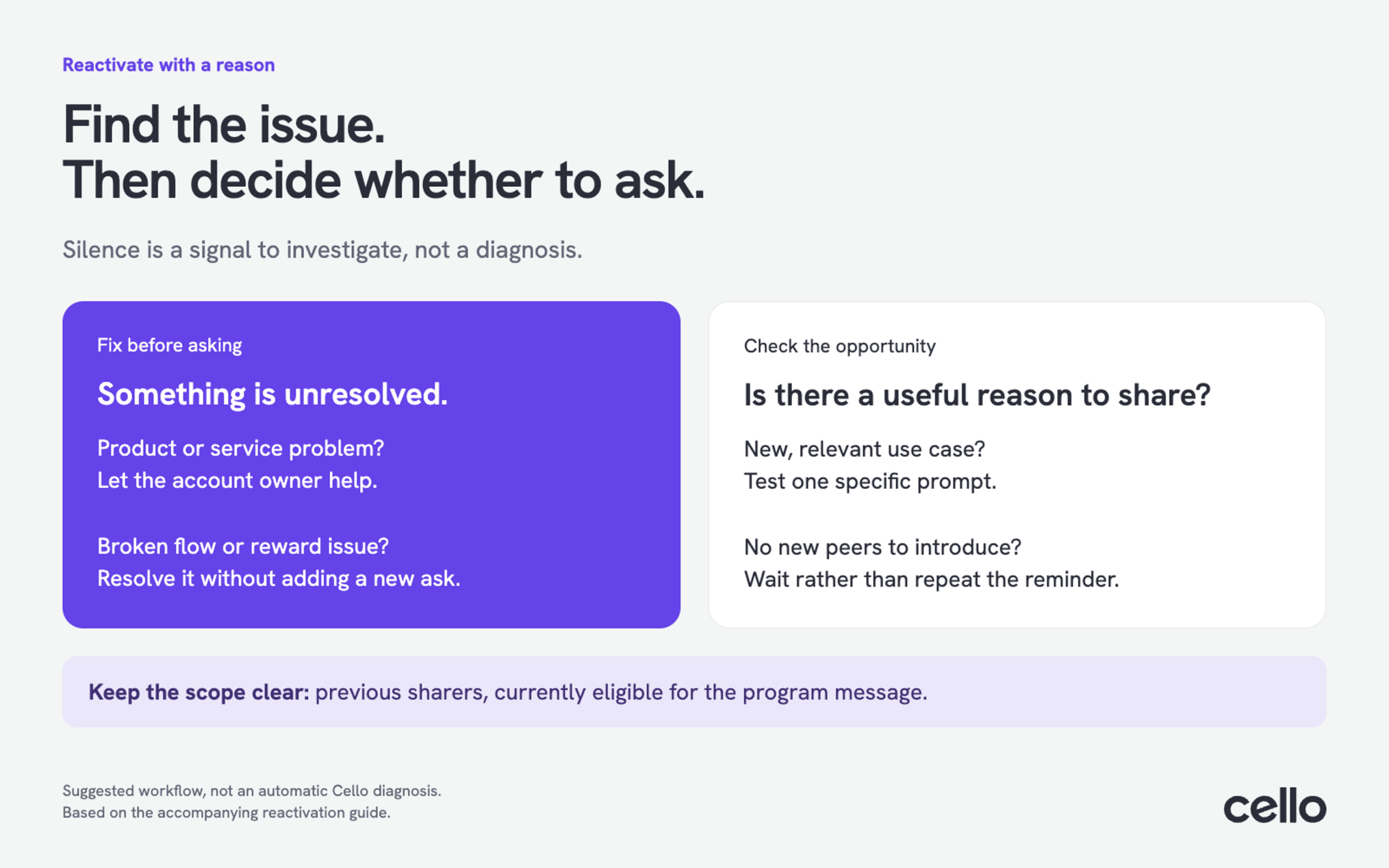
Give each case a next step and an owner. If several issues overlap, resolve the underlying product, service or reward problem first. Do not create a fixed waiting period that substitutes for checking whether the problem is actually resolved.
What can you send instead of another generic reminder?
A useful reactivation message gives the customer a relevant reason to reconsider sharing. It may point to a newly supported workflow, a clearer description of whom to refer or a repaired sharing experience. Keep the message specific, let the customer decide whether someone comes to mind and avoid repeating an ask simply because they did not respond.
The examples below are hypothetical wording to adapt, not tested campaign results.
After a sharing problem is fixed
The referral link issue you reported is fixed. You can now open your sharing link from [location]. Thanks for flagging it.
That message closes the issue. A new referral request does not need to be attached. If you later test a prompt, make sure it reaches users whose sharing route is working.
When a new use case is relevant
You previously recommended [product] for [workflow]. We now support [verified new capability]. If a peer has mentioned [specific problem], here's a short overview you can share.
Use a real capability relevant to that customer. A feature announcement is not automatically a reason to ask every inactive referrer again.
When users are unsure whom to refer
[Product] is designed for [team] dealing with [recognizable problem]. If someone comes to mind, this overview explains where it helps and where it does not.
For the copyable template, use the companion guide on attracting better-fit customers through SaaS referrals. Clearer buyer guidance reduces uncertainty; it does not create new contacts for someone who has already referred everyone they know.
When the reason is unknown
Thanks again for recommending [product]. If another peer is working through [specific problem], your referral link is here: [link]. The current program offers [accurate reward summary].
Keep the ask short and make the program details accurate. The referral email templates provide further starting points. Treat no response as a reason to review the approach, not an instruction to increase frequency.
How do you measure whether reactivation worked?
Measure the effect of the additional message against a randomized holdout from the same eligible cohort, the control-group method behind incrementality testing with control groups. The holdout receives no extra reactivation ask while both groups retain the same ordinary service experience. Compare rates instead of raw totals when group sizes differ, and allow both groups the same time to produce outcomes.
Do not withhold a reward fix or service resolution for an experiment. If you want to test a later referral message, resolve the issue first for everyone affected, then test the additional ask among comparable eligible referrers.
Before starting, define the sharing event, suitable-customer criteria, first-paid conversion and follow-up window. Keep audience rules, rewards and other planned messaging consistent between groups. Decide how much evidence you need with the person responsible for the analysis; there is no universal sample size or test duration.
Track these measures together:
- Assigned referrers: the denominator for comparing outcomes between groups.
- Resumed sharing: the number and percentage completing the defined sharing event again.
- Referred signups: lead volume, kept separate from paid acquisition.
- Suitable first-paid customers: the count and rate associated with each group, using the same qualification method.
- Costs: rewards, campaign work and other agreed operating costs.
- Opt-outs: a separate outcome showing whether the message is unwelcome.
In this hypothetical example, 1,200 eligible lapsed referrers are randomly assigned to one reminder or a holdout. The 60-day window is illustrative, not a recommendation for every program.
All figures in the table below are invented for illustration. They are not observed results from any real program.
|
Outcome |
Reminder: 960 referrers |
Holdout: 240 referrers |
|---|---|---|
|
Resumed sharing |
58 (6.04%) |
10 (4.17%) |
|
Referred signups |
31 |
6 |
|
Suitable first-paid customers |
9 (0.94%) |
2 (0.83%) |
|
Program-message opt-outs |
12 (1.25%) |
0 |
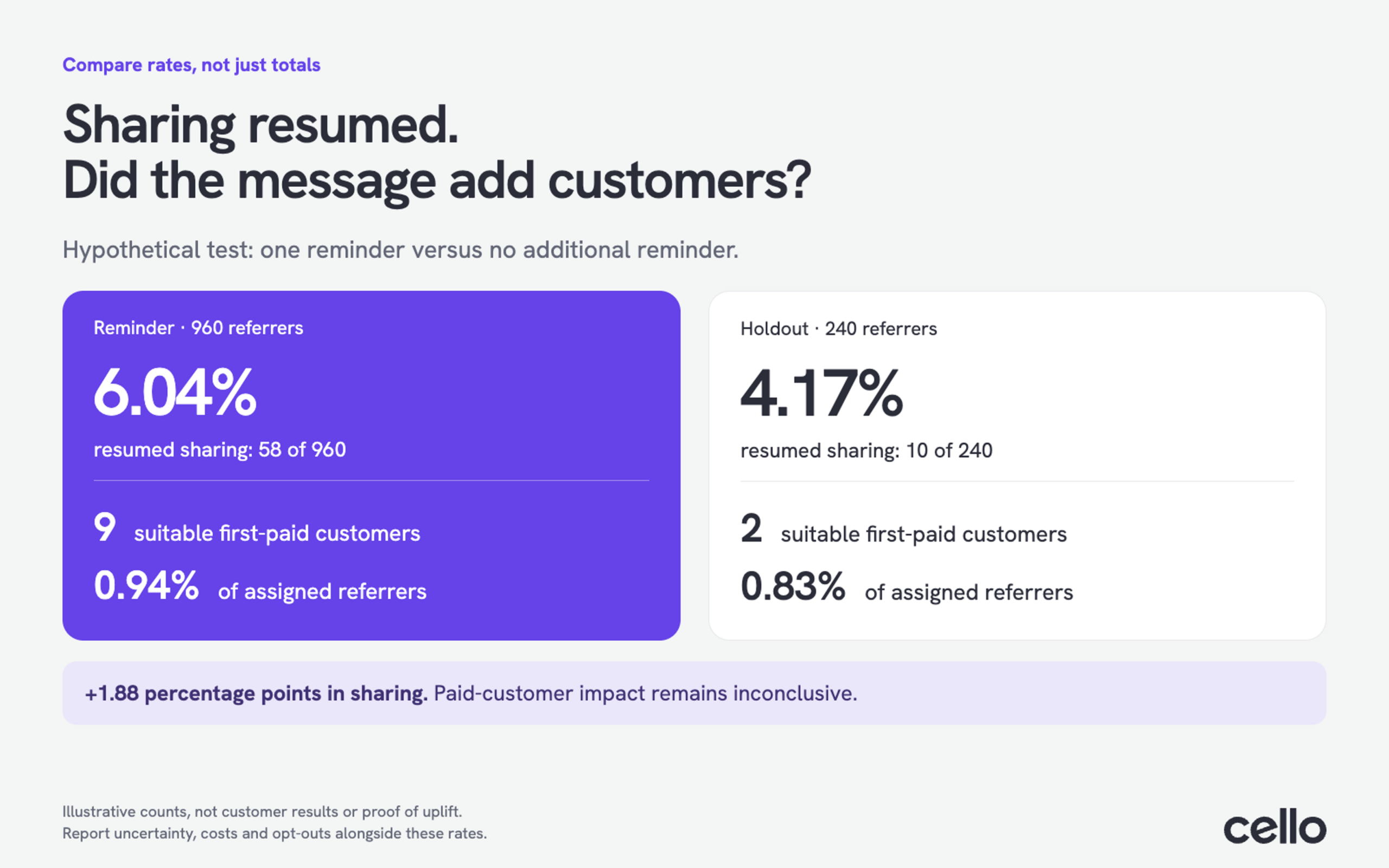
The reminder group's 6.04% sharing rate is an observed response. The difference from the holdout is approximately 1.88 percentage points, equivalent to a point estimate of 18 additional sharers among the 960 assigned referrers. That estimate still has uncertainty; it is not a guaranteed number caused by the message.
The paid-customer rates are much closer: 0.94% versus 0.83%. Nine customers versus two does not prove a reliable acquisition gain when the groups are different sizes and the counts are this small. The 12 opt-outs also belong in the decision. Do not declare success based on the sharing rate alone.
A holdout comparison helps distinguish observed activity from estimated additional activity. Follow the analysis plan instead of extending a test only until a favourable result appears.
What does Cello support in this workflow?
Cello provides the referral experience and documented notifications. Your team defines the lapsed cohort, investigates customer issues and designs the comparison. Start by checking which messages are already running so a new campaign does not duplicate an existing prompt or create a different experience for the holdout.
The Cello notification documentation describes activation alerts and announcements, welcome and successful-share emails, new-reward notifications and an unclaimed-rewards email. The unclaimed-rewards email is sent when payment details have not been entered seven days after the first reward; it is not a remedy for every payout or attribution issue.
The documentation also describes an optional recurring activation campaign with activity and prior-announcement conditions. Engagement notifications can be turned off, while required notifications remain on. Review the actual configuration with the program owner before adding a reactivation message.
Cello's performance reporting covers attributed ARR and its movements. That is aggregate revenue data, separate from event-level sharing history. It does not by itself prove that you have the event-level history needed to calculate individual sharing gaps. Confirm the available records for your setup before building a cohort around them.
Start with one well-defined group and one question. Fix what is broken, choose a relevant reason to ask again and judge the result using customer outcomes alongside activity. If no useful new referral opportunity exists, waiting is better than manufacturing another reminder.
How long should a referrer be inactive before a reactivation message?
Use your own program's referral cadence as a starting point. Review gaps between comparable events, then choose a provisional threshold. Account for seasonality and one-time referrers. A long gap is a reason to investigate, not proof that the customer needs another message.
Should users who never shared join the same campaign?
No. First-time activation and reactivation answer different questions. Keep previous sharers in the reactivation cohort and use a separate flow for users who never completed the sharing action.
What should happen when a reward is unresolved?
Resolve the issue and explain the outcome without attaching another referral ask. Do not delay a reward fix to create a control group. Any later messaging test should begin after the underlying issue has been resolved.
How often should you remind a lapsed referrer?
Start with one relevant message, check existing campaign activity and review the outcome before adding more. Do not treat a missing link view as proof that someone ignored the message; they may not have had a suitable peer to introduce
Who should stay out of the reactivation test?
Exclude users who never activated, people currently outside the program criteria and people who declined the relevant program messaging. Keep customers with unresolved product, service or reward issues out of a new referral ask while those issues are being resolved.
What if someone has nobody new to refer?
Wait for a genuinely relevant opportunity. A new supported workflow or a new peer relationship may give them a reason to share later. More reminders do not expand their network or make an unsuitable introduction useful.
Which metrics matter beyond resumed sharing?
Track suitable first-paid customers, referred signups, rewards, campaign costs and opt-outs. Sharing is an early signal. It does not prove that the campaign produced additional customers or enough value to warrant its cost.
How do you separate reactivation from people returning anyway?
Randomly assign comparable eligible referrers to the extra message or a no-additional-message holdout. Compare outcomes over the same window and report uncertainty. Small differences based on a few paid customers should remain inconclusive instead of becoming an uplift claim.