

- TL; DR
- Why Referral Programs Fail to Convert (The 3 Root Causes)
- How to Diagnose Your Referral Funnel in 3 Steps
- What Analytics Features to Look For in a Referral Platform
- How Cello Fixes Low Referral Conversion for B2B SaaS
- Testing Your Referral Program: What to Experiment With First
- Conclusion: From Under 3% to a Compounding Referral Channel
If your referral program has been running for three to six months and conversion is still under 3%, the problem is execution, not motivation.
B2B SaaS referral programs using in-product placement consistently achieve 15–25% click-to-conversion rates, based on Cello's referral ROI benchmark data from programs on the platform. If you're seeing 1–2%, something specific in your funnel is broken. This guide gives you the diagnostic framework to find it and fix it.
TL; DR
- A referral program under 3% conversion is failing at one of three points: share friction, incentive mismatch, or broken attribution, not lack of user motivation.
- Healthy B2B SaaS benchmarks: participation rate 5–15%, share rate 10–30%, click-to-conversion 15–25%.
- Server-side tracking is required for accurate attribution. Cookie-based tracking undercounts conversions by 20–40% in ad-blocker-heavy B2B audiences.
- The right referral platform embeds inside the product, detects fraud, and surfaces referral ARR in real time.
Why Referral Programs Fail to Convert (The 3 Root Causes)
A referral program with under 3% conversion is almost always broken at one of three points: the moment of sharing, the incentive design, or the data layer. Identifying which root cause applies to your program is the prerequisite to any fix. Patching incentives when the real problem is a broken attribution layer wastes months of iteration cycles.
1. Share Friction: The External Portal Problem
The single most common cause of sub-3% referral conversion is asking users to leave your product to participate. External referral portals, standalone pages hosted outside the core product UI, introduce enough friction to kill participation before a user ever sends a share.. The difference is structural: when users must leave your product to participate in a referral program, most of them don't. In-product placement removes the biggest drop-off point in the funnel before a user ever sends a share..
The fix is embedding the referral experience directly inside your product, at the exact moment a user has just experienced value. A drop-in SDK widget that lives inside the product UI, not outside it, removes the biggest drop-off point in the referral funnel.
2. Incentive Mismatch: Rewarding the Wrong Action
Incentives that feel irrelevant to the referrer produce low share rates regardless of placement. In B2B SaaS, cash or account credit tied directly to the product, such as a billing credit or a plan upgrade, consistently outperforms one-size-fits-all gift cards. Peer recommendations are the highest-trust acquisition channel in B2B: referred prospects produce significantly higher conversion rates than cold outbound, because they arrive with established social proof rather than zero context. If your referral reward has nothing to do with your product, referred prospects are also harder to convert.
The right incentive structure depends on your product's pricing model. For usage-based or freemium SaaS, a credit toward the next paid tier works because it accelerates the user's own upgrade path while motivating them to bring in peers.
3. Broken Attribution and Self-Referral Fraud
Many teams believe their referral program is converting poorly when the actual problem is that conversions are happening but not being tracked. Cookie-based attribution, the default for most referral platforms, fails silently when users have ad blockers enabled, switch devices, or clear cookies between click and signup. Ad blocker adoption among internet users globally exceeded 40% in 2024 (Blockthrough Ad Block Report). A program built on cookie tracking systematically undercounts referral conversions, making an 8–12% true conversion rate look like 1–2% in your dashboard.
Self-referral fraud is the other side of the same problem. Fraudulent self-referral activity inflates your click count without producing real conversions, making your program appear to have a conversion problem when what it actually has is a data integrity problem. Any credible referral platform must include automated fraud detection that blocks self-referrals before they distort your metrics.
How to Diagnose Your Referral Funnel in 3 Steps
A three-step funnel audit, measuring participation rate, share rate, and click-to-conversion rate separately, isolates the exact stage where your referral program is leaking. Each metric points to a different fix.
Step 1: Measure Participation Rate
Participation rate is the percentage of active users who have seen your referral program at least once. A healthy participation rate for a B2B SaaS referral program is 5–15%. If your participation rate is below 5%, the program is invisible, the fix is placement and discoverability, not incentive design. Check where the referral widget or CTA appears in your product and whether it is placed at a moment of genuine user activation.
Step 2: Measure Share Rate
Share rate is the percentage of users who, after seeing the referral program, actually send a referral link. A healthy share rate is 10–30%. If you have solid participation but a share rate below 10%, the problem is incentive relevance or the friction of the sharing action itself. A share button that requires copying a link, navigating to another tab, and composing a manual message will always underperform a one-click share with pre-populated message copy.
Step 3: Measure Click-to-Conversion Rate
Click-to-conversion rate measures the percentage of referred visitors who complete a signup, trial, or purchase. A healthy click-to-conversion rate for B2B SaaS referral programs is 15–25%. If this number is under 5%, the problem is on the landing page or in the onboarding experience, not in the referral program itself. The referred visitor is arriving but not seeing enough reason to convert. Test a dedicated referral landing page with personalised copy that acknowledges the referral source.
What Analytics Features to Look For in a Referral Platform
A referral platform's analytics capability is not a nice-to-have. It is the mechanism that determines whether you can diagnose and fix a conversion problem at all. If your current platform shows only total clicks and total signups, you are operating blind. The analytics layer must expose each stage of the funnel separately so you can isolate where conversion drops off.
Funnel-Level Metrics (Not Just Totals)
A credible referral analytics dashboard must show participation rate, share rate, click-to-conversion rate, and referral ARR contribution as distinct, separately trackable metrics. Platforms that report only aggregate totals, total clicks, total signups, make it impossible to isolate which stage of the funnel is underperforming. Look for platforms that attribute referral-driven revenue directly to the referral channel so you can calculate exact ROI without needing a BI tool.
Server-Side Tracking vs Cookie-Based Tracking
When evaluating any referral platform, the tracking method it uses determines whether the data you see is accurate. Server-side referral tracking records conversions at the server level, independent of the user's browser. Cookie-based tracking records conversions in the browser, which means it fails silently whenever a user has an ad blocker enabled, clears cookies, or switches devices between clicking a referral link and completing a signup. For a B2B SaaS audience, where ad blocker adoption exceeds 40%, cookie-based tracking systematically undercounts real conversions.
The result is a dashboard showing 1–2% conversion when the true rate is meaningfully higher. See how Cello solves this in the platform section below.
| Tracking Method | Ad Blocker Impact | Device Switching | B2B SaaS Accuracy | Setup |
|---|---|---|---|---|
| ✅ Server-Side Tracking Cello's default |
None | Handled correctly | High | Moderate (SDK) |
| ❌ Cookie-Based Tracking Most other platforms |
Fails for 40%+ of B2B users | Conversion lost | Undercounts by 20–40% | Low (pixel) |
Built-In Fraud Detection
When assessing a platform's analytics integrity, the first thing to check is whether fraud detection is built in or bolted on. Self-referral fraud is a structural data quality problem, not an edge case. Without automated fraud detection, users referring themselves to claim rewards pollute a referral program's click data. This inflates click volume while suppressing conversion rate, making it appear as though the program is underperforming when the real problem is fraudulent participation. Any platform under evaluation should be able to demonstrate how it detects and blocks self-referrals in real time, before they reach your analytics. See how Cello handles this in the platform section below.
How Cello Fixes Low Referral Conversion for B2B SaaS
Cello is a referral marketing platform built specifically for B2B SaaS companies. Unlike generic referral tools that were designed for e-commerce or consumer apps, Cello addresses the four structural reasons B2B SaaS referral programs underperform: share friction, incentive inflexibility, attribution inaccuracy, and payout complexity. The result is referral conversion that compounds over time rather than plateauing at the industry average.
In-Product SDK: Eliminating the Biggest Conversion Leak
Cello's drop-in SDK embeds the referral experience directly inside your product UI, no external portal, no redirect, no context switch. The widget appears at the moments of highest user motivation: post-activation, post-upgrade, or after a key feature milestone. tl;dv implemented Cello's drop-in SDK in two working days without diverting engineering capacity from their core product. They reached 30.3% freemium-to-paid conversion via referrals, a result that would be structurally impossible with an external portal approach.
Server-Side Tracking and Real-Time ROI Dashboard
Cello uses server-side tracking by default, which means referral conversions are recorded at the server level regardless of the referred visitor's browser settings. This eliminates the silent undercounting that afflicts cookie-dependent competitors. Cello's real-time ROI dashboard surfaces participation rate, share rate, click-to-conversion rate, referral ARR, and fraud signals in a single view, without requiring a separate BI tool or manual data export. Moss, the B2B expense management platform, used Cello's attribution layer to measure and achieve 600% referral ARR growth alongside a 50% reduction in CAC.
Merchant of Record: Rewarding Referrers Without Tax Liability
One of the hidden reasons B2B SaaS teams cap their referral incentives is payout compliance. Paying cash rewards to users in multiple jurisdictions creates tax reporting obligations that most growth teams are not equipped to manage. Cello operates as the Merchant of Record for all referral payouts, handling tax compliance, global currency support, and zero-commission payouts automatically. This means growth teams can test higher-value incentives, without routing every incentive change through legal.
"We went live in just two days." Peter Tribelhorn, Co-founder, Hera.
Hera launched with Cello in just two working days, with referrals now driving over 15% of their ARR growth.
Testing Your Referral Program: What to Experiment With First
Once you have identified which funnel stage is leaking: participation, share rate, or click-to-conversion, you can run targeted experiments. Testing everything at once produces noise, not signal. Prioritise by the stage with the largest gap against benchmark, and change one variable at a time.
Incentive Type: Cash vs Credit vs Subscription Discount
For B2B SaaS, account credit tied to the product almost always outperforms cash or gift card incentives when measured by share rate. Credit creates a direct link between the referral reward and the product's core value, the referrer earns more of what they already use. Cash payouts work best for users who are power users but not yet fully activated on premium features. Subscription discounts (e.g., one month free) are most effective for programs targeting annual contract upgrades. Cello's configurable reward logic allows teams to test all three incentive types without a platform migration.
| Incentive Type | Best For | Share Rate Impact | Referred-Side Conversion | Watch Out For |
|---|---|---|---|---|
| ✅ Dual-Sided Reward Highest overall performance |
All user types | Highest | Highest: referred user arrives with an incentive to act | Higher cost per acquisition: offset by LTV of referred users |
| ✅ Account Credit Recommended for most B2B SaaS |
Activated paying users | High | High: reward tied directly to product value | Low impact on freemium-only users |
| ⚠️ Subscription Discount | Users approaching annual renewal | Medium | High for renewal-stage users | Narrow audience: works only near contract end |
| ⚠️ Cash Payout | Power users not yet on a paid plan | Medium | Medium: no product connection for the referred user | Tax and compliance complexity across jurisdictions |
Trigger Timing: When to Surface the Referral Ask
Timing is the most underrated variable in referral program optimisation. Surfacing the referral widget at login, before a user has experienced value, produces consistently low share rates. The highest-performing trigger moments in B2B SaaS are:
- Immediately after a user completes their first meaningful action in the product (the activation moment)
- After a user reaches a key usage milestone (e.g., tenth report generated, fifth team member added)
- Immediately after a billing upgrade Cello allows teams to configure widget triggers tied to specific product events without custom development work.
Placement: Where the Widget Appears in the Product
Three placements consistently outperform all others in B2B SaaS referral programs:
- A persistent in-navigation link (low friction, always visible)
- A post-action modal triggered by a milestone event (high intent, contextual)
- A dashboard card in the user's home screen (recurring visibility) Each placement targets a different user mindset. A persistent nav link catches habitual users. A milestone modal catches users in a peak satisfaction moment. Testing placement changes the context of the referral ask, and context determines whether a user feels motivated or interrupted.
Conclusion: From Under 3% to a Compounding Referral Channel
A referral program with under 3% conversion is not a failed program. It is an undiagnosed one. The fix is specific, not sweeping. Use the three-step funnel diagnosis to isolate the leak, then apply the targeted fix to that stage alone.
Most teams that do this systematically see conversion improvements within 30 days, without rebuilding their program from scratch.
- Sub-3% referral conversion is caused by share friction, incentive mismatch, or broken attribution. Diagnose before you redesign.
- Healthy benchmarks: participation 5–15%, share rate 10–30%, click-to-conversion 15–25%.
- B2B SaaS referral programs require server-side tracking for accurate attribution. Cookie-based tracking undercounts conversions in ad-blocker-heavy audiences.
- tl;dv reached 30.3% freemium-to-paid conversion after implementing Cello's in-product SDK in two working days.
- Moss achieved 600% referral ARR growth and a 50% reduction in CAC by using Cello's server-side attribution and real-time ROI dashboard.
Ready to see what a properly instrumented referral program looks like? See how Moss achieved 600% referral ARR growth, how tl;dv reached 30.3% freemium-to-paid conversion, and how Hera went live in two days with referrals now driving over 15% of ARR growth.
Frequently Asked Questions
What is a good conversion rate for a SaaS referral program?
A healthy click-to-conversion rate for a B2B SaaS referral program is 15–25%. Programs using in-product placement and server-side tracking consistently land in this range; those relying on external portals and cookie-based tracking typically see 1–3%. Under 3% almost always points to share friction, incentive mismatch, or broken attribution, not lack of user motivation.
Why is my referral program getting clicks but not conversions?
High click, low conversion is typically a landing page or onboarding problem. Referred visitors arrive with high intent, but if the landing page treats them like a cold prospect, conversion drops sharply. Test a dedicated referral landing page that acknowledges the referral source. Also check for cookie-tracking failures, many 'unconverted' clicks have actually converted but were not tracked.
How do I measure referral program ROI?
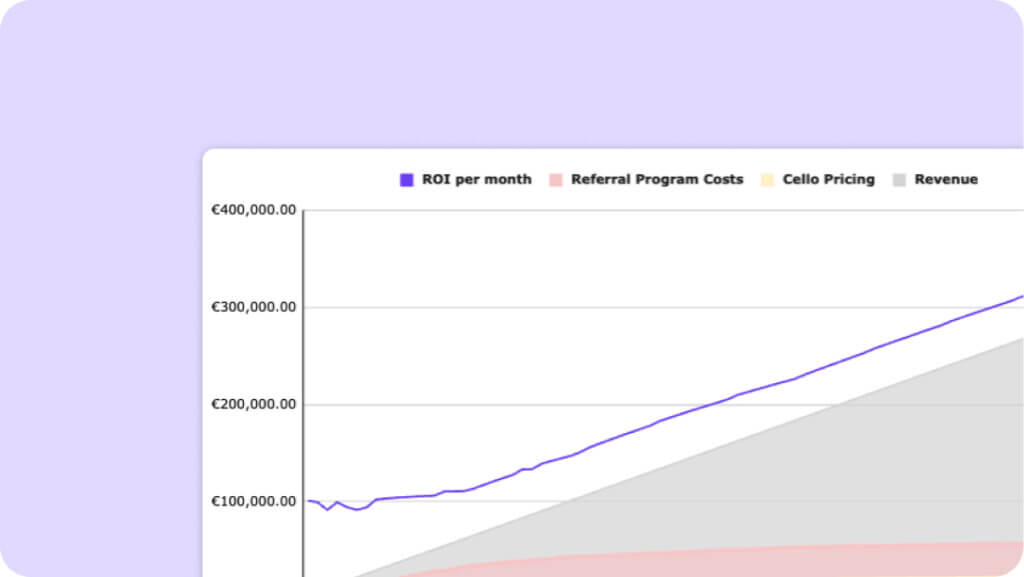
Referral program ROI is (referral-attributed ARR minus total incentive cost) / total incentive cost. Accurate calculation requires server-side attribution that connects a referral link click to a closed deal in your CRM, most platforms only track free trial signups, which understates ROI. Use Cello's referral ROI calculator to model expected return before launch.
What is the difference between share rate and conversion rate in a referral program?
Share rate is the percentage of users who send at least one referral link after seeing the program. Conversion rate is the percentage of referred visitors who complete a trial signup or purchase. These are separate metrics with separate levers: a low share rate points to an incentive or placement problem; a low conversion rate points to a landing page or onboarding problem. Conflating the two leads to the wrong fix.
How do I reduce friction in my referral program?
The highest-impact friction reduction is moving the referral experience inside the product. External portals require users to: leave their workflow, remember a URL, log in again, and find the share link. An in-product SDK widget removes all of these barriers.
What incentives work best for B2B SaaS referral programs?
Product credit (billing credit applied to the referrer's account) consistently outperforms cash and gift cards for B2B SaaS when measured by share rate. Cash works well for activated power users not yet on a paid plan. Subscription discounts perform best ahead of an annual renewal. Dual-sided incentives, rewarding both referrer and referred user, produce the highest click-to-conversion on the referred side.
How does server-side referral tracking differ from cookie-based tracking?
Server-side tracking records the referral conversion at the server level, independently of the referred visitor's browser. Cookie-based tracking stores attribution in the browser and fails when an ad blocker, cookie deletion, or device switch interrupts the session. For B2B SaaS audiences, where ad blocker adoption exceeds 40%, cookie-based tracking routinely undercounts conversions by 20–40%. Server-side tracking is the only method that produces accurate attribution data.
How long should I run a referral program before optimising it?
Run your referral program for a minimum of 60–90 days before drawing conclusions. Most programs need 4–6 weeks to generate statistically meaningful funnel data — before that, low conversion often reflects small sample sizes. After 90 days with no improvement, run the three-step diagnosis: participation rate, share rate, click-to-conversion rate. Identify the specific leaking stage before making any changes.


Cello made it effortless for us to launch a referral program that drives real revenue
Discover how AI design platform Hera launched a fully automated referral program in just two ...
Referral Program ROI Calculator
Learn how to estimate and prove the ROI of your PLG Referral Program


How Cello helped Moss achieve 600% more referral ARR
Learn how Moss migrated their user referral program to Cello and boost referral ARR YoY by 600% ...