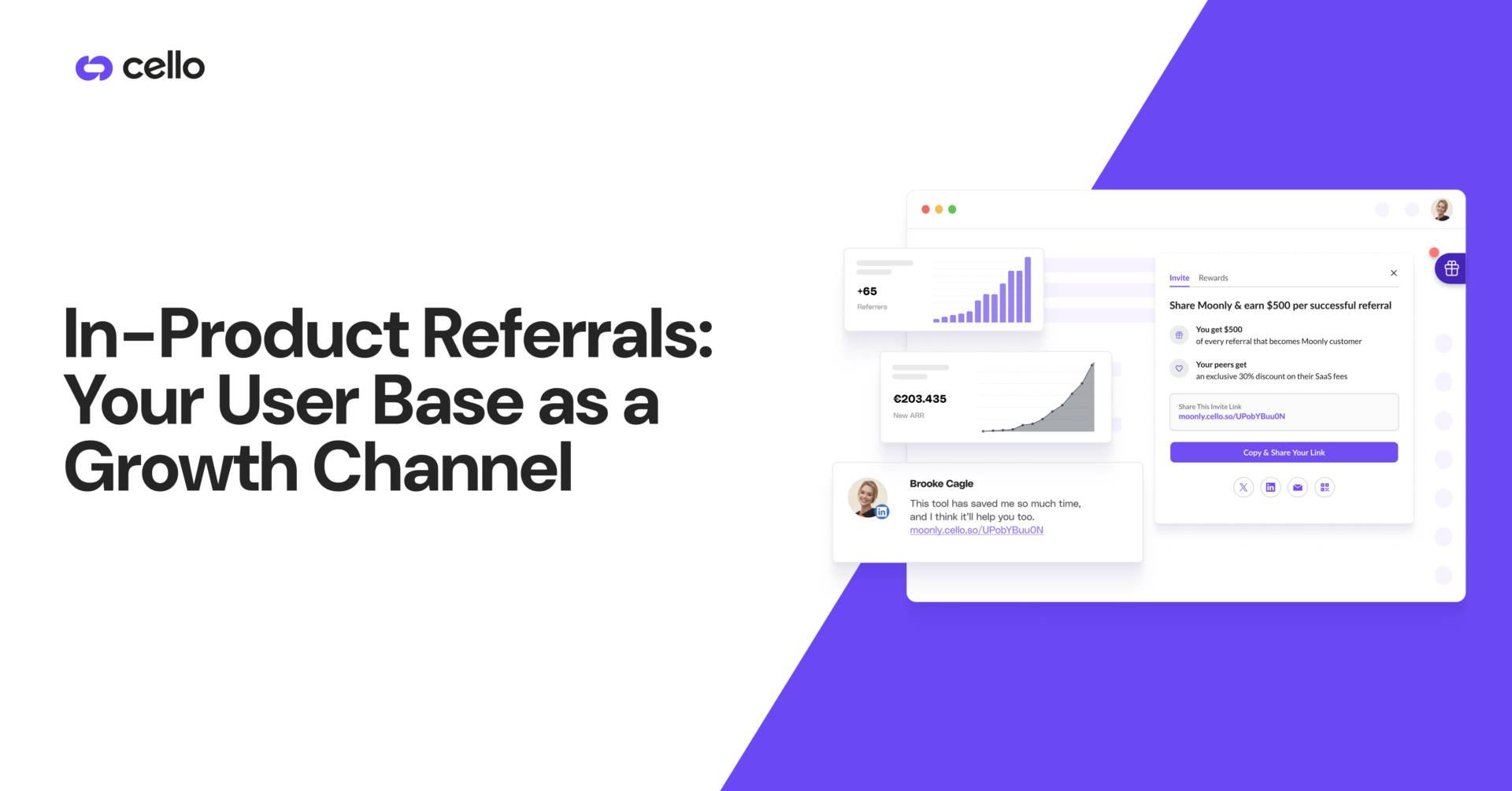

If your referral program lives on a separate landing page or inside a cold email, you're asking users to share at exactly the wrong moment. An in-product referral program works differently: it surfaces the invite prompt inside the logged-in product, timed to the moment a user just got real value from your tool. That timing gap between external referral portals and in-app referral mechanics is where most of the difference in activation rate lives, and it's worth understanding before you build or buy anything.
- What in-product referrals are
- Why referrals produce lower acquisition costs than paid channels
- How in-product referrals differ from external referral programs
- What makes a user base referral-ready
- Designing your reward structure
- Where and when to surface referral prompts in your product
- Attribution and tracking in B2B referral programs
- Metrics that measure referral program health
- Scaling and automating your referral program
- How Cello helps B2B SaaS teams run referrals on autopilot
- Key takeaways on in-product referrals for B2B SaaS
TLDR:
- In-product referrals embed the share moment inside the authenticated session, cutting acquisition costs vs paid channels by a material margin: VEED reduced CAC by 90.4%.
- Server-side attribution writes referrer IDs into Stripe or Chargebee at signup, so tracking survives Safari's Intelligent Tracking Prevention (ITP), iOS App Tracking Transparency (ATT) and ad blockers.
- Two-sided rewards outperform one-sided programs; keep reward cost below 10 to 20 percent of first-year revenue per referred customer.
- Fire referral prompts after a user completes a meaningful job, not on page load. Placement and timing decide activation before any reward does.
- Cello delivers in-product referral infrastructure with server-side attribution, risk-factor monitoring and automated payouts for B2B SaaS teams.
What in-product referrals are
In-product referrals are referral mechanics embedded inside the authenticated product experience, surfaced to users while they are already logged in and engaged. The share moment lives where the user already is, not on a separate marketing site or a cold email.
That distinguishes them from three older patterns: external referral portals that route users to a standalone destination, brochure-style landing pages acting as static share buttons, and email-only programs that depend on inbox attention.
Three delivery surfaces show up in practice:
- Embedded widget inside the logged-in product. Attached to a launcher, floating action button, or custom UI element within the authenticated app. Sharing happens in the same session as product use.
- Standalone partner portal. A separate dashboard for referrers who are not product users themselves: affiliates, agencies, influencers, brokers, investors.
- Email-based link distribution. Referral links sent through the company's own email infrastructure, used when customers log in episodically or when the GTM team distributes links on behalf of accounts.
Why referrals produce lower acquisition costs than paid channels
Paid channels keep getting more expensive. 2026 B2B CAC benchmarks put paid channels at an average of $802 per customer, while referrals sit near the floor at $141 to $200 per customer.
The gap shows up across the Cello customer base. VEED reduced CAC by 90.4% versus paid acquisition. Softr achieved a 5x conversion lift after migrating from an external portal. Moss runs referrals at 50% lower CAC than inbound.
Two structural reasons sit behind the gap:
- A pre-existing trust signal. A referred prospect arrives with a peer endorsement attached, so the sales cycle starts further along and closes faster.
- Better fit on average. Users refer people who look like them, so referred accounts convert at higher rates and retain longer than cold-acquired ones.
How in-product referrals differ from external referral programs
External referral programs treat sharing as a separate workflow. The user leaves the product, opens a portal or email, copies a link, then returns. Each step taxes attention and drops activation.
In-product referrals collapse that workflow into the session where engagement already lives. Four structural differences fall out of that placement in any B2B referral program:

|
Dimension |
External program |
In-product referral |
|---|---|---|
|
User state at share moment |
Out of context, often disengaged |
Already authenticated and active |
|
Timing |
Untethered from product use |
Anchored to a milestone event |
|
Attribution path |
Cookie-dependent across domains |
Server-side, inside an authenticated session |
|
Activation friction |
Context switch required |
Share happens in-session |
Authenticated sessions resolve identity at the server, so attribution survives ITP, ATT, and ad blockers that break cookie tracking on external portals.
What makes a user base referral-ready
A referral program instruments advocacy that already exists. It does not manufacture it.
Three signals indicate readiness:
- Repeat session frequency. Users return weekly or daily under their own motivation, not because of lifecycle email nudges.
- Feature adoption past the activation event. Users have hit the moment where the product solved the job they hired it for.
- Organic word-of-mouth already surfacing in support tickets, social mentions, or self-reported "how did you hear about us" answers.
When those signals are missing, the gap is product-market fit, not program design. A referrer stakes personal credibility on every share. Incentive size cannot substitute for underlying satisfaction.
Designing your reward structure
Two-sided rewards, where both referrer and referee receive something, outperform one-sided programs in B2B SaaS. The referee has a reason to convert beyond the recommendation, and the referrer has a reason to share that does not feel extractive.
Match reward type to how the product makes money:
- Cash as a percentage of attributed revenue. Aligns cost with realized revenue, adds finance and tax overhead.
- Flat-fee per conversion. Predictable per-unit cost, weak fit when deal sizes vary.
- Non-cash. Subscription credits, free months, feature unlocks. Useful in compliance-sensitive or enterprise contexts.
Every reward must pass one test: psychological drivers of referral behavior as a share of expected LTV, with a working ceiling around 10 to 20 percent of first-year revenue.
Where and when to surface referral prompts in your product
Placement and timing decide activation before any sharing happens. A launcher buried three menus deep produces a low active rate no matter the reward.
Three placements show up in practice:
- Floating action button. Persistent, low commitment, easy to ignore.
- Embedded navigation element. Higher visibility, treats referral as a first-class surface.
- Post-milestone modal. Surfaces only after a defined event completes.
A prompt fired right after a user finishes a meaningful job, exporting a deliverable, closing a deal, completing a project, catches sharing intent at its peak. The same prompt on a login screen lands flat. Map your product's natural moments of satisfaction, then fire against those events instead of page loads, and consider multiple referral launchers to drive higher activation.
Attribution and tracking in B2B referral programs
B2B referral attribution runs on three layers. Link-based tracking carries a short code identifying the referrer at click time. First-party cookies catch the return visit when a prospect signs up days later. Server-side attribution, written into the billing system at signup, survives when the others break.
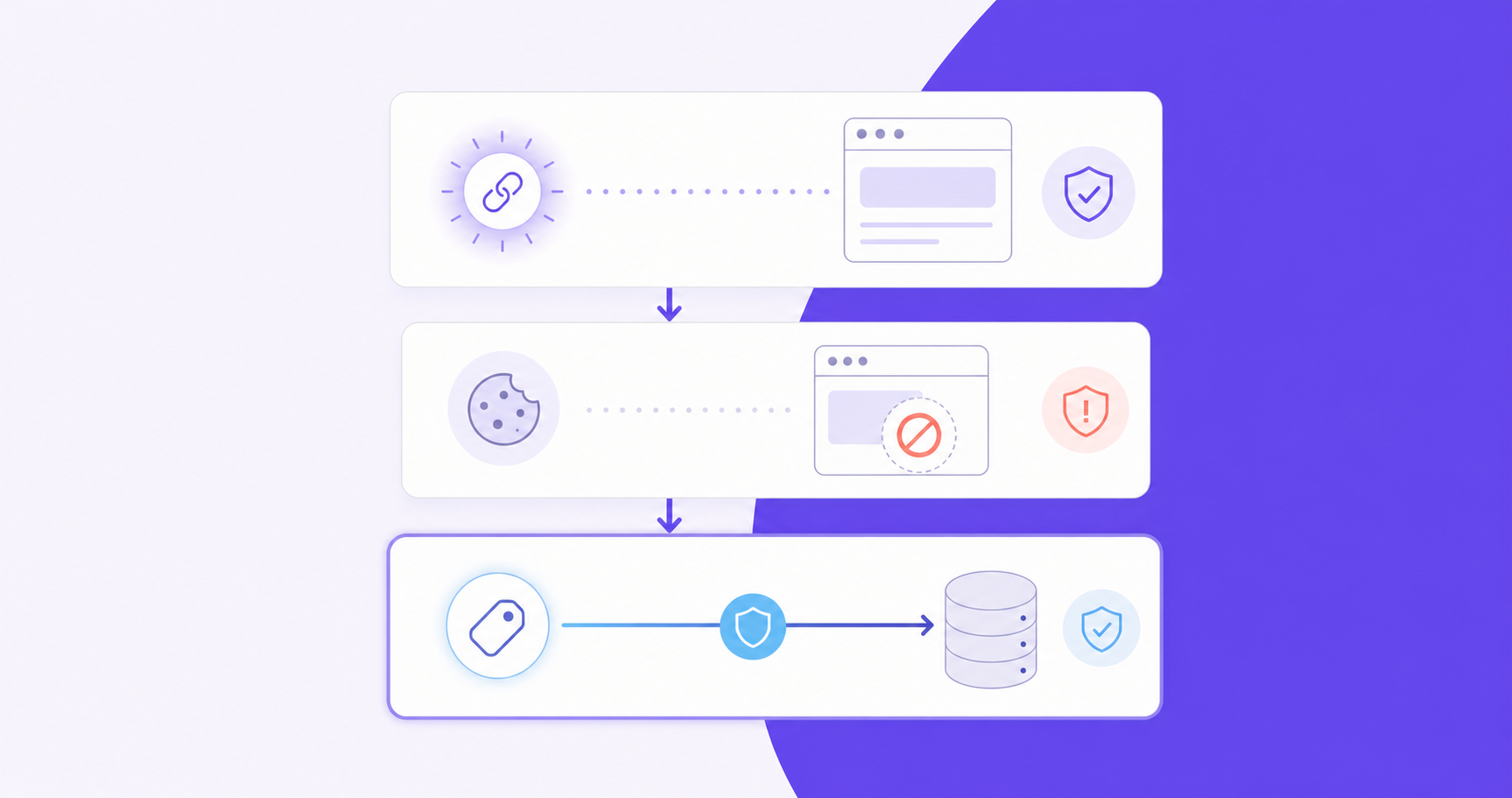
Cookies fail at meaningful rates. Ad blockers strip scripts, Safari's Intelligent Tracking Prevention (ITP) caps cookie lifetime, and iOS App Tracking Transparency (ATT) opt-out rates sit around 65 percent by industry estimates.
Server-side attribution writes the referrer code onto the customer object in Stripe or Chargebee (see the guide to referral tracking), so invoice.paid events carry the referrer ID without a browser involved.
Org-level attribution then keeps credit with the right referrer when procurement or finance, not the original signup, completes the purchase.
Metrics that measure referral program health
Four B2B referral program KPIs diagnose referral funnel health, each tied to a different stage:
- Activation rate. Users in the program who engage with the referral surface at least once. Weakness points to launcher visibility or program awareness.
- Sharing rate. Active users who distribute a link. Weakness points to reward perception or share-flow friction.
- Signup rate. Referred visitors who create an account. Weakness points to landing-page messaging or referee incentive.
- Conversion rate. Signups that become paying customers. Weakness points to product-fit between referrer and referee.
Well-optimized referral programs in SaaS contribute 10 to 20 percent of new customer acquisition revenue, giving operators a working target.
Track referral CAC as a channel-level number, not folded into blended CAC. Blended CAC hides the gap that makes referrals worth running.
Scaling and automating your referral program
A live program with early signal is the moment to harden the infrastructure layer so it compounds without a person watching it.
Five jobs to automate or systematize:
- Reward calculation and payout. Tie reward triggers to billing events (
invoice.paid,charge.succeeded) so payouts fire only on realized revenue, not signups that may churn the same week. - Fraud detection. Auto-exclude self-referrals where referrer ID matches new user ID, hold rewards through a review window for unusual usage patterns and cancel pending rewards on
charge.refunded. - Multi-campaign segmentation. Run distinct incentive structures in parallel for different cohorts: SMB versus enterprise, freemium versus paid, regional programs with localized rewards.
- A/B testing reward structures. Validate a reward change against a control cohort before committing program-wide, especially if you need to fix a referral program converting under 3%. Compare sharing rate, signup rate and conversion rate.
- Iteration cadence. Review the four funnel metrics monthly. Fix the weakest first; do not change three variables at once.
How Cello helps B2B SaaS teams run referrals on autopilot
Cello is the referral infrastructure B2B SaaS teams use to turn an existing user base into a measurable acquisition channel. The pieces covered above show up as concrete product surfaces:
- In-product Referral Component embedded via JavaScript on web and native SDKs for iOS, Android, React Native and Flutter.
- Server-side attribution written into Stripe and Chargebee customer metadata, so credit survives ITP, ATT and ad blockers.
- Multi-campaign architecture with segmentation by user attributes, subscription tier and region.
- Risk-factor monitoring for unusual usage patterns across a 30-day review window.
- Automated payouts via PayPal and Venmo with tax handling.
The customer evidence sits behind each piece. VEED reduced CAC by 90.4%. Moss grew Referral ARR 650% year over year. Softr achieved a 5x conversion lift after migrating from an external portal. Butter went live in under 5 hours; Hera in two days.
That is what "Referrals on Autopilot" resolves to: a program that compounds quietly and reports against CAC, ARR, and activation like any other channel on the operator's dashboard.
Key takeaways on in-product referrals for B2B SaaS
- Your existing users already know who else should be using your product, and an in-product referral program gives them a frictionless way to act on that.
- The channel delivers lower CAC and better-fitting customers than most paid sources can deliver.
- Setup work is front-loaded; once attribution, rewards and prompts are in place, the program runs without someone babysitting it.
Should I build my in-product referral program in-house or use dedicated referral infrastructure?
Dedicated referral infrastructure handles the jobs that decay and compound maintenance debt: cookie-blocked attribution, payout retry logic, fraud rule updates, tax-form validation and sanctions screening. Your engineering lift collapses to a one-time integration — SDK installation, identity token wiring, webhook configuration. sevDesk replaced a custom-built program with Cello and reported a 30% performance lift in month one while cutting maintenance effort substantially.
What's the fastest way to get an in-app referral program live for a B2B SaaS product?
The quickest path is a billing-native integration: connect Cello to your Stripe or Chargebee account via pre-built webhooks, install the JS SDK, and tie reward triggers to `invoice.paid` events so payouts fire only on realized revenue. Butter went live in under five hours; Hera in two days.
How does referral attribution work when Safari ITP or iOS App Tracking Transparency blocks cookies?
Server-side attribution writes the referrer code onto the customer object in your billing system — Stripe or Chargebee — so the `invoice.paid` event carries the referrer ID without a browser involved. Industry estimates put iOS App Tracking Transparency opt-out rates around 65%, which means cookie-only attribution programs lose credit for a material share of conversions before any sharing friction is factored in.
What reward structure works best for a two-sided B2B referral program?
Two-sided rewards — where both the referrer and the referred user receive an incentive — outperform one-sided programs in B2B SaaS because the referee has a reason to convert beyond the peer recommendation. Match reward type to how your product bills: percentage-of-revenue rewards align cost with realized ARR; flat-fee rewards simplify unit economics when deal sizes are consistent; non-cash rewards (subscription credits, feature unlocks, free months) suit regulated or enterprise contexts where direct cash incentives create compliance friction.
How do I measure whether my product referral program is actually working?
Track four metrics at each stage of the referral funnel: activation rate (how many enabled users engage with the referral surface), sharing rate (how many active users distribute a link), signup rate (referred visitors who create an account) and conversion rate (signups that become paying customers). Well-optimized referral programs in SaaS contribute 10 to 20 percent of new customer acquisition revenue — measure referral CAC as a standalone channel number rather than folding it into blended CAC, or the gap that makes the channel worth running stays hidden.
How do I measure whether my product referral program is actually working?
Track four metrics at each stage of the referral funnel: activation rate (how many enabled users engage with the referral surface), sharing rate (how many active users distribute a link), signup rate (referred visitors who create an account) and conversion rate (signups that become paying customers). Well-optimized referral programs in SaaS contribute 10 to 20 percent of new customer acquisition revenue — measure referral CAC as a standalone channel number rather than folding it into blended CAC, or the gap that makes the channel worth running stays hidden.
What's the difference between a user referral program and an affiliate or partner program, and when should I use each?
User referral programs turn your existing product users into referrers — the share moment lives inside the authenticated app, and rewards fire automatically on billing events like invoice.paid. Partner and affiliate programs serve referrers who are not product users themselves: agencies, influencers, brokers, and investors access referral links through a standalone Partner Portal with no SDK embed required. Most B2B SaaS teams benefit from running both in parallel — user referrals compound through the product experience, while partner programs extend reach into audiences that never log into your product.
How does an in-product referral program work for a sales-led B2B SaaS with a long enterprise sales cycle?
Sales-led funnels use demo-call-attended as the reward trigger rather than a self-service invoice.paid event, so referrers earn credit when referred leads book and attend a product demonstration — not when a deal closes months later. Attribution runs through HubSpot or Salesforce Apex Triggers tied to deal stage transitions, tracking SQL qualification, demo completion and closed-won events without requiring visibility into deal amounts. Referral links can also be distributed by account managers on behalf of customers, which covers enterprise accounts that rarely log into the product after the initial sale.
Should I show referral prompts to every user, or only a specific segment of my user base?
Segment first — showing the referral surface to users who have not hit a meaningful activation milestone produces low sharing rates regardless of reward size. Multi-campaign architecture lets you target distinct cohorts by subscription tier, job title, organization size, or custom attributes, so a prompt fires only for users who have completed the job they hired your product for. A user who has genuinely gotten value stakes personal credibility on every share; an under-activated user ignores the prompt or shares without conviction, which degrades referred lead quality.
How does referral attribution hold when the person who pays is different from the person who shared the referral link?
finance completing a contract does not break the attribution chain back to the original referrer. On Stripe or Chargebee, the new_user_organization_id metadata field ties the billing event to the correct referring organization. For sales-led deals processed through Salesforce, Apex Triggers can pass Opportunity stage transitions and closed-won events back to Cello without requiring deal-amount visibility.
Can I run different referral reward structures for different subscription tiers in the same product?
Yes — Cello's multi-campaign architecture lets you configure independent reward logic per segment, so a business-tier customer triggers a different payout than a basic-tier customer within the same program. Segmentation runs on user attributes including subscription tier, organization size, job title, and custom fields, and each campaign maintains its own reward type, eligibility rules, and payout timing. Plancraft runs this pattern and reports a 5.7 referral ROI alongside 47% trial-to-paid conversion on referred traffic.
What's the best way to improve referral program activation when most of my enabled users never share a link?
Launcher visibility is the first variable to fix — a referral widget buried three menus deep produces a low active rate before any reward structure is considered. Move the referral surface into primary navigation or attach it to a post-milestone event trigger so it fires right after a user completes a meaningful job: exporting a deliverable, closing a deal, or finishing a project. JOIN grew activation from 4.8% to 25% after improving launcher placement and adding Cello's notification functions, which produced an 11% additional monthly revenue increase.
Do ad blockers or privacy tools interfere with referral link attribution in an in-app referral program?
Ad blockers and privacy tools affect client-side tracking but not server-side attribution, which is why Cello writes the referrer code into the Stripe or Chargebee customer object at signup rather than relying exclusively on browser scripts. The Attribution JS SDK uses first-party cookies as a fallback for return-visit handling, but those cookies become irrelevant once the referrer ID is captured server-side at the billing event. This architecture means a referred user who signs up with an ad blocker active still generates correct attribution, because the credit assignment happens at the identity layer in your billing system, not in the browser.
How do I make sure referral rewards only fire on paying customers, not on free trials that churn before converting?
Tie reward triggers to invoice.paid or charge.succeeded billing events rather than the new-signup event, so payouts only fire when revenue is confirmed. Cello also supports configuring a payout delay until after a free trial converts to a paid subscription, which structurally prevents negative-margin referral economics where reward costs exceed realized revenue from high-churn trial signups. For programs with early-churn risk, drip-fed reward schedules can distribute payouts incrementally over multiple months as the referred customer stays active, aligning commission cost with realized customer lifetime value.
Can partners self-serve to get a referral link immediately, or does every new partner require manual admin approval?
Self-service partner signup is supported — approved partners can retrieve their referral link immediately upon completing an application form without requiring manual admin action in the portal. The auto-approval workflow connects customer-hosted forms (Typeform, HubSpot Forms, or custom web forms) to the Cello Partner Portal via webhook, so partners completing an approved application are automatically provisioned with portal access and link generation. For programs requiring vetting, an application-gated path with explicit admin review is also available before partners gain access.
How do I track whether my product referral program is generating compounding growth or just one-off spikes?
Track Referral ARR as a channel-level metric over rolling quarters rather than monthly signups, which surfaces whether referred revenue is accumulating or resetting. Sharing rate, signup rate and conversion rate measured against industry benchmarks — Cello surfaces reference lines on dashboard charts for all four core funnel metrics — will show whether each stage of the funnel is compounding or stalling. Moss grew Referral ARR 650% year over year by treating referrals as a measured channel with its own CAC target rather than a supplementary campaign; their program runs at 50% lower CAC than inbound.