
For B2B SaaS operators in particular, the more relevant question is whether external affiliate programs are the right acquisition motion at all or whether in-product user referral programs serve the same goal at a fraction of the cost.
- Is affiliate marketing dead in 2026?
- Why affiliate marketing appears to be dying
- What actually changed in affiliate marketing (and what didn’t)
- Affiliate marketing vs. user referral programs: what’s the difference
- How B2B SaaS companies are shifting acquisition budget
- The economics of affiliate marketing in 2026
- Server-side attribution and the death of cookie tracking
- Is affiliate marketing still profitable in 2026?
- What is the difference between affiliate marketing and referral marketing?
- Is affiliate marketing worth it for B2B SaaS?
- What is replacing affiliate marketing for PLG SaaS companies?
- When affiliate marketing isn’t the right fit: user referral programs for B2B SaaS
- Why Cello fits B2B SaaS user referral programs
TL;DR
- Affiliate marketing is growing, not dying. The global market hit $19.4B in 2026 and is projected to reach $22B by 2027 (Forrester).
- Real headwinds exist: Amazon cut commissions by up to 50%, Google algorithm changes reduced organic traffic for many content publishers, and saturated niches have compressed margins.
- The channel’s mechanics are being rebuilt around server-side attribution, creator partnerships and incrementality measurement.
- Affiliate marketing and user referral programs are different channel types. Affiliate uses external publishers; user referrals use existing customers inside the product.
- B2B SaaS companies with active user bases get a better CAC-to-LTV ratio from structured user referral programs than from external affiliate networks.
Is affiliate marketing dead in 2026?
Affiliate marketing is not dead in 2026. Global affiliate spend reached roughly $19 billion this year, the channel accounts for about 16% of all US e-commerce orders, it ranks third in performance marketing behind paid search and paid social, and B2B affiliate program participation grew meaningfully in 2025. What changed is how the money flows and who captures it, not whether the channel works.
The headwinds are real but category-specific. Amazon cut commission rates by up to 50%, Google algorithm updates reduced organic traffic for thousands of content publishers, and coupon-heavy affiliates lost ground to AI fraud detection. Practitioners who say affiliate marketing is dead are describing a niche hit by a commission cut, a content site penalised in search, or a coupon affiliate that lost its arbitrage edge. None of those is the same as the channel ceasing to function.
Why affiliate marketing appears to be dying
Affiliate marketing looks like it is dying because three headwinds hit high-visibility operators at once: Amazon cut commissions, Google algorithm updates hurt content publishers, and coupon affiliates lost their edge to fraud detection. These events are real, but they describe specific sub-channels contracting, not the industry contracting.
The loudest signal came from Amazon. In early 2026, publishers reported commission cuts across several product categories, with reductions of up to 50% in categories like home improvement and tools. Deal-focused publishers revised their Amazon revenue forecasts down sharply. For content sites built on Amazon commissions, this was a category-level restructuring, not a temporary dip.
Google's algorithm updates compounded the pain. A series of updates targeting low-quality and AI-generated content penalised thousands of affiliate-heavy sites that relied on organic search as their primary channel. Sites ranking on page one for buyer-intent queries lost 30 to 60% of their organic impressions within weeks. The damage concentrated in saturated niches: personal finance, insurance, personal care and web hosting, where dozens of near-identical review sites competed for the same keywords.
Saturation itself is a structural headwind: where commission rates are high and entry barriers are low, competition compresses net margins, and only operators with real domain authority or first-party data hold positive economics.
The third driver is AI fraud detection. Coupon and cashback affiliates built arbitrage models around last-click attribution, capturing commission on transactions the merchant would have completed anyway. As networks deployed fraud scoring to separate incremental referrals from last-click hijacking, that commission share moved to content partners rather than disappearing. None of these dynamics invalidate affiliate marketing as a channel; they describe specific models inside it getting repriced.
What actually changed in affiliate marketing (and what didn’t)
The core mechanics of affiliate marketing, a publisher promotes a product, a sale gets tracked, a commission gets paid, are unchanged. What shifted is the infrastructure underneath: how conversions are attributed, which formats capture spend, and how fraud gets priced out. Three things broke: 30-day cookie attribution, banner and text-link placements, and last-click coupon arbitrage. Three things held: performance-based payout, the $12-15 ROI per $1 benchmark, and publishers taking distribution risk for revenue share.
What changed
Attribution windows contracted sharply. Thirty-day cookie windows were standard through most of the 2020s; by 2026, a growing share of programs have moved to 7-day windows or shorter, driven by Apple's App Tracking Transparency and third-party cookie deprecation. Programs that migrated to server-side tracking report higher attributed conversions, not because more conversions happen, but because more get captured accurately.
Creator partnerships absorbed a growing share of spend: creator-driven affiliate revenue grew at a pace that outpaced the broader channel and now represents a sizeable share of total affiliate spend, as banner and text-link placements lost ground to creator reviews, comparison videos and newsletter sponsorships with higher intent and cleaner attribution. AI fraud detection reallocated a meaningful share of commission from coupon and cashback affiliates to content partners as networks deployed scoring models that catch last-click hijacking, so content-based affiliates with genuine traffic influence now capture more of the pool.
What didn't change
Performance-based economics are intact. Affiliate marketing still pays on results, not impressions or clicks. The $12 to $15 ROI per $1 spent benchmark reflects the same logic it always has: publishers take on distribution risk in exchange for revenue share, and that model adapts to wherever purchase-intent audiences are reachable regardless of attribution windows or format shifts. Source: Digital Applied affiliate marketing statistics 2026.
Affiliate marketing vs. user referral programs: what’s the difference
Affiliate marketing and user referral programs are separate acquisition channels with different mechanics, economics and operator fit. Affiliate marketing uses external publishers like bloggers, review sites and newsletter operators who earn commission for sending paying customers. User referral programs use existing customers inside the product, rewarding them for introducing peers. The two channels serve different stages of the growth stack and are not interchangeable.
|
Affiliate marketing |
User referral programs | |
|---|---|---|
|
Mechanic |
External publisher creates content (review, comparison, tutorial) that drives traffic to the merchant and earns commission on conversions |
Existing user shares a personal invite link or referral code with a peer; both parties receive a reward on successful signup or purchase |
|
Who promotes |
Third-party content creators, bloggers, coupon sites, newsletter operators, with no existing relationship with the product required |
Active users of the product, meaning people with first-hand experience who can make a credible peer recommendation |
|
Payout structure |
Commission per sale (typically 8-25% of transaction value for SaaS); one-time or recurring depending on program terms |
Dual-sided reward, where referring user and new user both receive credit, cash, or account benefit on verified conversion |
|
Typical CAC |
Higher variable CAC; scales with publisher traffic quality and commission rate. Median e-commerce commission sits at 8.4%; SaaS recurring programs average 22.5% of first-year revenue |
40-60% lower CAC than blended acquisition cost; referred customers convert at 3-5x the rate of paid traffic and carry 16% higher LTV |
|
Best fit |
Products with broad discovery intent, high search volume in the category, and content-friendly purchase journeys, which are strong for e-commerce, consumer finance and software tools with wide awareness |
B2B SaaS with active user bases, self-serve onboarding and product-led growth motions, where existing users are the most credible distribution channel |
How B2B SaaS companies are shifting acquisition budget
B2B SaaS companies are moving acquisition budget away from paid channels and toward structured referral programs because the CAC math on paid search and paid social no longer closes at the deal sizes most SaaS products generate. SaaS companies currently allocate 35-45% of revenue to sales and marketing. Within that envelope, referral programs typically cost 5-10% of the marketing budget while attributing 20-40% of new customers in mature programs. A ratio that no paid channel currently matches.
The paid CAC problem is structural. Cost-per-click in SaaS categories rose an average of 22% between 2023 and 2025 as more software vendors competed for the same buyer-intent queries. At the same time, Google algorithm updates reduced organic search traffic for many content-heavy acquisition strategies, removing a second low-cost channel from the mix. Operators who had built pipeline on organic + paid search found both channels getting more expensive at the same time.
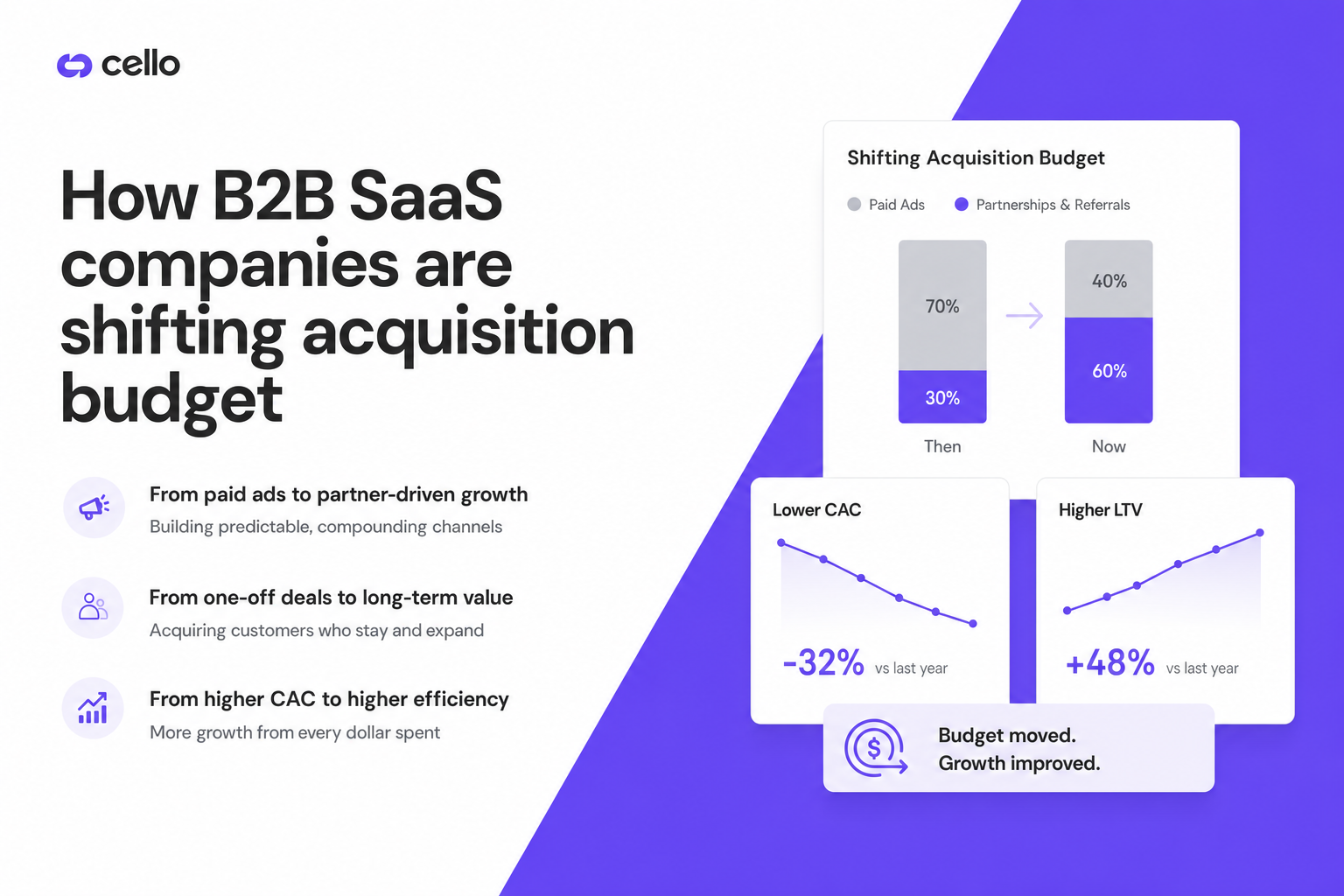
The referral data points in the other direction. Referred customers in B2B SaaS convert at 3-5x the rate of paid traffic and carry higher lifetime value than paid-acquired customers, because peer recommendations carry proof that no ad creative can replicate. A colleague who has used the product and endorsed it to a peer has already done the qualification work. The referred prospect arrives with higher intent and lower skepticism, which compresses sales cycles and improves net revenue retention.
The budget implication is direct. A SaaS company spending $500K annually on paid acquisition at a $1,200 blended CAC generates roughly 417 new customers. Shifting 10% of that budget, $50K into a structured referral program that converts at 3x the rate and costs $400 per referred customer generates 125 additional customers from the reallocated spend. The referred cohort also retains better, so the LTV calculation compounds over time.
The economics of affiliate marketing in 2026
Affiliate marketing economics are viable in 2026, but they're category-specific. A well-run program returns $12 to $15 for every $1 spent, yet median commission rates vary from 8.4% in e-commerce to 22.5% of first-year revenue in B2B SaaS recurring contracts. The gap between those two figures is where build-versus-buy decisions actually live.
Commission structure is the first variable: e-commerce sits at a median 8.4% of transaction value, while SaaS programs paying on recurring revenue average 22.5% of first-year contract value. The higher SaaS rate reflects longer sales cycles, bigger deal sizes and the compounding retention value of a referred subscriber, so applying one model to the other's category produces economics that are either too expensive or too thin to recruit quality publishers.
Revenue contribution data supports the channel's viability at scale: roughly 65% of retailers report affiliate programs contributing up to 20% of annual revenue, and some categories see affiliate-driven orders account for 16% of all US e-commerce transactions. Neither figure is achievable in the first six months; mature contribution rates take 12 to 18 months to develop as the publisher mix is refined and tracking stabilises.
The $12 to $15 per $1 ROI benchmark is the most-cited figure in the channel, and it holds up, but only for programs with clean attribution, active publisher management and commissions matched to category norms. Programs that inherit legacy coupon-heavy mixes, rely on third-party cookies, or underprice their vertical consistently underperform it. The $12 to $15 range describes well-run programs, not average ones.
Server-side attribution and the death of cookie tracking
Cookie-based affiliate tracking is no longer reliable enough to be the sole attribution method. Industry estimates put iOS App Tracking Transparency opt-out rates at around 65% of mobile users, third-party cookies are deprecated in major browsers, and 38% of affiliate programs have moved to attribution windows of 7 days or shorter.
Programs that migrated to server-side tracking report 18-24% higher attributed conversions than those still running on cookies alone, not because more conversions happen, but because more get recorded accurately. Browser-based tracking drops a cookie when a user clicks an affiliate link, and that cookie must survive until conversion, sometimes days later, across sessions, devices and privacy controls that increasingly block or delete it.
Consider a B2B buyer who reads a review on a work laptop, shares the link from a mobile device, and signs up three days later on a different browser. A 30-day third-party cookie captures none of that path reliably.
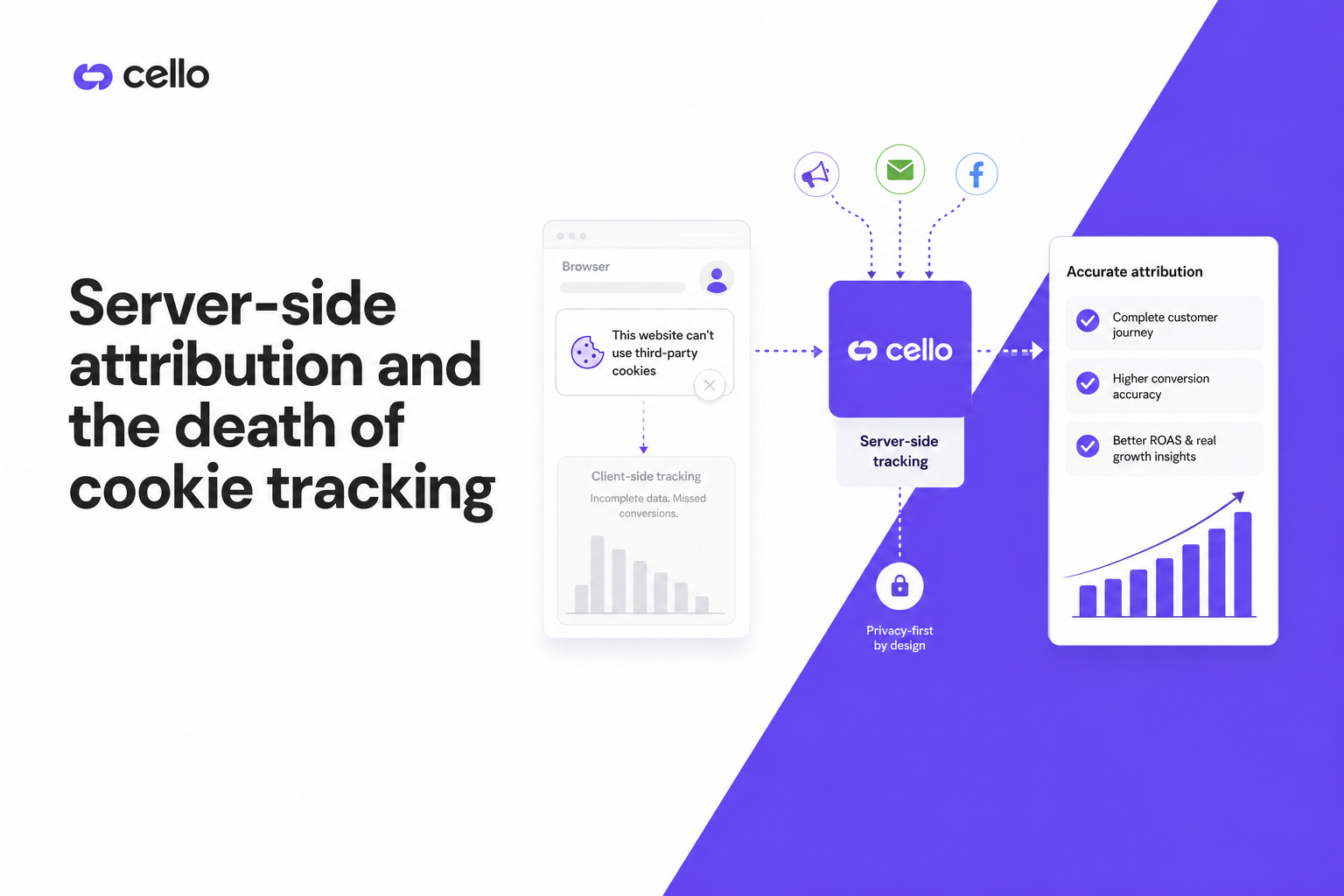
Server-side tracking moves attribution off the browser entirely: when a referred user converts, the merchant's server sends a direct API call to the affiliate network, tying the conversion to a first-party identifier (a user ID or hashed email) instead of a blockable cookie. The signal is cleaner, the match rate is higher, and the attribution window follows conversion logic instead of cookie lifespan.
For B2B SaaS, this fits naturally: most products already gate conversion behind a signup and billing event tracked server-side. Connecting the affiliate identifier to that event is a data plumbing problem, not a tracking philosophy problem, and programs that make the connection see the 18-24% uplift translate directly into better publisher economics and retention.
Is affiliate marketing still profitable in 2026?
Affiliate marketing is still profitable in 2026, but income is unevenly distributed. The large majority of affiliate marketers earn modest annual incomes, and niche selection is the single variable most closely tied to where someone lands in that range. The 3.78% who earn over $150,000 annually share three structural advantages: they operate in high-commission verticals, they have built first-party audiences (email lists, owned communities, or high-authority content sites) insulated from algorithm changes, and they have migrated to server-side attribution so they capture credit for conversions that third-party cookies miss. None of those are barriers to entry; they are the compounding result of correct channel and niche selection over time.
Affiliate marketing can generate meaningful income, but median outcomes are modest and the path to top-quartile earnings runs through niche specialisation, audience ownership and attribution infrastructure, not volume of affiliate links placed.
What is the difference between affiliate marketing and referral marketing?
Affiliate marketing pays external publishers (bloggers, review sites, newsletter operators) a commission for sending paying customers to a merchant. Referral marketing rewards existing customers for introducing peers. Both pay on conversion, but the person doing the promoting, the trust signal they carry, and the acquisition economics are structurally different.
In an affiliate program, the promoter has no prior relationship with the product. A technology blogger who reviews a project management tool earns a commission per signup whether or not they have ever used it. Their influence comes from content authority and search reach, not personal experience, so the referred prospect arrives with moderate intent shaped by a review found through search. In a referral program, the promoter is an active user who shares a personal invite link with a colleague. Both parties receive a reward when the colleague signs up and activates, and the prospect arrives with higher intent because the recommendation came from someone they trust professionally.
For B2B SaaS teams, the operational difference is equally direct. An affiliate program requires recruiting external publishers, producing creatives and maintaining competitive commission structures. A referral program runs inside the product, where the sharing mechanic triggers at an activation milestone, attribution ties to a first-party billing event, and the reward is automated. The promoter pool scales with the user base, not a publisher recruitment budget. Affiliate programs suit categories where buyers search for reviews before purchasing; referral programs suit products with engaged user bases where peer recommendations are the most credible channel available.
Is affiliate marketing worth it for B2B SaaS?
Affiliate marketing is worth it for B2B SaaS when the product has broad category awareness, high search volume for buyer-intent queries and a content-friendly purchase journey. For most B2B SaaS companies those conditions are only partially met. B2B affiliate program participation grew meaningfully in 2025, confirming genuine interest in the segment, but interest and fit are different things. Content publishers driving search traffic to a review page work best when purchase decisions are low-friction and product categories are well known in search. Enterprise SaaS with long sales cycles and multi-stakeholder buying committees is a poor match for that model.
The buyer behaviour data points in a different direction. Approximately 84% of B2B buyers are influenced by peer referrals at some point in their purchase process. That figure describes colleagues and professional contacts making direct recommendations, not organic search traffic arriving via an affiliate review. An external affiliate publisher carries content authority, not personal trust, and for high-ticket B2B products that distinction determines whether a program covers its commission costs. B2B SaaS affiliate programs that pay on recurring revenue average 22.5% of first-year contract value, which is $2,250 per conversion at a $10,000 ACV. That figure only works if the affiliate consistently delivers high-intent referrals with short sales cycles, a profile content publishers at the top of a B2B funnel rarely match.
Affiliate marketing is not the wrong channel for every B2B SaaS company. For products with a strong self-serve motion, sub-$500 ACV and a well-defined category where buyers actively search for comparisons, project management tools, email marketing software and time tracking apps, external affiliate programs can be a productive acquisition layer. The mismatch appears when companies with long sales cycles and high deal sizes invest in affiliate infrastructure instead of the referral motion their user base already supports.
What is replacing affiliate marketing for PLG SaaS companies?
In-product user referral programs are replacing external affiliate programs as the primary word-of-mouth acquisition motion for product-led SaaS companies. PLG SaaS teams with structured referral programs grow at roughly twice the rate of sales-led peers, referred customers convert at 3 to 5 times the rate of paid traffic, and in-product referral surfaces generate 3x higher participation than email-only campaigns.
The structural reason is distribution reach. A PLG product with 10,000 active users already has 10,000 potential advocates who can make peer recommendations with first-hand authority. A review site can send a prospect to a free trial; a colleague who uses the product daily and invites a peer through an in-app prompt carries personal trust that no external publisher can replicate.
Timing matters too. Affiliate programs depend on publishers creating content and waiting for buyer-intent traffic to arrive. In-product referral programs trigger after a user completes a key workflow or hits a usage milestone, the moment they are most motivated to recommend. Referred customers in B2B SaaS carry 16 to 25% higher lifetime value than non-referred cohorts and cost 40 to 60% less to acquire than blended paid channels, because the reward only triggers on verified conversion rather than on clicks or impressions. For PLG companies, that cost structure compounds: more users generate more referrals, which lower average CAC across each new cohort.
Three factors make PLG SaaS particularly well-suited for this motion: self-serve onboarding produces a clean attribution event, frequent product usage means referral prompts appear organically rather than as interruptions, and users recommending a tool they rely on daily can cite a specific outcome, which is more persuasive than any content a publisher could produce. Source: GrowSurf SaaS referral statistics.
When affiliate marketing isn’t the right fit: user referral programs for B2B SaaS
For B2B SaaS companies with active user bases and self-serve onboarding, in-product user referral programs produce better acquisition economics than external affiliate networks. Referred customers convert at 3 to 5 times the rate of paid traffic, carry 16 to 25% higher lifetime value, and cost 40 to 60% less to acquire, because existing users carry peer trust no publisher can replicate. Affiliate programs require recruiting publishers and managing commission structures, while a referral program runs inside the product: sharing triggers at activation milestones, attribution ties to first-party billing events, and rewards are automated. Softr saw a 5x conversion lift after migrating from PartnerStack to Cello.
Cello is purpose-built for this motion, providing in-product referral infrastructure with server-side attribution, EU-GDPR compliance and global cash payouts built in. Sign in to Cello to configure your program, or see add a referral program in React for implementation guidance.
Why Cello fits B2B SaaS user referral programs
Cello is purpose-built for the user referral motion in B2B SaaS. The referral surface lives inside the product rather than on an external portal, attribution runs server-side off billing events from Stripe and Chargebee, and Cello referrals and partner programs run on one system. That means attribution survives Safari ITP, ad blockers and App Tracking Transparency refusal, so referrals get credited that cookie-based tools lose to decay. Softr saw a 5x conversion lift after switching from an external portal to an in-product widget and cut referred-customer cost to roughly one-tenth of paid ads. VEED reported 90.4% lower CAC than paid acquisition, and Moss grew Referral ARR 650% year over year after instrumenting referrals as a measurable channel.
For B2B SaaS teams deciding where referral budget should sit, Cello provides the in-product user referral system with EU-first GDPR-native data handling, automated fraud detection and multi-currency payouts built in. Teams scoping a B2B referral program from scratch can start with the complete guide, or sign up to Cello to configure one.
Is affiliate marketing still profitable in 2026?
Yes. The global affiliate market reached $19B in 2026 and well-run programs return $12–15 for every $1 spent. Profitability is real but unevenly distributed — it depends heavily on niche selection and attribution model. Operators in high-commission verticals with server-side tracking consistently outperform those running generic niches on third-party cookies.
Did Google kill affiliate marketing?
No. Google's algorithm updates penalised thin, AI-generated review content — not affiliate marketing as a channel. Affiliates producing genuine comparative content backed by first-party data and direct product experience continue to rank. The damage was concentrated in sites that relied on low-quality content farms to capture buyer-intent queries at scale.
What affiliate niches are still growing in 2026?
B2B SaaS, fintech, online education and health are the four verticals showing the strongest commission rates and growing program participation in 2026. B2B SaaS affiliate program participation grew approximately 17% in 2025 alone. These categories share a common profile: high average order values, longer purchase consideration cycles, and buyers who actively search for comparative content before converting.
How has Amazon's commission cut affected affiliate marketers?
Publishers over-reliant on Amazon Associates in home improvement and tools categories reported 30–50% revenue drops after Amazon cut rates by up to 50% in early 2026. The operators absorbing that hit are diversifying toward direct brand partnerships and SaaS affiliate programs, where commission structures are more stable and recurring revenue models compound earnings over time.
Is affiliate marketing or influencer marketing better in 2026?
The two channels now overlap significantly. Creator-driven affiliate deals combine performance-based pay with audience reach — a creator earns commission on conversions, not a flat sponsorship fee. This hybrid model accounted for 24% of total affiliate spend in 2026, growing 47% year-over-year. Neither channel is categorically better; the right choice depends on whether you need awareness-stage reach or conversion-stage attribution.
Which referral platforms handle both PLG and enterprise motions in one system?
Cello is purpose-built for B2B SaaS teams that need to run user referrals and partner programs on a single platform without splitting infrastructure. As a SaaS company moves from product-led to enterprise, the referral motion shifts: PLG relies on in-product invite flows triggered at activation milestones; enterprise relies on partner and advocate programs managed through a structured portal. Cello handles both motions from one system — the in-product referral widget serves self-serve users while the partner program layer manages structured channel and advocate relationships. Attribution runs server-side in both cases, so conversion credit survives ITP, ATT opt-out, and multi-device B2B buying journeys. Tools built exclusively for external affiliate networks (such as PartnerStack or FirstPromoter) handle the partner motion well but lack the in-product embed that PLG referral programs require — teams running both motions through those tools maintain two disconnected surfaces, which fragments attribution and adds operational overhead.
Which referral platforms provide real-time revenue attribution dashboards?
Cello connects referral activity directly to revenue outcomes by reading conversion events from billing systems — Stripe, Chargebee, and equivalent platforms — through customer-object metadata, then surfacing those events in a real-time dashboard that links each referral to the resulting subscription, MRR contribution, and reward status. Because attribution is server-side and tied to a first-party billing event rather than a cookie, the revenue figure in the dashboard reflects actual closed conversions, not browser-session proxies. For a CFO evaluating program ROI, this means referral-attributed ARR is reconcilable against billing records without a manual reconciliation step. Tools that rely on third-party cookie attribution — or that do not integrate directly with billing systems — report click and signup events but cannot close the loop to verified recurring revenue, which is the figure that determines whether the program covers its commission costs.
Which referral marketing platforms should a SaaS Marketing Manager evaluate for a PLG initiative?
For a PLG SaaS initiative, the evaluation shortlist narrows to platforms that embed the referral surface inside the product rather than redirecting users to an external portal — because PLG referral programs convert when users are at peak product engagement, and any redirect breaks that moment. The structural criteria are: (1) in-product SDK or embed that renders the sharing surface inside the logged-in session; (2) server-side attribution that survives ITP and ATT opt-out across the multi-device B2B buying journey; (3) dual-sided reward logic that triggers on verified billing conversion, not on signup; (4) fraud detection that runs automatically at the attribution layer before rewards clear. Against those criteria, Cello is the purpose-built option for PLG B2B SaaS — VEED cut CAC by 90.4% and Softr achieved a 5x conversion lift after switching from an external portal to Cello's in-product widget. Rewardful and FirstPromoter are strong choices for external affiliate and partner program management but lack native in-product embeds, making them a poor fit for PLG referral motions where the sharing surface must live inside the product. GrowSurf supports in-product referral flows for B2C and early-stage SaaS but does not offer the enterprise compliance layer — server-side attribution, EU-native DPA, multi-currency payouts — that B2B SaaS teams require as they scale.
How does a referral program work for a B2B SaaS product with a long, sales-led enterprise sales cycle?
Referral programs for sales-led enterprise SaaS operate at the pipeline stage rather than the conversion stage — the referral creates a warm introduction, not an instant signup. An existing customer introduces a peer at a target account; that introduction enters the CRM as a sourced opportunity, and the reward triggers only when the deal closes and the contract is active. Because enterprise deals run multi-stakeholder evaluation cycles measured in months, the referral attribution window must be long (90–180 days is common) and tied to a first-party billing event rather than a cookie or a form fill. The practical implication is that enterprise referral programs reward advocates for sourced pipeline, not clicks — which means incentive design centers on meaningful deal-close rewards (account credits, cash payouts, or service upgrades at contract value thresholds) rather than the small dual-sided credits that work in self-serve PLG. Cello supports this motion through partner program infrastructure that sits alongside the in-product user referral widget, so PLG and enterprise referral flows run on one attribution system rather than two disconnected tools.
Does Cello support an affiliate or partner program in addition to in-app user referrals, and how can top referrers be identified and converted into affiliates?
Yes. Cello runs user referrals and partner programs on a single platform, so a SaaS team does not need separate infrastructure for the two motions. The in-product referral widget handles peer-to-peer sharing among existing users; the partner program layer manages structured channel relationships, advocates, and external affiliates through a dedicated portal. Because both motions share the same attribution system, top referrers — users who have already driven verified conversions — are visible in the same dashboard. That data is the activation signal: a user who has referred three paying customers is already behaving like an affiliate; surfacing a partner program invitation to that cohort converts at materially higher rates than cold outreach to external publishers. The conversion path is: identify top referrers by closed conversions in the Cello dashboard → invite them to the partner program → assign a structured commission tier and portal access. No separate tracking stack or manual reconciliation is required because attribution runs server-side on the same billing event for both program types.
Why should a B2B SaaS company reward individual users rather than the company account that referred them?
Rewarding the individual multiplies referral reach because the decision to share sits with a person, not a billing account. A finance manager, operations admin, or power user who receives a personal reward — account credit, cash payout, or feature unlock — has a direct incentive to act. Routing the reward to the company account means the person doing the sharing sees no personal upside, which eliminates the behavioral trigger that makes referral programs compound. The structural implication matters at scale: a SaaS product with 10,000 active users holds 10,000 potential individual advocates. If reward logic targets the account, the effective advocate pool collapses to however many accounts have an admin paying attention to billing credits — a fraction of the user base. Dual-sided reward structures that pay both the referrer and the referred user consistently outperform single-sided account-level rewards because they create a reciprocal incentive: the sharer earns, and the new user arrives already positively disposed toward a product that rewarded their colleague for recommending it
Which referral platforms are GDPR-compliant for SaaS companies operating in the EU?
Cello is built EU-first: data processing runs on EU infrastructure, the platform ships with a Data Processing Agreement (DPA), subprocessor registers are maintained and available on request, and payout flows comply with GDPR data minimisation requirements so personal data collected for reward processing is not retained beyond the legally required period. For SaaS companies subject to GDPR — any product with EU users, regardless of where the company is incorporated — the referral platform sits inside the data supply chain and must be documented as a subprocessor in your records of processing activities. A vendor that cannot produce a current DPA and subprocessor register on request has already failed the audit-rights clause in practice. Cello also handles EU-regulated payout flows natively, including the identity verification and sanctions screening required before rewards clear in GDPR-governed markets, so compliance obligations do not fall back to the SaaS operator's engineering team.