
- TL;DR
- Can Sales-Led SaaS Companies Actually Run Referral Programs?
- How Referral Programs Work for Sales-Led SaaS
- The Real Differentiators: GTM Context, Not Product Mechanics
- PLG vs. Sales-Led: Key Differences at a Glance
- Real Examples: Sales-Led and Hybrid SaaS Companies Using Cello
- Referral Program Benchmarks
- How to Implement a Referral Program Alongside Your CRM
- Start Your Sales-Led Referral Program with Cello
TL;DR
- Referral programs are not a Product-Led Growth (PLG)-only tactic: sales-led teams use them alongside CRM workflows to generate new pipeline.
- The in-app widget is the core experience for both PLG and sales-led customers. For sales-led companies, email and lifecycle triggers are layered on top.
- Moss grew referral ARR by 650% YoY and reduced CAC by 50% using Cello with Salesforce, without changing their sales motion.
- Referred leads convert at significantly higher rates than non-referred inbound leads, arriving with social proof from a trusted peer already built in.
Can Sales-Led SaaS Companies Actually Run Referral Programs?
Yes, and they should. Referral programs are among the highest-ROI growth channels available to sales-led B2B SaaS companies. Yet they remain underused, because many teams assume they work only for product-led growth. They work for both.
Sales-led companies using Cello report CAC reductions of 33–90% compared to paid inbound channels (Cello customer data, 2026). Referred leads convert at higher rates than non-referred inbound leads, arriving with social proof from a trusted peer already built in.
The fundamental mechanics are the same for both motions: happy customers recommend your product to peers and receive a reward when those peers become paying customers. What changes is the go-to-market context: who initiates the referral, how the referred lead enters your funnel, and when you expect to see ROI.
This guide covers how real sales-led SaaS companies use Cello to run referral programs alongside their CRM stack, what results they are seeing in 2026, and how to implement.
How Referral Programs Work for Sales-Led SaaS
What changes in a sales-led context is the go-to-market context around the program:
- Who initiates: In PLG, users discover and share via the in-app widget, mostly self-serve. In sales-led, Customer Success Managers (CSMs) and Account Executives (AEs) typically introduce the program. Though users can also discover it organically via the widget.
- How leads enter: In PLG, referred leads typically self-serve into signup. In sales-led, referred leads enter a sales process: AE qualifies → demo → close.
- When ROI shows up: PLG companies often see referral signups quickly. In sales-led, the longer sales cycle means ROI compounds over quarters rather than weeks.
The Real Differentiators: GTM Context, Not Product Mechanics
Where the Referral Lives and additional triggers
The widget is the primary interface regardless of GTM motion, for PLG and sales-led customers alike.
PLG users interact with the product frequently; the in-app widget alone is high-reach. Sales-led relationships are human-mediated: email at post-onboarding and renewal moments, plus CSM/AE prompts during calls, extend the program's reach without replacing the in-app experience.
Path the referred lead takes
In PLG: self-serve signup, referred leads go through the same flow as any new user. In sales-led: referred leads typically enter a CRM pipeline. They are qualified by an AE, taken through a demo, and closed as a paid account.
Reward Structures: What Works for PLG vs. Sales-Led
Cash rewards and account credits are available to both PLG and sales-led programs. For sales-led companies with higher ACV, rewards are often scaled to deal size with longer payout windows (e.g. post go-live rather than post signup). Account credits applied to the next renewal invoice are also common as they reduce churn risk while incentivising referrals.
When ROI shows up
PLG companies often see referral signups quickly, though if a freemium model is involved, time-to-paid can extend. In sales-led, the longer sales cycle means meaningful pipeline contribution typically appears within 3–6 months; the flywheel compounds over quarters.
💡 Note: CRM tracking is available to both PLG and sales-led customers. Cello is CRM-agnostic and integrates via API; not limited to Salesforce or HubSpot.
PLG vs. Sales-Led: Key Differences at a Glance
| Dimension | PLG | Sales-Led |
|---|---|---|
| Who initiates | In-app widget, self-serve | CSM/AE prompt + in-app widget |
| Lead entry path | Self-serve signup | CRM pipeline (AE qualifies → demo → close) |
| Reward structure | Flat cash (e.g. €50/referral) or product credits | Cash scaled to ACV (e.g. 10–20% of first year) or account credits |
| Payout trigger | Post-payment (first paid conversion) | Post-go-live |
| ROI timeline | Weeks to months | 3–6 months |
| CRM tracking | Available, rarely used | Core to the program |
Real Examples: Sales-Led and Hybrid SaaS Companies Using Cello
Moss: FinTech / Corporate Expense Management
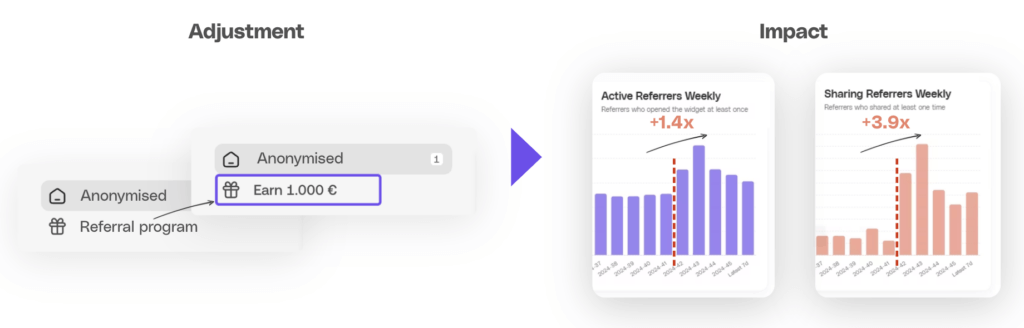
The result: 650% year-over-year growth in referral ARR. 50% lower CAC. Referral activation rate improved from 2.8% to 15% monthly (a 436% improvement).
Moss is a corporate expense management and smart card platform for mid-market B2B companies. Their buying process is sales-led: deals are closed by an account executive, with Salesforce as the system of record. Adding a referral program meant integrating Cello with Salesforce to ensure every referred lead was attributed, tracked, and routed correctly without creating duplicate records or bypassing the sales pipeline.
"Cello boosted our referral program with their integrations, automated payouts, and smart notifications." Sebastian Hoffmann, Product & Growth Lead, Moss
How they run it: Moss uses the in-app referral widget as the primary experience. They do also now send emails and in-app communications after high NPS. New referrals route directly into Salesforce as leads owned by the relevant account manager, preserving the sales-led motion and preventing duplicate records.
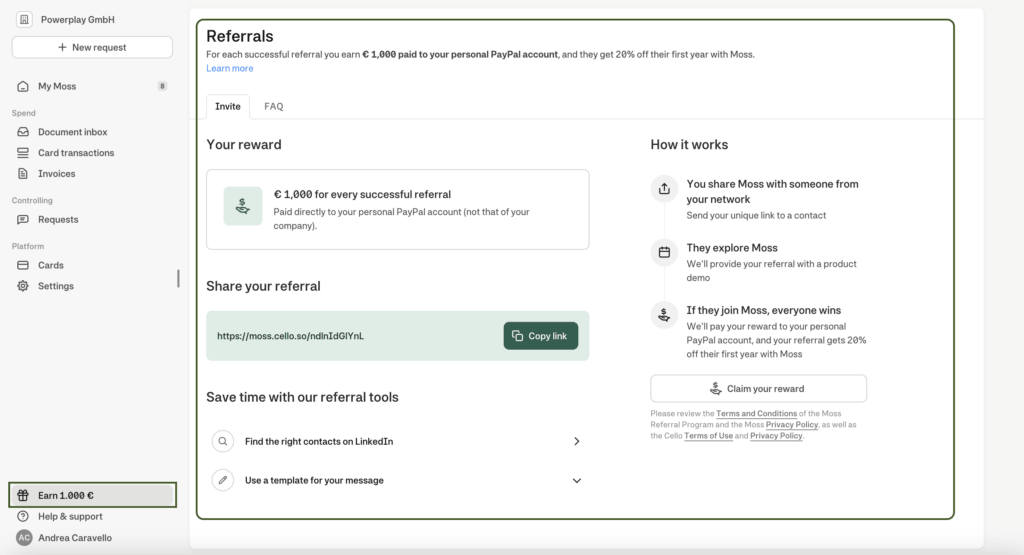
Caption: In-app Moss experience
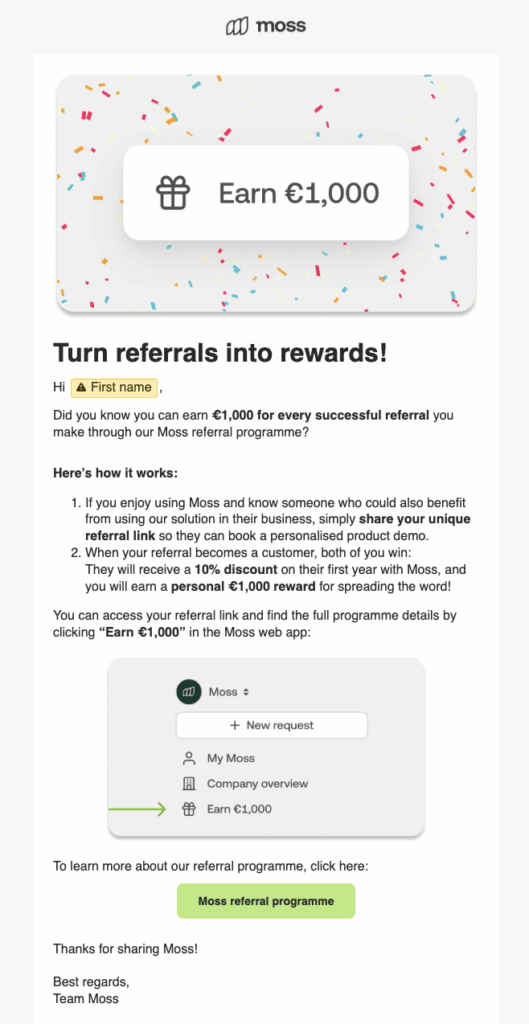
Caption: Mail communication by Moss to high NPS users
Reward structure: Cash-based rewards, with automated payouts via Cello.
Implementation: primarily driven by Salesforce integration, CRM workflow setup, and internal data governance requirements (duplicate prevention, attribution logic).
Xentral: ERP Software / Cloud-Based Business Operations
The result: approximately 60% growth in referral ARR over 14 months. Up to 3.4× higher sharing rate from moment-of-delight triggers. 20.1% widget open rate from in-app announcements.
Xentral is a cloud-based ERP platform built for growing SMBs, handling order management, warehouse logistics, and fulfilment. Their buying process is B2B and sales-assisted: no freemium tier, paid plans only. Running referrals meant identifying the right moments rather than broadly prompting all users.
How they run it: Xentral uses the in-app referral widget, triggered at moments of delight, specific product milestones where a customer has just had a positive experience. Showing "Earn €2,000" explicitly in the referral launcher (rather than a generic "Referral program" label).
Reward structure: €2,000 cash per successful referral (PayPal payout), plus a 15% discount for the referred customer. A two-sided incentive designed to drive both sharing and conversion. Cello's configuration handled a temporary bonus reward campaign without any engineering overhead.
In-app announcements: When Xentral reactivated their in-product announcement channel, 20.1% of recipients opened the referral widget directly. A strong engagement rate for a channel that requires zero incremental budget once configured.
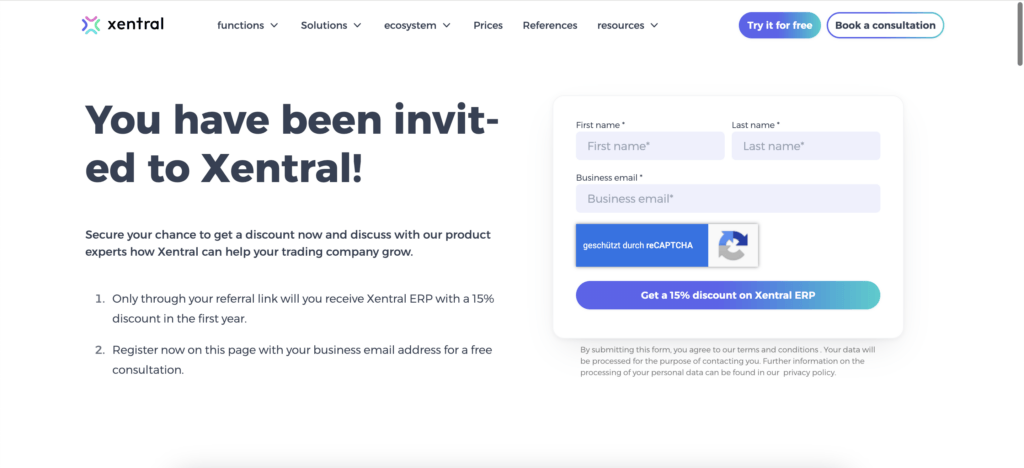
Personalised landing pages: Referred visitors land on a page tailored to who referred them, with the signup form embedded directly.
Referral Program Benchmarks
The following benchmarks are drawn from Cello's customer base as of 2026. Use these as reference points when setting targets for a new referral program, or run your own numbers in the Cello ROI Calculator.
CAC Reduction vs. Other Acquisition Channels
Referral acquisition can meaningfully reduce blended CAC compared to paid inbound channels. Moss achieved 50% lower CAC within their first full year running Cello. Xentral reports similar results through AE-initiated referral touchpoints in HubSpot. For a company spending €500 per lead on paid search, that spend is incurred on every lead, most of which never close. A referral reward, by contrast, is only paid out when the referred deal actually closes (Cello fires attribution on won opportunities and pays on realised revenue). So even a sizeable per-referral reward can beat blended paid CPL, while the leads arrive pre-qualified and warmer.
Referral Activation Rates
Activation rate = the percentage of customers who actively refer at least one peer.
- Early-program benchmark: 2–5% (Cello customer data, 2026)
- Moss (sales-led, post-optimisation): 15% monthly activation rate (up from 2.8%)
For sales-led companies, a 10–15% monthly activation rate is a realistic target after 6 months of operation.
Revenue Attribution from Referrals
- Moss: 650% YoY growth in referral ARR (growth rate, not % of total revenue)
Sales-led companies with established customer bases often see referral revenue acceleration in Year 2 rather than Year 1. The referral flywheel takes time to build, but once activated, the compounding effect is significant, especially with a loyal enterprise customer base.
How to Implement a Referral Program Alongside Your CRM
Both PLG and sales-led implementations require the Cello SDK. The in-app widget is the core experience for all Cello customers. What varies for sales-led companies is the additional CRM integration: routing referred leads into your pipeline, setting up attribution, and configuring duplicate prevention. The phases below run in sequence but aren't tied to a fixed timeline. How quickly you move through them depends on your CRM complexity and internal resourcing.
Phase 1: Foundation
- Install Cello SDK (required for all Cello customers. The in-app widget is the core experience)
- Define reward structure and approval workflow:
- What works: two-sided rewards (referrer cash + referee discount), Cello data shows this lifts conversion 30–50% vs one-sided. Scale cash to deal size for higher-ACV sales-led motions, and spread rewards over time (Cello prorates by default) rather than front-loading. This reduces refund exposure and keeps referrers engaged.
- What to avoid: front-loaded lump-sum payouts (higher clawback risk) and time-based reward caps (Cello's research shows these dampen sharing. Amount-based caps perform better).
- Approval workflow: rather than a bespoke sign-off chain, Cello uses a configurable payout delay (e.g. 14 days, matched to your refund window) during which no payment is made, plus reviewable reward statuses in the Portal. Note payouts are via PayPal/Venmo only.
Phase 2: CRM Workflow Build
Choose your integration:
- Salesforce: Integrate via Apex triggers and HTTP callouts to the Cello API. A trigger on the Opportunity fires when the deal hits a defined stage with the cello_ucc field populated, sending attribution to Cello. Referrals route as Leads owned by the account manager; email and lifecycle triggers layer on top of the in-app widget.
- HubSpot: Use Cello's native integration. Works well with HubSpot Sequences for renewal and expansion touchpoints alongside the in-app widget.
- Other CRM: Cello connects via API. Any CRM that accepts lead data via webhook or API can receive Cello referral data.
- Hybrid (PLG + sales-led): Run both in parallel. In-app widget for all users; email and CSM-initiated triggers for enterprise accounts. Track both separately in Cello's analytics. Moss runs this model.
Then configure:
- Map referral lead routing: which queue, owner, and deal stage does a referral create?
- Configure duplicate prevention rules
- Set up attribution tagging (UTM or CRM source field) for referral-originated deals
Phase 3: QA and Testing
- Run end-to-end test: trigger referral, confirm lead appears in CRM correctly, confirm reward logic fires
- Review with sales ops and legal (reward tax handling, terms)
- Train account managers and CS team on how to prompt referrals during calls
Phase 4: Launch
- Go live with a targeted cohort (e.g. top 20% of customers by NPS or ARR)
- Monitor activation rate, CRM data quality, and payout accuracy
- Prepare launch materials before rollout**:**
- Internal enablement: CSM/AE talk track for prompting referrals, plus a reward/approval cheat-sheet.
- Customer-facing assets: in-app announcement, launch email to the target cohort, and a personalised landing page (dedicated pages convert up to 2× better).
- Copy lead time: submit any widget, email, or announcement copy to Cello early.
What affects time-to-live: complexity of CRM workflow rules (territory-based routing, duplicate logic), legal review of reward structure, number of integration touchpoints, and internal resource availability.
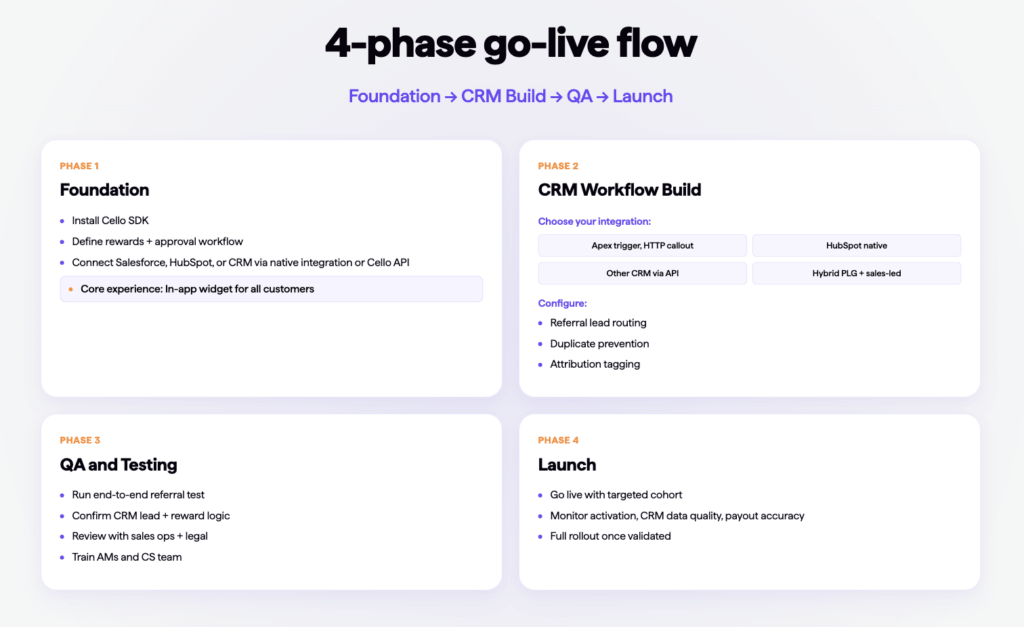
Caption: The 4-phase go-live flow summary of key actions
How to Choose the Right Referral Setup for Your CRM Stack
If you're on Salesforce and run a sales-led motion → use Cello's Salesforce integration.
If you're on HubSpot and run a sales-led motion → use Cello's HubSpot integration.
If you use a different CRM → Cello is CRM-agnostic and integrates via API. Any CRM that accepts lead data via webhook or API can receive Cello referral data.
If you're a hybrid PLG + sales-led company → run both channels in parallel. Track both separately in Cello's analytics dashboard. Moss runs this hybrid approach.
Start Your Sales-Led Referral Program with Cello
Cello is the AI-powered referral platform built for B2B SaaS companies, both PLG and sales-led. It integrates with Salesforce, HubSpot, Stripe, and Chargebee, with automated global payouts in 60+ countries, built-in fraud detection, and GDPR compliance.
Can a sales-led SaaS company run a referral program without a freemium or PLG motion?
Yes. Cello does require the in-app SDK. The widget is the core experience for all Cello customers. What changes for sales-led companies is how you complement the in-app experience: email and lifecycle triggers and CSM prompts help surface the program to customers who aren't in the product daily. New referrals route into your existing CRM pipeline rather than a self-serve signup flow.
How do you attribute referral revenue in Salesforce when running a Cello integration?
Cello's Salesforce integration uses Apex triggers, not native automatic tagging. A typical setup fires an Apex trigger on the Opportunity object when the deal reaches a defined stage (e.g. "Proposal/Price Quote") and a custom cello_ucc field is populated, sending a referral-attribution event to Cello via an HTTP callout.
What referral reward structure works best for sales-led B2B SaaS?
Cash rewards and account credits both work well. Cash rewards are available to both PLG and sales-led programs. For sales-led companies with higher ACV, rewards are often scaled to deal size with longer payout windows (e.g. post go-live). Account credits applied to the next renewal invoice can also reduce churn risk while incentivising referrals.
How do you prevent referral fraud in a B2B sales-led referral program?
Cello's fraud detection flags duplicate accounts, referral loops, and suspicious patterns. For sales-led companies, an delayed payout step can be added before reward triggered.
Does Cello support referral programs for companies outside of Europe?
Yes. Cello supports referral programs globally with automated payouts in 60+ countries and currencies. The platform is GDPR-compliant, handles multi-currency rewards, and supports referral programs for companies selling into North America, Europe, and APAC.
How long before a referral program shows measurable ROI for a sales-led company?
For most sales-led companies, meaningful pipeline contribution appears within 3–6 months. Year 1 is typically about building the program and activating the customer base. Right early metrics to track: activation rate and pipeline contribution, not immediate ARR.
Is it possible to run a referral program without involving engineering?
Both PLG and sales-led implementations require the Cello SDK. The SDK install enables the in-app widget. Once installed, reward configuration, CRM integration setup, and program design are handled without engineering overhead.
What is the difference between a referral program and an affiliate program for B2B SaaS?
Referral programs are user-to-user: your existing customers recommend your product to their peers and earn a reward when those peers become customers. Affiliate programs use external publishers, bloggers, or marketers who earn commission on traffic or signups they send. Cello is built for user referral programs.
What reward types does Cello support?
Cello supports cash rewards (PayPal) and account credits. Both reward types are available to PLG and sales-led programs.