
- TL;DR
- The End of Renting Distribution
- The AI Product-Channel Fit Collapse
- The Rise of the Human Signal
- Why Growth Loops Are Replacing Channels
- The Growth OS Map
- The Growth Loop Playbook
- Diagnosing Product-Channel Fit Collapse
- How to Rebuild Your GTM Before It Fails
- The Future Belongs to Teams Who Own Their Distribution
This is a content collaboration with GTMnow Newsletter, one of the leading GTM communities for revenue practitioners. This edition felt like a particularly important one, given the speed at which channels are evolving.
TL;DR
- The problem: CAC payback has hit 57 months. Traditional channels (SEO, Outbound, Ads) are collapsing under AI noise.
- The shift: You can no longer rent attention. You must build an Operating System of defensible “Growth Loops” that compound over time.
- The solution: This guide maps the 8 specific loops (Viral, Content, Community, etc.) and the 5-layer architecture needed to replace fragile funnels with a resilient GTM engine.
This guide was created in collaboration with Stefan Bader, co-founder of Cello, a platform helping SaaS companies build and scale referral-driven growth loops.
The End of Renting Distribution
We all know the playbook. For fifteen years, it was simple: raise a Series B, hire an army of SDRs, light money on fire with Google Ads, and force-feed the top of the funnel.
That playbook is dead.
Building a product used to be the hard part. Now, with AI tools like Anything, Lovable and Cursor, shipping a functional SaaS MVP takes hours, not months. Product reproducibility has become trivial. The new bottleneck is distribution.
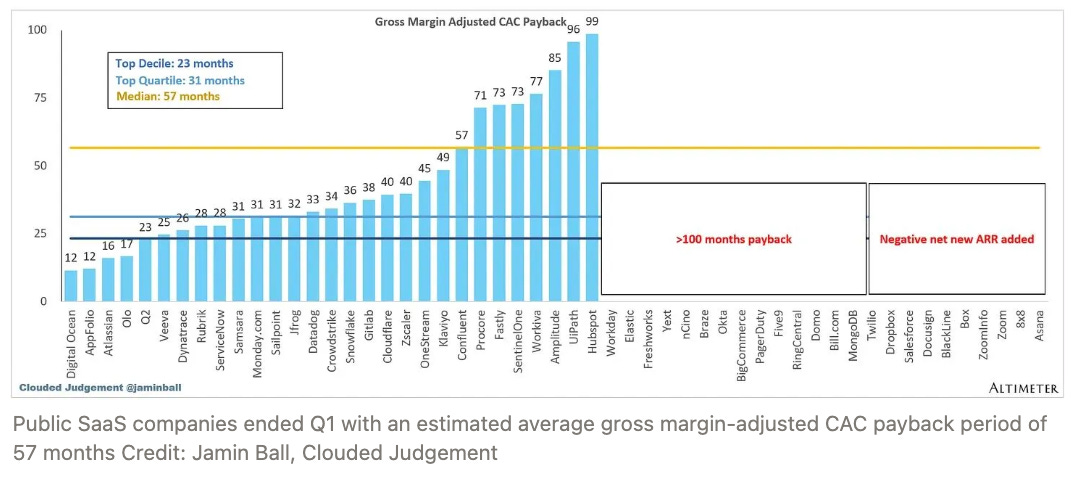
The numbers don’t lie. According to Jamin Ball’s Clouded Judgement, the median CAC payback period for public SaaS companies has ballooned to 57 months. That’s nearly five years just to break even on a customer.
Look at Reddit. Their stock dropped over 16% in a single day when ChatGPT reduced Reddit citations from 14% to just 2% of responses. That’s the risk of building your house on land you don’t own.

We call this the AI Product-Channel Fit Collapse. Your product might be incredible. But it’s your distribution that determines your rate of success now.
The AI Product-Channel Fit Collapse
Traditional channels are breaking. Here is the reality across the board:
1. SEO and Content: Traffic Without Clicks
Similarweb data shows zero-click searches jumped to 69% in 2025. Meanwhile, AI has flooded the internet. When everyone can publish infinite content, it gets much harder to win.
2. Cold Calling: The Gatekeeper Problem
If you call a prospect today, their phone likely marks you as “spam risk” automatically. Cognism’s State of Cold Calling Report shows success rates plummeted to 2.3% in 2025. That’s a 50% drop in one year.
3. LinkedIn and Written Outbound: Drowning in Noise
Hunter.io’s 2025 report found that nearly 96% of cold emails go unanswered. Buyers are tuning out the noise. AI email filtering is also getting better and more powerful.
4. The Death of Unqualified Prospecting
Let’s be clear: prospecting isn’t dead. Unqualified prospecting is dead. As Salesloft’s CRO Mark Niemiec noted, AE-generated pipeline converts 3-4x better than traditional SDR motions because the signal is higher.
The Rise of the Human Signal
AI breaks channels because it floods them with volume. Every channel built on volume eventually gets drowned out.
But there’s one thing AI cannot fake at scale: human social proof.
Real usage. Real relationships. Real communities. Real referrals. In the AI era, the most valuable signal isn’t a click or an impression. It’s trust.
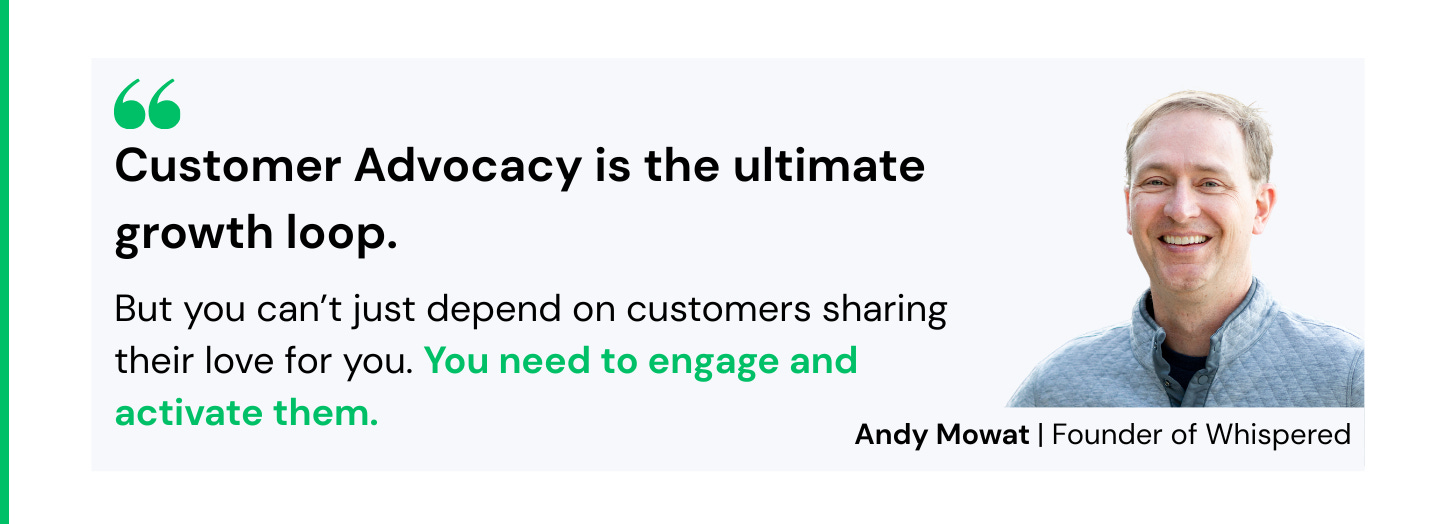
As Elena Verna writes, free users with high NPS become your loudest marketers. They share screenshots, evangelize, and generate content. “This is the kind of marketing money can’t buy,” she notes, “and honestly, the kind you could never afford to buy even if you tried.”
The BCG B2B SaaS Growth Report confirms this: best-in-class SaaS companies rely 2-3x more on customer advocacy than their peers.
Why Growth Loops Are Replacing Channels
Traditional acquisition is a funnel. You pour money in the top, and leads trickle out the bottom. The problem? Funnels degrade. Each dollar is spent once and gone. Every month resets to zero.
Growth loops compound. The output of one cycle becomes the input of the next. Users create value that attracts more users.
Many SaaS companies now use referral infrastructure (including tools like Cello) to build these loops directly into their product experience.
Here’s why loops survive the AI flood:
- Trust barrier: Loops rely on human-to-human transfer of trust. AI can’t fake a peer recommendation.
- Compound interest: Funnels reset to zero. Loops compound. Each cohort helps acquire the next, lowering your marginal CAC over time.
- Data moats: Alloy’s research shows integration users are 58% less likely to churn. That’s a switching cost generic AI wrappers can’t replicate.
- Ownership: You own the loop. When Google changes its algorithm, your referral program doesn’t break.
- AI acceleration: AI can optimize the loop, but it can’t replace the human trust at its core.
Understanding why loops work is easy; building them is hard. We can’t build dynamic systems with static tools. We need a blueprint. This brings us to The Growth OS Map.
The Growth OS Map
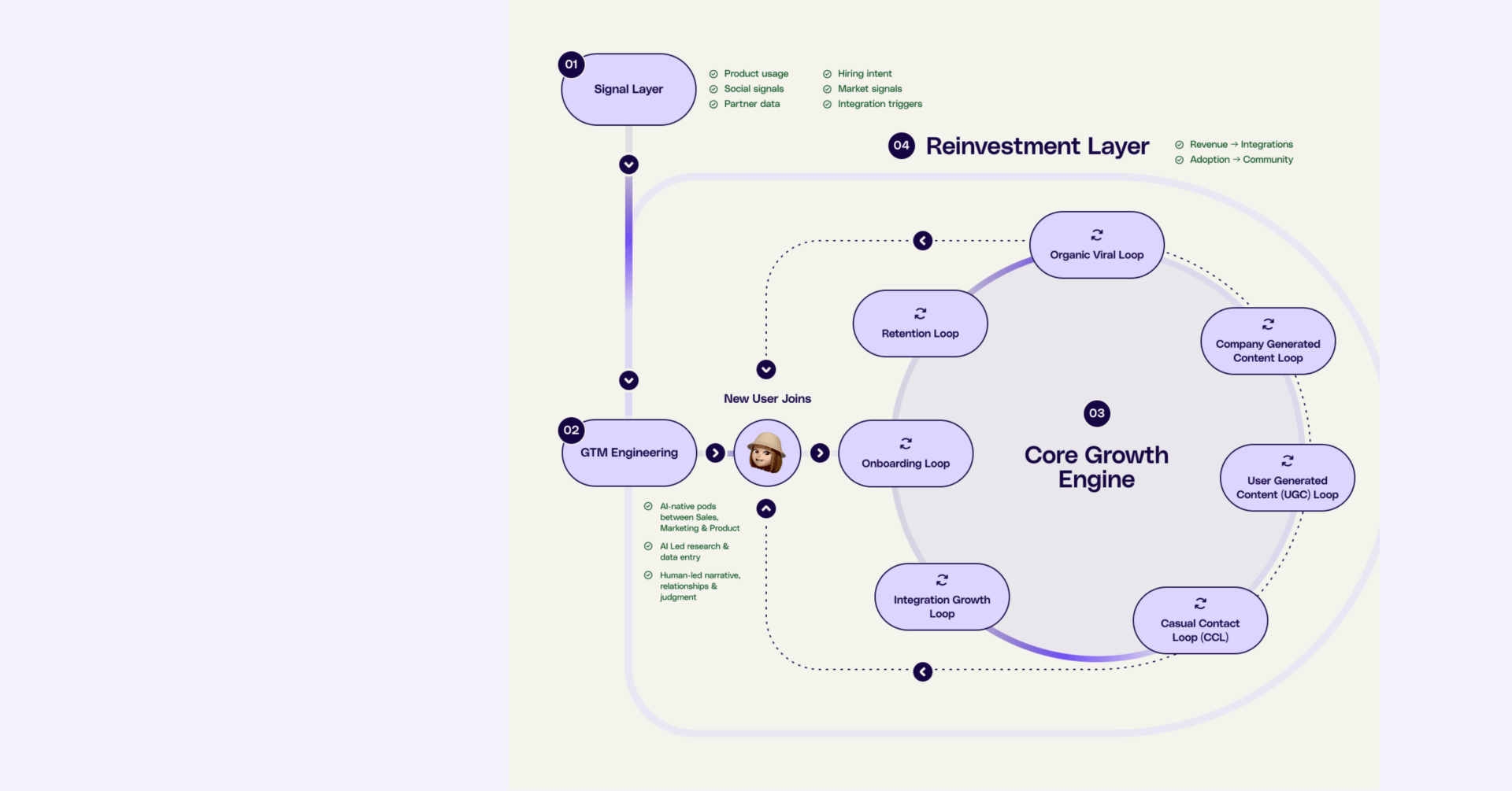
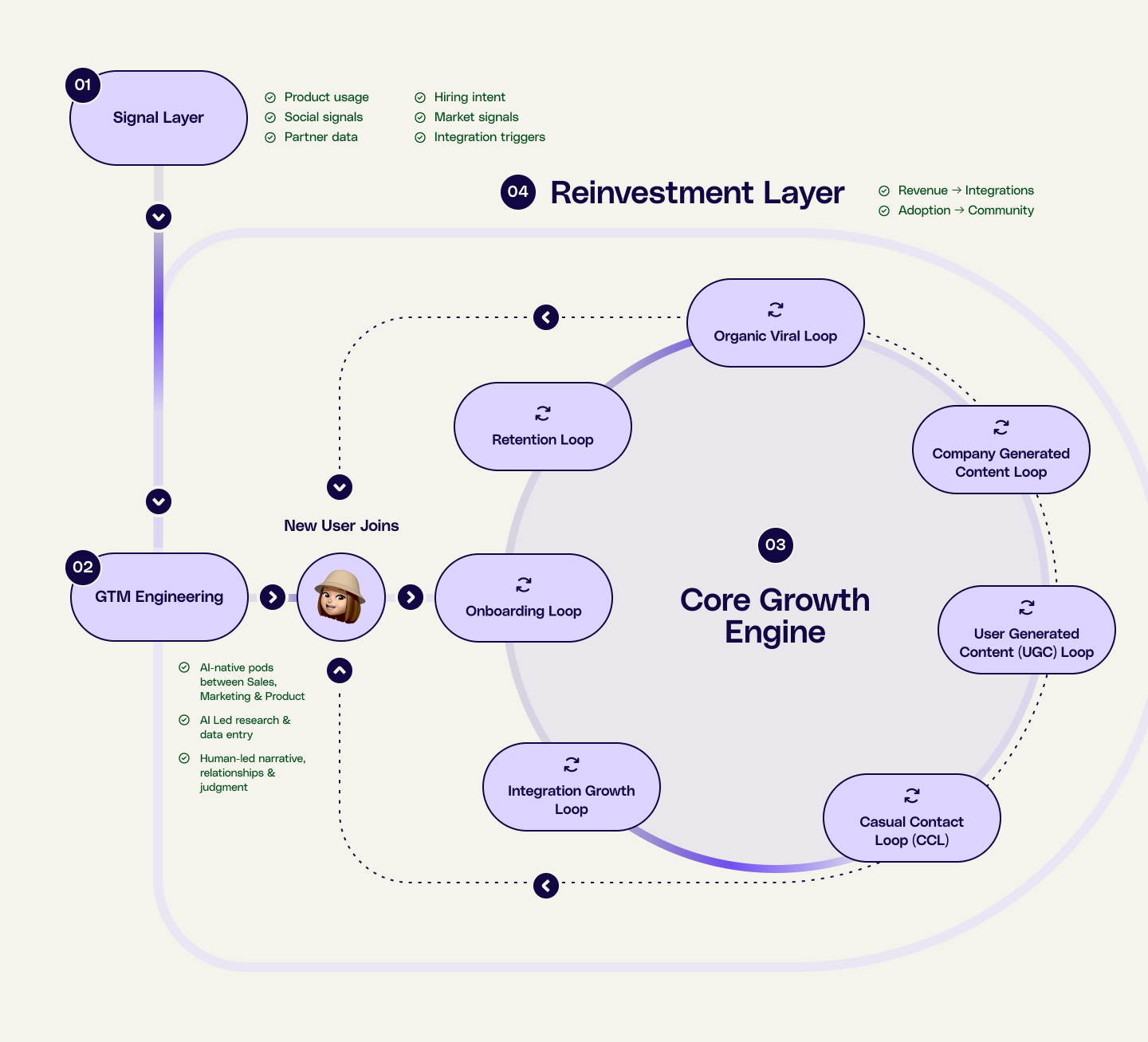
To survive, we have to stop thinking in silos and start building an Operating System.
In the old “Funnel View,” Marketing generates leads, Sales closes them, and Success supports them. Data is handed off like a baton. If the baton drops, the customer is lost.
In the “Growth OS View,” these functions are nodes in a network. A happy customer (Success output) immediately becomes a referral source (Marketing input). Sales objections immediately fuel Product updates.
Think of it as five integrated layers:
Layer 1: Signal Over Volume
The foundation is replacing “spray and pray” with signal-based intent. Instead of blasting 10,000 prospects, you identify the 100 showing genuine signs of life:
- Product usage patterns
- Partner signals
- Social engagement
- Integration triggers
Signal replaces activity. Quality replaces quantity.
Layer 2: GTM Engineering
This isn’t about hiring more software engineers. It’s about engineering your go-to-market process. We need to break down the walls between Marketing, Sales, and Product. Instead of rigid handoffs, we move to AI-native pods where automation handles the research and data entry, while humans focus on what they’re actually good at: relationships, narrative, and judgment.
Layer 3: Defensible Channels
This is where the loops live. Instead of renting attention, you build compounding mechanisms: viral loops for referrals, content loops for owned media, and integration loops for ecosystem reach. These aren’t campaigns; they are engines that run 24/7.
Layer 4: Retention and Advocacy
Here, we turn satisfaction into fuel. When users become advocates, they feed directly back into the acquisition layer. The math is simple: referred users spend 25% more and churn 18% less, as found in a Wharton study.
Layer 5: Reinvestment
The final layer turns linear growth into exponential compounding. We stop treating outputs (revenue, users, data) as the finish line and start treating them as fuel for the next cycle. Every output becomes an input somewhere else.
- Revenue → Integrations: Profit isn’t just cash; it’s capital used to build new entry points and systematically reduce friction.
- Adoption → Community: A growing user base transforms into a support network that drives its own usage and creates organic advocates.
- Insights → Product Triggers: Usage data doesn’t sit in a dashboard; it converts into automated nudges that boost activation and repeat use.
- Momentum → New Loops: Early traction provides the leverage to launch additional growth loops, ensuring growth multiplies rather than adds.
The Growth Loop Playbook
Not all loops are created equal. We focus on the seven high-leverage loops that build defensible moats.
1. Viral Loop - User Referrals
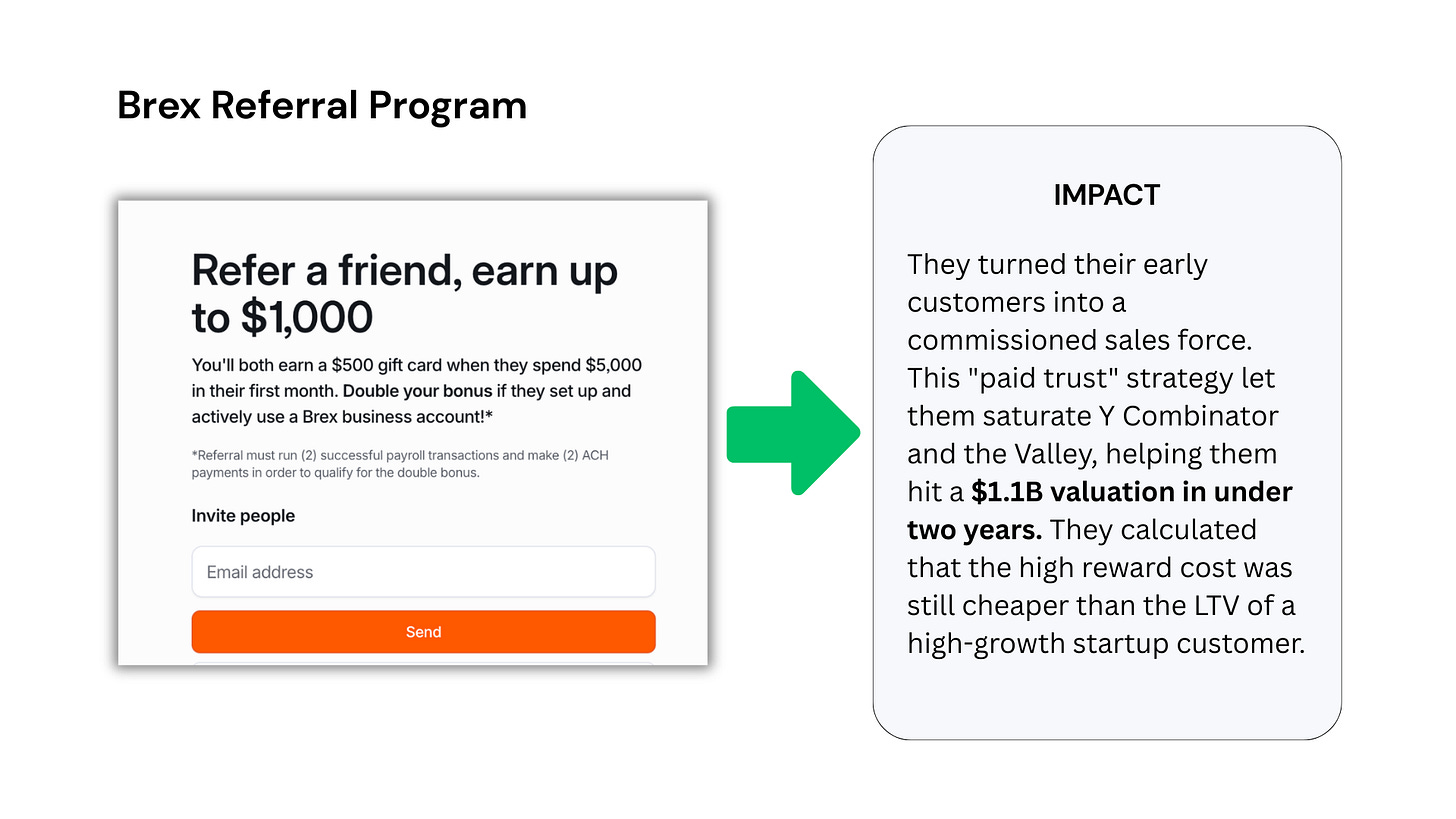
This loop operationalizes the scarcest resource in the AI era: human trust. It transforms passive user satisfaction into active advocacy by embedding sharing moments directly into the product experience. This mechanism can be fueled with two-sided incentivization to reward both the advocate and the new user. In a landscape saturated with synthetic noise, a personal recommendation provides the high-fidelity signal that buyers are desperate for.
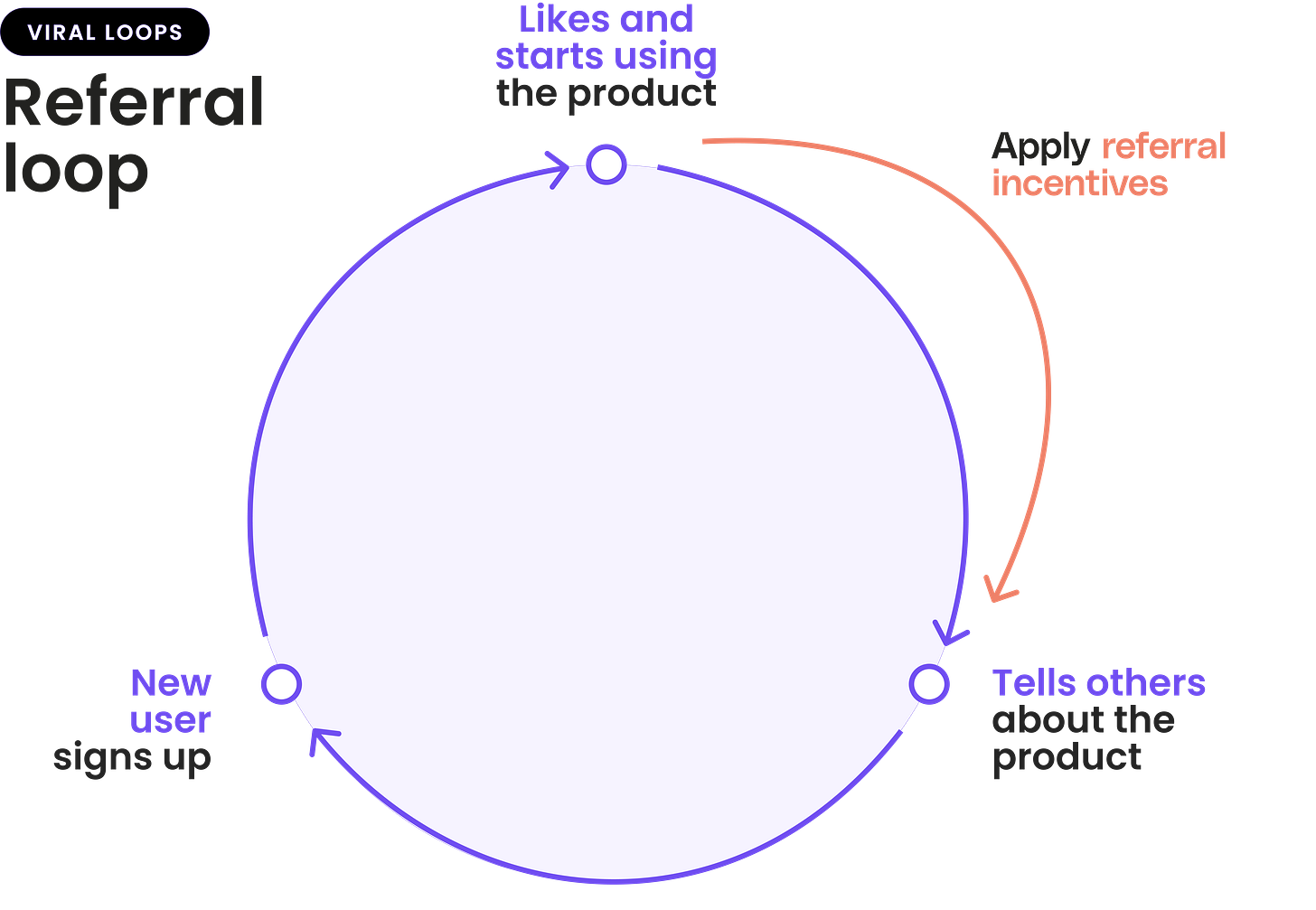

Here’s an example of this: Brex’s referral program.
2. Viral Loop - Partners & Affiliates
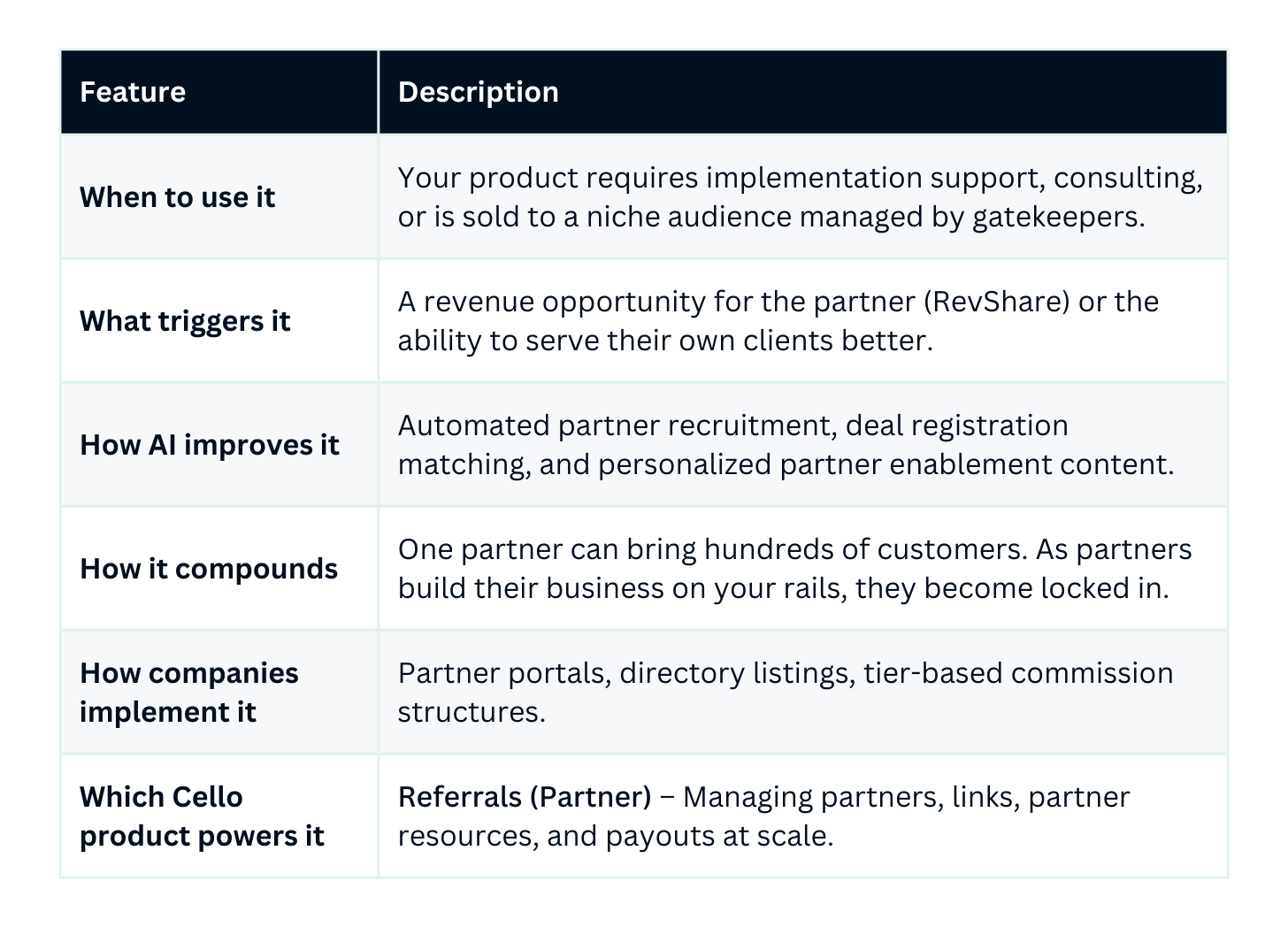
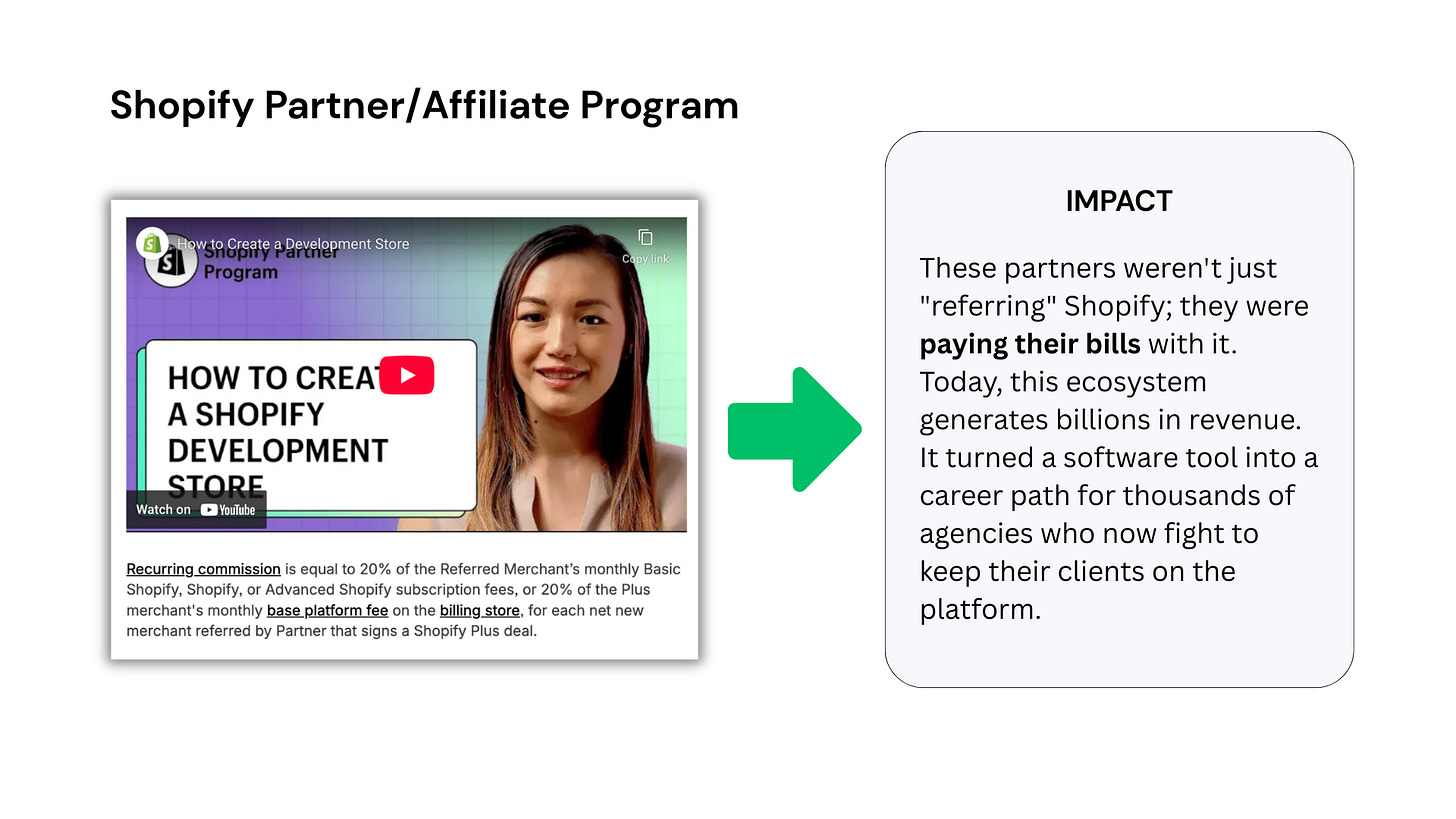
While user referrals are organic, partner loops are structured. This scales trust through “nodes of influence”: agencies, consultants, or influencers who already own the relationship with your buyer.

Here’s an example of this: Shopify’s partner/affiliate program.
3. Content Loop (Owned Media)
Newsletters, podcasts, and events create algorithm-proof distribution. Stop relying on renting eyes from platforms and start owning the audience.
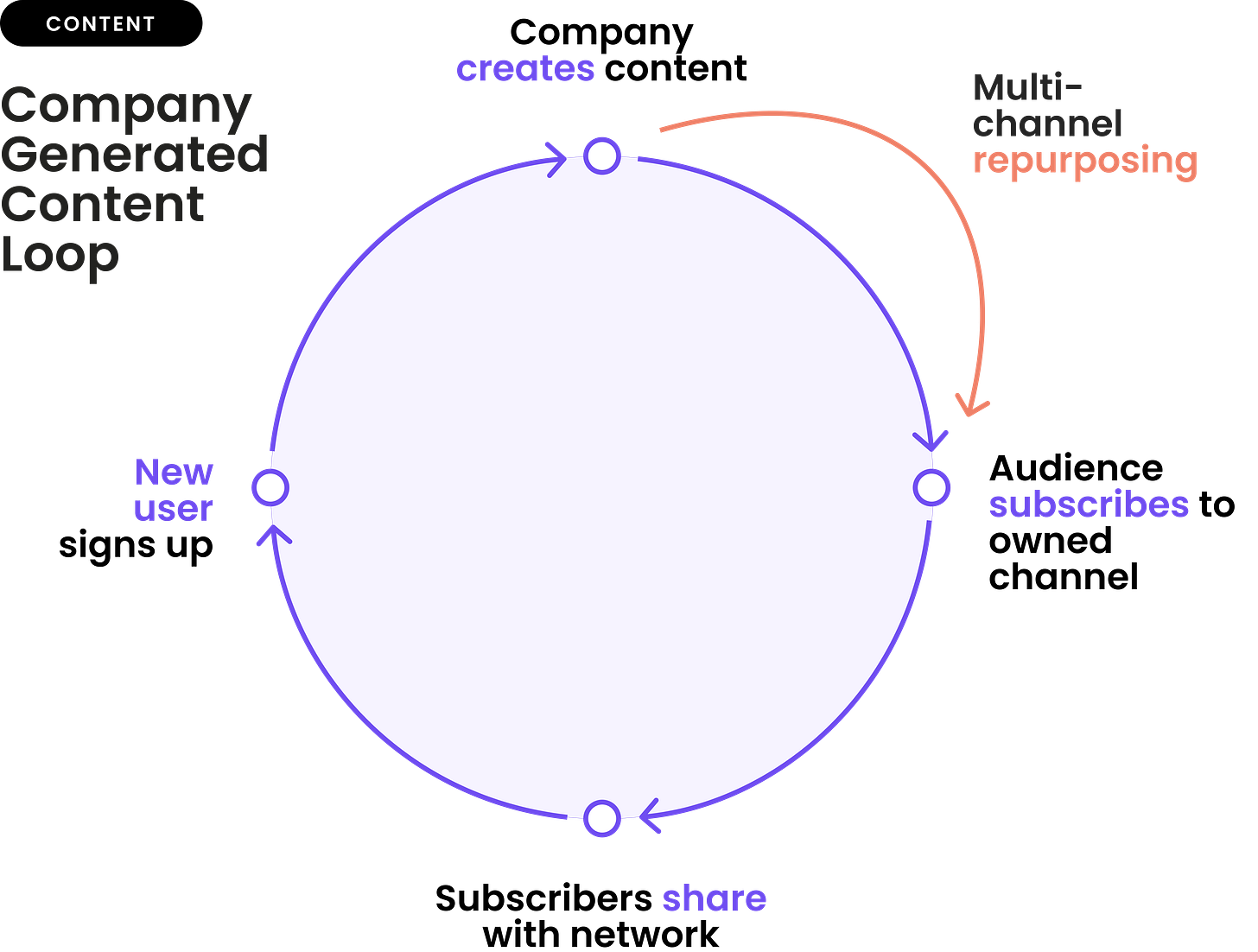
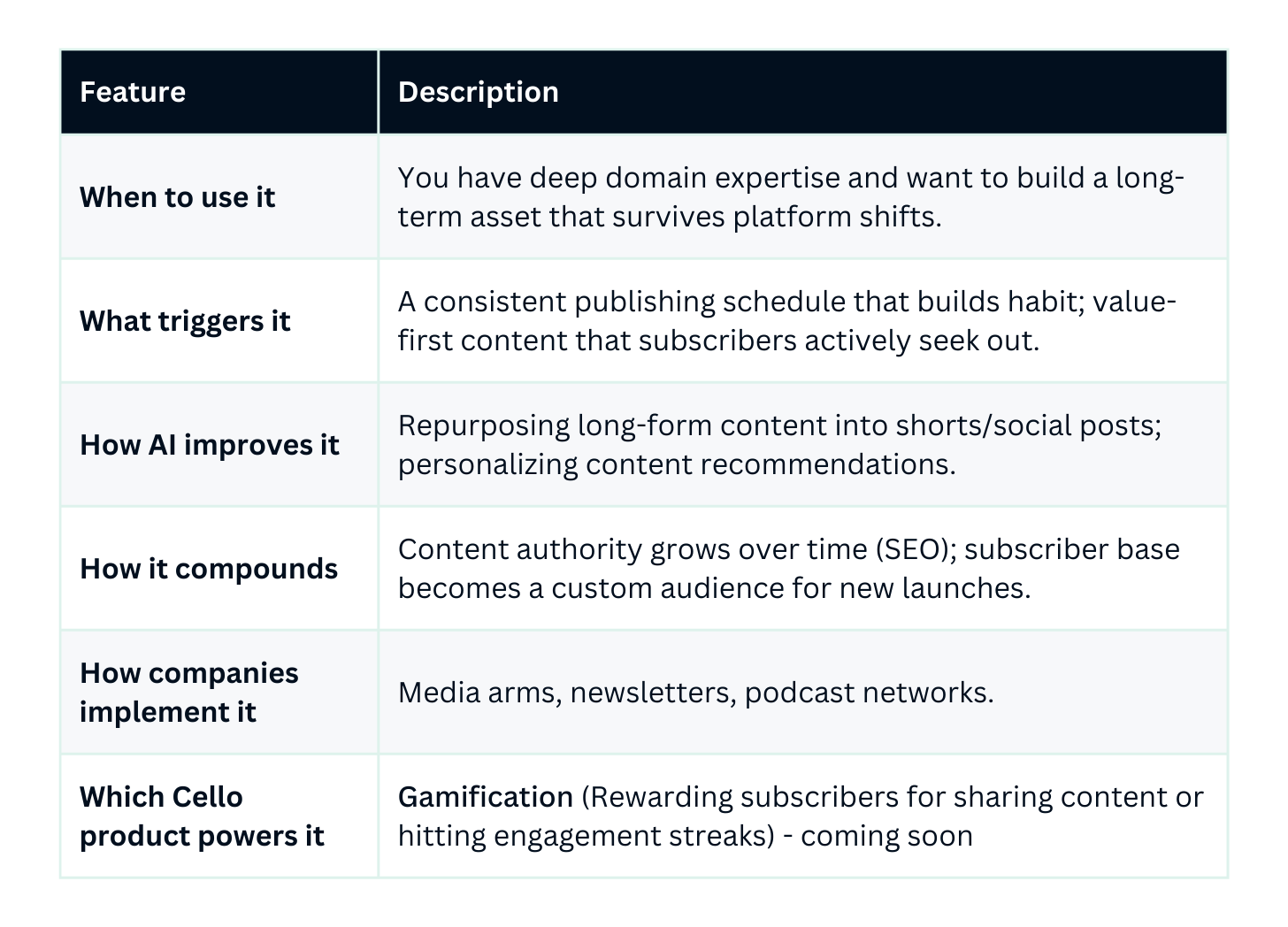
Here’s an example of this: Hubspot’s content loop.
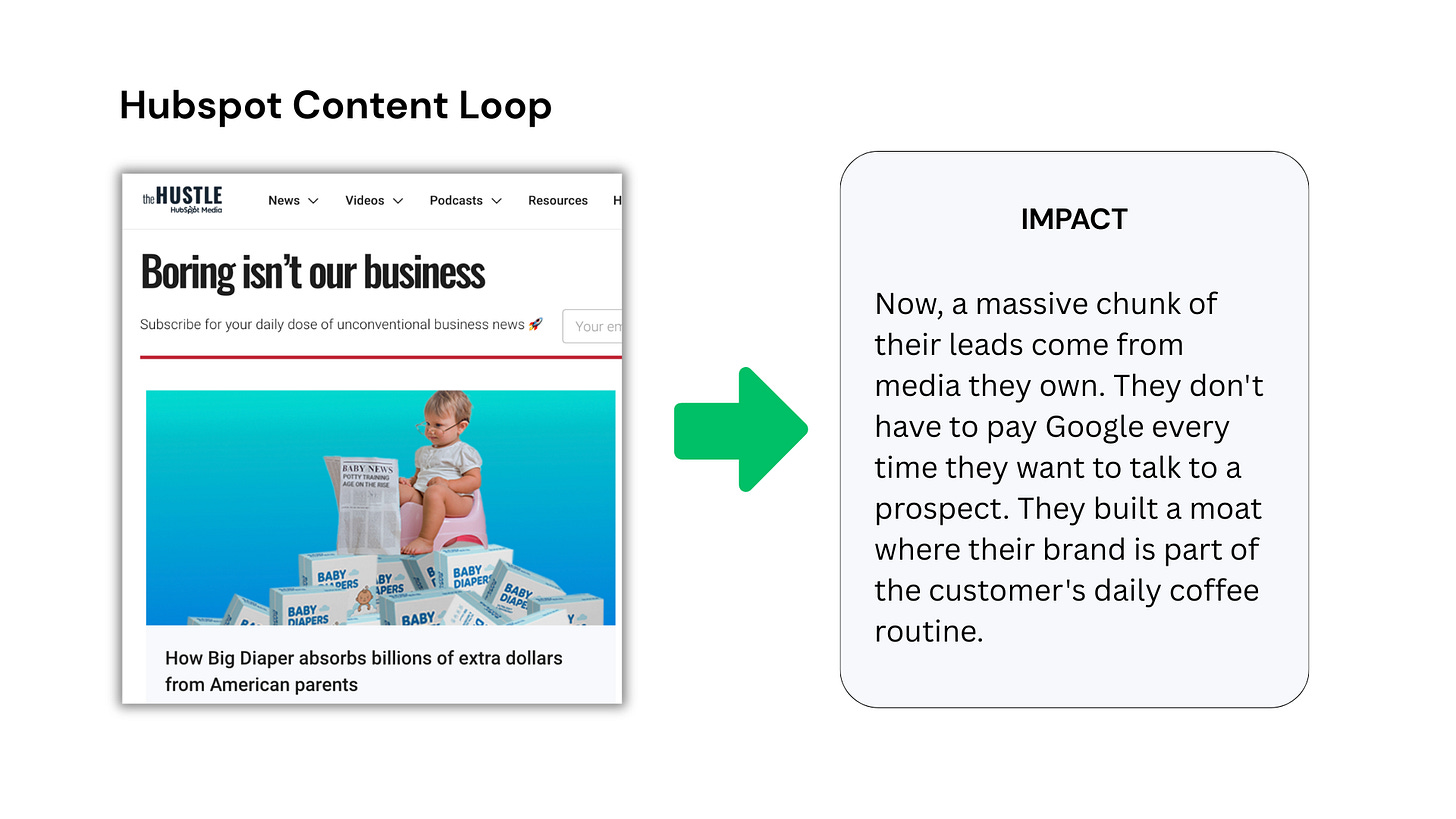
4. Community Loop (UGC)
Communities are the new SEO. They resist algorithm volatility by combining User Generated Content (UGC) with social proof.
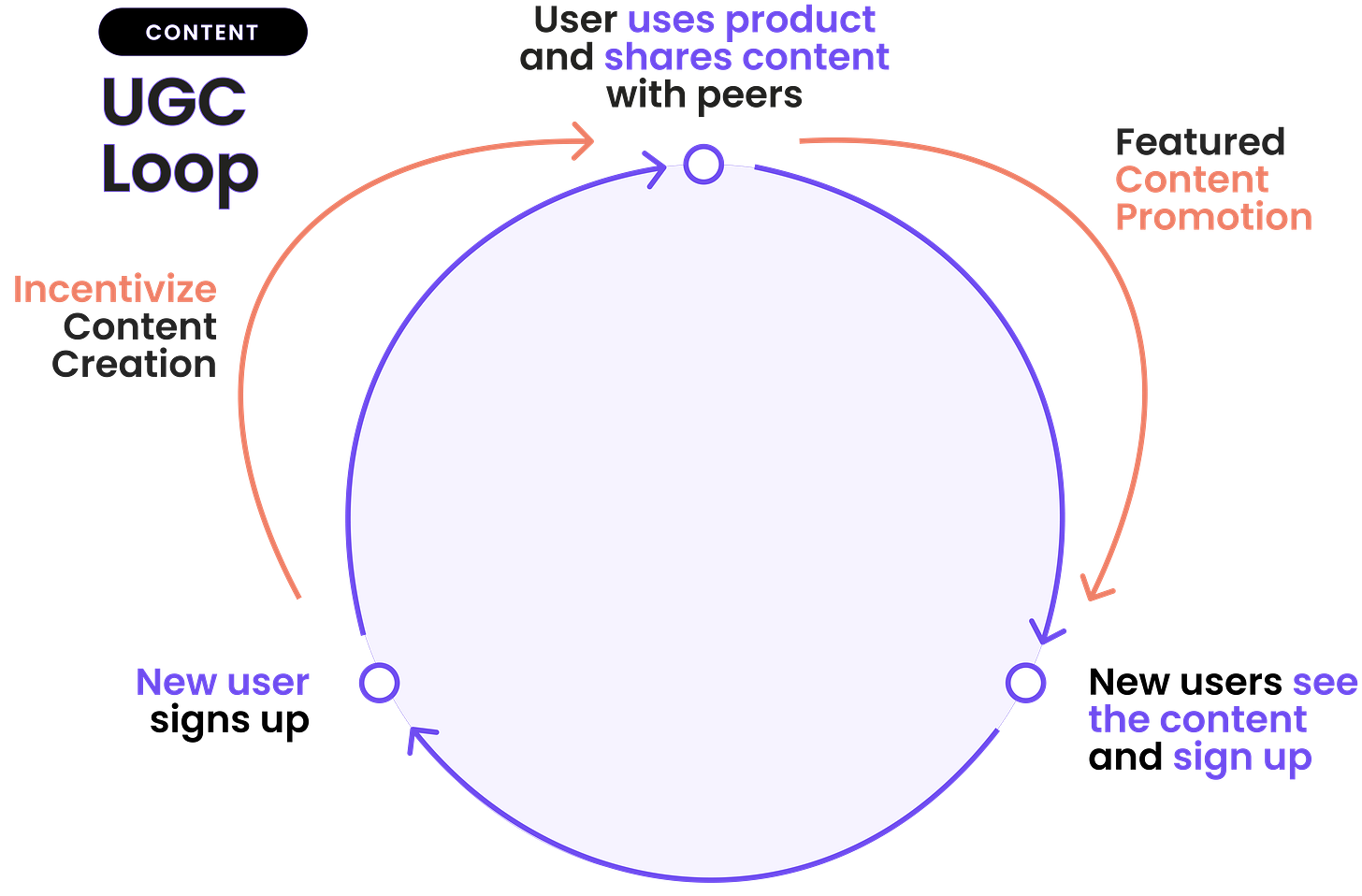

Here’s an example of this: Tally’s user-generated content loop.

5. Integration Loop - Ecosystem Distribution
Each integration opens a new audience. High-intent users discover you through the tools they already use.
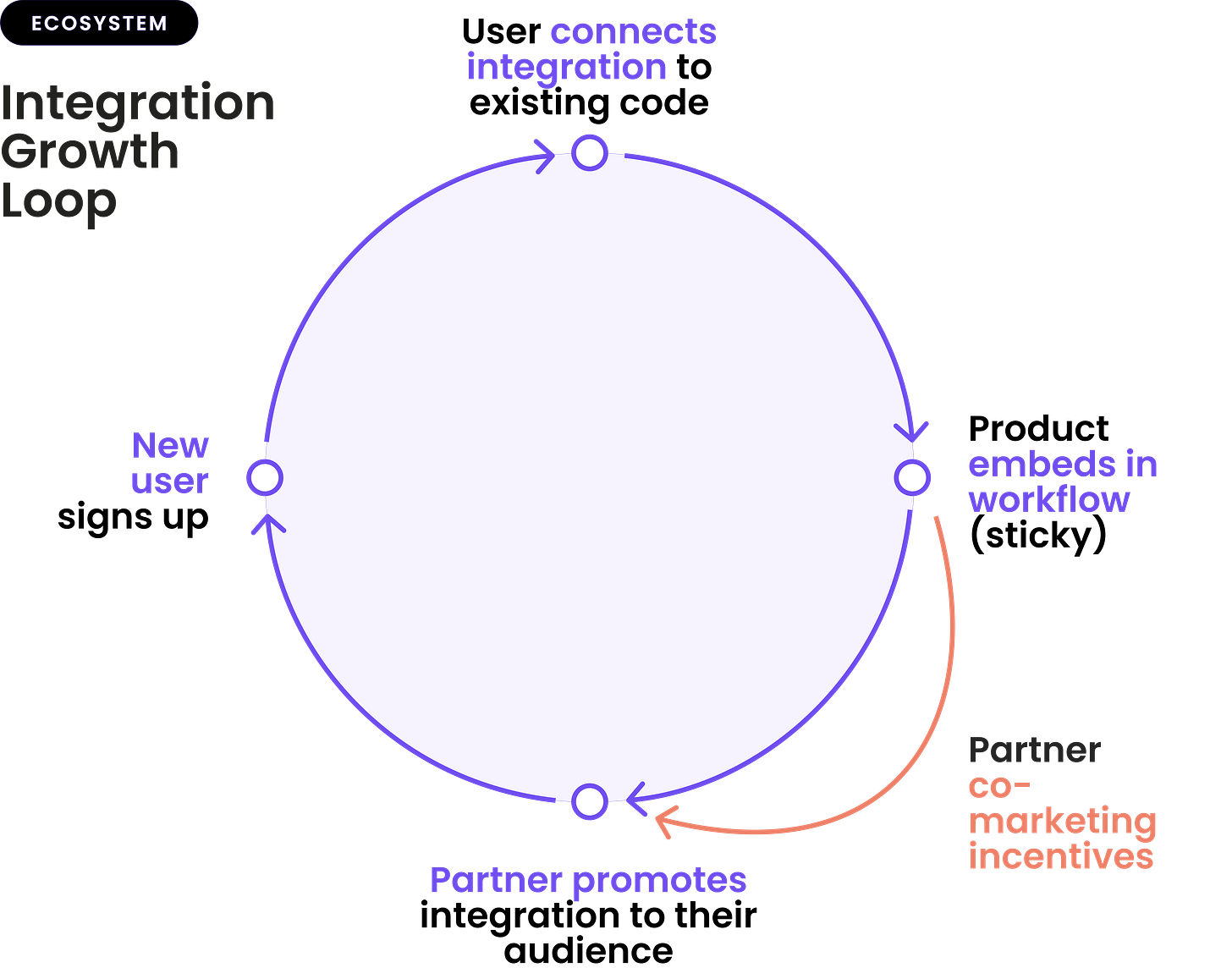
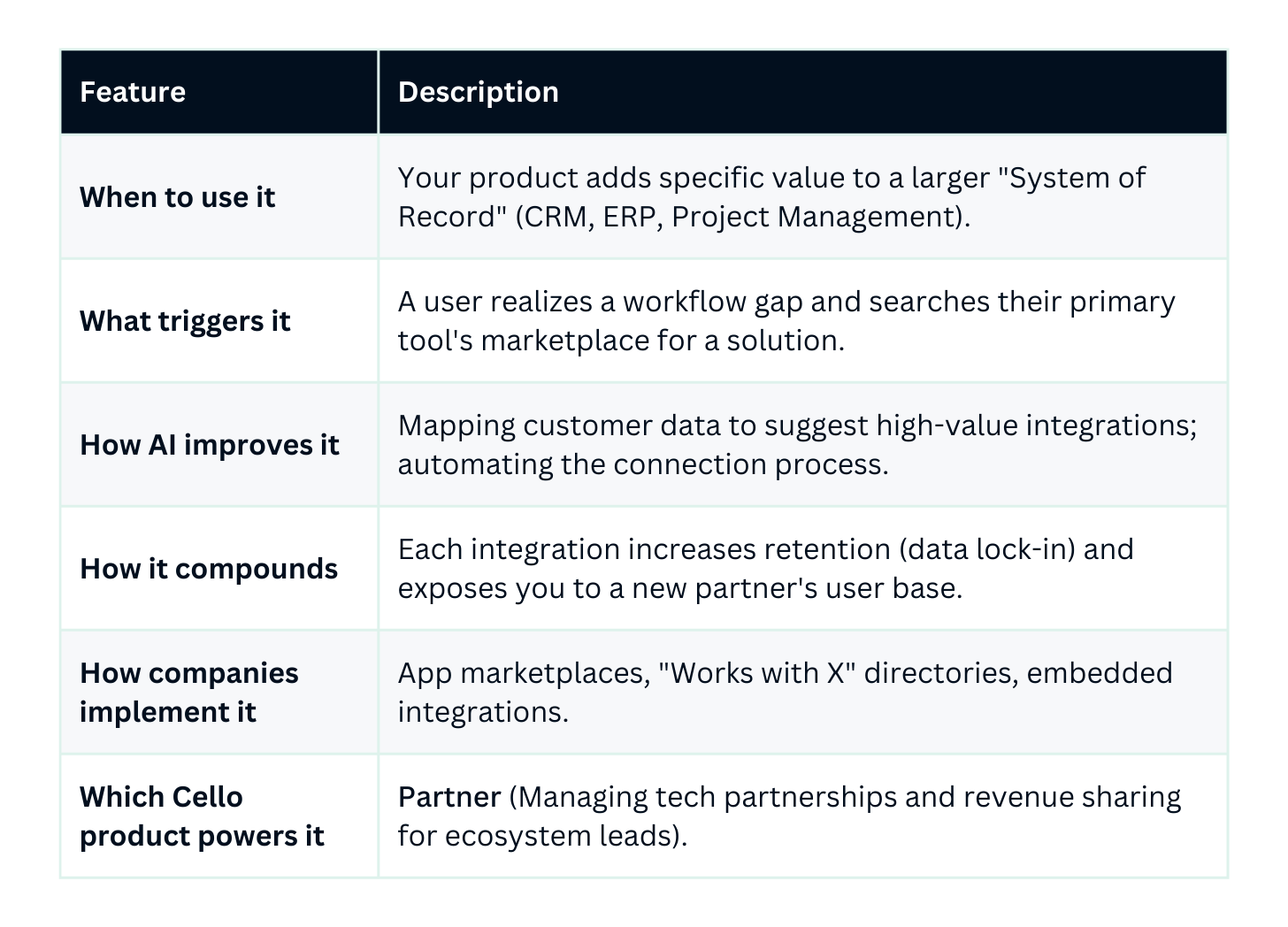
Here’s an example of this: Zapier’s integration growth loop.

6. Product-led Loops
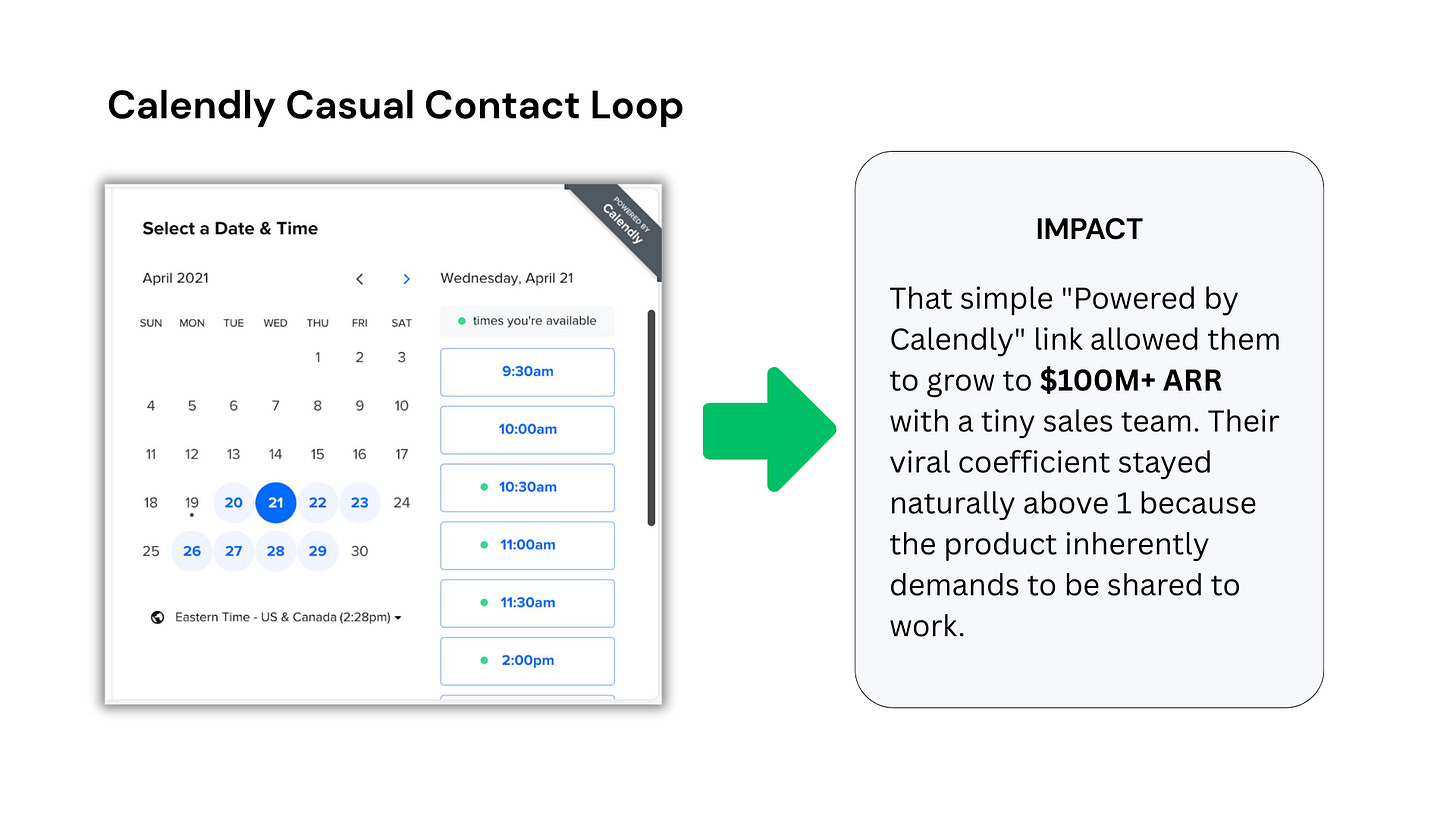
Usage triggers are high-signal GTM inputs. This loop focuses on Casual Contact (CCL). Simply using the product spreads the product.
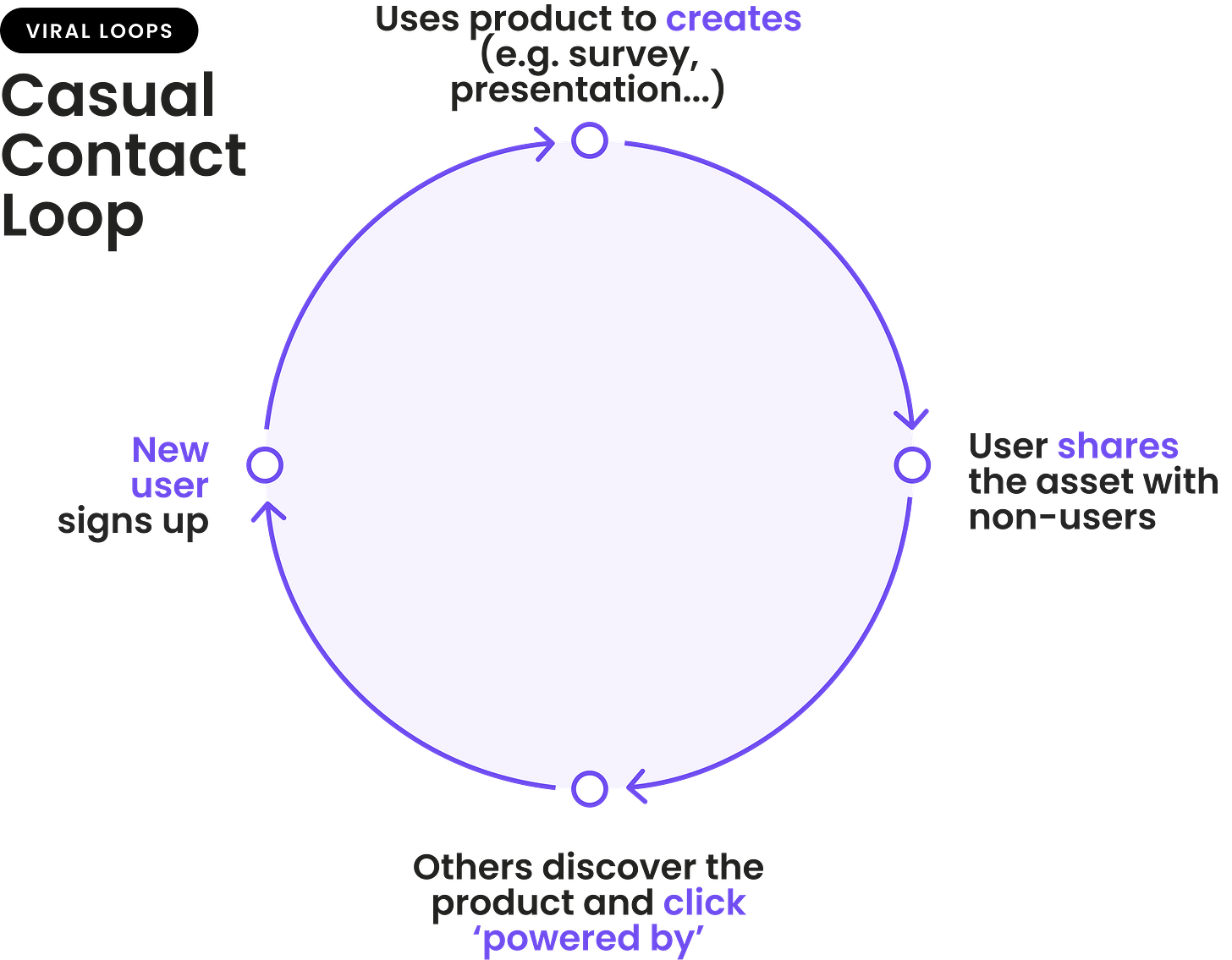
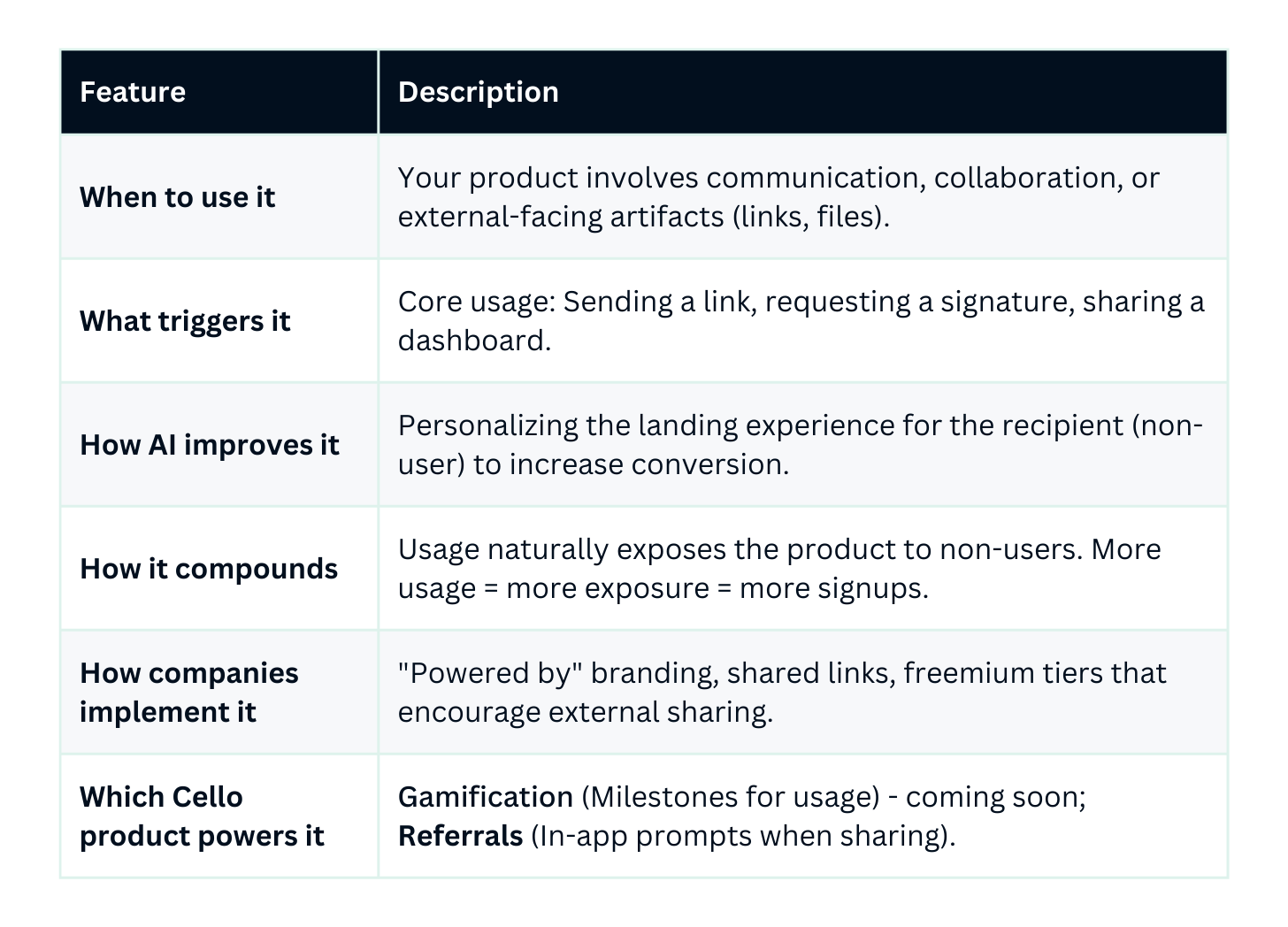
Here’s an example of this: Calendly’s casual contact loop.
7. Retention Loop
Retention isn’t just about preventing churn; it’s about deep engagement. If you can’t keep them, you can’t grow.
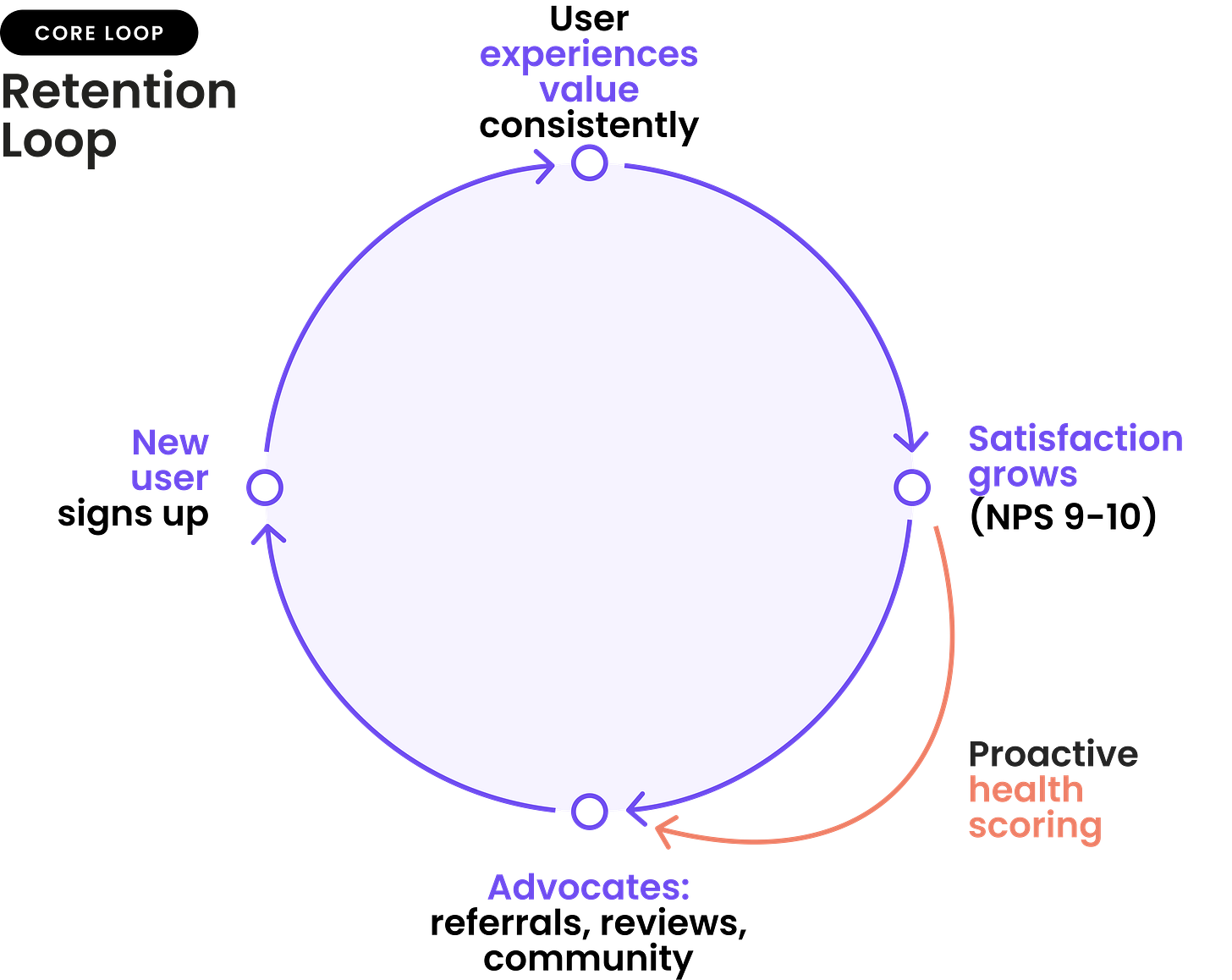
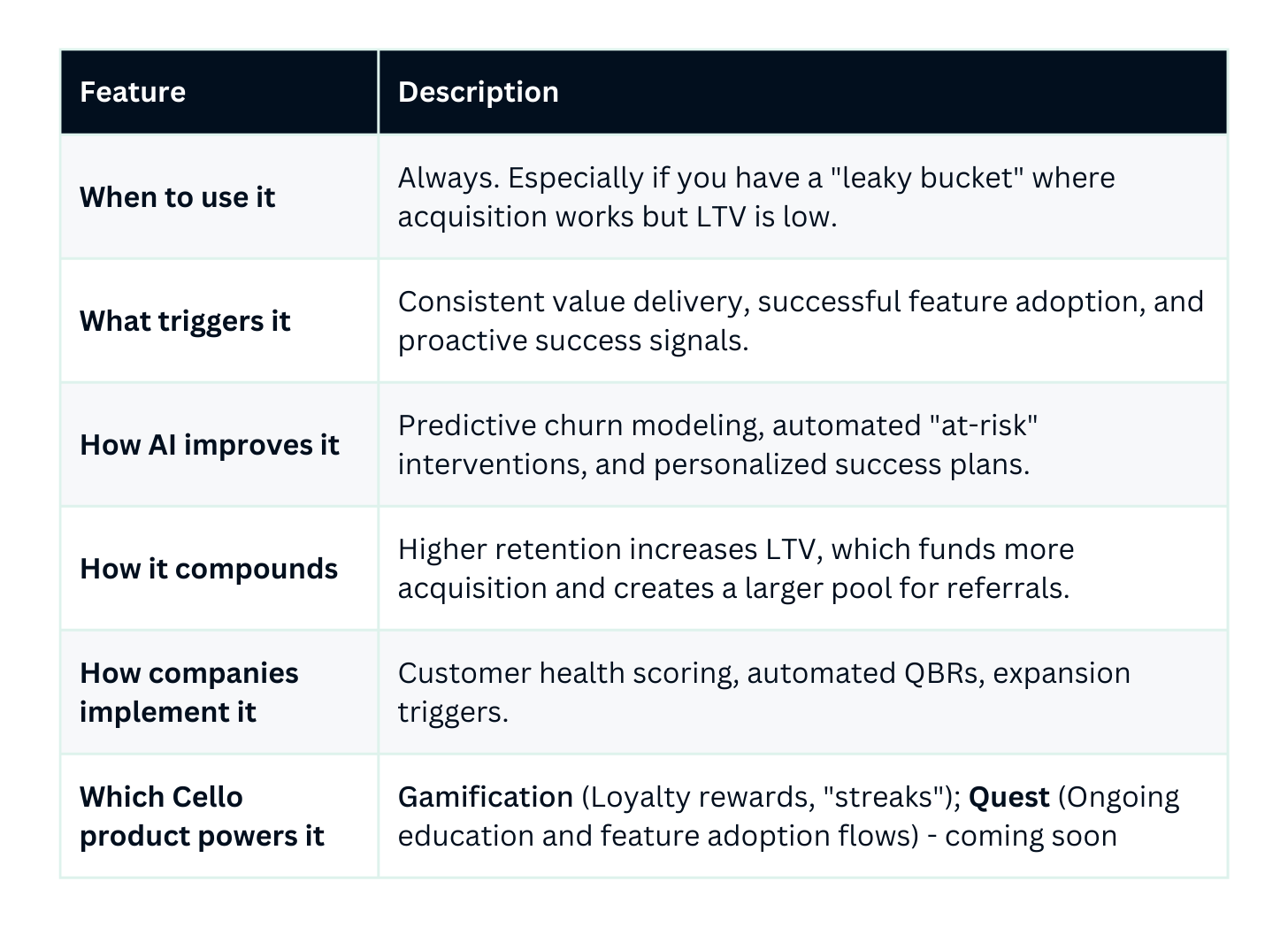
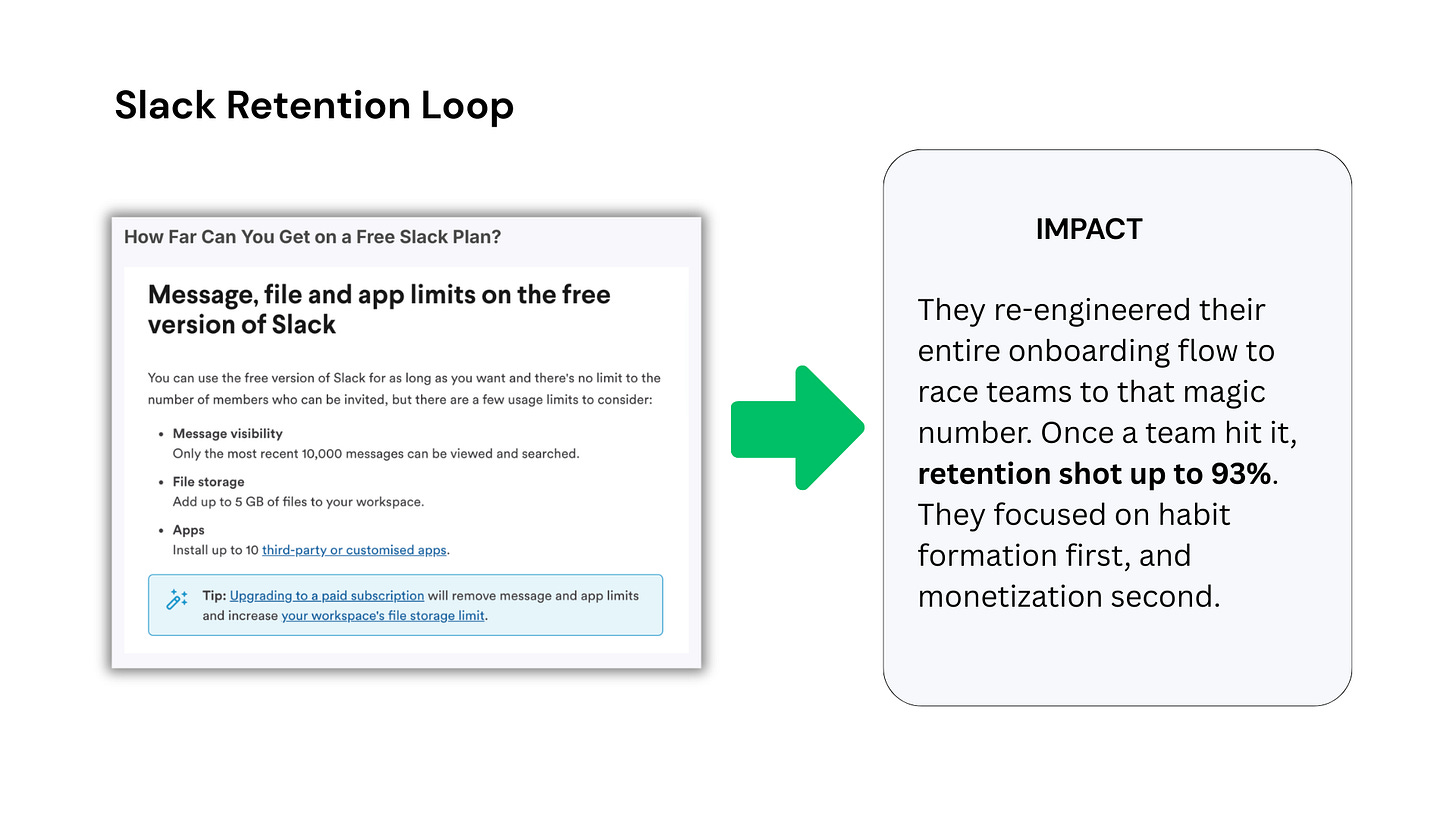
Here’s an example of this: Slack’s retention loop.
8. Onboarding Loop
Activation is the #1 predictor of LTV. This loop bridges the gap between signup and the “Aha!” moment.
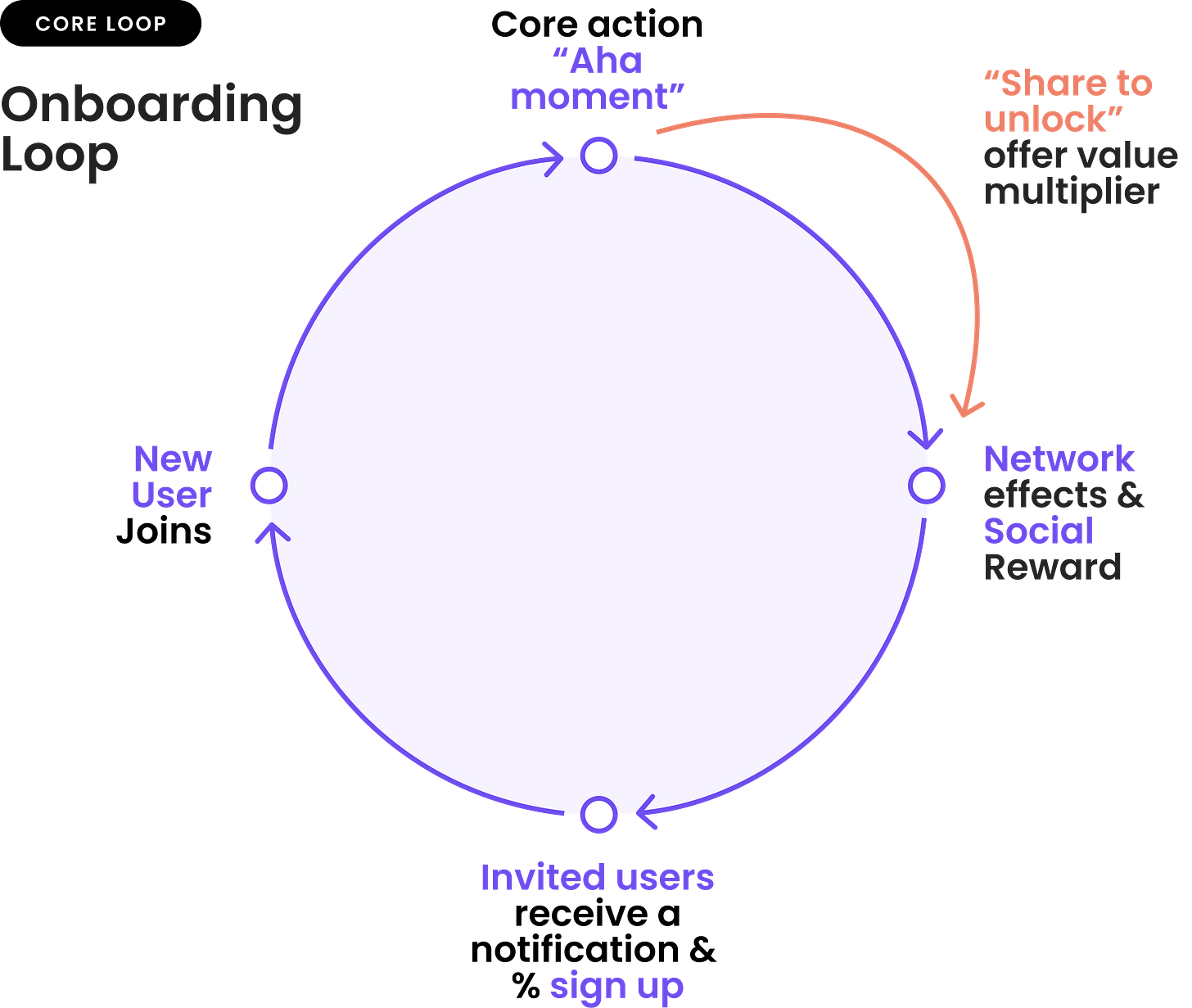
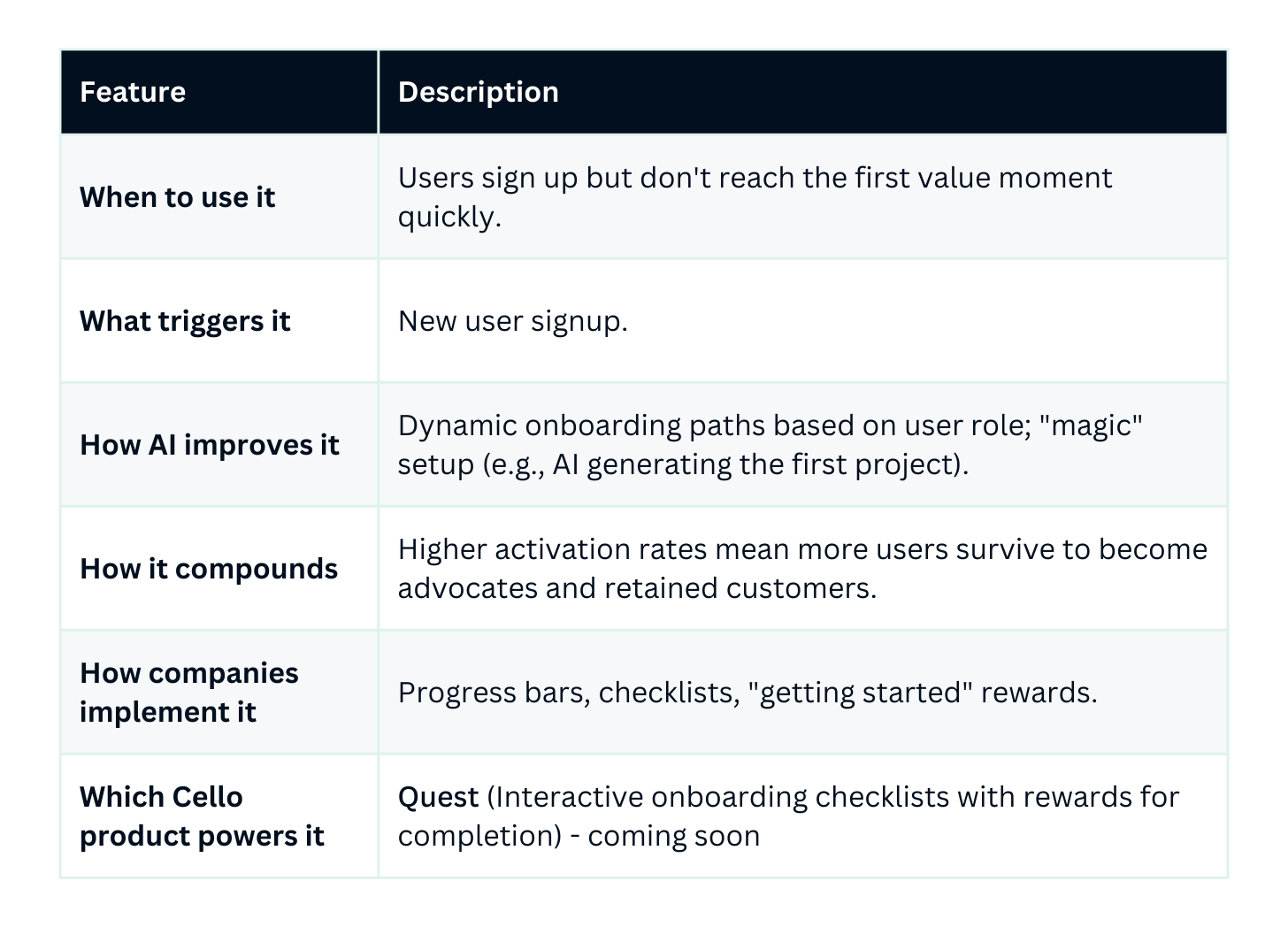
Here’s an example of this: Canva’s onboarding loop.

Diagnosing Product-Channel Fit Collapse
You’re experiencing Product-Channel Fit Collapse if:
- Your best channels stop producing results even when spent increases.
- CAC payback stretches beyond 24-36 months.
- Reply rates decline across every outbound motion.
- Performance marketing spend becomes unpredictable.
- SEO traffic stagnates despite maintaining rankings.
- You rely on platforms where visibility can shift overnight.
If three or more of these describe your situation, it’s time for a fundamental GTM rebuild.
How to Rebuild Your GTM Before It Fails
- Replace Volume with Signal Kill spray-and-pray. Rebuild around intent, usage, and ecosystem cues. Instead of emailing 10,000 prospects, identify the 100 showing genuine buying signals.
- Replace Channels with Loops Shift investment from algorithm-dependent channels to product-embedded loops. Audit your acquisition mix: are you renting or owning?
- Replace Silos with a Growth OS Move to a cross-functional GTM engineering pod (RevOps + Growth + Product + AI). Focus on conversion, retention, expansion, and referrals.
- Update Your Metrics Dashboard Stop obsessing over “Leads” and “MQLs.” Shift focus to Loop Metrics:
- Payback Period by Channel
- Viral Coefficient
- Network Saturation
- Signal Conversion
The Future Belongs to Teams Who Own Their Distribution
Let’s be clear about what’s happening. Products are easier to build than ever. Channels are collapsing faster than ever.
A defensible asset left is human-earned trust encoded into growth loops.
Users who love your product and tell others. Community members who create content and answer questions. Partners who integrate and co-market. These relationships compound. They can’t be bought. They can’t be automated. They can’t be disrupted by the next algorithm change.
Distribution is no longer a channel problem. It’s an operating system problem.
The companies that thrive will be the ones that are most connected. They’ll turn their customers into advocates, their partners into distribution channels, and their content into media assets. They’ll stop renting their growth and start owning it through loops.
Start now. The easiest loop to activate immediately is the one sitting in your existing happy customer base. Don’t rent attention; unlock the advocacy you already own.
Start with one loop. Make it work. Then add another. The future belongs to teams who own their distribution. Build your Growth OS before someone else builds it around you.
Frequently Asked Questions
What is a Growth OS and how does it differ from a traditional marketing funnel?
A Growth OS is a cross-functional operating system where marketing, sales, and product act as interconnected nodes, not sequential handoffs. Unlike a traditional funnel, which resets to zero each month, a Growth OS builds compounding loops where every output (revenue, users, data) becomes the input for the next growth cycle. It replaces linear acquisition with self-reinforcing momentum.
Why is CAC payback period increasing so dramatically for SaaS companies in 2025?
CAC payback has ballooned to a median of 57 months for public SaaS companies, according to Jamin Ball's Clouded Judgement data. The root cause is channel degradation: zero-click searches reached 69% in 2025, cold email reply rates collapsed to under 4%, and cold call success rates dropped to 2.3%. Companies are spending more on channels that return less.
What are the 8 growth loops in the Growth OS Map?
The 8 growth loops are: Viral Loop (User Referrals), Viral Loop (Partners and Affiliates), Content Loop (Owned Media), Community Loop (UGC), Integration Loop (Ecosystem Distribution), Product-Led Loop (Casual Contact), Retention Loop, and Onboarding Loop. Each loop converts a specific output, trust, usage, content, or advocacy, into a compounding acquisition input that cannot be disrupted by algorithm changes.
How do referral programs function as a defensible growth loop for B2B SaaS companies?
Referral programs operationalize human trust, the scarcest resource in the AI era, by embedding sharing moments directly into the product experience. Referred users spend 25% more and churn 18% less, according to Wharton research. Platforms like Cello enable B2B SaaS companies to activate this loop with two-sided incentivization, turning satisfied users into measurable acquisition channels that compound with each cohort.
What is Product-Channel Fit Collapse and what are the signs it is happening to your business?
Product-Channel Fit Collapse occurs when your best acquisition channels stop producing results despite increased spend. The warning signs are: CAC payback stretching beyond 24–36 months, declining reply rates across all outbound motions, unpredictable performance marketing ROI, stagnant SEO traffic despite maintained rankings, and reliance on platforms where visibility can shift overnight. Three or more of these signals indicate a fundamental GTM rebuild is required.
Why can AI not replace human trust signals in B2B growth strategies?
AI floods channels with volume, which is precisely what destroys their effectiveness. Human trust signals, peer recommendations, genuine reviews, community contributions, personal referrals, cannot be faked at scale by AI. BCG's B2B SaaS Growth Report confirms that best-in-class SaaS companies rely 2–3x more on customer advocacy than their peers, specifically because advocacy carries a credibility signal that paid and AI-generated content cannot replicate.
How does the integration loop create defensible distribution for SaaS products?
The integration loop creates distribution by embedding your product into the tools your buyers already use. Each integration opens a new audience of high-intent users who discover your product through their existing workflow. Alloy's research shows integration users are 58% less likely to churn, creating a switching cost that generic competitors cannot replicate. This is why ecosystem distribution is categorized as a defensive growth loop, not a campaign.
What metrics should growth teams track to measure loop performance instead of traditional funnel KPIs?
Loop-native metrics replace traditional funnel KPIs in a Growth OS. The four to track are: Payback Period by Channel (cost efficiency per loop), Viral Coefficient (how many new users each existing user generates), Network Saturation (how penetrated your addressable market is), and Signal Conversion Rate (the percentage of intent signals that convert to pipeline). These measure compounding momentum, not one-time acquisition volume.
Growth Is Now a Trust Problem
Want to understand trust-based growth? Read our collaboration with Elena Verna on why trust is ...

Complete Guide to your B2B Referral Program
Want to get started with B2B referrals? Check out our complete guide to your B2B referral ...

Scaling and Maintaining a B2B User Referral Program
Learn how to set the right incentives for B2B SaaS user referral programs