

You probably know referrals convert better and cost less than paid acquisition, but the gap between knowing that and actually running referrals as a real channel is where most B2B SaaS teams get stuck. Static landing pages. Manual coupon codes. Cookie tracking that breaks under Safari. Payouts handled in spreadsheets. No ownership, no metrics, no repeatability. If you want a referral program that drives measurable ARR, you need to build it like infrastructure with unique links, server-side attribution, automated rewards tied to billing events and in-product placement. This post walks through what a referral program is, why the economics matter for SaaS and how to build one in six steps.
- What is a referral program?
- Why referral programs matter for B2B SaaS companies
- How referral programs work (the mechanics)
- Types of referral programs for SaaS
- Referral program rewards and incentive structures
- How to build a referral program for your SaaS in 6 steps
- Referral program metrics and benchmarks
- Common referral program mistakes and how to avoid them
- B2B SaaS referral program examples
- Referrals on autopilot with Cello
- Final thoughts on SaaS referral program mechanics
TLDR:
- Referral programs turn word-of-mouth into a measurable channel by tracking every share, signup and conversion through software tied to billing events.
- B2B SaaS companies cut blended CAC by 25 to 35 percent with referral programs because rewards only fire after verified conversions.
- Server-side attribution via billing metadata survives Safari ITP and ad blockers where cookie tracking fails.
- Two-sided rewards work best: the referee gets a signup discount, the referrer gets paid after the first invoice clears.
- Cello embeds referral surfaces inside B2B SaaS products and attributes server-side off Stripe or Chargebee webhooks.
What is a referral program?
A referral program is a structured growth motion where existing customers recommend a product to peers in exchange for rewards, with every share, signup and conversion tracked through software instead of spreadsheets.
That tracking layer is what separates it from organic word-of-mouth. Word-of-mouth happens whether you instrument it or not. A referral program turns the same behavior into a measurable acquisition channel with attribution, reward logic and triggers tied to billing events.
The software layer handles four jobs that spreadsheets cannot do reliably at scale:
- Generates a unique link per user so every share traces back to a single referrer.
- Captures the referral code and stamps the referrer ID onto the new account, so attribution holds even when cookies drop.
- Listens for the qualifying billing event and calculates the reward against your payout rules.
- Triggers the payout itself, whether that is account credit applied in-product or cash sent to an external account.
Take any one of those jobs back into manual tracking and the program stops being a channel you can measure and starts being guesswork.
How it works in B2B SaaS
For B2B SaaS, the mechanics look like this:
- Each user gets a unique referral link tied to their account.
- They share it with colleagues or peers.
- The referred person signs up and hits a qualifying milestone: paid subscription, demo attended or invoice paid.
- Both sides receive a reward automatically, whether cash, account credit, a discount, an extended trial or a gift card.
No reward fires until the billing or product layer logs a verified event.
Why referral programs matter for B2B SaaS companies
The case for referrals in B2B SaaS is a channel-economics argument, not a brand argument. SaaS companies that add a referral channel cut blended CAC by 25 to 35 percent, per SaaS referral benchmarks, because rewards only fire after a verified conversion. There is no cost-per-click or cost-per-lead exposure.
Quality compounds the cost advantage. Referral marketing research reports that referred leads convert at higher rates than paid leads and that referred B2B customers tend to retain longer.
Lower acquisition cost, higher conversion, longer retention. Paid channels structurally cannot match that combination.
How referral programs work (the mechanics)
Every referral program runs the same four-step loop, and the mechanics determine whether it produces reliable revenue or attribution headaches.

- Share. A user pulls their unique link from inside the product and sends it over email, Slack, LinkedIn or a QR code.
- Click and land. The prospect clicks, the referral code is captured and the visit is tied to the referrer.
- Sign up and attribute. The referrer ID is stamped onto the new user record as metadata, so attribution survives without cookies.
- Convert and reward. When the new user hits a qualifying billing event, the billing system fires a webhook back to the referral software, which calculates the reward and triggers payout.
Server-side attribution is what makes step 3 hold up. Reading the referrer ID off the Stripe or Chargebee customer object closes the loop even under Safari ITP, ad blockers, or strict consent regimes. Two-sided structures then map cleanly to revenue: the referee gets a discount at signup, the referrer gets cash, credit or a gift card once the first invoice is paid.
Types of referral programs for SaaS
Three program types get lumped together in most blog posts, but they map to different GTM motions and buyer expectations.
|
Program type |
Who refers |
Best fit |
|---|---|---|
|
User referrals |
Existing product users referring peers |
PLG and self-service SaaS |
|
Partner programs |
B2B partners, agencies, resellers |
Sales-led and hybrid SaaS |
|
Affiliate programs |
External content publishers and creators |
Top-funnel awareness plays |
User referrals compound where you have engaged daily users, since the referrer is a paying customer with peer trust. Partner programs work when deals close through introductions and account relationships. Affiliate programs sit closer to paid media, with publishers driving cold traffic for commission.
Referral program rewards and incentive structures
Reward design is the variable most likely to make or break participation. Underpay and share rates collapse; overpay relative to LTV and margin per referral goes negative.
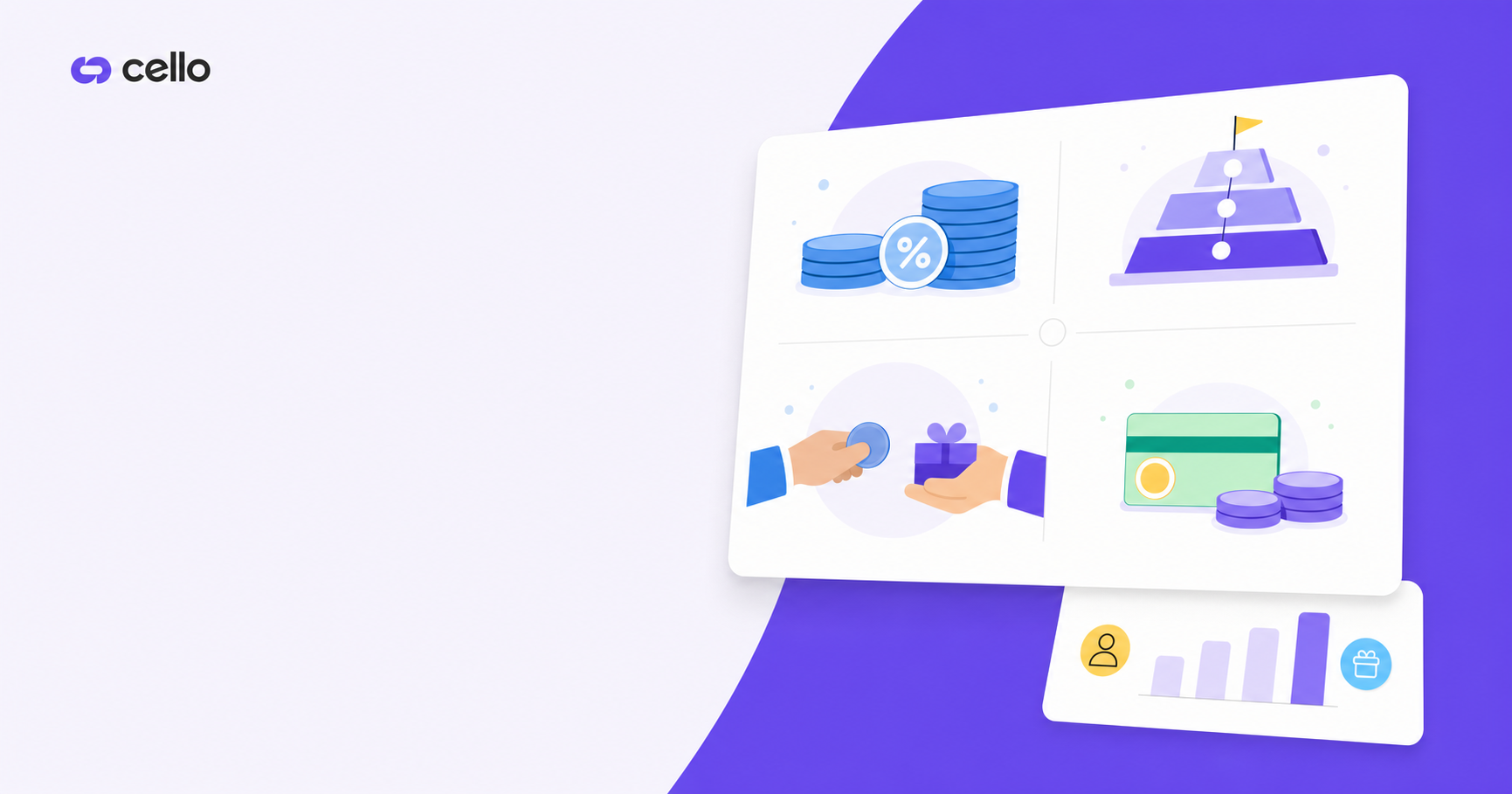
The reward types worth knowing:
- Percentage-based cash: a share of attributed new revenue that scales with subscription size.
- Flat-fee payouts: a fixed amount per conversion, simpler when billing does not expose per-customer revenue.
- Tiered structures: payout changes with plan or cumulative referrals, such as $100 per business-tier customer or $5 to $20 per basic-tier.
- Two-sided rewards: the referee gets a signup discount and the referrer gets cash, credit or a gift card after the first paid invoice.
- Non-cash alternatives: account credits, free months, trial extensions, training vouchers or feature access, useful in compliance-heavy industries where cash incentives raise compliance concerns.
The question to answer before launch is what is the most you can pay per converted referral and still beat blended paid CAC over 12 months. Cap reward percentages, fire payouts on invoice.paid instead of signup or drip rewards across renewal milestones when churn risk is high.
How to build a referral program for your SaaS in 6 steps
Six decisions, in order, get a program from zero to live.
- Define the goal and one north-star metric. Referral ARR, referred-user activation rate or program ROI, pick one.
- Set the reward structure. Choose percentage, flat-fee or tiered, then anchor the amount to a payback period under 12 months against blended paid CAC.
- Choose the attribution method. Server-side via billing metadata is the durable path; cookies are fallback only.
- Wire up billing. Map
cello_uccandnew_user_idonto the Stripe or Chargebee customer object soinvoice.paidtriggers reward calculation. - Configure eligibility and fraud rules. Exclude self-referrals, set payout delays for trials and decide which charge types count.
- Launch with in-product placement first, then layer email, lifecycle prompts and customer-success outreach to seed the first cohort.
Referral program metrics and benchmarks
Five metrics tell you whether a program is working.
- Share rate. Percentage of activated users who share a link. As a rough working target, many B2B SaaS programs aim for a share rate in the 5 to 15 percent range, though the right benchmark depends on your product and how visibly the referral surface is placed.
- Referral conversion rate. Of clicks that hit the landing page, how many convert. Median sits at 3 to 5 percent, with top performers above 8 percent, per published referral program benchmarks.
- Referral CAC vs blended CAC. Compare reward cost per converted referral against paid CAC. If the gap is under 50 percent, the program is underperforming.
- Program ROI. Referral program ROI data reports an average in the 5 to 8x range, with top-quartile brands driving up to 30 percent of total revenue from referrals.
- Referral ARR as percentage of total ARR. The compounding signal. Above 10 percent means referral has earned a seat at the channel table.
Common referral program mistakes and how to avoid them
Five failure modes account for most underperforming programs. Each has a clean fix.
- One-sided rewards. Rewarding only the referrer suppresses referee click-through. Fix: structure two-sided incentives so the new user sees a discount or credit at signup.
- Email-only placement. Asking for shares in a marketing email misses the moment of intent. Fix: embed the referral surface in-product, anchored to milestones like project completion or a paid invoice.
- Vague payout terms. “Earn rewards for referring friends” creates support tickets. Fix: state the exact amount, qualifying event, and payout timing in the widget itself.
- Campaign thinking. Quarterly pushes starve compounding. Fix: run referrals as an always-on channel with an owner and weekly metric review.
- Cookie-only attribution. Tracking leaks under Safari ITP and ad blockers. Fix: stamp
cello_uccandnew_user_idonto the billing customer before launch, so conversions attribute off theinvoice.paidwebhook.
B2B SaaS referral program examples
Five published B2B SaaS programs, each tied to a specific mechanic worth copying.
- Typeform hit a 27.2 percent sharing rate among activated users by placing the referral surface inside the product and pairing it with a two-sided reward.
- VEED cut CAC by 90.4 percent versus paid acquisition after replacing email-only prompts with an embedded widget and automated payouts.
- Moss grew Referral ARR 650 percent year over year, running the program in English, German and Dutch from a first-level menu placement.
- tl;dv drove 30.3 percent freemium-to-paid conversion on referred traffic by triggering rewards on the paid event, not signup.
- Softr saw a 5x conversion lift after migrating from PartnerStack to Cello.
The pattern is in-product placement, server-side attribution and payout tied to a billing event.
Referrals on autopilot with Cello
Cello is the referral layer for B2B SaaS teams running this as infrastructure, not a side project. We embed inside your product via web and mobile SDKs, attribute server-side off Stripe and Chargebee webhooks so tracking survives ITP and ATT, and automate reward math and payouts across PayPal, Venmo, ACH and UPI. Fraud detection, tax-form collection, sanctions screening and compliant payouts ship by default. User referrals and partner programs run on one system, with the Cello AI Assistant flagging optimization moves against benchmarks.
Go-live takes days, not quarters: Hera shipped in two days and Butter shipped in under five hours.
Final thoughts on SaaS referral program mechanics
A referral program that compounds is just attribution plus reward logic plus a surface your users actually see, all tied to verified billing events. You can build that loop in-house over months, or spin up Cello and go live in days with tracking that survives ITP, automated payouts and fraud detection out of the box. The difference between a referral motion that stalls and one that scales is whether you treat it like infrastructure or a marketing experiment. Most SaaS teams already have the engaged users, they just need the software layer that turns shares into attributed ARR.
Our referral program's active share rate is below benchmark. What are the most effective ways to increase user awareness and participation?
A below-benchmark share rate almost always traces to one of three structural causes: the referral surface is placed where users haven't yet experienced value, users don't know the program exists, or the reward isn't visible at the moment they're prompted to share. The highest-leverage interventions, in priority order: Move the in-product surface to a post-value moment (anchor the referral widget to a milestone the user just completed); add an email activation layer for users who missed the in-product prompt; make the reward visible at every share touchpoint (state the exact amount, the qualifying event, and the payout timing in the widget itself); activate your highest-NPS accounts directly via customer-success outreach; and distribute referral links through channels users already live in (email signatures, community Slack, WhatsApp or SMS). Treat the first 90 days after any placement change as a calibration window
Our referral program launched 6 months ago but conversion is under 3%. Which analytics and testing tools help optimize an underperforming program?
A referral conversion rate under 3% typically points to one of three failure modes: the referral surface is placed where users have not yet experienced value, the landing page the referee sees carries no incentive, or the attribution layer is leaking conversions before they close. The analytics and testing capabilities that matter: funnel-stage attribution (to show where the conversion chain breaks — click, signup, or paid conversion); referral surface placement testing (to compare share rates per in-product placement); reward structure testing (to run different reward types or amounts against user segments); an attribution audit trail (a per-referral log showing click timestamp, billing event timestamp, reward trigger, and whether attribution was server-side or cookie-dependent); and benchmark comparison (platform-level benchmarks for share rate and conversion rate by industry or motion). Cello's portal surfaces funnel-stage analytics, per-placement share rates, and an attribution audit trail linked to billing events.
How can we drive referral program awareness and participation outside the in-app widget — through email, WhatsApp, or other channels?
The distribution channels that produce measurable share volume beyond the in-app widget include: Lifecycle email (trigger a referral invite email at the same activation milestone the in-product widget fires, state the exact reward amount and qualifying event in the subject line, and link directly to the share flow); WhatsApp and messaging channels (referral links are URL-portable and work in any channel that supports link sharing, with identical attribution fidelity via the UCC stamped to the customer object at click time); email signature embed (adding the referral link to outgoing email signatures from customer-success, onboarding, and support teams); community Slack or Discord (pinning the referral link in a dedicated channel or community welcome messages); and customer-success outreach (a direct CSM message to high-NPS accounts is the fastest way to seed the first referrer cohort, with CS-seeded programs typically seeing their first attributed conversions 30–45 days earlier than programs relying on in-product placement alone)
Will referral programs work for B2B SaaS in niche markets with long sales cycles and multiple decision-makers?
Referral programs work in long-cycle, multi-stakeholder B2B markets — including regulated verticals like credit and collections — but the mechanics need to match the buying motion. The structural adjustments that make referral programs viable in these markets: set the reward trigger on a milestone the sales cycle actually produces (e.g., a demo attended, an SQL qualification completed, or a signed contract) rather than requiring a billing event; map attribution to organizational identifiers (new_user_organization_id) rather than individual user IDs so the original referrer earns credit even when the person who pays is not the person who clicked the link; use non-cash rewards (account credits, subscription discounts, or feature access) where compliance requires it; and seed distribution through industry-specific communities and events rather than relying solely on in-product placement. The compounding effect is present in niche markets even at lower absolute share volumes, and the LTV-to-CAC ratio on a referred enterprise customer in a sticky vertical is structurally higher than in a commodity self-serve market.
How do you measure customer referral program ROI?
Referral program ROI is referral-attributed ARR divided by total reward spend over the same period — and the number is meaningful only when attribution closes at the billing layer, not at signup. Five metrics drive the calculation: share rate (the percentage of activated users who share a referral link — many B2B SaaS programs aim for 5 to 15 percent as a rough working target); referral conversion rate (the share of clicks that result in a qualifying paid conversion — median sits at 3 to 5 percent, with top performers above 8 percent); referral CAC vs blended CAC (reward cost per converted referral compared against blended paid CAC — a gap under 50 percent signals the program is underperforming); referral ARR as a percentage of total ARR (the compounding signal — once it crosses 10 percent, referral has earned a seat at the channel table); and program ROI (referral-attributed ARR divided by reward spend, with an average in the 5 to 8x range reported, and top-quartile programs driving up to 30 percent of total revenue from referrals). The single most common measurement failure is closing attribution at signup rather than at a paid billing event.
What incentives work for B2B SaaS customer referrals?
Two-sided cash or credit rewards that fire on a verified paid conversion outperform one-sided or non-monetary structures in most B2B SaaS programs. The structures worth evaluating: two-sided cash rewards (the referee receives a signup discount or trial extension; the referrer receives cash after the first invoice is paid); percentage-based payouts (a share of attributed new MRR that scales with subscription size); flat-fee payouts (a fixed amount per paid conversion, simpler when billing does not expose per-customer revenue); tiered structures (reward amount scales with plan tier or cumulative referral count); and non-cash alternatives (account credits, free months, trial extensions or feature access — preferred in compliance-heavy industries where cash incentives raise regulatory concerns). Cap the reward at an amount that keeps referral CAC below your blended paid CAC over a 12-month payback period. Fire payouts on invoice.paid rather than signup, and when early churn is a known risk, drip rewards across the first two or three renewal milestones.
I approved a referral program budget but can't attribute revenue to it. Which platforms provide real-time ROI dashboards linking referral activity to revenue?
The attribution gap is almost always structural — conversion credit closes at signup rather than at a verified billing event, so the program counts leads it did not earn and misses conversions that happened weeks after the initial click. The platform requirements for a revenue-linked ROI dashboard: billing-event attribution closure (the platform must read invoice.paid or charge.succeeded webhooks from your billing system — Stripe, Chargebee, Paddle, or Recurly — and close conversion credit at that event, not at signup); a real-time reward and payout ledger (a line-item view of every reward triggered, the billing event that triggered it, the reward amount, and the payout status); referral CAC vs blended CAC comparison (surfaced without a manual spreadsheet calculation); and referral ARR as a percentage of total ARR (the compounding metric for CFOs, requiring the platform to read MRR or ARR data from billing rather than self-reported deal values). Cello's portal links every referral event to its originating billing webhook, producing a real-time payout ledger and a referral ARR figure that ties directly to Stripe, Chargebee, Paddle, or Recurly data.
How do you position a referral incentive program to B2B customers in trust-sensitive industries who believe recommendations should be based purely on product quality?
The positioning that resolves this objection in practice: Frame the incentive as acknowledgement, not inducement — the reward does not create the referral, it acknowledges the referrer's effort after the fact; use non-cash rewards (account credits, subscription discounts, or training vouchers) where cash feels transactional or raises compliance concerns; make the reward transparent to the referee at signup so both parties know the reward structure and the recommendation is not hidden behind a neutral facade; set the qualifying event at a milestone that reflects genuine product engagement (not just a signup) so the reward aligns with a real outcome; and pilot with your highest-NPS accounts first, since customers who already advocate publicly are the segment least likely to experience the incentive as a conflict with their existing advocacy. Regulated and trust-sensitive B2B SaaS companies run referral programs successfully when the program design matches the industry's norms around professional relationships.
We need a referral platform with SSO, role-based admin access, and enterprise SLAs. Which platforms meet enterprise security requirements?
Enterprise SaaS teams should look for four structural capabilities: SAML-based SSO (the platform must support SAML 2.0 federation with major identity providers — Okta, Azure AD, Google Workspace — so access provisioning is controlled by the organization's IdP); role-based access control (at minimum, separate roles for program owner, finance reviewer, and read-only analyst — enterprise procurement typically requires demonstrating that payout approval and program configuration are separated permissions); SOC 2 Type II certification (an independent audit of security, availability, and confidentiality controls covering at least six months — SOC 2 Type I does not satisfy most enterprise security teams); data residency and DPA availability (for regulated industries or EU jurisdictions, a Data Processing Agreement and, where required, EU data residency); and a contractual uptime SLA (typically 99.9% or higher) with a defined incident response window. Cello is SOC 2 Type II certified, supports SAML SSO, provides role-based access control across program owner, finance, and analyst roles, and offers a DPA for EU customers, with server-side attribution keeping billing metadata within the enterprise's existing compliance boundary.
How long until a customer referral program starts producing pipeline?
Most B2B SaaS programs see their first attributed conversions within 30 to 60 days of launch — but sustained pipeline requires a referrer base that compounds across cohorts, which typically takes 90 to 180 days to build. The variables that compress time-to-pipeline: in-product placement at an activation milestone (programs relying on email-only outreach see slower initial share rates); a two-sided reward the referee sees at signup (if the prospect sees no incentive, click-to-signup conversion drops); server-side attribution from day one (cookie-based tracking leaks attribution during the ramp phase, making the program appear to underperform and delaying budget protection); and customer-success seeding of the first cohort (proactively inviting highest-NPS accounts to share during launch week establishes the first referrer base before automated placement scales organically). Treat the first 90 days as a calibration window: measure share rate, referral conversion rate and referral CAC weekly, adjust placement and reward structure against those signals, and run the program as an always-on channel rather than a quarterly campaign.
We want to activate our power users as advocates. Which platforms let us segment referral audiences by usage tier or customer attributes?
Segmenting referral audiences by usage tier ties referral eligibility and prompt placement to identity and billing metadata — not to a manually maintained list. The segmentation capabilities an advocate activation program requires: user-attribute eligibility rules (the ability to gate referral program access or prompt display based on customer-object metadata — plan tier, seat count, usage events, or days since activation); tiered reward structures by segment (configuring different reward amounts or types per user segment, so reward spend is proportional to the pipeline value each segment produces); in-product surface targeting (triggering the referral widget at activation milestones specific to power-user behavior rather than at a fixed point in the flow); and attribution by segment (reporting that breaks referral ARR, share rate, and conversion rate by user segment). Cello supports eligibility rules tied to customer-object metadata from Stripe, Chargebee, Paddle, or Recurly — so power-user segmentation does not require a separate CRM integration or a manual upload.
How does word-of-mouth marketing scale for SaaS products with a freemium or trial model?
Word-of-mouth scales for freemium and trial SaaS when the sharing moment is triggered at the point of experienced value — not at signup, and not from a marketing email sent days later. The mechanics that make word-of-mouth scalable in a freemium or trial model: activation-gated prompts (triggering the share surface at a defined activation milestone, not on day one of the trial — users who have experienced value refer peers more likely to convert); freemium-to-paid conversion as the reward trigger (structuring the referral reward to fire when the referred user converts from free to paid, which aligns the referrer's incentive with revenue — tl;dv drove a 30.3% freemium-to-paid conversion rate on referred traffic this way); unique link generation for free and trial users (making referral links available to the full activated user base so the referrer pool scales with the installed base, not just the paid customer count); in-product surface placement over email campaigns (embedding the share prompt inside the product at the activation event rather than in a post-trial email sequence); and server-side attribution across the free-to-paid funnel (stamping the referrer ID to the customer object at click time so the conversion is attributed regardless of how long the free period lasts).
How does Cello handle referral attribution when the person who pays is different from the person who shared the link?
Server-side attribution maps organizational identifiers (new_user_organization_id) rather than individual user IDs so the original referrer earns credit even when payment occurs through a separate contact like procurement, finance or executive leadership. This addresses enterprise sales motions where the product user drives the referral but contract signature happens outside standard subscription billing, and you implement this through CRM integration with Salesforce Apex Triggers or HubSpot deal associations.