We use cookies to analyze site performance and deliver personalized content. By clicking “Agree” you consent to the storing of cookies.
Customize Consent Preferences
We use cookies to help you move through the site efficiently and perform certain functions. You will find detailed information about all cookies under each consent category below.
The cookies that are categorized as "Necessary" are stored on your browser as they are required for supporting the basic functionalities of the site. ...
Always Active
Necessary cookies are required to support the basic features of this site, such as providing secure log-in or adjusting your consent preferences. These cookies do not store any personally identifiable data.
- Cookie__hssrc
- Durationsession
- DescriptionThis cookie is set by Hubspot whenever it changes the session cookie. The __hssrc cookie set to 1 indicates that the user has restarted the browser, and if the cookie does not exist, it is assumed to be a new session.
- Cookiecookieyes-consent
- Duration1 year
- DescriptionCookieYes sets this cookie to remember users' consent preferences so that their preferences are respected on their subsequent visits to this site. It does not collect or store any personal information of the site visitors.
- Cookie_lfa
- Duration1 year
- DescriptionThis cookie is set by the provider Leadfeeder to identify the IP location of devices visiting the website, in order to retarget multiple users routing from the same IP location.
- Cookieintercom-id-*
- Duration8 months 26 days 1 hour
- DescriptionIntercom sets this cookie that allows visitors to see any conversations they've had on Intercom websites.
- Cookieintercom-session-*
- Duration7 days
- DescriptionIntercom sets this cookie that allows visitors to see any conversations they've had on Intercom websites.
- Cookieintercom-device-id-*
- Duration8 months 26 days 1 hour
- DescriptionIntercom sets this cookie that allows visitors to see any conversations they've had on Intercom websites.
- Cookie_cfuvid
- Durationsession
- DescriptionCalendly sets this cookie to track users across sessions to optimize user experience by maintaining session consistency and providing personalized services
- CookiewpEmojiSettingsSupports
- Durationsession
- DescriptionWordPress sets this cookie when a user interacts with emojis on a WordPress site. It helps determine if the user's browser can display emojis properly.
Functional cookies help perform certain functionalities like sharing the content of the website on social media platforms, collecting feedback, and other third-party features.
- Cookie__cf_bm
- Duration1 hour
- DescriptionThis cookie, set by Cloudflare, is used to support Cloudflare Bot Management.
- Cookie__hssc
- Duration1 hour
- DescriptionHubSpot sets this cookie to keep track of sessions and to determine if HubSpot should increment the session number and timestamps in the __hstc cookie.
- Cookieli_gc
- Duration6 months
- DescriptionLinkedin set this cookie for storing visitor's consent regarding using cookies for non-core purposes.
- Cookielidc
- Duration1 day
- DescriptionLinkedIn sets the lidc cookie to support data center selection.
Analytical cookies are used to understand how visitors interact with the website. These cookies help provide information on metrics such as the number of visitors, bounce rate, traffic source, etc.
- Cookie__hstc
- Duration6 months
- DescriptionThis is the main cookie set by Hubspot, for tracking visitors. It contains the domain, initial timestamp (first visit), last timestamp (last visit), current timestamp (this visit), and session number (increments for each subsequent session).
- Cookiehubspotutk
- Duration6 months
- DescriptionHubSpot sets this cookie to keep track of the visitors to the website. This cookie is passed to HubSpot on form submission and used when deduplicating contacts.
- Cookie_ga_*
- Duration1 year 1 month 4 days
- DescriptionGoogle Analytics sets this cookie to store and count page views.
- Cookie_ga
- Duration1 year 1 month 4 days
- DescriptionGoogle Analytics sets this cookie to calculate visitor, session and campaign data and track site usage for the site's analytics report. The cookie stores information anonymously and assigns a randomly generated number to recognise unique visitors.
- Cookie_gcl_au
- Duration3 months
- DescriptionGoogle Tag Manager sets the cookie to experiment advertisement performance of websites using their services.
- Cookie_hjSessionUser_*
- Duration1 year
- DescriptionHotjar sets this cookie so that data from subsequent visits to the same site is attributed to the same user ID, which persists in the Hotjar User ID, which is unique to that site.
- Cookie_hjSession_*
- Duration1 hour
- DescriptionHotjar sets this cookie so that data from subsequent visits to the same site is attributed to the same user ID, which persists in the Hotjar User ID, which is unique to that site.
Other uncategorized cookies are those that are being analyzed and have not been classified into a category as yet.
- Cookie_lfa_test_cookie_stored
- DurationLess than a minute
- DescriptionDescription is currently not available.
Powered by

Guidelines on Tax Reporting for Referral-Users in Israel
Table of Contents
Table of Contents
Disclaimer: Cello takes the tax treatment for end-users very seriously and provides country-specific information. Taxes are a complex subject. Your tax obligations may vary depending on your particular circumstances. The following summary is intended to provide initial information only and cannot and should not be relied on as a tax advice.
THE SUMMARY BELOW IS INCLUDED FOR GENERAL INFORMATION ONLY AND MAY NOT BE APPLICABLE TO YOU DEPENDING UPON YOUR PARTICULAR SITUATION. YOU ARE URGED TO CONSULT YOUR OWN TAX ADVISOR WITH RESPECT TO THE TAX CONSEQUENCES APPLICABLE TO YOU AS A CELLO USER.
Being located in Israel and using Cello, a Referral User (Users that use the Cello Platform to participate in a referral program by referring the Customer's SaaS products to their network) needs to be aware, among other things, of the following Israeli tax considerations.
TLDR:
- Israeli referral users are suppliers of a service and bear full tax reporting responsibility to the Israel Tax Authority (ITA).
- Register as OSEK PATUR (exempt) if annual turnover stays below NIS 120,000; register as OSEK MURSHE (authorized dealer) above that threshold.
- OSEK MURSHE registrants must charge VAT at 18% effective January 2025, up from 17%, and file returns monthly or bi-monthly.
- Israel has not yet fully adopted OECD digital platform reporting rules, but the ITA is moving toward greater cross-border tax transparency for referral income.
- Cello issues a credit note twice a month and provides a monthly earnings summary; you use those documents to file your own returns with the ITA.
Definitions
Recipient vs. Supplier
- Recipient
- In this legal relation Cello is the recipient of a service.
- Supplier
- Referral Users are the suppliers of a service.
Since you are based in Israel and in this case the supplier, by conducting a referral and receiving a payment, you are responsible for taxes in Israel.
Israeli VAT
As a Referral User in Israel, you have to register with the ITA as either a
- Business which is exempt from VAT (”OSEK PATUR”)
- You should sign up as an exempt business if your annual turnover does not exceed NIS 120,000 (verify the current threshold on the ITA website before registering). In this context, you do not have to charge Israeli VAT on your income and you should not offset any input VAT.
- Please note that although OSEK PATUR is exempted from VAT, such an exempt business should still comply with several reporting obligations to the ITA (including VAT reporting obligations).
- Business that collects VAT (”OSEK MURSHE”)
- For businesses with annual turnover exceeding the "OSEK PATUR" threshold, or those who otherwise need to charge Israeli VAT, registration with the Israeli VAT Authority as an authorized dealer ("OSEK MURSHE") is required.
Tax Treatment
Referral User
In the following paragraphs, we provide examples of Referral User’s Israeli tax treatment.
Cello creates a credit note on your behalf two times a month listing all the referrals you have conducted and pays you your full earnings. You are responsible for reporting your earnings to the Israel Tax Authority ("ITA") and paying your taxes to the ITA.
Your tax obligations involve submitting periodic Israeli tax returns to the ITA. The OSEK PATUR (small business) must report annually (VAT statement and income tax return), while OSEK MURSHE (business subject to VAT) must report monthly or bi-monthly (VAT return) and annually (income tax return).
Please consider that if you choose to provide services as an individual, you may be required to comply with other mandatory reporting requirements (e.g., social security) regarding your income from Cello.
Legal form of referrer | Business which is exempt from VAT (OSEK PATUR) | Business that collects VAT (OSEK MURSHE) |
|---|---|---|
VAT Rate | Exempt from VAT | VAT on taxable sales (currently at rate of 17%) |
Tax Treatment | Personal Income Tax | Corporate tax |
Reporting Due Dates | While income tax returns are required to be filed annually, a monthly reporting and payment of tax advances is required. | While corporate income tax returns are required to be filed annually, a monthly reporting and payment of tax advances is required. |
More information can be found on the Israel Tax Authority website.
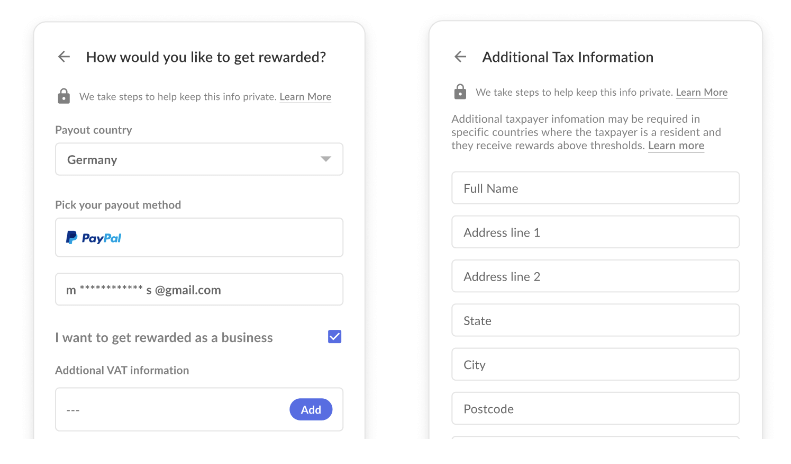
To support accurate reporting to local authorities for both the Referral User and Cello, Cello is required to report specific Referral User information to local authorities. In the payout process, you can choose to be rewarded as a corporation or as an individual and fill in the required information. The respective information will be displayed in the credit note issued to you by Cello.
Business Registration
Depending on the type of business (self-employed individual or corporation), different registration formalities are applicable in Israel. Here’s a detailed breakdown:
Sole Traders and Independent Contractors
Registration with Israel Tax Authority:
- If you are producing an income from Cello, you must register with Israeli VAT office and the Israeli income tax office.
- Choosing the Type of VAT Registration:
- Exempt from VAT (OSEK PATUR): if your annual turnover (including from platforms like Cello or independent income sources) does not exceed NIS 120,000 (confirm the current threshold on the ITA website) you can register with the Israeli VAT office as OSEK PATUR.
- Suitable for small businesses, it simplifies administration and then your income should not be subject to Israeli VAT.
- Authorized Dealer (Osek Murshe): Required if your earnings exceed the OSEK PATUR threshold or you need to charge VAT.
- Professional Assistance:
- Consider getting assistance from a certified accountant or tax advisor to set up your business.
- Income Tax:
- You are required to register with the ITA and report your income for Israeli income tax purposes.
Companies
- Choosing the Type of Company:
- Private Company (Ltd): Suitable for all businesses.
- Submission Requirements:
Formation of an Israeli limited liability company is done through an on-line system which is available for any person wishing to form a company. The incorporator is required to provide articles of association, shareholders' declaration and directors' declaration, which are all created by the on-line system.
Registration with Israel Tax Authority:
If you choose to provide services as a company, you must register with Israeli VAT office and the Israeli income tax office
VAT Registration
You can register for Israeli VAT online through the Israel Tax Authority's website. Here’s a structured guide on how to do this:
Online Registration Process
- Create an Account on the Israel Tax Authority Website:
- Visit the Israel Tax Authority's website.
- Provide your personal or business tax identification number to create an account.
- Access and Complete the VAT Registration Form:
- Log in to your account.
- Access the VAT registration form.
- Complete the form by providing the following information:
- Business Details: Business name, contact information, and type of business.
- Taxable Supplies and Acquisitions: Details of your taxable supplies and acquisitions.
- Exemptions and Deductions: Information on any exemptions or deductions that may apply.
Professional Assistance
- Certified Accountant or Tax Advisor: Alternatively, you can seek assistance from a certified accountant or tax advisor to help you with the VAT registration process.
By following these steps, you can efficiently register for VAT in Israel and keep your business in compliance with the relevant tax regulations.
FAQ
How do I know my total income from Cello?
Cello provides you a monthly overview of your earned income.
Do I need to create an invoice?
Cello will provide you with a credit-note with all required information for your local authorities. You will get a monthly tax summary overview that provides a detailed breakdown of your earnings (gross fares). This document will help you to issue an invoice to Cello and also prepare your tax return.
FAQ
How do Israeli referral users know what income to report to the Israel Tax Authority?
Cello issues a credit note twice a month listing all referrals completed and pays out full earnings. You also receive a monthly earnings summary with a detailed breakdown of gross income. Use both documents to prepare your tax return and, if required, issue an invoice to Cello.
What is the difference between OSEK PATUR and OSEK MURSHE registration for Israeli referral income?
OSEK PATUR applies when your total annual turnover stays below NIS 120,000. You do not charge VAT and you report annually. OSEK MURSHE is required above that threshold; you charge VAT at 18% (effective January 2025) and file returns monthly or bi-monthly, plus an annual income tax return.
Do I need to create my own invoice as an Israeli referral user on Cello?
No. Cello creates the credit note on your behalf, so you do not need to generate a separate invoice from scratch. The monthly earnings summary Cello provides contains the information required by local authorities and gives you the basis to file your own returns with the Israel Tax Authority.
What VAT rate should Israeli OSEK MURSHE referral users charge on Cello income in 2025?
18%, up from 17% effective January 2025. OSEK PATUR registrants remain exempt from charging VAT regardless of this rate change, provided annual turnover stays below the NIS 120,000 threshold.
Can Israeli referral users receive Cello payouts as a company rather than as an individual?
Yes. During the payout process you can choose to be rewarded as a corporation or as an individual. The selection determines how your details appear on the Cello-issued credit note and affects which tax obligations apply: a flat 23% corporate tax rate for companies versus progressive personal income tax rates starting at 10% for individuals.