

Paid acquisition costs for B2B SaaS have climbed to a point where referral programs aren't a nice-to-have anymore. But a lot of teams still haven't moved on it, mostly because the referral program setup feels like a bigger lift than it is. The real timeline depends on the application stack, billing flow, and referral experience. This guide covers the decisions, setup steps, and verification process required to launch safely.
- Why referral programs outperform paid acquisition in SaaS
- The three types of SaaS referral programs
- What to decide before you build anything
- How to design a reward structure that drives participation
- How to set up a SaaS referral program step by step
- Choosing referral software for SaaS
- Where your referral program should live in the product
- Attribution and fraud prevention: what breaks most programs
- Metrics to measure referral program performance
- Common mistakes that slow down or stall a SaaS referral program
- How Cello helps SaaS teams launch and verify a referral program
- Final thoughts on running a SaaS referral program at lower CAC
TL;DR
- Referral channels deliver new customers at $141 to $200 each versus $802 for paid search, per B2B tech CAC benchmarks.
- Lock five decisions before building: conversion event, referrer audience, reward type, one-sided vs two-sided and surface placement.
- Server-side attribution anchored to billing events is the only reliable path when ad blockers, Safari ITP and iOS ATT strip cookies.
- Referred customers show higher retention and lower churn, so measure ROI against lifetime value, not first-invoice revenue.
- Cello delivers an in-product referral component via SDK across web, iOS, Android, React Native and Flutter, with VEED running referrals at 90.4% lower CAC versus paid acquisition.
Why referral programs outperform paid acquisition in SaaS
Paid acquisition math has moved against B2B SaaS. According to B2B tech CAC benchmarks, referral channels deliver new customers at $141 to $200 each while paid search sits around $802. The gap is structural, not seasonal, and it changes how teams should model customer acquisition cost going forward.
You pay rewards only when a referred user converts to verified revenue, so spend tracks realized outcomes instead of impressions or clicks. No media budget burns while attribution settles.
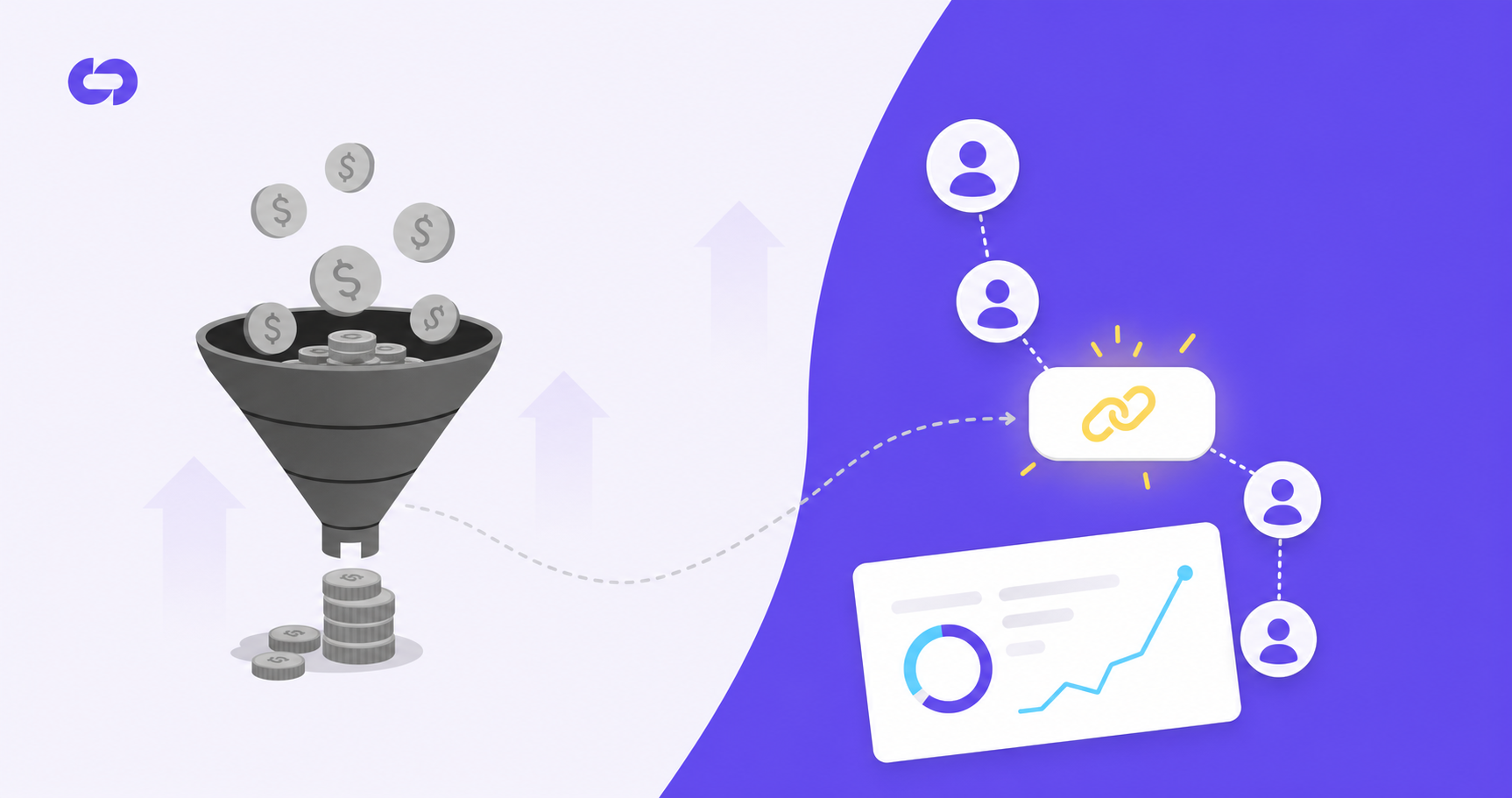
Quality compounds the advantage. Referred leads convert at higher rates and retain longer than paid traffic, pulling blended CAC down once the channel reaches steady state.
The three types of SaaS referral programs
Three distinct program types sit under the referral umbrella, and treating them as synonyms produces misconfigured rewards, broken attribution, and partners enrolled in the wrong workflow.
- User referral programs. Existing customers refer peers through an in-product surface. Fit: PLG and self-service SaaS with active users who experience the product enough to advocate for it.
- Partner programs. Agencies, consultants and resellers refer leads without being product users. Fit: sales-led or hybrid companies with existing distribution relationships and longer deal cycles.
- Affiliate programs. Publishers, creators and networks earn commission on conversions through their audiences. Fit: top-of-funnel reach with performance-based media budget.
Pick the model that matches your go-to-market before designing anything downstream. If you need a primer, see what a referral program is and how to build one for SaaS.
What to decide before you build anything
Most stalled programs trace back to decisions skipped before integration. Five choices shape the technical setup that follows.
- Conversion event. Pick the trigger that fires a reward: signup, first paid invoice or demo attended. PLG funnels anchor on invoice paid to align reward cost with realized revenue.
- Referrer audience. All users, activated users only, or a segment by tier, role or geography. This drives launcher visibility logic.
- Reward type. Cash, account credits, free subscription time, or non-cash vouchers for compliance-sensitive enterprise segments.
- One-sided or two-sided. Two-sided incentives lift referred conversion but compress per-referral margin.
- Surface placement. Embedded widget inside the authenticated product, or a standalone portal for non-users.
Lock these five before scoping integration. Each maps to billing webhooks, identity tokens and campaign rules, so reversing them post-launch means rebuilding tracking from scratch.
How to design a reward structure that drives participation
Reward design is where programs compound or leak budget. Six structures cover the practical range in B2B SaaS:
|
Reward type |
How it works |
Best fit |
|---|---|---|
|
Cash percentage |
Fixed percent of attributed new revenue |
PLG with clean MRR data |
|
Flat-fee per conversion |
Fixed amount on the conversion event |
Sales-led or opaque billing |
|
Subscription credits |
Service time extended on the referrer account |
Product-led, cash-averse teams |
|
In-app credits |
Usage or API credits |
Usage-based pricing |
|
Non-cash incentives for B2B SaaS |
Vouchers, tickets, feature unlocks |
Enterprise and compliance-sensitive buyers |
|
Tiered or progressive |
Reward escalates with cumulative referrals |
High-volume referrer cohorts |
Two-sided symmetric rewards lift referred conversion in PLG funnels; flip to one-sided if margin pressure appears at scale.
Timing protects unit economics. Pay on first paid invoice or after a retention hold, not at signup. For freemium, trigger on paid conversion.
Size rewards against the revenue a referred customer generates over a defined window. Treat sharing rate as a working target you calibrate against your own program data instead of a fixed industry number.
How to set up a SaaS referral program step by step
Work through these eight steps in order. Skipping any compresses launch by hours and adds weeks of debugging later. Choosing the right B2B SaaS referral software before step one avoids most of that rework.
- Define program goals and conversion events. Map each goal (Referral ARR, paid signups, demos) to a billing or CRM event.
- Choose reward structure and payout rail (PayPal, Venmo, account credits, manual).
- Score vendors against in-product embed, server-side attribution, days-to-live, and compliance posture.
- Wire Stripe, Chargebee, Paddle or Recurly to fire on the conversion event, passing referrer identity through customer metadata.
- Install the SDK inside the authenticated product, or stand up the partner portal for non-users.
- Test in a sandbox. Trigger end-to-end events and confirm rewards calculate and queue correctly.
- Soft-launch to a whitelisted cohort, watch attribution and activation, then expand.
- Set a 30-day cadence reviewing active rate, sharing rate, signup rate and unique views per share.
In practice, steps 4 and 5 tend to take the longest to get right. Server-side attribution anchored to billing events validates faster: replay invoice webhooks in sandbox and watch rewards fire without coordinating browser sessions or ad-blocker conditions.
Choosing referral software for SaaS
Four criteria separate B2B SaaS referral software from generic affiliate tools:
- Server-side attribution that holds when Safari ITP, ATT, or ad blockers strip cookies, with credit assigned at the billing event.
- In-product embedding via web and native mobile SDKs, not a standalone hosted portal that pulls users off-product.
- Pre-built billing integrations for Stripe and Chargebee, with API paths for Paddle and Recurly.
- Automated fraud detection covering self-referrals, duplicate signups, and chargeback reversals.
The build vs buy referral program decision comes down to engineering capacity. Building means owning attribution, payout retries, fraud rules, and tax-form validation. Buying collapses that to a one-time integration.
Where your referral program should live in the product
Placement decides whether a program activates. Three surfaces cover the practical range:
- In-product widget inside the authenticated experience, for PLG products with regular logins.
- Standalone partner portal for referrers without product accounts.
- Email or manual distribution for low-session-frequency products and sales-led motions.
A hidden launcher suppresses activation regardless of reward size. Behavioral triggers fixed after project completion, milestone events or positive satisfaction signals catch sharing intent at its peak. See the B2B referral program guide for placement patterns. On mobile, native SDKs hook the iOS and Android share sheet directly; webview wrappers break that path.
Attribution and fraud prevention: what breaks most programs
Attribution must survive ad blockers, Safari ITP, multi-device journeys, and iOS App Tracking Transparency, where estimated opt-out rates run high across the industry. Cookies alone will not hold.
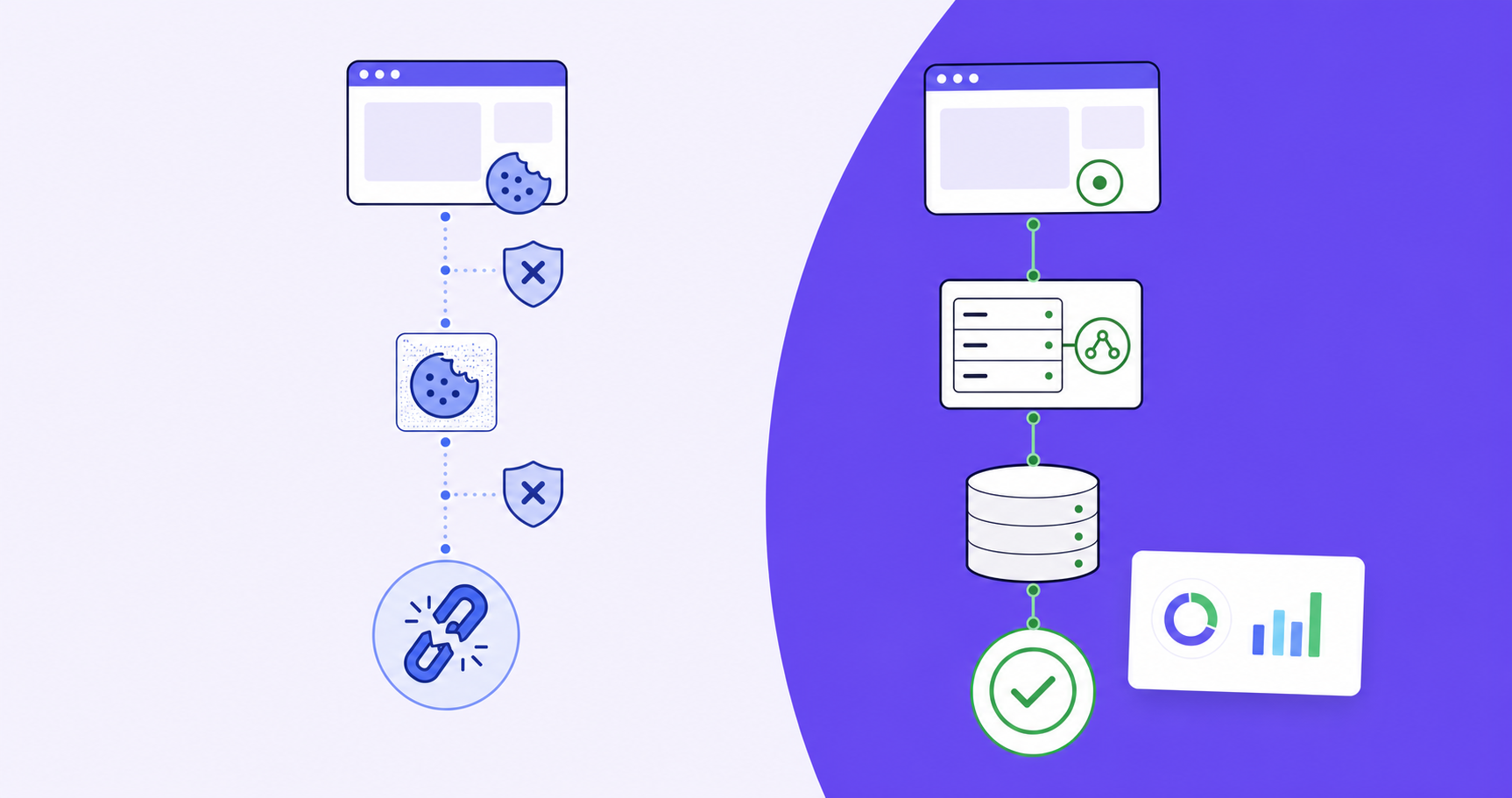
Server-side attribution is the reliable path. Pass the referrer identifier through billing system metadata on the customer object so credit is assigned at the invoice event, not the browser session. For a deeper look, the referral tracking guide covers attribution methods in full.
On fraud, three patterns recur: self-referrals from a second account, fake signups that never activate, and coupon stacking. Dedicated referral fraud detection software automates these checks. Cross-check referrer and new-user IDs at attribution time, delay payouts until a trial converts, and hold suspicious rewards in review before release.
Metrics to measure referral program performance
Four funnel metrics carry the program once it is live:
- Active rate: users who generate at least one share.
- Sharing rate: active referrers who actually send a link.
- Signup rate: unique link visitors who complete signup.
- Signup-to-paid conversion: signups that become paying customers.
Calculate referral CAC by dividing total reward payouts plus tooling cost by paid conversions, then compare against paid search, outbound and content CAC. Per referral benchmark data, referred customers show 37 percent higher retention and 18 percent lower churn, so calculate ROI against LTV, not first-invoice revenue. See how to prove referred customers higher LTV with your own data.
Give the program 60 to 90 days of data before making optimization decisions. Early reads tend to be too thin to act on.
Common mistakes that slow down or stall a SaaS referral program
Five failure patterns stall most programs before they compound:
- Launching without a visible in-product surface. Placement issues compound fast: users who never see the referral option can't act on it, no matter what the incentive is.
- Triggering rewards on signup instead of paid conversion. Negative unit economics surface within the first cohort.
- Relying on cookie-only attribution. Credit disappears as ITP, ATT and ad blockers strip the chain.
- Running one undifferentiated program across every segment. Power users, free users and partners have different motivations.
- Skipping sandbox QA. Reward triggers fail quietly in production until someone audits the queue.
One more pattern: treating activation as a launch task. Users joining after week one never see the program unless promotion runs continuously through onboarding emails and in-app prompts. A structured referral marketing strategy keeps that motion running after launch.
How Cello helps SaaS teams launch and verify a referral program
Cello is purpose-built referral infrastructure for B2B SaaS, delivering an in-product Referral Component via JavaScript SDK on web and native SDKs on iOS, Android, React Native and Flutter. User referrals and partner programs run on one system.
Implementation time depends on the application stack and the referral experience being launched. Published Cello examples include Butter going live in under five hours and Hera in two days, but those are customer-specific outcomes rather than a universal estimate.
The CAC pattern holds at scale. VEED runs referrals at 90.4% lower CAC versus paid acquisition (Cello VEED case study). Softr operates at one-tenth the cost of paid channels after migrating from an external portal to Cello's in-product widget, where the same audience showed a 5x conversion lift.
The technical layer maps to the attribution and fraud sections above: server-side attribution via billing metadata, automated risk-factor monitoring on a 30-day window, multi-currency payouts through PayPal and Venmo, and an EU-hosted AI assistant grounded in live program data. Cello MCP adds a read-only verification checkpoint from a supported AI client: retrieve current setup guidance, check the referral widget, attribution, signup tracking, and purchase tracking, and inspect recent events for missing or malformed fields. Ask it to list issues and link the relevant Cello documentation, but do not change Cello settings. Developers implement fixes, and teams manage the program in the Cello Portal.
That is the Referrals on Autopilot model. The program compounds in the background without constant manual oversight.
Final thoughts on running a SaaS referral program at lower CAC
The math on referral CAC only holds if your attribution survives cookie blocking, your rewards fire on paid revenue and your launcher is visible to the users most likely to share. Get started with Cello and plan the launch around your stack and end-to-end testing requirements.
How do you set up a SaaS referral program without rebuilding it after launch?
Lock five decisions before touching integration: conversion event, referrer audience, reward type, one-sided versus two-sided incentives, and surface placement. Each maps directly to billing webhooks, identity tokens and campaign rules — reversing any of them post-launch means rebuilding attribution from scratch. Get these right in planning and the technical setup follows a predictable eight-step sequence.
What's the fastest way to launch a referral program for a PLG SaaS product?
Wire your billing system first. Server-side attribution anchored to Stripe or Chargebee invoice events validates faster than browser-based tracking because you can replay webhooks in a sandbox and confirm rewards queue without coordinating browser sessions or workarounds for ad blockers. Purpose-built referral software for SaaS — like Cello — collapses the integration to SDK installation, identity token wiring and webhook configuration; Butter went live in under five hours, Hera in two days.
How does referral program attribution hold up when users have ad blockers or decline iOS tracking?
Cookie-only attribution fails under Safari's Intelligent Tracking Prevention, iOS App Tracking Transparency (industry estimates put opt-out rates around 65 percent), and standard ad blockers. Server-side attribution resolves this by passing the referrer identifier through billing system metadata on the customer object, so credit is assigned at the invoice event rather than the browser session — the attribution chain survives device switches, cookie deletion and tracking opt-outs.
Should I trigger referral rewards at signup or at first paid invoice?
Trigger on first paid invoice, not signup. Paying rewards at signup creates negative unit economics within the first cohort, particularly in freemium models where trial-to-paid conversion is well below 100 percent. Tying the reward to a verified `invoice.paid` billing event means reward cost tracks realized revenue — you pay only when a referred user becomes a paying customer.
What reward structure works best for B2B SaaS referral programs?
Cash percentage of attributed revenue fits PLG products with clean monthly recurring revenue data; flat-fee per conversion suits sales-led motions or opaque billing systems. For enterprise segments with compliance constraints, non-cash incentives — feature unlocks, training vouchers, subscription credits — remove the bribery-perception risk that direct cash creates in procurement-heavy buying cycles. Two-sided symmetric rewards lift referred conversion rates in self-service funnels, but compress per-referral margin at scale, so monitor unit economics after the first 60 to 90 days before committing the structure permanently.
What's the difference between a user referral program and a partner or affiliate program, and when should I use each?
User referral programs run inside the product — existing customers share links through an embedded widget while they are already logged in, making them the right fit for PLG and self-service SaaS with active daily users. Partner and affiliate programs run through a standalone portal that requires no product account, making them the right fit for agencies, resellers, influencers and other non-user referrers who drive leads from outside the product experience. If your growth motion involves both, a single platform can run them in parallel rather than requiring two disconnected systems.
How does a SaaS referral program work when users rarely log back into the product after initial setup — for example, infrastructure or API products?
For infrastructure and API products with low session frequency, the in-product widget is the wrong primary surface because users are not present to see it. The practical alternatives are email-based referral link distribution (embedded in existing transactional or onboarding emails), sales-team-distributed links managed by account managers, or a standalone partner portal that referrers access independently of the product. Server-side attribution via billing metadata still assigns credit at the invoice event regardless of which surface the link came from, so the attribution model does not change — only the distribution channel does.
Can we run a referral program if the person who signs the contract or pays is different from the person who shared the referral link?
Yes — this is a documented attribution pattern for sales-led B2B SaaS where the product user drives the referral but procurement or finance completes the transaction. The solution is to map attribution at the organization level using the organization ID field on the billing customer object rather than matching individual user IDs, so credit is assigned to the referrer when payment clears regardless of which person at the buying company is named on the invoice. CRM integration via HubSpot deal associations or Salesforce Apex Triggers handles the cases where payment occurs through a manual contract rather than self-service checkout.
How do I improve referral program activation when the launcher is buried and users are not finding it?
Launcher placement is a first-order activation determinant — a hidden launcher suppresses the active rate before any sharing or conversion can occur, regardless of reward size. The practical fixes are moving the launcher into a high-traffic navigation surface, deploying multiple launcher placements across high-intent product moments, and configuring behavioral triggers that surface the referral widget automatically after milestone events like project completion or a positive outcome rather than waiting for users to discover it organically. An announcement message anchored to the launcher also prompts discovery for users who have not yet engaged with the referral surface.
Can I manage both in-product user referrals and external affiliate or partner campaigns in the same platform?
Yes — Cello runs user referrals and partner programs on one system with a shared attribution engine, fraud detection layer, analytics surface and campaign configuration, so there is no separate portal or integration debt for managing both motions. Each program type has its own deployment surface: the in-product widget for user referrals and the standalone Partner Portal for affiliates, influencers and non-user referrers. Multi-campaign architecture means distinct reward structures, eligibility rules and payout logic can run in parallel for each segment without cross-contamination.
What payout options are available beyond PayPal for international markets, including India and Southeast Asia?
PayPal is the primary payout method across more than 60 supported countries, with Venmo available for US-based referrers. UPI (Unified Payments Interface) is supported for the Indian market, where PayPal adoption is lower and UPI is the standard peer-to-peer payment method. Rewards can also be issued as non-cash incentives — subscription credits, feature unlocks, free subscription periods — which have no geographic payout dependency and work in any market regardless of payment infrastructure.
At what point does it make sense to move from a custom-built referral system to dedicated referral software for SaaS?
The inflection point is when the maintenance burden of the custom system starts consuming engineering capacity that should be compounding the program instead. The concrete signals are recurring tickets for attribution edge cases (cookie blocking, multi-device journeys, mobile ATT), manual payout handling, fraud rules that need updating as abuse patterns evolve, and tax-form or compliance requirements that vary by market. Purpose-built referral software for SaaS collapses that recurring maintenance to a one-time integration — SDK installation, identity token wiring, webhook configuration — and the vendor absorbs attribution reliability, payout retries, fraud rule updates and compliance handling from that point forward.
How do referral rewards work when we have multiple subscription tiers with different pricing?
Tiered reward structures tie payout amounts to the subscription tier or deal size of the referred customer, using billing system metadata to distinguish which plan the new customer purchased. For example, a referred business-tier customer might trigger a $150 reward while a basic-tier signup triggers $25, with the differentiation handled per-campaign rather than applying a uniform rate across all conversions. The same multi-campaign architecture also supports running separate programs for monthly self-service signups versus annual contract customers, so the reward economics match the actual revenue contribution of each segment.
Can partners self-serve to access their referral links and track performance without requiring manual admin setup for each one?
Partners can be provisioned automatically through a webhook integration between a customer-hosted application form (Typeform, HubSpot Forms or a custom web form) and the Partner Portal — approved applicants receive portal access and a working referral link immediately upon form submission without requiring manual admin action. For programs requiring explicit vetting, the admin approval workflow is also available, but high-volume partner acquisition strategies like influencer networks or open affiliate models can run fully self-serve to avoid operational bottlenecks at scale.
How do you measure the ROI of a SaaS referral program beyond first-invoice revenue?
Referral CAC is calculated by dividing total reward payouts plus tooling cost by the number of paid conversions in the period, then compared against your paid search, outbound and content CAC figures. The more complete ROI picture accounts for the quality difference in referred customers: referred users show meaningfully higher retention and lower churn than paid-acquisition cohorts, so measuring against lifetime value rather than first-invoice revenue changes the payback math significantly. Four funnel metrics track program health week to week — active rate, sharing rate, signup rate and signup-to-paid conversion — and expect 60 to 90 days of data before optimization decisions are statistically meaningful.