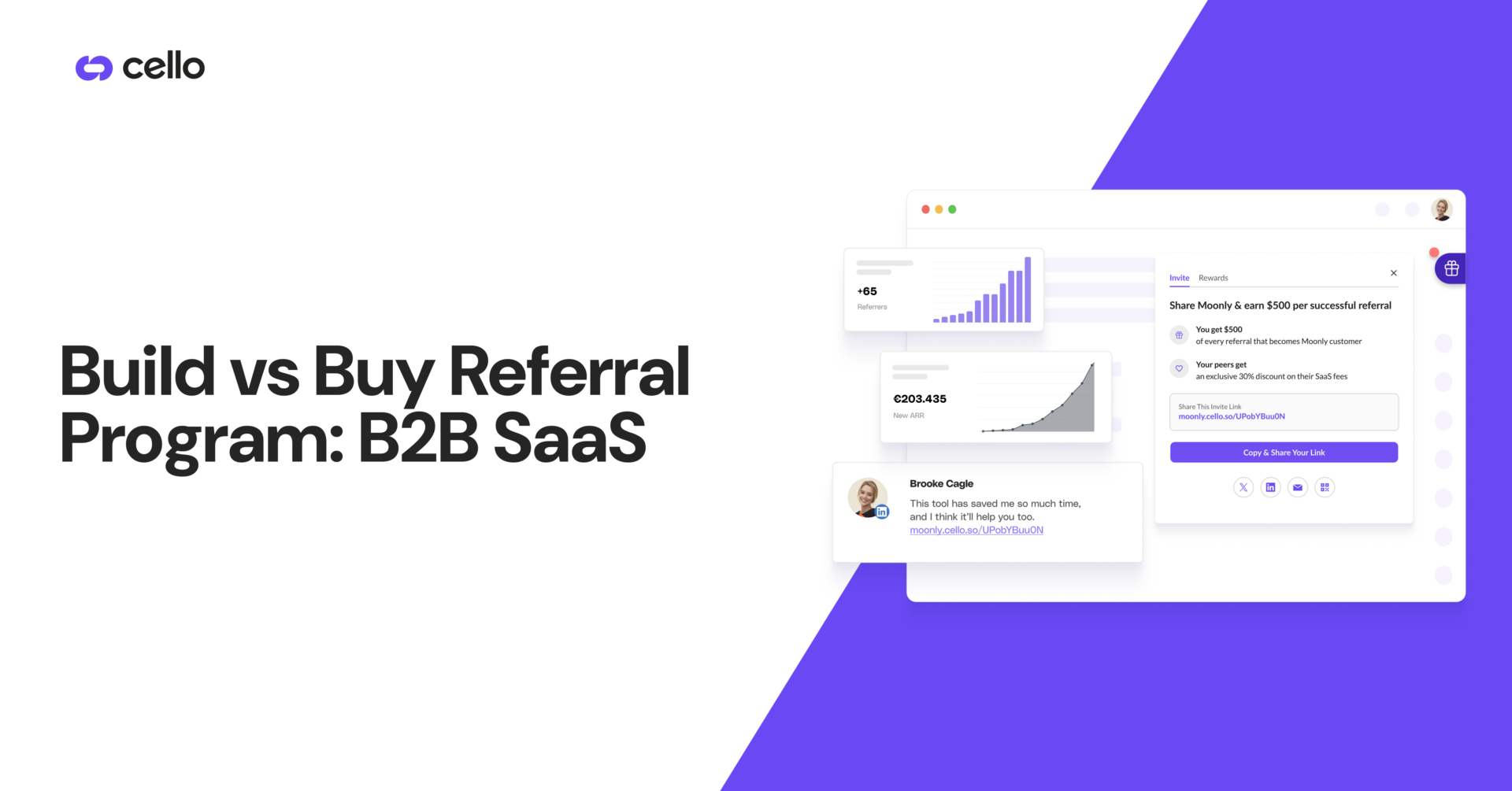

A growth lead can scope referral tracking as a six-week build. But the referral link is only the first layer of the system.
Once a program pays monetary rewards, the operating surface expands: who can receive a payout, how they are verified, what tax information must be collected, how rewards are held or reversed after refunds, and how the team detects abuse before money leaves the program. Add subscription attribution, payout retries and changing billing integrations, and a launch project becomes an ongoing operating responsibility.
That is the build-versus-buy decision. Not whether a team can create a referral link, but whether it wants to own the operating layer behind a paid referral program.
- The decision framework for B2B SaaS referral programs in 2026
- Should you build, buy or wait on a referral program?
- Four hidden costs of building a referral program in-house
- The technical debt trap: when referral infrastructure becomes legacy code
- When buying makes strategic sense for subscription software
- Monetary rewards turn referral programs into an operating system
- The Cello approach: infrastructure for B2B SaaS referral programs
- Final Thoughts on the Build-or-Buy Framework
TL;DR:
- Build in-house when referrals are a product capability you sell against, and you are prepared to permanently own attribution, fraud controls, payout operations and compliance workflows.
- Monetary rewards create operating work beyond tracking: recipient verification, tax-information collection, payment processing, refund/reversal logic and abuse prevention.
- Buy when referrals are a growth channel for a recurring-revenue software business, rather than a feature that differentiates the product itself.
- The useful decision inputs are your revenue model, active users/customers, LTV and reward economics, operational appetite, and time-to-market, not a universal ARR ceiling.
- Cello combines referral infrastructure with automated reward operations, including KYC, compliance and fraud detection, according to its public product materials.
The decision framework for B2B SaaS referral programs in 2026
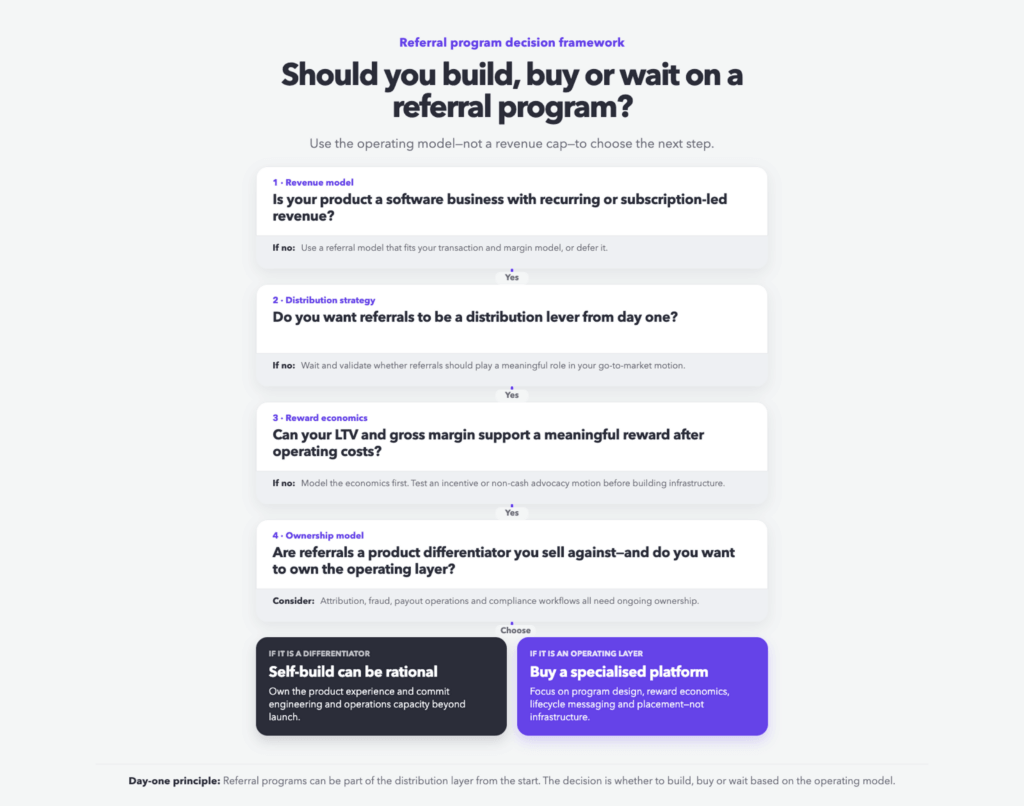
Build when referrals are core to your product. Buy when they are a growth channel. The framework uses four operating inputs: your revenue model, whether referrals are a day-one distribution lever, LTV and reward economics, and whether the referral surface is a differentiator you sell against.
The right choice is not set by an ARR band or the size of an existing user base. It depends on whether the reward economics work and whether your team wants to operate attribution, fraud controls, payout exceptions and compliance workflows after launch.
Should you build, buy or wait on a referral program?
Use the operating model, not a revenue cap, to choose the next step.
Four hidden costs of building a referral program in-house
The build estimate on the roadmap covers only the launch. The bulk of the work surfaces later in places engineering leads rarely model upfront.
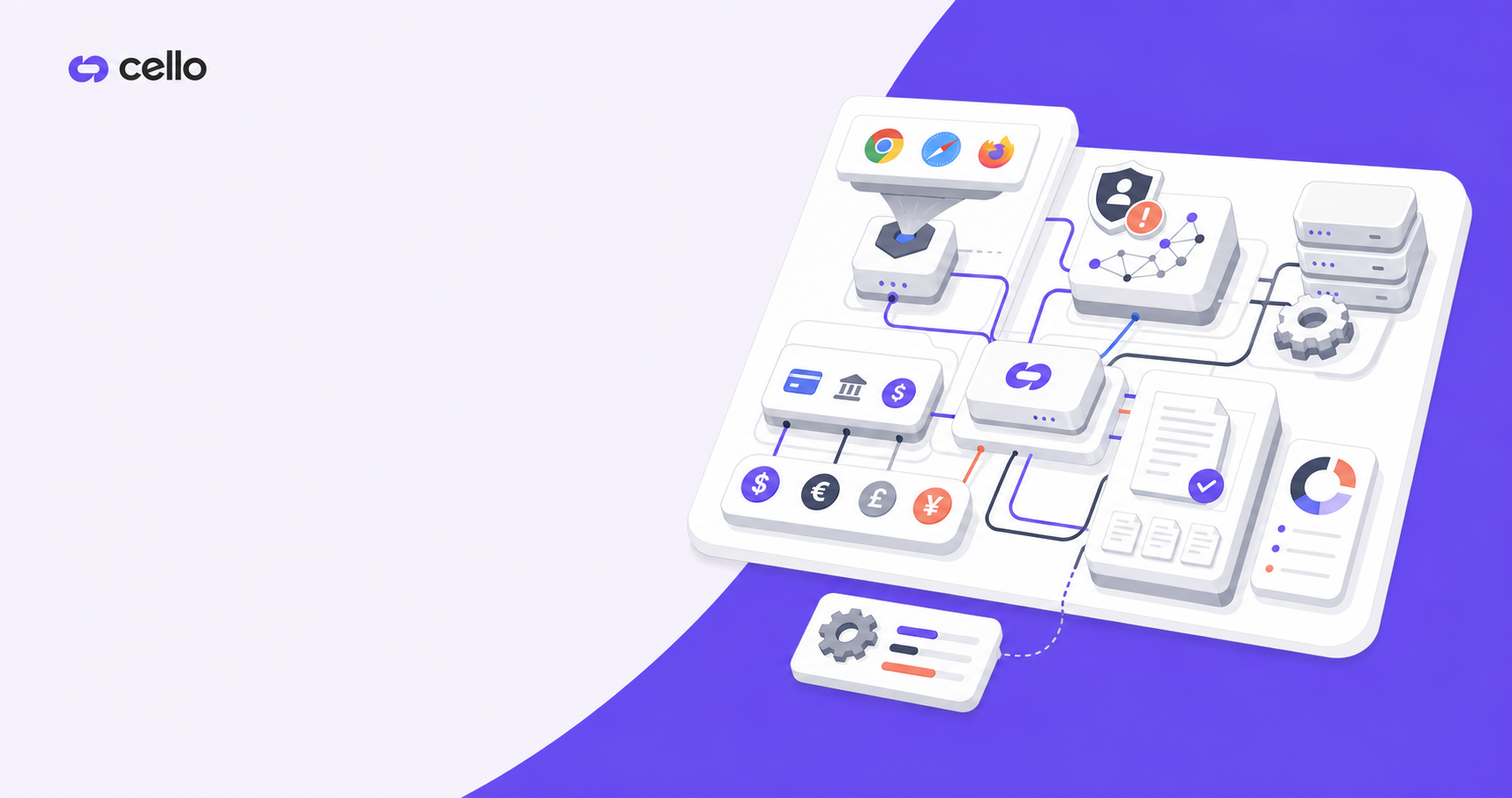
- Attribution that survives the browser. Cookie tracking leaks under Safari ITP, Firefox ETP, ad blockers and consent-banner refusal. A durable layer means server-side event ingestion from Stripe or Chargebee, organization-level identity mapping and replay logic for delayed conversions.
- Fraud detection that keeps up. Self-referral loops, velocity abuse, chargeback reversals and refund clawbacks need patterns that evolve as abusers do.
- Payouts and tax compliance. Multi-currency cash, W-9 and W-8BEN collection, 1099-NEC filing, VAT on cross-border rewards and OFAC screening cannot be retrofitted.
- Integration upkeep. Stripe ships breaking webhook changes. Chargebee deprecates fields. HubSpot rotates auth schemes. Every shift sends a ticket to whoever owns your referral software integrations.
What building actually delivers (and what it doesn't)
Building in-house delivers three real things: a referral surface that matches your product's exact components and design tokens with no third-party widget styling, a data schema you own end-to-end so attribution events sit in your own warehouse next to billing and product analytics, and no recurring vendor line item against Referral ARR. If referrals are a differentiator you sell against, those three advantages support the build cost.
The price is rarely modeled honestly. "Full control" means you own the fraud rules when an abuser finds a new pattern at 2am Saturday. You own the 1099-NEC filing logic the week the IRS lowers the threshold. You own the rebuild when Stripe ships a webhook version bump. Engineering capacity does not free up after launch; it compounds into a permanent maintenance footprint.
For teams with surplus engineers and referrals as a wedge in their pitch deck, build. For everyone else, the trade rarely clears.
The technical debt trap: when referral infrastructure becomes legacy code
The failure mode is not the launch. It's month 14, when the engineer who built the system has moved teams, the Confluence page is half-written, and a new abuse pattern is bleeding rewards that nobody on call can diagnose.
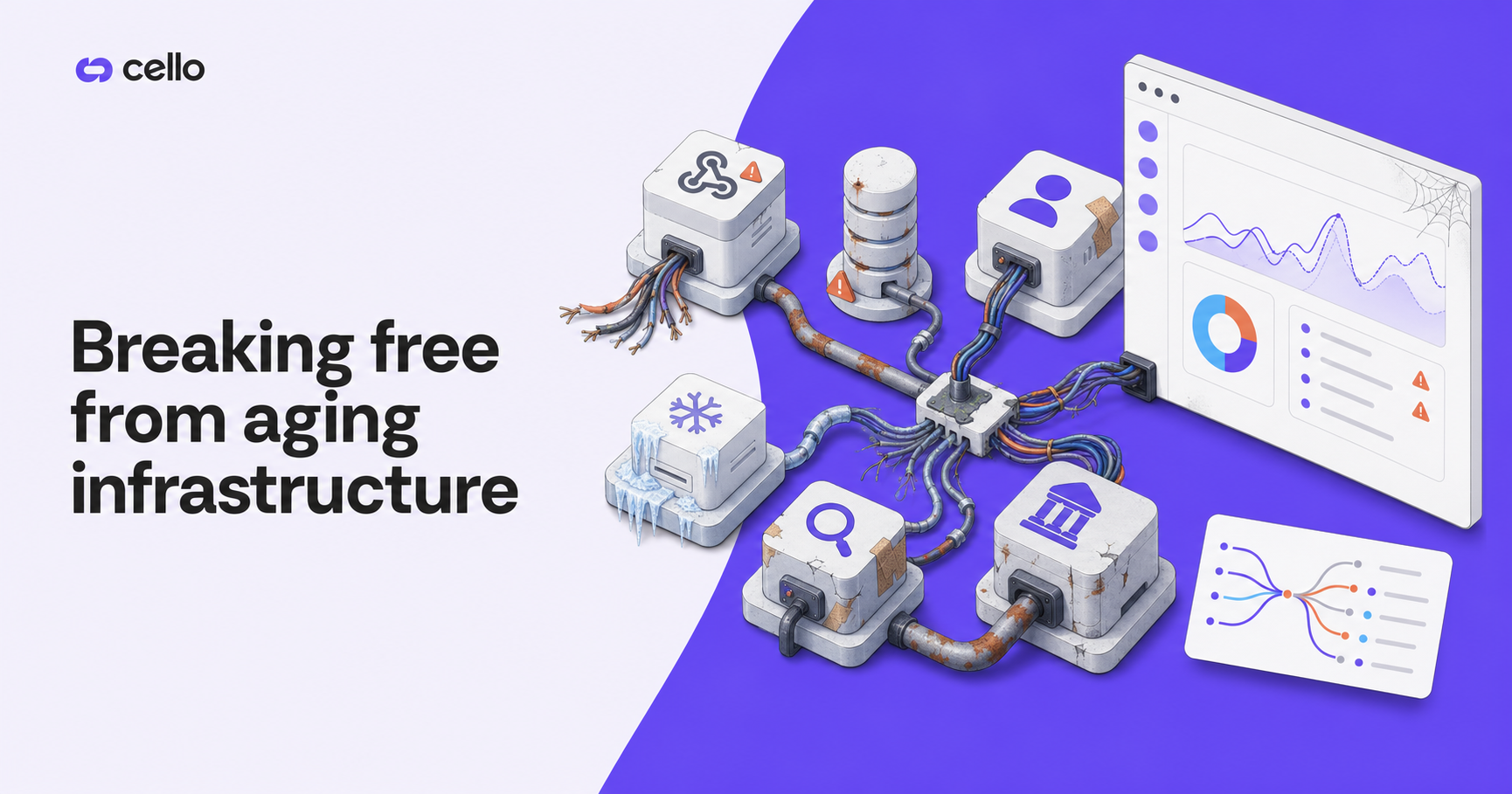
Referral code ages badly because the surface sits at the intersection of four moving systems: billing webhooks, identity, fraud signals and payout rails. Stripe ships an API version. A consent vendor reclassifies a cookie. The IRS lowers a reporting threshold. Each drift turns a working integration into a silent failure surfacing as a payout dispute weeks later. This is the classic shape of technical debt, compounding interest on shortcuts that were rational at the time.
Three patterns recur across in-house systems we see during migration calls:
- Attribution logic written against one billing flow, then patched when annual plans, usage-based pricing and mid-cycle upgrades arrived. The patches share no test suite.
- Fraud rules frozen at the launch ruleset. New abuse patterns like disposable email cycling and shared payout accounts pass through untouched.
- Reward and payout code coupled tightly to one billing provider. Adding a second processor costs more than the original build.
The organizational tax of unmanaged debt shows up as refusal to touch the system. Tickets get reassigned. Edge cases get marked won't-fix. By the time leadership asks why referral ARR has plateaued, the honest answer is that the system has been in maintenance mode for a year.
Fraud detection: the capability most teams underestimate
Self-referrals are the version most in-house builds catch. The harder patterns sit one layer deeper: coordinated rings sharing payout accounts behind rotating identities, headless browsers signing up against leaked codes and incentive farms that pass basic email checks because the accounts are real.
Detecting referral fraud at scale requires signals that compound: IP and ASN clustering, device fingerprinting, velocity against rolling windows, email-domain entropy and behavioral fingerprints on the signup. No single signal works alone.
The pattern we see in migration calls: a team launches with a same-domain check, runs clean for a quarter, then a Telegram thread surfaces the program and reward leakage jumps overnight. Reactive rule-writing always lags. A specialised platform may reduce internal operating work, but teams should verify its current fraud controls and ownership model.
When buying makes strategic sense for subscription software
The decision is not about an ARR band or the size of your existing user base. It is about the role referrals play in your distribution strategy and who will operate the program after launch.
A referral program can be a distribution lever from day one. You do not need an established advocate base before you start; the first customers, design partners or community members can create the first loop.
A specialised platform is usually the stronger fit when all three are true:
- The motion is recurring-revenue software: referrals need to connect to subscriptions, renewals, upgrades or another defined conversion event.
- Referrals are part of the distribution plan: you want referrals to help create early distribution, not merely harvest advocacy from an already mature user base.
- The economics and ownership model are clear: LTV and margin can support a meaningful reward, and the team would rather focus on program design and growth than permanently operate attribution, fraud controls, payout exceptions and compliance workflows.
Self-building can still be rational when referral mechanics are a core product differentiator and the company is willing to own that operating layer. If neither path is ready, validate the offer and reward economics before investing heavily in referral infrastructure.
Monetary rewards turn referral programs into an operating system
A referral program without cash or other monetary rewards is mostly a product and attribution problem. Once funds move to advocates, it also becomes an operations and risk problem.
A team building in-house needs to define who is eligible to receive a reward, collect the information required to pay them, manage payment failures and reversals, decide when a reward becomes payable, and investigate suspicious activity before money leaves the system. The requirements vary by market and payout method, but the operating burden is real even when the referral flow looks simple in the product.
Cello positions this layer as part of its platform: automated referral payouts with KYC, compliance and fraud detection. Product overview
The strategic question is therefore not “Can we build the interface?” It is “Do we want to operate the reward infrastructure after launch?”
What referral software actually handles (and what you still build)
Buying does not zero out engineering. It moves the work from infrastructure to integration, and from maintenance to optimization. The vendor owns the parts that decay; you own the parts that compound. Concretely, the vendor absorbs the recurring jobs no growth team should be staffing against: server-side attribution off Stripe and Chargebee webhooks, identity mapping at the organization level, fraud signals that update as new patterns surface, multi-currency payout rails, and tax-form collection with 1099-NEC filing. Your engineering lift collapses to a one-time integration: mapping referral metadata onto your billing events, dropping the SDK or launcher into the product, and verifying attribution fires correctly in your own checkout flow. From there the work that remains is program work, not plumbing. Reward economics per segment, incentive structure, lifecycle messaging and launcher placement all stay with your team because they move program ARR. The table below splits the line precisely.
|
Vendor owns |
You own |
|---|---|
|
Attribution tracking and webhook drift |
Program design and reward economics |
|
Fraud detection and signal updates |
Incentive structure per segment |
|
Payout rails and currency conversion |
Lifecycle messaging and user comms |
|
Tax forms, withholding, 1099-NEC filing |
Launcher placement and in-product surfacing |
|
Billing-provider integration upkeep |
Attribution testing in your billing flow |
Program design and optimization stay with your growth team. That work compounds program ARR. The infrastructure underneath it does not.
Time to market: the compounding advantage of velocity
Every month between roadmap and launch is a month of missed referrals. The compounding matters because referred customers become referrers; a program live sooner starts learning from its first cohort sooner. For an example of a referral program at scale, see how VEED uses Cello—its public case study reports 1.3M enabled users, a 14.5% sign-up rate and referral CAC 90.4% lower than paid channels.
That time-to-market delta is early learning and distribution that a team does not recover later. The typical split:
- Buy: hours to a week from contract to first attributed conversion.
- Build: 8-16 weeks before the first referral link goes live, then another quarter patching edge cases against production traffic.
The first cohort of referrers seeds every cohort after it. Delaying that seed by a quarter delays every downstream loop by a quarter.
The Cello approach: infrastructure for B2B SaaS referral programs
If the buy path fits, see how Cello handles the operational layer. Cello positions its platform around referral infrastructure and automated reward operations, including KYC, compliance and fraud detection, as described in its public product materials.
What that looks like in production:
- VEED: 90.4% lower CAC versus paid channels.
- Moss reports 600% more referral ARR year over year after migrating to Cello.
Final Thoughts on the Build-or-Buy Framework
Referral infrastructure sits in the same category as billing and payments for most B2B SaaS companies. You would not write your own Stripe replacement and the same logic applies here once you account for attribution, fraud, payouts and tax handling. The teams that build successfully treat referrals as a differentiator they sell against. Everyone else loses six months and a quarter of referred ARR by the time the system goes live. Spin up your referral program in hours and start converting your best customers into a repeatable acquisition channel.
Can I build a referral program without engineering resources?
Yes — buying pre-built referral software launches in hours to days instead of months. The vendor handles attribution tracking, fraud detection, payout rails and tax compliance while your team configures reward rules, placement and messaging through a dashboard. Building requires 8-16 weeks of engineering time upfront plus permanent maintenance for webhook changes, fraud patterns and regulatory updates.
Build vs buy referral program: which option reduces CAC faster?
Buying delivers CAC reduction in the first quarter because the program launches immediately and attribution works across all browsers and mobile platforms from day one. Building delays launch by months while engineering solves attribution, fraud and payouts — losing 180+ days of compounding referrals where early referrers would have seeded secondary sharing loops.
What's the biggest hidden cost when building a referral program in-house?
Permanent maintenance load after launch. Stripe ships webhook changes, fraud patterns evolve, tax thresholds adjust and billing providers deprecate fields. Each change generates tickets for the team that built the system. The engineering capacity never frees up — it compounds into ongoing operational debt that most teams underestimate by 70-80% during initial planning.
When does building a referral program actually make sense?
Build when referrals are a product differentiator you sell against and you have surplus engineering capacity to own fraud rules, tax filing and integration upkeep permanently. For many B2B SaaS companies, referrals sit in the same infrastructure category as payment processing — critical to operate but not a competitive moat worth the maintenance cost.
How does Cello handle fraud detection compared to building in-house?
Cello positions its platform as including automated fraud detection; see its public product materials for current capabilities. In-house teams need to monitor and update their own controls.
Does server-side attribution work when users decline cookies in consent banners?
Server-side attribution tracks conversions through billing system webhooks (Stripe, Chargebee) via customer-object metadata fields rather than browser cookies, so referral tracking survives when users decline non-essential cookies in consent management interfaces. The referral code passes as a URL parameter and gets captured server-side at conversion, removing dependency on client-side cookie storage that consent banners block.
What's the fastest way to launch a referral program in 2026 without engineering bottlenecks?
Buy pre-built referral software with native SDKs and billing integrations instead of building in-house. Cello launches in hours via web and mobile SDKs with server-side attribution that reads conversion events from Stripe or Chargebee webhooks, removing the 8-16 week engineering cycle required for custom builds plus the permanent maintenance load for fraud rules, webhook drift and tax compliance.
Can I run different referral campaigns for different customer segments simultaneously?
Yes — multi-campaign architecture lets you run independent referral programs with distinct reward structures, eligibility rules and incentive amounts targeted by user attributes including subscription tier, geographic region, organization size and user role. Each campaign operates separately while sharing unified attribution infrastructure and fraud detection.
How do referral programs handle subscription upgrades and downgrades mid-cycle?
Referral platforms process incremental charge events and credit adjustments as distinct billing transactions rather than assuming fixed monthly intervals. You send upgrade charges as separate line items added mid-cycle and downgrade credits as negative invoice amounts, enabling accurate reward calculation across subscription lifecycle changes without requiring replacement of the base subscription record.
What happens to referral rewards when a customer requests a refund?
Automated fraud detection cancels pending rewards when refund events fire from your billing system (Stripe charge.refunded webhook). The reward never processes if the refund occurs before payout, and already-issued rewards can be clawed back through configurable payout delay windows that hold rewards until conversion stability is confirmed.
Referral program for sales-led B2B SaaS: how does attribution work without self-service checkout?
Attribution runs through CRM deal progression instead of billing-event triggers. You configure Salesforce Apex Triggers or HubSpot deal associations to send conversion events when Opportunities hit specific stages (SQL qualified, demo completed, closed won) rather than waiting for invoice.paid events, enabling referral tracking in sales-assisted funnels where procurement completes transactions offline.
Can referrers see which specific users clicked their referral links and signed up?
Referral platforms surface aggregate performance metrics (signups, conversions, revenue attributed) and individual referrer performance tracking but typically do not expose recipient-level detail showing which specific individuals clicked links or where links were shared. This visibility gap exists across most B2B referral software and represents a product limitation for businesses seeking granular referrer behavior analytics.
Do I need separate tools for user referrals and partner affiliate programs?
No — unified referral platforms combine peer-to-peer user referrals and partner-driven affiliate programs on a single system with shared attribution, fraud detection, analytics and campaign infrastructure. Running both motions separately creates duplicate operational overhead, integration debt and fragmented reporting that a unified platform eliminates.
How long does technical debt from a custom-built referral system take to surface?
The failure mode hits around month 14 when the engineer who built the system has moved teams, fraud patterns evolve beyond the original ruleset, and billing provider API changes break attribution silently. Maintenance tickets compound because referral code sits at the intersection of four moving systems (billing webhooks, identity, fraud signals, payout rails) where each drift turns working integrations into silent failures.
What reward structures work for enterprise B2B customers who prohibit employees from receiving personal cash?
Configure organizational-level rewards where benefits flow to the company account instead of individual referrers — subscription credits, service-tier upgrades, account-level discounts or access to premium features. This addresses enterprise compliance requirements where individual cash incentives raise procurement or ethics concerns while maintaining referral program economics tied to successful conversions.