
Customer Lifetime Value (CLV) is a key metric that businesses use to determine the long-term profitability of their customer base. It quantifies the potential revenue that a customer can generate throughout their interaction with the company.
By understanding Customer Lifetime Value, businesses can make informed decisions and build effective strategies to maximize customer value and drive sustainable growth.
TLDR:
- CLV is the predicted net profit a business earns over the full lifespan of a customer relationship.
- CLV calculation draws on average purchase value, purchase frequency, customer acquisition costs and retention rate.
- Segmenting customers by CLV lets you allocate marketing spend toward accounts most likely to generate long-term revenue.
- Inaccurate data and shifting customer behavior degrade CLV models over time, requiring regular recalibration.
- Cello's peer-to-peer referral program gives SaaS teams a channel for growing CLV through user-led acquisition.
|
Key Element |
Description |
Tips for Optimization |
|---|---|---|
|
CLV's Role in Profitability |
Measures the long-term revenue potential of a customer to inform strategic decisions for growth. |
Enhance customer retention and focus on high-value segments to maximize CLV. |
|
Strategic Decision Making |
CLV insights guide resource allocation, marketing strategies, and customer retention efforts. |
Use CLV data to rank and tailor marketing efforts for maximum impact. |
|
Components of CLV |
Takes into account revenue, costs, customer lifespan, and purchase behaviors to estimate value. |
Regularly update and analyze CLV components to reflect current customer dynamics. |
|
Calculating CLV |
Involves analyzing variables like purchase value, frequency, acquisition costs, and retention rates. |
Adopt both traditional and predictive modeling to gain accurate insights into CLV. |
|
Benefits of CLV |
Supports enhanced customer segmentation and improved marketing strategy effectiveness. |
Use CLV insights for targeted marketing campaigns and resource allocation to high-value customers. |
|
Limitations of CLV |
Relies on accurate data and must be adapted to reflect changing customer behavior. |
Keep data quality high and regularly recalibrate CLV to maintain accuracy and relevance. |
Understanding the concept of CLV
CLV, also known as Customer Lifetime Value, refers to the total revenue a business can expect to generate from a customer over the entire duration of their relationship.
It is a forward-looking measure (output metric) that takes into account the customer's purchasing behavior, repeat purchases, and the length of their association with the brand.
When businesses analyze Customer Lifetime Value, they are able to gain insights into the profitability of their customer base. By understanding the long-term value of each customer, companies can make informed decisions about resource allocation, marketing strategies, and customer retention efforts.
Definition of CLV: What does customer lifetime value mean?
CLV can be defined as the predicted net profit a company can expect to earn over the entire lifespan of a customer. It considers the revenue generated by the customer's purchases and also factors in the costs associated with acquiring, serving, and retaining the customer.
Calculating CLV involves taking into account various factors such as the average purchase value, purchase frequency, customer acquisition costs, customer retention rate, and the average lifespan of a customer.
By considering these variables, businesses can estimate the future value of a customer and make strategic decisions accordingly.
Importance of CLV in business
Suppose a SaaS team finds that customers who finish onboarding in their first 14 days have a higher CLV than those who do not. Moving budget into onboarding emails and a first-week check-in call puts retention effort where it adds the most revenue.
When businesses focus on customer retention, they can reduce customer churn and increase the lifetime value of their customers. This leads to increased revenue and also helps in building a strong and loyal customer base.
What's more, CLV helps in identifying valuable segments of customers. By analyzing Customer Lifetime Value across different customer segments, businesses can identify which segments are most profitable and allocate their resources accordingly.
This allows companies to adapt their marketing and retention strategies to specific customer segments, maximizing the return on investment.
Beyond that, Customer Lifetime Value provides insights into the effectiveness of marketing campaigns and customer acquisition efforts. By comparing the CLV of customers acquired through different channels or campaigns, businesses can identify which channels are bringing in high-value customers and adjust their marketing strategies accordingly.
Components of customer lifetime value
CLV calculation involves three components: monetary value, purchase frequency and customer lifespan. Together they show how much a customer spends, how often they buy and how long they stay, which helps businesses allocate resources wisely.
Monetary value
The monetary value component of CLV reflects the revenue generated by a customer through their purchases. It takes into account both the average transaction value and the number of transactions made by the customer, giving businesses a clear picture of the financial impact a customer has on their bottom line. The average purchase value formula divides total revenue by the number of purchases (average purchase value = total revenue ÷ number of purchases), as the image below shows.
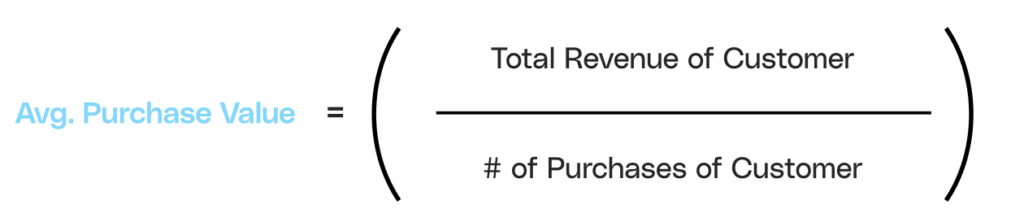
Avg Purchase Value Formula (Source: Cello)
Frequency of purchase
The frequency of purchase component focuses on how often a customer makes a purchase. By identifying the regular customers who make repeated purchases, businesses can develop strategies to encourage more frequent buying behavior and nurture customer loyalty. The below shows an example formula.
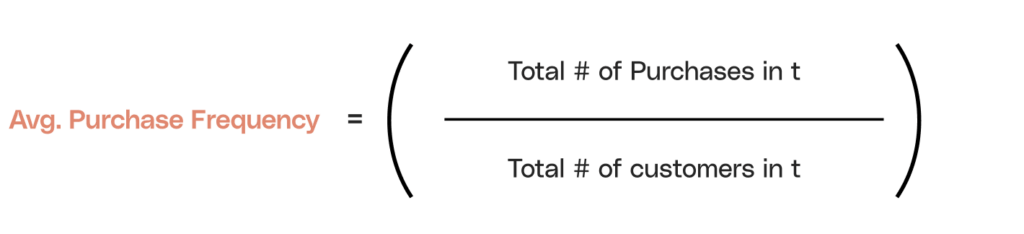
Avg Purchase Frequency Formula (Source: Cello)
Customer lifespan
The customer lifespan component represents the duration of a customer's association with the business. Longer customer lifespans indicate higher customer loyalty and can be an opportunity for businesses to deepen their relationship with the customer through personalized marketing, loyalty programs and exceptional customer service. The below shows an example formula.
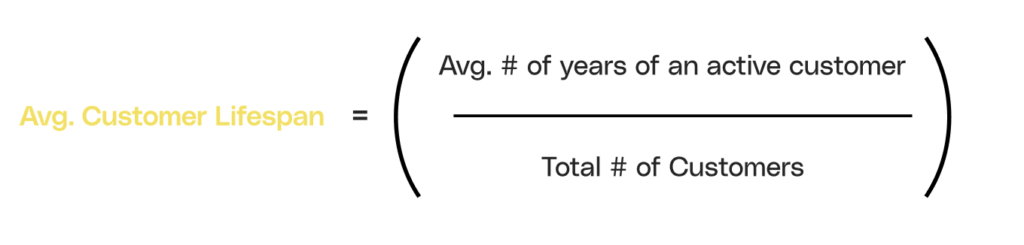
Avg Customer Lifespan Formula (Source: Cello)
Calculating CLV
There are different methods to calculate CLV, ranging from traditional approaches to more advanced predictive models. These calculations give businesses insight into the future value of each customer, and pairing them with the SaaS metrics that matter supports data-driven decisions.

Image showing the Customer Lifetime Value Formula
Traditional calculation
The traditional Customer Lifetime Value calculation involves aggregating historical data on customer transactions and applying set formulas to estimate future revenue. This method requires accurate data on customer purchases, length of association with the brand, and average profit margins.
Predictive calculation
Predictive CLV models rely on advanced analytics and machine learning algorithms to predict the future value of customers based on their behavior, preferences, and other relevant data.
These models take into account factors such as customer demographics, past interactions and external market trends to generate more accurate insights that teams can act on.
Benefits of using CLV
Integrating CLV into business strategies can yield several benefits, helping businesses improve their marketing efforts and enhance customer experiences.
Enhanced customer segmentation
Understanding Customer Lifetime Value allows businesses to segment their customer base effectively. By categorizing customers based on their estimated value, companies can adapt their marketing campaigns and communication to meet the specific needs and preferences of each group, resulting in higher customer engagement and improved conversion rates.
Improved marketing strategies
CLV allows businesses to optimize their marketing strategies by focusing on high-value customers. By allocating marketing resources to those customers who are more likely to generate sizable revenue over time, companies can maximize their return on investment and improve overall marketing effectiveness.
LTV:CAC benchmarks for B2B SaaS in 2026
A healthy B2B SaaS company in 2026 earns at least three dollars of customer lifetime value for every dollar it spends on acquisition. Optifai's 2026 study of 939 B2B SaaS companies puts the median LTV:CAC ratio at 3.2:1, with 3:1 as the minimum target and 5:1 or higher signaling strong efficiency (Optifai LTV benchmarks). The same study reports CLV ranging from $15K to $40K for SMB accounts and from $300K to $1M+ for enterprise accounts.
Use those figures for context, not as targets. Simple CLV formulas assume constant churn, and early cohorts rarely behave like mature ones, so Optifai recommends tracking CLV by signup month for at least 12 months before projecting it forward.
The acquisition channel changes the CLV side of that ratio, and referral is one channel where you can measure the difference directly. Cello's guide on how to prove referred customers have higher LTV walks through the cohort comparison.
Limitations of CLV
While CLV is a valuable metric, it is important to consider its limitations to gain a full understanding of a customer's value to the business.
Data accuracy issues
Accurate CLV calculations rely on reliable and accurate data. Inaccurate or incomplete data can lead to flawed predictions and inaccurate estimations of a customer's lifetime value.
For this reason, it is important for businesses to invest in data management and keep data quality high to obtain reliable CLV insights.
Changing customer behavior
Customer behavior keeps shifting and can change over time. Factors such as evolving market trends, competitor offerings, or changes in customers' needs and preferences can impact their purchasing behavior. For this reason, CLV should be regularly monitored and recalibrated to account for these changes in customer behavior.
CLV gives businesses a complete view of a customer's long-term value. By studying its components and acting on the results, companies can improve customer experiences, optimize marketing efforts and drive sustainable growth.
Treat CLV as a strategic input to budget, retention and acquisition decisions, and recalibrate it as your customer base changes.
How do I set a CAC ceiling from my CLV estimate?
Divide your CLV estimate by three to get the most you can spend to acquire a customer at the 3:1 LTV:CAC minimum that Optifai's 2026 benchmark study recommends for B2B SaaS. A segment with an illustrative CLV of $9,000 supports a CAC ceiling of about $3,000. Then check the ceiling against CAC payback, which the same study targets at under 12 months for SMB and under 18 months for mid-market.
Which referral marketing strategies and tools reduce CAC for a B2B SaaS company?
In-product user referral programs reduce CAC because rewards are paid only after a referred account converts, so acquisition spend follows revenue instead of impressions. Build in four practices from the start: place the referral launcher inside the logged-in product, trigger rewards on paid billing events such as Stripe invoice.paid, run a partner program alongside it for agencies and other external promoters, and compare the CLV of referred cohorts with paid cohorts. Affiliate-first tools such as FirstPromoter are built for external partner programs, while Cello embeds the referral surface in your product, attributes referrals server-side and handles rewards, fraud detection and payouts in one system.
What is the difference between a user referral program and an affiliate program for a SaaS business?
A user referral program rewards existing customers for introducing new customers from inside the product, while an affiliate program pays external promoters such as creators, agencies and publishers for sending buyers from their own audiences. Referrers in a user program are paying users with first-hand experience, whereas affiliates are usually outsiders who promote through content, newsletters or communities. A user program runs on an in-product launcher, while affiliates work from a standalone portal with tracking links and promotional assets. Cello runs both motions in one system, with an in-product Referral Component for users and a Partner Portal for affiliates and other external partners.
How should referral rewards be structured to protect CLV?
Tie the reward to a paid billing event and spread payouts over the first months, so reward cost tracks the revenue you have actually collected. Cello supports rewards that trigger on paid events such as Stripe invoice.paid, drip-fed schedules that pay out over several months and payout delays that wait for a retention period or for a free trial to convert. A combined structure, such as a one-time payment at deal close plus an ongoing percentage over later months, is harder for referrers to follow than a single flat reward, so confirm the setup with the Cello team and test it as a separate campaign against a simple control before rolling it out.