

Viral marketing is a growth strategy where existing users distribute a brand’s message on its behalf, reaching millions of people through peer sharing at a fraction of what paid advertising costs to achieve the same scale.
This guide covers the full picture: a clear definition and how viral marketing works mechanically, real-world examples that broke through (and why), a step-by-step process for building a campaign, and the metrics (including the virality coefficient) used to measure whether it is actually working.
This guide covers the concept of viral marketing, its mechanics, benefits, challenges, and how to measure its success.
Understanding the concept of viral marketing
🦠Viral marketing, in simple terms, refers to a strategy that encourages individuals to share a brand’s message or content with others, so each new user brings in more than one additional user (a virality coefficient above 1). It relies on the power of word-of-mouth and social sharing to reach a large audience in a short period of time.
Pros and cons of viral marketing
The mechanics of viral marketing
While viral marketing may seem like a random process, there are specific elements and strategies that increase the likelihood of success. Understanding these mechanics is key to developing an effective marketing campaign.
How to create a viral marketing campaign
- Define a single emotionally resonant message. Campaigns that spread are built around one hook (humor, awe, outrage, or inspiration), not a list of product features. The message must be simple enough to survive retelling: if a user cannot explain it in one sentence, they will not share it at all.
- Choose the right content format for your distribution channel. Short-form video works on TikTok and Instagram Reels because each channel’s algorithm extends reach beyond your existing audience. For PLG SaaS, referral incentives embedded in the product (invite links, reward prompts, in-app sharing) are the format that converts because the user is already inside the product at the moment of highest intent.
- Seed with high-network individuals before broad distribution. Launch with influencers, power users, and brand advocates: people whose shares carry outsized reach and social proof. Seeding this way concentrates the initial signal in the accounts most likely to trigger secondary sharing, which is more efficient than paying to reach a cold audience from day one.
- Embed a frictionless sharing mechanism. Every additional step between the decision to share and the act of sharing kills conversion. One-tap share buttons, pre-populated referral links, and challenge tags reduce that friction to near zero. The mechanism must work on mobile, require no account creation, and deliver the referral link in the same screen where the sharing impulse occurs.
- Measure the virality coefficient and iterate. The K-factor (invites sent × conversion rate) is the single metric that tells you whether the campaign is self-reinforcing. A K-factor above 1 means each cohort of users generates more than one additional user, so growth compounds without additional paid spend. Below 1, you are subsidizing distribution; identify which step in the sharing funnel is losing users and fix it before scaling.
Benefits
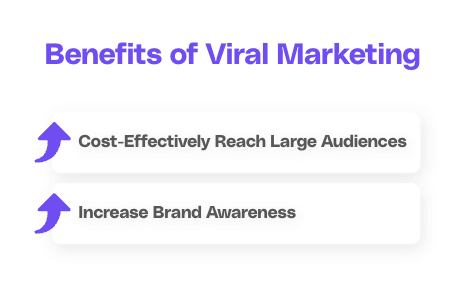
Viral marketing offers numerous benefits for businesses aiming to expand their customer base and increase brand exposure.
Source: Cello
Challenges
While viral marketing can be highly effective, it is not without its challenges. Understanding and tackling these challenges is key to maximizing the success of a campaign.
Before investing in a viral campaign, weigh these core trade-offs:
|
Pros |
Cons |
|---|---|
|
Extremely low cost per acquisition |
Highly unpredictable; virality cannot be reliably engineered |
|
Exponential reach without proportional budget increases |
Risk of negative brand associations if content is misinterpreted |
|
Builds authentic credibility through peer sharing |
Short content lifespan; viral moments fade quickly |
|
Can expand brand awareness beyond the core audience |
Loss of message control once content spreads organically |
|
Compounds with referral mechanics (K-factor > 1) to reduce CAC |
Difficult to attribute direct revenue with standard analytics |
Measuring the success
Measuring the success of a viral campaign is key to understanding its impact and improving future campaigns.
Key performance indicators (KPIs) for viral marketing
There are several KPIs that can be used to measure the success of a viral campaign. These include the number of shares, reach, engagement rates, conversion rates, and the increase in brand mentions or website traffic.
The virality coefficient formula is: Virality Coefficient (K) = Number of invitations sent per user x Conversion rate of those invitations.
For example, if each user invites 10 people and 20% of those accept, K = 10 x 0.20 = 2.0. A K above 1 means the user base grows without additional paid acquisition; each cohort produces more than one new user.
If K falls below 1, check which step is losing users. A low invite rate points to the share trigger: the prompt, placement or incentive needs work. A low conversion rate on shared links points to the landing experience or the reward offer.
Analyzing the impact through the virality coefficient
To analyze the impact of a viral campaign, brands should analyze the data collected from social media platforms, website analytics, and customer feedback.
This analysis can provide valuable insights into the campaign’s effectiveness, audience demographics, and areas for improvement.
The most important metric is the virality coefficient formula, which helps you understand the growth potential.

Virality Coefficient Formula (Source: Cello)
Let’s take an example:
- 100 current users
- 2 referrals in total per user
- Purchase rate of 40%
- (100*2*40%) / 100 = 0.4
- Result: For every new user/ customer you acquire you can expect 0.4 more users/ customers to join
What is the virality coefficient and what number should I aim for?
The virality coefficient (K-factor) measures how many new users each existing user generates: K = invitations sent per user x conversion rate of those invitations. A K above 1.0 means the user base grows on its own, since each cohort produces more than one additional user without paid spend. For most B2B SaaS programs, a coefficient between 0.3 and 0.7 is realistic; even a sub-1 coefficient reduces blended CAC by adding organic users alongside paid ones.
How much does a viral marketing campaign cost?
Content creation costs vary widely, from near-zero (Hotmail's footer text) to mid-five-figures for a scripted video. Distribution cost is the structural advantage: once seeded, peer sharing carries the message at no incremental cost per additional user, compared to paid media where each impression requires budget. The variable to manage is the cost of the sharing mechanism itself, not the cost of reaching each subsequent viewer.
What types of content go viral most often?
Video, social challenges and emotionally resonant formats (humor, awe, inspiration) consistently outperform purely informational content in share rate. Content that gives the sharer a social identity signal (shareable data about themselves, a stance worth broadcasting, or a challenge tag that signals group membership) adds a social-currency dimension that further raises distribution. Interactive formats such as quizzes and personalized reports combine emotional resonance with a built-in share artifact.
Can small businesses use viral marketing?
Yes. Authenticity and community fit matter more than budget at small scale, and niche audiences often share more densely within their networks than broad ones. Micro-influencers with tight community ties frequently generate higher per-post engagement than accounts with large but diffuse followings. A small business with a clear audience and a genuine story has the ingredients; the mechanism (a referral link, a hashtag, a challenge prompt) can be low-cost to build.
What is the difference between viral marketing and word-of-mouth marketing?
Viral marketing is intentional and engineered; campaigns are designed with explicit sharing mechanisms, incentives, and distribution infrastructure built in. Word-of-mouth is organic and unplanned: customers recommend a product because they genuinely value it, with no prompt or reward structure behind the share. In practice, the best referral programs convert organic word-of-mouth into a measurable, repeatable viral motion by adding tracking, incentives, and a frictionless sharing surface.
What is a good virality coefficient?
A K-factor above 1.0 means the user base is growing on its own, since each cohort generates more than one additional user without additional paid spend. Even a coefficient of 0.5 meaningfully reduces CAC: every two paid acquisitions produce one organic user, compressing the blended cost of growth over time. Most B2B SaaS referral programs operate between 0.3 and 0.7; optimizing the sharing funnel, including invite rate, click-through, and conversion, is where the largest K-factor gains are found.
Can B2B companies use viral marketing?
Yes, B2B viral mechanics are different from consumer campaigns but equally effective when matched to the right format. In-product referral programs turn existing users into a repeatable acquisition channel; shareable benchmark reports and original research give buyers a reason to distribute content to peers; collaborative product features (shared workspaces, co-authored documents, multi-user dashboards) make the product itself the sharing mechanism. The constraint in B2B is that the audience is smaller and more defined, so the sharing incentive needs to be professionally relevant instead of socially entertaining.
What are common viral marketing mistakes to avoid?
The four most common failure modes are: using fake urgency that erodes trust when the deadline passes; losing control of the brand message once content spreads and audiences reinterpret it; creating open-ended content with no clear call to action so viewers engage but do not share; and launching a campaign with no sharing mechanism built in, forcing users to copy-paste a URL instead of triggering a one-tap invite. Each of these errors breaks the distribution loop at a different point: the mechanism, the message, the incentive, or the call to action.
What makes content go viral?
Content spreads when it combines emotional resonance, social shareability and clear incentives. The most effective campaigns use highly shareable formats (video, interactive content), tap into existing social networks and include user-generated content to extend reach. A clear call to action prompting viewers to share or engage also raises the likelihood of spread.
What are the main benefits of viral marketing?
The two primary benefits are cost-effectiveness and brand awareness. Viral campaigns can reach a large audience at a fraction of the cost of paid advertising because distribution is driven by users instead of ad spend. When a campaign spreads widely, it also generates visibility among audiences who had no prior exposure to the product.
What are the biggest risks in viral marketing?
The two main risks are negative feedback and unpredictability. Wider reach increases exposure to criticism or misinterpretation, and there is no guarantee that any piece of content will resonate with its intended audience. Brands can reduce these risks by creating authentic content aligned with their audience's values and monitoring performance data closely.
What is viral marketing?
Viral marketing is a strategy that encourages existing users to share a brand's message with others, producing exponential audience growth through word-of-mouth and social sharing. The goal is to create content compelling enough that people distribute it on their own, which reduces the cost of each new customer acquired.