

In growth marketing, the landing page is a critical tool. It serves as the first point of contact between a business and its potential customers. It is a standalone web page, distinct from a company’s main website, designed with a single focused objective known as a Call to Action (CTA). This article covers what landing pages are, their role in growth marketing, and how they can be optimized for maximum results.
The landing page is often the first impression a potential customer will have of your business. That is why it needs to be well-designed, easy to use, and clear about your value proposition. This article gives you a full understanding of the different elements of a landing page, the strategies for creating an effective one, and how it can be used as a powerful tool in growth marketing.
TLDR:
- A landing page is a standalone web page built around a single call to action, separate from your main site
- Unlike a homepage, a landing page targets one audience segment and removes navigation to keep visitors focused on one action
- Five page types serve distinct purposes: click-through, lead generation, splash, sales and squeeze pages
- A/B testing headlines, copy, images and CTAs is how you find the combination that raises conversion rate
- Cello uses lead generation landing pages to feed referral signups directly into its user-led growth programs
|
Key Element |
Description |
Tips for Optimization |
|---|---|---|
|
Understanding Landing Pages |
Critical tool in growth marketing, serving as the first point of contact with potential customers. |
Keep clarity in design and messaging to communicate value proposition effectively. |
|
Purpose of a Landing Page |
Drive visitors to take a specific action (CTA) and capture visitor information. |
Craft compelling CTAs and optimize forms for data capture. |
|
Types of Landing Pages |
Include click-through, lead generation, and splash pages, each with distinct purposes. |
Select the appropriate type based on campaign objectives. |
|
Creating an Effective Landing Page |
Involves good design, clear messaging, and a strong CTA to drive conversions. |
Design with simplicity, clarity, and consistency; use persuasive copywriting. |
|
Optimizing for Conversion |
Testing different elements to increase conversion rate. |
Conduct A/B testing and apply conversion rate optimization techniques. |
Understanding landing pages
A landing page is a specific page on a website that a visitor can arrive at or “land” on. It is typically a standalone page, separate from a company’s main website, and is designed to guide visitors towards a specific action, such as signing up for a newsletter, downloading a white paper, or making a purchase.
Landing pages are often linked to marketing, social media, email campaigns, or a referral link shared by an existing user. They are designed to convert visitors into leads or customers. They are a critical component in the marketing funnel, serving as the gateway through which visitors enter and become customers.
Landing page vs. homepage: key differences
Landing pages are frequently confused with homepages, but the two serve different purposes. A homepage introduces your brand to a broad audience, while a landing page drives a single segment toward a single action. Every design and copy decision follows from that distinction.
|
Attribute |
Landing page |
Homepage |
|---|---|---|
|
Primary goal |
Single conversion action |
Broad brand introduction |
|
Navigation links |
None or minimal |
Full site nav |
|
Target audience |
Specific campaign segment |
General visitors |
|
Traffic source |
Paid ads, email, social |
Organic, direct, referral |
|
Content focus |
One offer |
Many topics |
The purpose of a landing page
The primary purpose of a landing page is to drive visitors to take a defined action. This action, known as the Call to Action (CTA), is the core of any landing page. The CTA might be to sign up for a newsletter, download a white paper, register for a webinar, or make a purchase. The goal of the landing page is to convince the visitor to take this action.
Another important purpose of a landing page is to capture visitor information. Marketers typically do this through a form that asks for the visitor’s name, email contact, and possibly other information. This information can then be used for future marketing efforts, such as email campaigns or retargeting ads.
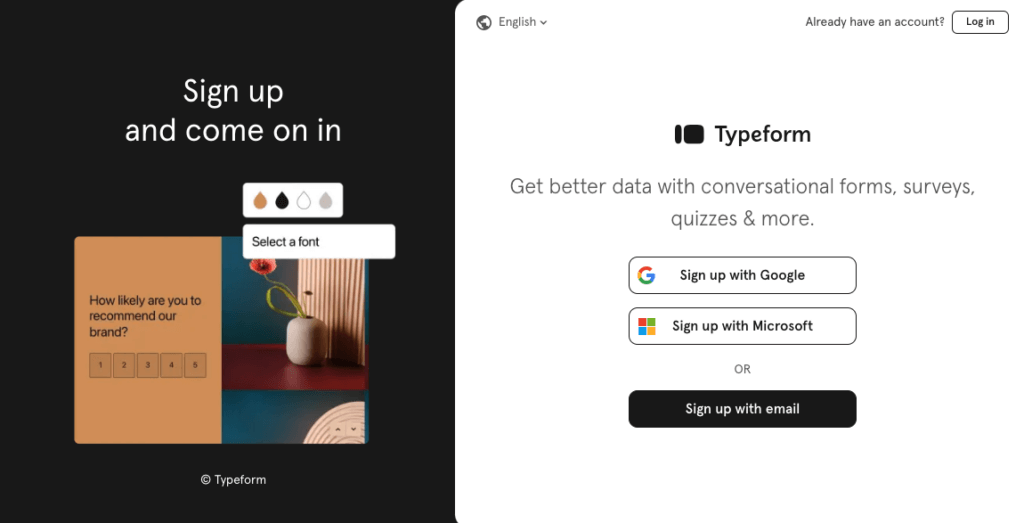
An example of a landing page, encouraging viewers to sign up (Source: Typeform)
Types of landing pages
There are several types of landing pages, each built for a specific purpose. The most common are click-through, lead generation, splash, sales and squeeze pages.
Click-through pages sit between an ad or email and a product or checkout page. Their job is to warm the visitor by presenting the offer, resolving the obvious objections and earning the click to the next step, not to capture data directly.
Lead generation pages (also called lead capture pages) gate a piece of value such as a demo, a whitepaper or a free trial behind a form. The visitor exchanges contact details for access, and those details feed a nurture sequence, a sales queue, or a downstream growth program that turns new signups into referrers.
Splash pages appear before a visitor reaches the main site content. Marketers use them to surface a time-sensitive announcement, enforce an age gate, or promote a campaign without altering the homepage.
Sales pages carry the full conversion argument in one place: problem framing, product proof, pricing, objection handling and a purchase CTA. That makes them the default format for high-ticket or self-serve offers where no sales call is involved.
Squeeze pages are the most minimal form of lead capture: a single headline, a brief value statement and an email field. They maximize opt-in rate by removing every distraction, and work best at the top of a funnel where a low-friction first exchange is the only realistic ask, including campaigns built around viral marketing loops that rely on rapid list growth.
The right type depends on the campaign goal and where the visitor sits in their buying journey.
Creating an effective landing page
Creating an effective landing page involves a combination of good design, clear messaging, and a strong CTA. The design of the landing page should be clean and uncluttered. This makes it easy for visitors to understand what action we are asking them to take.
The messaging on the landing page should clearly communicate the value proposition of the offer. It should explain what the visitor will get in exchange for taking the action, and why it is valuable. The CTA should be clear and direct, encouraging the visitor to take the desired action.
Design principles
The design of the landing page plays a key role in its effectiveness. A well-designed landing page can guide visitors’ attention towards the CTA, while a poorly designed page can confuse or distract visitors.
Some key design principles for landing pages include simplicity, clarity, and consistency. The design should be simple and uncluttered, with a clear path to the CTA. The messaging and visuals should be consistent with the brand and the marketing campaign that led the visitor to the landing page.
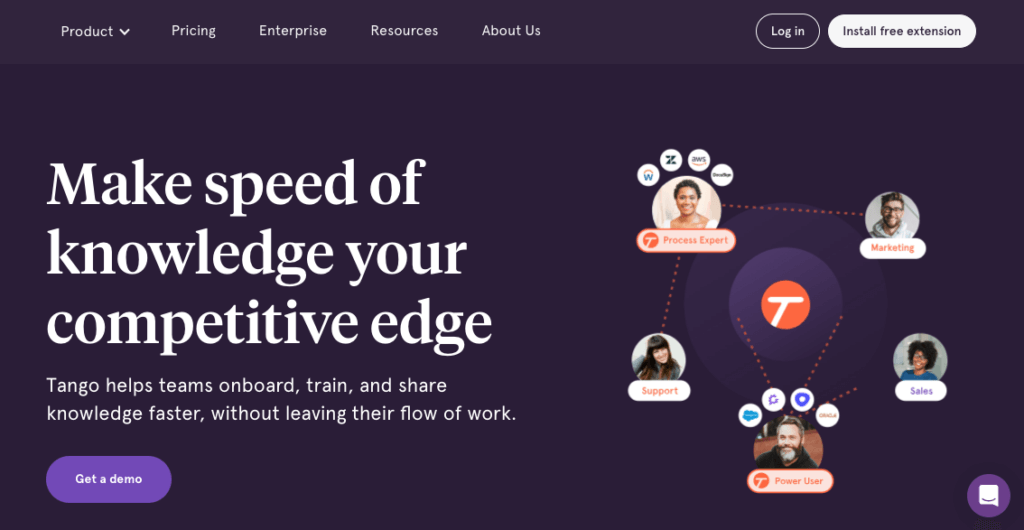
Simple and clear design makes the CTA stand out for viewers (Source: Tango)
Copywriting techniques
The copy on a landing page is another critical factor in its effectiveness. Good copy can convince visitors of the value of the offer and persuade them to take action.
Effective copywriting techniques for landing pages include using clear and concise language, focusing on benefits instead of features, and creating a sense of urgency. The copy should clearly communicate the value proposition, explain what the visitor will get in exchange for taking the action, and why it is valuable.
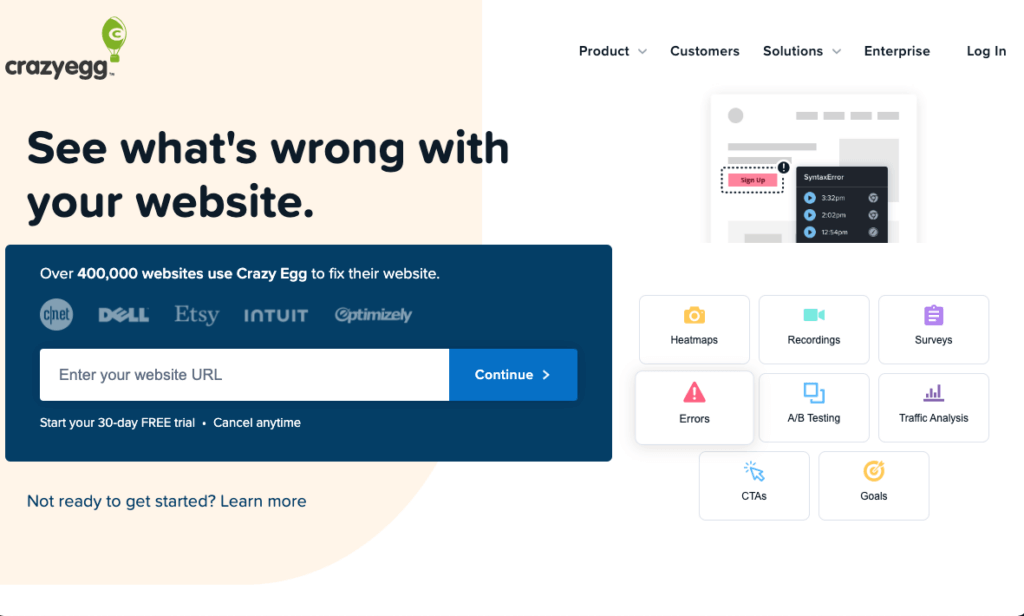
Making the value proposition clear from the start helps viewers understand the product (Source: Crazyegg)
Optimizing landing pages for conversion
Once marketers have created a landing page, it’s important to optimize it for conversion. This involves testing different elements of the page to see what works best at convincing visitors to take the desired action.
Some common elements to test include the headline, the copy, the images, the CTA, and the form. By testing different versions of these elements, you can find the combination that results in the highest conversion rate.
A/B testing
A/B testing, also known as split testing, is a method of comparing two versions of a webpage to see which one performs better. Marketers do this by showing the two versions to similar visitors at the same time and comparing the results.
The goal of A/B testing is to determine which changes to the landing page result in a higher conversion rate. This can involve testing different headlines, copy, images, CTAs, or any other element of the page.
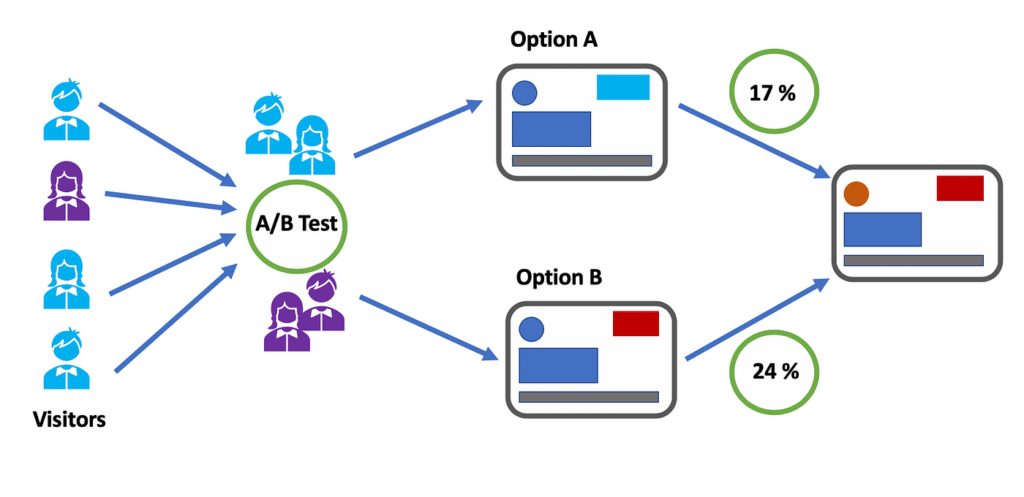
A/B Testing helps businesses choose the most effective landing page
Conversion rate optimization (CRO)
Conversion Rate Optimization (CRO) is the process of increasing the percentage of visitors to a website that convert into customers, or more generally, take any desired action on a webpage. In the context of landing pages, CRO involves making changes to the landing page to increase the number of visitors who take the desired action.
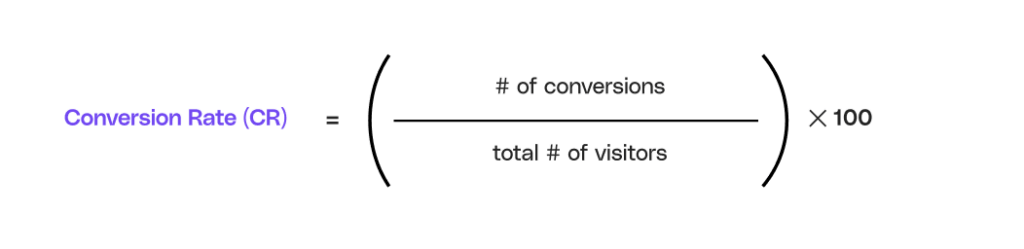
The conversion rate formula (Source: Cello)
CRO can involve techniques such as A/B testing, heatmap analysis (e.g. Hotjar) and session recordings (e.g. FullStory). The goal is to understand what factors are influencing visitor behavior. Based on this, marketers make changes to encourage more visitors to take the desired action.
Measuring landing page performance
Measuring the performance of a landing page is key to understanding its effectiveness and identifying areas for improvement. Marketers use several key metrics to measure landing page performance. These include conversion rate, bounce rate, and time on page.
Together, these conversion rate and engagement metrics show how well the landing page is performing and where improvements can be made. Bounce rate is the percentage of visitors who leave the page without taking any action. Time on page is the amount of time visitors spend on the page. These metrics can provide valuable insights into how well the landing page is performing and where improvements can be made.
Using analytics tools
Analytics tools can provide valuable insights into landing page performance. These tools can track a variety of metrics, including the number of visitors, the conversion rate, the bounce rate, and the time on page.
By analyzing these metrics, you can gain a better understanding of how visitors are interacting with the landing page, what elements are working well, and what areas need improvement. Marketers can then use this information to optimize the landing page for better performance.
Interpreting the data
Interpreting the data from analytics tools can be a complex task, but it is key for understanding landing page performance. The key is to look for trends and patterns in the data that can provide insights into visitor behavior.
For example, a high bounce rate might indicate that visitors are not finding what they expected when they arrived at the page, or that the page is not compelling enough to keep them engaged. A low conversion rate might suggest that the CTA is not compelling enough, or that the offer is not appealing to visitors. By interpreting the data in this way, you can identify areas for improvement and make informed decisions about how to optimize the landing page.
Conclusion
Landing pages are a critical tool in growth marketing, serving as the gateway through which visitors enter and become customers. By understanding the purpose and types of landing pages, applying effective design and copywriting techniques, optimizing for conversion, and measuring performance, businesses can create landing pages that drive visitor action and contribute to growth.
While the process of creating and optimizing landing pages can be complex, the potential benefits in terms of increased conversions and customer acquisition make it a worthwhile investment. With the right approach and tools, any business can use landing pages as a powerful tool in their growth marketing strategy.
What is the difference between a landing page and a homepage?
A landing page targets a specific audience segment and drives a single conversion action, while a homepage introduces your brand to a broad audience across many topics. The structural difference matters for campaign performance: a landing page strips out navigation, limits choices and focuses every design and copy decision on one CTA, whereas a homepage serves general visitors arriving from organic or direct traffic.
What are the main types of landing pages and when should you use each one?
Click-through pages warm visitors before a product or checkout page; lead generation pages exchange a form submission for a demo, whitepaper or free trial; splash pages surface time-sensitive announcements before the main site; sales pages carry the full conversion argument for high-ticket or self-serve offers; and squeeze pages maximize opt-in rate with a single headline and email field for top-of-funnel campaigns. The right type depends on where the visitor sits in their buying journey and what single action you need them to take.
How do you measure whether a landing page is actually working?
Three metrics tell you most of what you need: conversion rate (the share of visitors who complete the CTA), bounce rate (the share who leave without any action) and time on page (how long visitors engage before deciding). A high bounce rate typically signals a mismatch between the ad or email that brought the visitor and what the page delivers; a low conversion rate points to a weak CTA or an offer that does not resonate with that specific segment.
What is the fastest way to improve landing page conversion rate without a full redesign?
A/B testing individual elements (headline, CTA copy, hero image or form length) is the lowest-effort, highest-signal path to lifting conversion rate without rebuilding the page. Run one variable at a time against similar traffic volumes, measure the conversion delta and roll out the winner; tools like Hotjar heatmaps and FullStory session recordings surface where visitors drop off so you can decide which element to test first.
How does a referral link fit into a landing page strategy for B2B SaaS?
A referral link functions as a traffic source that feeds a lead generation or click-through landing page, similar to a paid ad or email campaign but carrying a peer trust signal the ad cannot replicate. When a referred visitor lands on a page designed for that specific audience segment, with copy that matches the context of the referral, conversion rates are structurally higher than cold traffic because the visitor arrives pre-qualified by someone they already trust.