

Performance marketing is a widely used strategy in the digital marketing world that focuses on driving measurable results and maximizing return on investment (ROI). This detailed guide will provide you with an in-depth understanding of the basics, key components, process, and benefits of performance marketing.
TLDR:
- Performance marketing pays only for measurable results like leads, sales and conversions, not impressions or reach
- Key channels include pay-per-click (PPC) advertising, affiliate marketing, email marketing and search engine optimization (SEO)
- Start every campaign by defining goals, identifying target audiences and setting key performance indicators (KPIs) before launch
- Continuous A/B testing and data analysis are what separate improving campaigns from stagnant ones
- Cello adds peer-to-peer referral as a performance marketing channel, turning existing users into a measurable acquisition source
|
Key Element |
Description |
Optimization Tips |
|---|---|---|
|
Understanding the Basics |
Focus on measurable results and ROI through targeted audience actions. |
Set clear campaign objectives and select appropriate digital channels. |
|
Key Components |
Includes PPC, affiliate marketing, email marketing, and SEO. |
Invest in complete strategies and continually monitor and adjust tactics. |
|
Performance Marketing Process |
Involves setting up campaigns, tracking performance, and continuous optimization. |
Set clear campaign goals and give ongoing optimization efforts top priority. |
|
Benefits |
Cost-effectiveness, high ROI, and increased brand visibility. |
Regularly assess campaign performance and adapt strategies. |
Understanding the basics of performance marketing
Defining performance marketing
Performance marketing is a data-driven approach that aims to generate leads, sales, and conversions based on specific actions performed by the target audience. Unlike traditional marketing methods that rely on impressions or reach, performance marketing is all about achieving concrete results.
Performance marketing uses digital channels such as search engine marketing, social media advertising, affiliate marketing, and email marketing. Often called pay-for-performance advertising, the model generally moves more of the financial risk from the advertiser to the publisher or partner, since payment is typically due only after the desired outcome occurs.
📊 Performance marketing is a data-driven approach that aims to generate leads, sales, and conversions based on specific actions performed by the target audience.
The importance of performance marketing
Performance marketing has gained real importance in today's digital market due to its ability to provide measurable outcomes and optimize marketing efforts. By focusing on measurable actions, businesses can confirm that their marketing budgets are spent wisely, leading to increased profitability.
What is more, performance marketing allows for precise targeting and personalization, letting businesses adapt their campaigns to specific audience segments. This level of customization both enhances the user experience and improves the overall effectiveness of marketing initiatives.
Key components of performance marketing
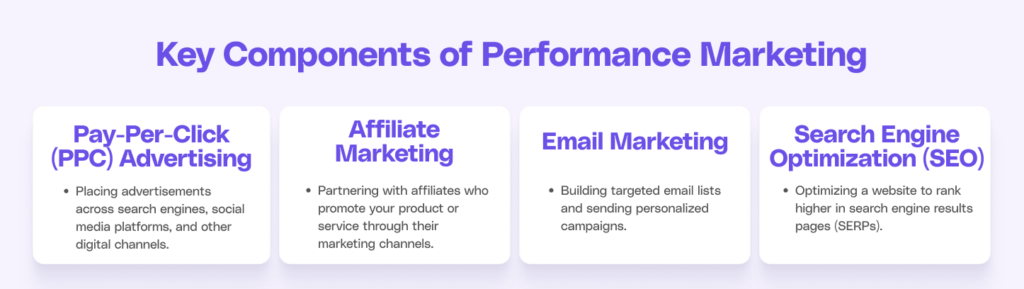
Pay-per-click (PPC) advertising
PPC advertising involves placing advertisements across search engines, social networks and other digital channels. Advertisers pay only when a user clicks on their ads, making PPC a cost-effective way to attract targeted traffic.
One of the key advantages of PPC advertising is the ability to target specific demographics, interests and behaviors. This makes certain that ads are shown to users who are more likely to be interested in the offering. On top of that, PPC campaigns can be easily tracked and optimized in real-time, allowing advertisers to make data-driven decisions to improve performance.
Word-of-mouth marketing
Word-of-mouth marketing relies on satisfied customers to spread positive recommendations about your product or service to their peers. Customers who have had exceptional experiences with your brand are more likely to advocate for it organically. Customers referred by existing customers also show a 37% higher retention rate, according to Revenue Memo's word-of-mouth marketing statistics. Moss replaced a manual partner program with embedded user referrals and reached 650% YoY Referral ARR growth [Moss case study].
Nurturing strong relationships with your customers is fundamental for successful word-of-mouth marketing. Offering exceptional customer service, actively listening to feedback and resolving concerns promptly can build loyalty and encourage customers to become brand ambassadors.
What is more, providing incentives or rewards for referrals can further motivate satisfied customers to share their positive experiences with others. SaaS teams can build this into a word-of-mouth growth strategy with tracked rewards.
Affiliate marketing
Affiliate marketing involves partnering with affiliates who promote your products or services on their websites or through other marketing channels. Affiliates are rewarded with a commission whenever they drive a sale or conversion.
Building strong relationships with affiliates is key for the success of an affiliate marketing program. Providing affiliates with the necessary resources and incentives can help drive their motivation and performance. On top of that, monitoring affiliate performance and providing feedback can lead to continuous improvement of the program. For B2B SaaS teams weighing the model, this look at whether affiliate marketing still pays off compares it with referral programs.

Template of a landing page for affiliate marketers (image credit: Fellow)
Email marketing
Email marketing plays a key role in performance marketing strategies. By building targeted email lists and sending personalized campaigns, businesses can nurture leads, drive conversions, and re-engage with existing customers.
Segmenting email lists based on user behavior, preferences, and engagement levels can greatly improve the effectiveness of email campaigns. Personalizing content and offers based on these segments can lead to higher open rates, click-through rates, and conversions.
A/B testing different elements of email campaigns, such as subject lines, call-to-action buttons, and visuals, can help optimize performance over time.
Search engine optimization (SEO)
Search engine optimization is the process of optimizing a website to rank higher in search engine results pages (SERPs). By optimizing various on-page and off-page factors, businesses can increase organic visibility, attract qualified traffic, and improve overall performance.
Continuous monitoring of search engine algorithms and updates is needed for maintaining a strong SEO presence. Staying informed about industry trends and best practices can help businesses adapt their SEO strategies to stay ahead of the competition. Conducting regular audits of website content, keywords, and backlinks can identify areas for improvement and keep the website optimized for search engines.
The process of performance marketing
A lively and data-driven approach is needed, which requires careful planning and execution to achieve the best results. Setting up a performance marketing campaign involves a series of strategic steps that are key for success in the digital market.
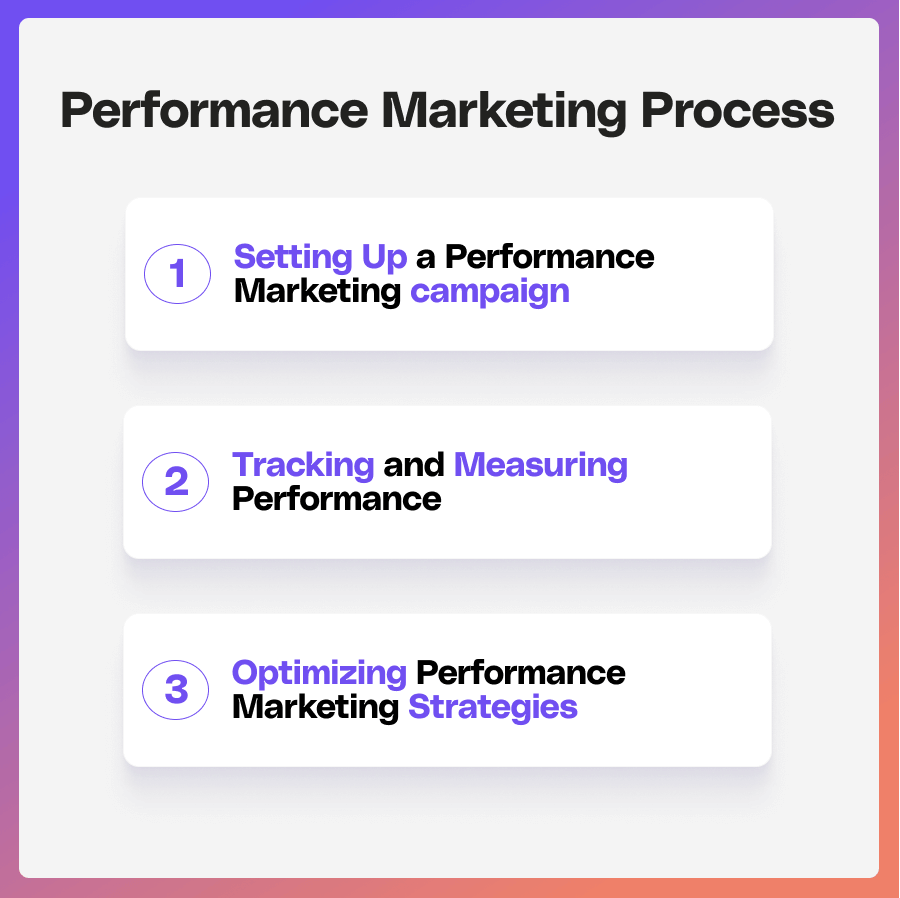
Setting up a performance marketing campaign
Before launching a performance marketing campaign, it is important to build a strong basis by:
- Defining goals.
- Identifying target audiences.
- Developing a thorough strategy.
- Setting up Key Performance Indicators (KPIs) - these are needed for measuring the success of the campaign as businesses can track progress effectively and make informed decisions.
A thorough strategy includes selecting the right advertising channels, optimizing landing pages, creating persuasive ad copy and implementing tracking mechanisms. Conducting thorough market research and competitor analysis can provide valuable insights to shape the campaign for maximum impact.
Tracking and measuring performance
One of the key advantages of performance marketing is the ability to track and measure the effectiveness of marketing campaigns. By using analytics tools and performance tracking software, businesses can gather valuable data to analyze campaign performance, identify areas for improvement, and make data-driven decisions.
Monitoring key metrics such as click-through rates, conversion rates, and return on investment (ROI) is key for judging the campaign's performance and optimizing future strategies.
Optimizing strategies
Continuous optimization is a critical component of performance marketing. By analyzing campaign data and using A/B testing, businesses can refine their strategies, eliminate underperforming elements, and focus on tactics that drive the best results.
Staying updated on industry trends and consumer behavior can help businesses adapt their strategies to remain competitive in the ever-evolving digital market.
In practice, that calls for testing one variable at a time, such as headline copy, button color, or audience segment, and giving each test enough volume to reach statistical confidence before acting on it. Teams often run weekly reviews of cost per acquisition and conversion rate by channel, then reallocate budget toward the top two or three performing placements. Pausing underperforming ad sets, refreshing creative every few weeks, and retesting landing page layouts are common tactics that keep campaigns from going stale.
Benefits of performance marketing
Cost-effectiveness
Wasted ad spend can be eliminated by focusing on actions that directly contribute to business goals. By paying only for desired results, businesses can see that their marketing budgets are allocated effectively and generate the highest possible return on investment.
For example, a PPC campaign that pays per click lets a team cap daily spend and pause underperforming keywords within hours instead of waiting for a monthly report. An affiliate program that pays only on a confirmed sale moves financial exposure away from the business, since commissions are paid after revenue is collected instead of upfront. Reviewing cost-per-acquisition by channel each month, then moving budget toward the channels with the lowest cost, keeps spend tied to outcomes instead of guesswork. A referral versus paid acquisition ROI comparison shows how to run that check for referral programs.
High return on investment (ROI)
Due to its data-driven nature and precise targeting, performance marketing provides a high ROI compared to traditional marketing methods. By continuously optimizing campaigns and building on successful tactics, businesses can achieve greater profitability and revenue growth.
For example, a company running PPC ads can compare cost per acquisition against customer lifetime value to decide whether to scale, pause or cut a channel. Pairing this with affiliate or referral programs, where payouts only occur after a sale closes, keeps spend tied directly to outcomes instead of impressions or clicks alone, reducing wasted budget across underperforming campaigns.
Increased brand visibility
By using various channels and tactics, businesses can enhance their brand visibility among their target audience. Increased exposure helps build brand authority, credibility, and recognition, leading to improved customer trust and loyalty.
Performance marketing in 2026: what has changed
Search clicks are getting scarcer, which raises the cost of every performance channel that depends on them. SparkToro's 2026 zero-click study found that 68.01% of US Google searches ended without a click in the first four months of 2026 (the most recent published data as of this writing, more recent figures may now exist), up from 60.45% in 2024, and it attributes much of the rise to AI Overviews, which now appear on more than 20% of searches.
For performance marketers the budget logic changes in three ways. Teams judge channels on cost per acquisition against customer lifetime value instead of click volume. They collect first-party conversion data through server-side tracking because browser-based signals keep degrading. They also add channels where buyer intent never passes through a search results page.
Peer-to-peer referral is one of those channels. A referred prospect arrives on a recommendation from someone they trust, so no AI Overview sits between the referrer and the signup, and rewards are paid only after a verified conversion, the same pay-for-outcome logic that defines performance marketing. Teams weighing it for B2B SaaS can start with this B2B SaaS referral marketing strategy guide.
Which referral marketing strategies and tools lower CAC for a B2B SaaS company, and where should a growth lead start?
Start with an in-product user referral program that pays rewards only after a referred account converts, then add a partner program once the first one runs reliably. Reward both the referrer and the new customer, tie the payout to a paid conversion event such as a paid invoice and add a payout delay that covers refunds, so reward spend tracks revenue instead of signups. For tooling, Cello is built for the in-product motion, with server-side attribution, fraud detection and reward payouts in one system, while PartnerStack, Rewardful and FirstPromoter are built mainly for external partner and affiliate programs. Choose Cello if the referral surface must live inside your product and an affiliate tool if most referrers sit outside it.
Is a referral program a performance marketing channel, and how do I compare it with PPC?
Yes, a referral program is a performance marketing channel because you spend only when a referred customer completes a defined action, usually a paid conversion. Compare it with PPC on the same metrics, namely cost per acquisition including rewards and software fees, conversion rate from referral link to paid account and payback against customer lifetime value. Volume works differently from PPC, because it depends on how many active users share the link, so track the share of users who become active referrers alongside conversion.
How do we keep performance marketing attribution accurate when browsers block cookies?
Move conversion tracking to the server, because a server-side event records the outcome from your backend or billing system instead of from a browser cookie. Safari's Intelligent Tracking Prevention (ITP) and iOS App Tracking Transparency (ATT) opt-outs then no longer erase the credit for a conversion. Capture the click or referral ID at first touch, store it on the customer record and read it when the paid-invoice event fires, so the gap between click and conversion does not break the chain. Cello applies this pattern to referrals by writing the referral code to the Stripe or Chargebee customer object at the moment of the link click. Judge every channel on paid conversions recorded this way, not on browser-reported clicks.
What payback threshold should we set before scaling a performance marketing channel?
Set a CAC payback limit in months against gross margin before the first budget increase, and scale only the channels that clear it. Calculate fully loaded cost per acquisition from media spend, rewards, commissions and software fees, then divide by the monthly gross-margin contribution of a new customer. Cap or pause any channel that misses the limit and review the numbers monthly next to the cost-per-acquisition check described above. Pay-for-outcome channels such as affiliate and referral programs tend to clear the limit sooner, because rewards are paid after revenue is collected.