

Better-fit referrals start with a clear answer to a simple question: who would find this product useful? A customer may be happy to recommend your software without knowing which peer, problem or situation makes a good match.
To improve referral lead quality, give users a short description of who benefits, show them how to make a relevant introduction and check what happens next. Keep buyer fit separate from sharing activity, signups and payments, so you can see whether the change brings more suitable prospects instead of a better-looking percentage.
TL;DR
- Tell users which problem and customer situation your product serves.
- Give them a five-line “who to refer” brief beside the sharing experience.
- Separate referrer readiness from the receiving buyer's fit.
- Test clearer introductions against your current message, keeping other major variables stable.
- Judge the result using suitable-prospect counts, fit rates and downstream outcomes together.
What makes a referred customer a good fit?
A useful referral-fit definition describes a problem your product solves, the context in which it solves it and the situations it does not support. It should help customers recognize a relevant peer without asking them to qualify a sales opportunity. A job title alone cannot tell you whether someone needs the product.
Keep the two sides of the referral separate:
- The referrer is your existing user making the recommendation.
- The referred buyer is the person or company considering your software.
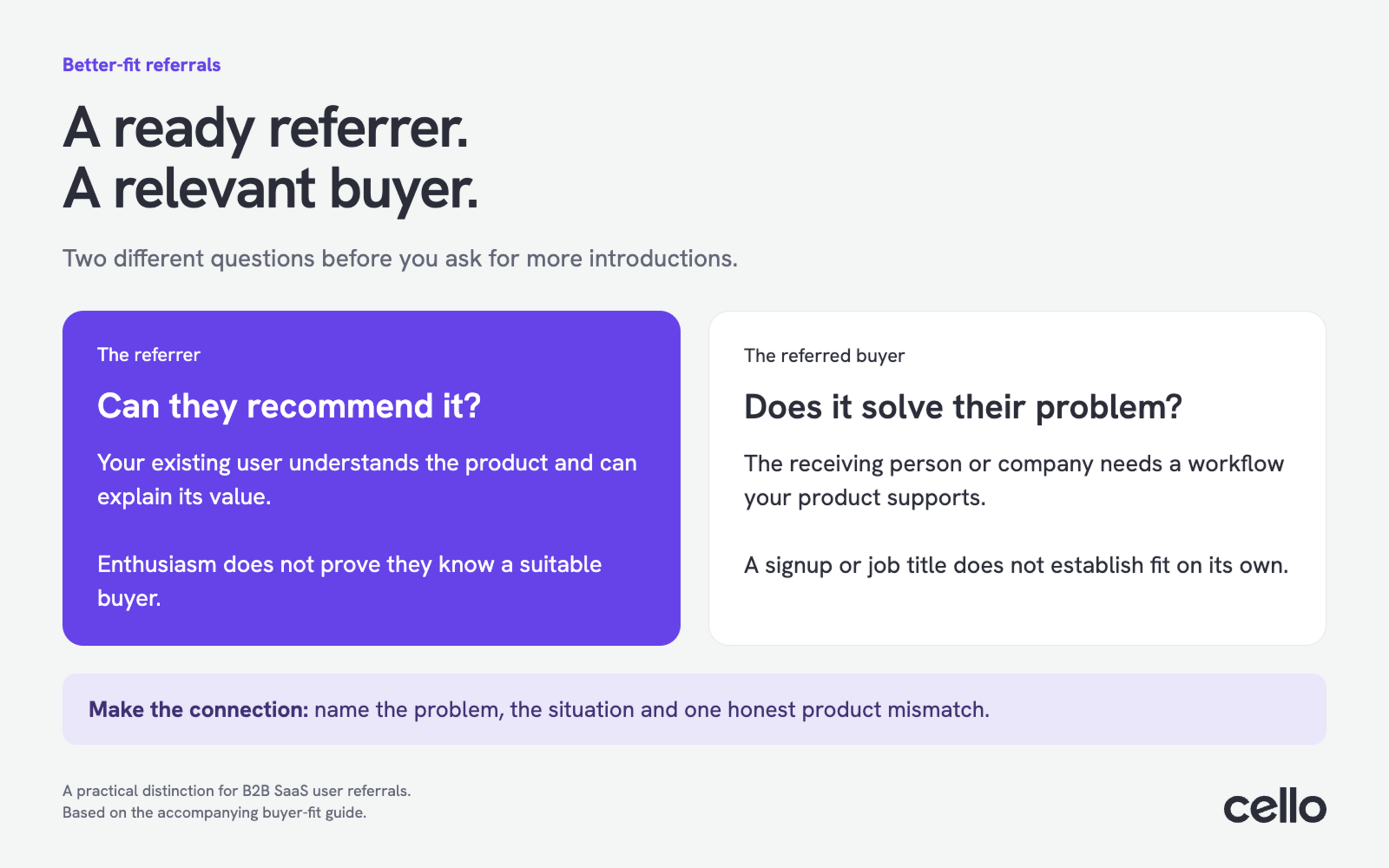
A satisfied power user may know nobody with the right problem. A less frequent user may know a peer who needs exactly what your product does. Referrer enthusiasm and buyer fit answer different questions.
Use customer conversations, successful onboarding examples and reasons prospects decide against your product to write a short fit definition. If you use an ideal customer profile (ICP), translate it from internal sales language into something a user can recognize.
For a hypothetical client-handoff tool, “operations leaders at growing companies” is too broad. “Teams coordinating recurring client handoffs where tasks get lost between departments” gives the referrer a recognizable situation. If the tool only handles repeatable workflows, say that one-off personal tasks are outside its intended use.
How do you tell customers whom to refer?
A buyer-fit brief turns your internal customer description into a small sharing aid. It names the likely user, their problem, a recognizable moment and a candid limitation, then offers a simple next step. Keep it short enough to sit beside the referral link instead of becoming another document users must read.
Cello's complete B2B referral program guide recommends making it easy for users to understand whom you want them to refer. Use this template to put that advice into practice.
|
Line |
Copyable template |
Hypothetical handoff-tool example |
|---|---|---|
|
Best suited to |
[Team or company context] |
Teams managing recurring client handoffs across departments. |
|
Usually trying to solve |
[Specific workflow problem] |
Tasks and responsibilities getting lost between teams. |
|
Especially relevant when |
[Recognizable situation] |
A peer mentions chasing updates or rebuilding the same handoff checklist. |
|
Probably not useful when |
[Candid product mismatch] |
Someone only needs a personal to-do list for occasional tasks. |
|
If someone comes to mind |
[Simple next step] |
Share this overview so they can decide whether it fits their workflow. |
Replace every example with facts about your own product. Name a real limitation instead of inventing exclusions to make the audience sound selective. Avoid asking customers to collect information they would not naturally know.
What should a useful referral introduction say?
A useful referral introduction connects something the recipient has mentioned with a specific reason to look at the product. It gives enough context to decide whether to take a closer look, without claiming results or assuming interest. Offer editable wording instead of a script customers must present as their own experience.
These examples use the same hypothetical handoff tool:
|
Vague wording |
More useful wording |
What changes |
|---|---|---|
|
Know anyone who needs new software? |
Know an operations lead who keeps chasing tasks between client-facing teams? |
Names a recognizable problem. |
|
You should try this tool. |
You mentioned rebuilding the same client-handoff checklist. This tool is designed for recurring handoffs across teams. |
Explains why the recommendation is relevant. |
|
Sign up now. |
Here's an overview if you want to see whether it fits your workflow. |
Offers a low-pressure next step. |
A short introduction template:
You mentioned [problem or situation]. [Product] is designed for [relevant workflow], so I thought it might be worth a look. Here's [overview or referral link] if you'd like to take a closer look.
Customers should only use context that is true. Do not put an invented success story or personal endorsement into their mouths. Keep the product benefit clear, and explain any referral reward accurately alongside the sharing experience.
Is the problem buyer fit or missing context?
A referred prospect who does not progress is not automatically a poor fit. They may misunderstand the recommendation, lack information or encounter a problem later in signup. Check whether their needs match your product separately from whether the introduction explained its relevance. Keep unknown cases visible instead of forcing a verdict.
|
Observed pattern |
Evidence to inspect |
Possible explanation |
Next test |
|---|---|---|---|
|
Prospects need an unsupported workflow. |
Their stated use case compared with product capabilities. |
The buyer description is too broad. |
Name the supported workflow and one clear mismatch. |
|
Suitable prospects expect a different product. |
What the introduction promised and what prospects say they expected. |
The message creates the wrong expectation. |
Replace broad benefits with a concrete product description. |
|
Introductions arrive without context. |
Whether the recipient knows why the product was recommended. |
The referrer needs a better starting message. |
Add the editable introduction template. |
|
Suitable, informed prospects still do not progress. |
Signup, onboarding and sales-handoff evidence. |
The issue may be downstream of fit. |
Investigate the journey instead of narrowing the audience. |
|
Very few referrals arrive. |
Offer exposure, sharing activity and available peer networks. |
There is too little evidence to judge buyer fit. |
Review individual journeys and collect feedback before drawing conclusions. |
For downstream losses, use the existing referral conversion troubleshooting guide. If the delay is between a first share and a qualified prospect or sale, the time-to-first-sale guide helps separate those intervals.
How do you test referral messaging without losing sight of volume?
A messaging test should assess whether clearer guidance produces more suitable prospects, and not merely a higher suitable-prospect percentage. Compare the current message with the buyer-fit brief while keeping the audience, reward and placement stable. Report the number of prospects, the fit rate and later outcomes together so a smaller pipeline cannot masquerade as an improvement.
Where feasible, randomly assign eligible referrers to the current message or the new brief, and keep each referrer in the same group. If you compare different time periods instead, describe the result as observational: a change in audience or timing may also affect what you see.
Agree on these definitions before starting:
|
Measure |
Definition |
|---|---|
|
Fit rate among assessed prospects |
Unique referred prospects meeting the predefined criteria ÷ unique referred prospects with enough information to assess. |
|
Assessment coverage |
Unique prospects assessed ÷ all unique referred prospects in the same group and entry period. Show unknown cases separately. |
|
Total suitable prospects |
The raw number meeting those criteria. Use the same counting unit in both groups. |
|
Suitable prospects per exposed referrer |
Suitable prospects ÷ unique eligible referrers shown that group's message. |
|
Sharing participation |
Unique exposed referrers completing a tracked sharing action ÷ unique exposed referrers. A copied link does not prove delivery. |
|
Downstream outcomes |
Counts of referred prospects reaching the defined activation and first-paid events, with the same follow-up window. |
Hypothetical example: Both versions reach 500 eligible referrers. The current message produces 80 prospects, all assessable, of whom 24 fit: a 30% fit rate. The new brief produces 40 assessable prospects, of whom 20 fit: a 50% fit rate. Fit improved as a proportion, but suitable prospects fell from 24 to 20. Suitable prospects per exposed referrer fell from 4.8% to 4%.
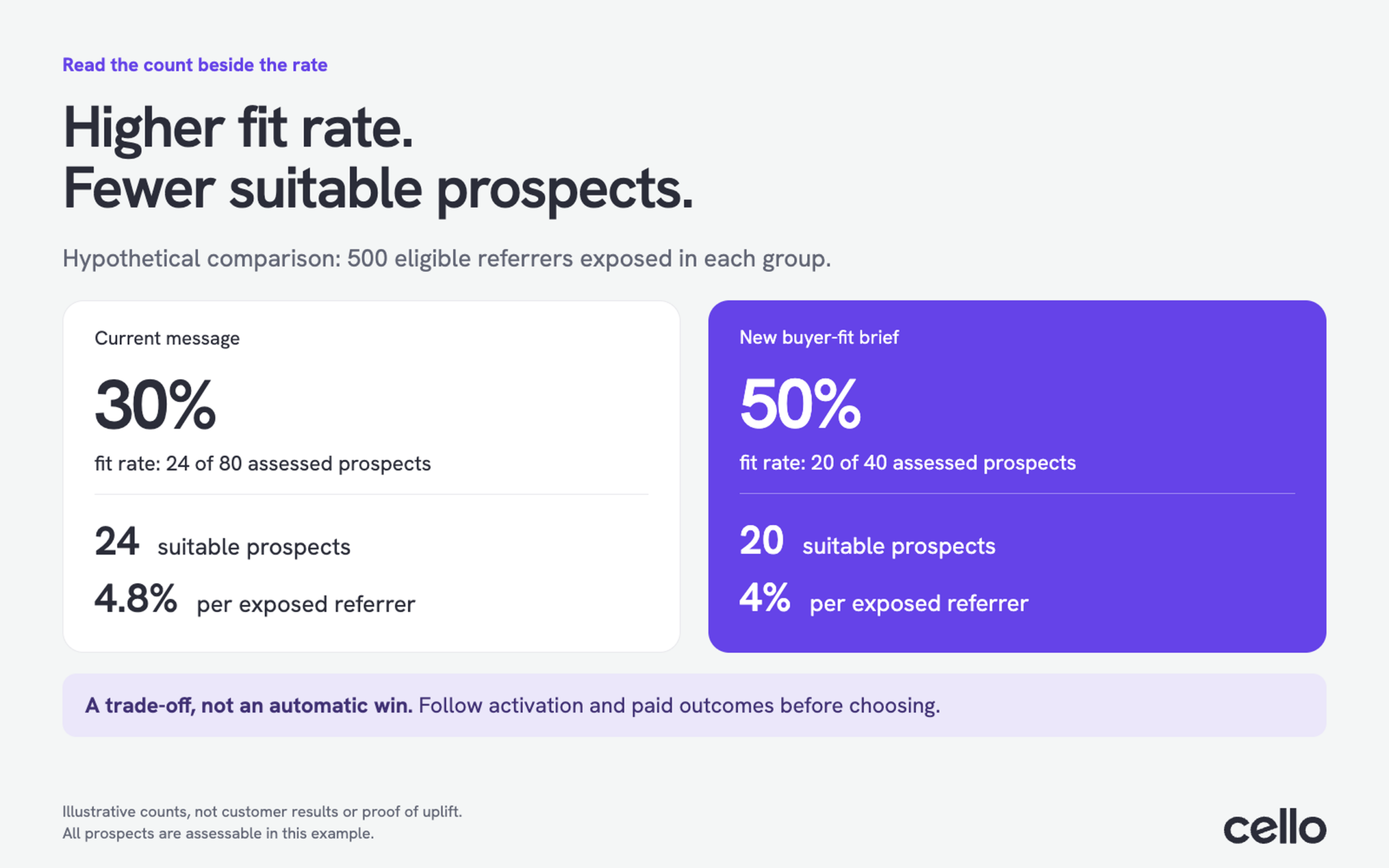
That is a trade-off, not an automatic win. Follow activation and paid outcomes before deciding which version better serves your acquisition goal. These illustrative counts do not confirm a statistically reliable result.
Choose the observation window and evidence needed for a decision before the test. Allow both groups the same time to progress. If referrals are sparse, use message feedback and case reviews to refine the brief; do not present a handful of outcomes as proof of uplift.
Put buyer-fit guidance where users share
The buyer-fit brief belongs close to the moment someone chooses to recommend your product. Start with one referral surface, make the guidance easy to scan and keep the introduction editable. Review whether users understand whom to refer and whether recipients recognize the problem before expanding the message elsewhere.
Cello supports embedding user referrals directly into your product. That gives teams an in-product place for the referral experience; the buyer description and fit assessment still need to come from your own customer knowledge. Treat the brief as a messaging asset, not an automatic qualification system.
Start small: write the five lines, review them with customers, place them beside one sharing route and inspect the resulting introductions. Keep the wording that brings relevant people into a useful conversation. Revise wording that attracts the wrong use case or leaves recipients confused.
What makes a referred customer a good fit?
A good-fit customer has a problem the product solves in a context it supports. Define those criteria using customer evidence and product capabilities. Signup, payment or a recognizable job title can provide context, but none confirms fit on its own.
How do you tell users whom to refer?
Give them a brief describing who benefits, the problem to listen for, a recognizable situation, one candid mismatch and a simple next step. Use everyday language instead of asking users to apply an internal sales qualification framework.
Is buyer fit the same as choosing the right referrers?
No. Referrer selection concerns who is willing and able to recommend the product. Buyer fit concerns whether the receiving person or company has a relevant need. Assess both, but do not use one as a substitute for the other.
What if the prospect fits but does not understand the referral?
Improve the introduction before changing the audience. Ask whether the message connected a real problem with a relevant product capability. Give referrers an editable example that explains why the recipient might find the product useful.
Should signup or payment count as proof of fit?
No. Track those outcomes separately from your fit assessment. A suitable prospect may need more time to activate, while someone who signs up quickly may need a workflow your product does not support. Follow both suitability and later outcomes.
How should you test a new who-to-refer message?
Compare it with the current message, keeping other major variables stable. Use consistent fit criteria and follow-up windows. Report assessment coverage, fit rate, suitable-prospect counts, sharing and downstream outcomes. Random assignment supports a stronger comparison than a simple before-and-after read.
What if referral volume is too low for a reliable comparison?
Review individual introductions and ask users what the message means to them. Use that feedback to improve clarity. Keep reporting raw counts and unknown cases, and describe early findings as learning instead of a proven performance gain.
Is a higher fit rate worthwhile if referral volume falls?
It depends on how many suitable prospects remain and what happens next. A higher percentage can conceal fewer relevant opportunities. Compare suitable prospects per exposed referrer, total suitable prospects and later activation or paid outcomes before choosing a version.