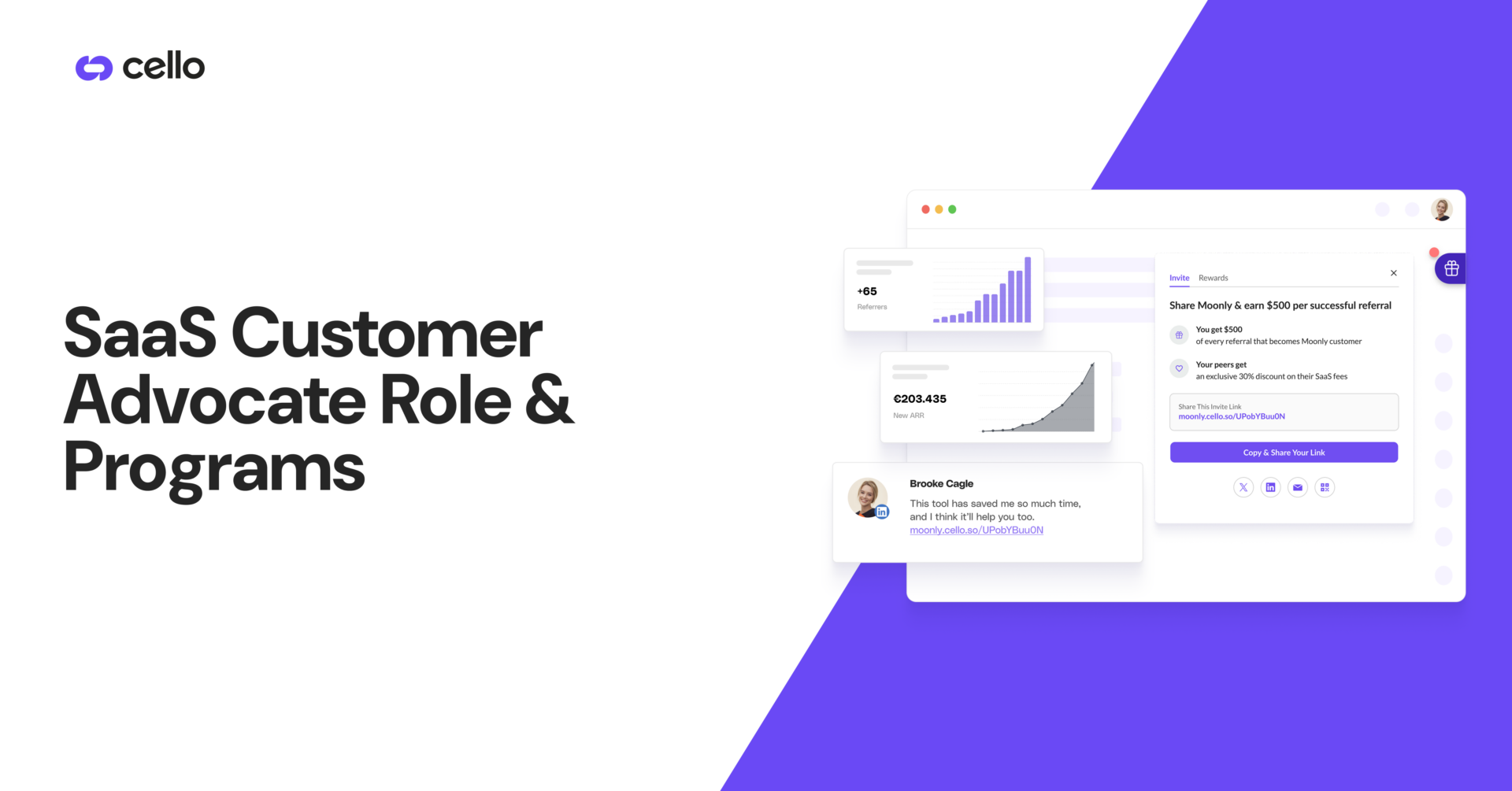

Somewhere in your user base right now, there are people who would recommend your product to a colleague without being asked. They're high-engagement, they've seen real results, and peer recommendations from users like them carry more weight than any ad you could run. The question isn't whether those users exist. It's whether your team has a structured way to find them, activate them, and actually see the pipeline they generate.
- What is a customer advocate?
- Why customer advocates matter more than any paid channel
- Customer advocate vs customer service: understanding the distinction
- What makes a SaaS user a genuine customer advocate?
- How to identify customer advocates in your user base
- What is a customer advocacy program?
- How to build a customer advocacy program for SaaS
- How to keep advocates engaged beyond launch
- How to measure customer advocacy
- Customer advocacy examples in B2B SaaS
- How Cello turns customer advocates into a measurable growth channel
- Final thoughts on customer advocacy in B2B SaaS
TLDR:
- A customer advocate in SaaS is an existing user who recommends your product unprompted: a growth asset, not a support hire
- Referred customers retain at higher rates than paid-acquired ones, making advocacy a higher-quality acquisition channel
- Advocates already exist in your user base; the gap is a structured path to activate them, not a shortage of willing referrers
- Server-side attribution is required to close the measurement gap; cookie tracking loses conversions when prospects switch devices before paying
- Cello treats customer advocates as the instrumented core of a measurable acquisition channel, with rewards firing on verified payment events, not form fills
What is a customer advocate?
A customer advocate, in the SaaS growth context, is an existing user whose satisfaction with your product motivates them to recommend it to peers, without being asked, scripted, or paid to do so.
The term gets used two ways. In job boards and healthcare companies, "customer advocate" describes a support or liaison role. In SaaS growth, it describes something structurally different: a user who has experienced enough value that they become a credible, self-motivated acquisition channel, the human engine behind User-Led Growth.
Per Revenue Memo's word-of-mouth marketing statistics, word of mouth drives most purchasing decisions, and customer advocates are the people generating those recommendations inside your ICP.
A support role is a cost center you staff. A customer advocate is a growth asset you identify, activate and reward.
Why customer advocates matter more than any paid channel
Peer recommendations beat paid ads because trust is structurally harder to buy than to earn. Per the Wynter B2B Software Buying Study, 2024, 73% of B2B marketing executives rank word of mouth and peer recommendations as the most influential factor in vendor consideration.
The downstream economics reinforce this. Referred customers show 37% higher retention than paid-acquired ones, per Revenue Memo's word-of-mouth marketing statistics, and they spend more over their lifetime. A customer advocate produces a higher-quality account at a fraction of the cost of a paid channel.
Customer advocate vs customer service: understanding the distinction
The confusion here is real and search-driven. Type "customer advocate jobs" into any job board and most results return support or patient services roles at companies like Blue Cross Blue Shield, Carvana, UnitedHealthcare or Centene. Those roles are functional: handle inquiries, resolve complaints, serve as a liaison between the customer and internal teams. Salary data at companies like HCSC or Fidelity reflects compensation for throughput and resolution quality, not for generating new pipeline.
That is a legitimate career path and a completely different concept from what this article covers.
|
Customer Service Advocate (job role) |
Customer Advocate (SaaS growth) | |
|---|---|---|
|
What it is |
A staffed support or liaison role |
An existing user who recommends the product to peers |
|
Examples |
Blue Cross Blue Shield, Carvana, UnitedHealthcare |
High-NPS users, power users, organic reviewers on G2/LinkedIn |
|
How it's created |
Hired via a job description with a defined salary band |
Identified in existing user data; activated via a referral program |
|
Primary function |
Resolve inquiries, reduce support friction |
Refer peers, generate new pipeline |
|
Cost structure |
Cost center (headcount, salary, benefits) |
Acquisition channel (reward fires on verified payment only) |
|
What it produces |
Improved customer satisfaction and retention |
Referred accounts with 37% higher retention than paid-acquired ones |
In SaaS growth, a customer advocate is not a hire. No job description, no salary band. They are an existing user whose product experience has been strong enough that they recommend it unprompted to peers in their network. Their recommendation carries weight precisely because it is voluntary.
The disambiguation matters because the two meanings lead to entirely different actions. Hiring a customer service advocate staffs a support function. Building a customer advocacy program identifies satisfied users and gives them a structured, rewarded path to share, which is an acquisition channel.
What makes a SaaS user a genuine customer advocate?
Several signals separate a genuine advocate from a satisfied user who simply hasn't churned yet.
- High and consistent product engagement: they return frequently, use core features, and show low churn signals in usage data
- Organic sharing behavior, where they mention the product in communities, tag it on LinkedIn, or refer colleagues without any prompt
- High NPS scores (9 or 10) combined with qualitative responses that name a specific outcome the product delivered
- A clear, personal result they attribute to your product, such as a hire made, revenue generated, hours saved
A growth or CS team can observe most of these signals in existing data: session frequency, NPS responses, support ticket absence, and referral link activity if a program is already running. No survey required to find the first layer.
Advocates exist in almost every SaaS product. The gap is not a shortage of willing referrers; it is the absence of a structured path to activate them. A user who would recommend your product to three colleagues this week will do nothing if there is no easy mechanism to share, no reward for the referral, and no visibility into whether their recommendation converted. That structural gap is what an advocacy program resolves.
How to identify customer advocates in your user base
Most advocacy programs stall before they start because no one owns the identification step. The signals are already in your data.
- NPS scores of 9 or 10, especially when paired with a written response naming a specific outcome, are the most direct indicator. A promoter who wrote "helped us close 40% more deals" is an advocate worth contacting; a bare score without qualitative context is only a starting point.
- Session frequency and feature depth separate engaged users from accidental ones. A user logging in five times a week and using three or more core features is a stronger candidate than someone who signed up and ran one report.
- Organic review submissions on G2 or Capterra, alongside unprompted LinkedIn mentions and community posts, are the highest-confidence signal. These users are already advocating without a program, forming the foundation of any referral marketing for B2B SaaS motion.
- Renewal behavior and low support ticket volume indicate satisfaction at the retention layer, a reliable proxy when usage data is limited.
Product analytics and CS tools can surface these signals in a single view by combining NPS responses with session data. The method matters less than the discipline of reviewing them on a regular cadence, and not merely when a case study is needed.
What is a customer advocacy program?
A customer advocacy program, in the acquisition sense, is a structured system that gives identified advocates a mechanism to refer peers, tracks whether those referrals convert, and issues rewards when they do.
That closed loop separates it from adjacent programs that often get labeled advocacy but operate differently. Review generation campaigns build credibility. NPS initiatives measure sentiment. Community management maintains engagement. All are legitimate word-of-mouth tactics, but none tie reward issuance to a verified revenue event. A referred user who signs up but never pays should not trigger a payout, and in most review or community programs there is no payout mechanism at all, because conversion attribution is not the goal.
A referral program for SaaS tracks the full chain: advocate shares a link, prospect clicks, signs up, converts to a paid account, reward fires. Every step is attributable, and the program can be measured against the same metrics as any paid acquisition channel, including conversion rate, CAC and program ROI.
How to build a customer advocacy program for SaaS
Five steps, in order.
Identify first. Pull NPS promoters, high-session users and anyone who has already mentioned your product publicly. These are your first cohort.
Give them a frictionless path to share. An external referral portal sends users away from the product at the moment of highest intent. The sharing surface should live inside the product, where in-product referrals keep advocates where sharing intent is highest. Butter went live with an in-product referral widget in under five hours. Hera did it in two days.
Design a two-sided incentive. Reward the referrer for a successful conversion and give the referred user a reason to act. A cash reward to the referrer plus a discount for the new signup is the most common B2B structure. Free months or account credits work for segments where cash creates compliance friction.
Set up attribution that holds. Cookie-based tracking loses conversions when a prospect switches devices or clears their browser between clicking a referral link and signing up. Server-side attribution writes the referral code to the billing system at the moment of the click, not at signup, so device switching does not break the chain. The conversion event that triggers the reward should be a verified payment, not a signup.
Define what success looks like before launch. B2B referral programs that convert share a common set of health metrics: how many registered referrers are actively sharing, how many shares result in clicks, how many clicks convert to signups and how many signups convert to paid accounts. Benchmarks on all four give you a reference point within weeks of going live.
How to keep advocates engaged beyond launch
Launch is not the hard part. Keeping advocates sharing six months later is.
Most referral programs spike in week one then go quiet. The fix is activation design: surfacing referral prompts at the moments when sharing intent is naturally highest, instead of relying on users to remember the program exists.
Contextual in-app prompts outperform static launchers. Typeform's 27.2% sharing rate shows what happens when a prompt surfaced after a user completes a meaningful milestone reaches them when they are most likely to say "you should try this." Cello's behavioral trigger configuration lets teams define which in-product events surface the referral widget instead of waiting for organic discovery.
Lifecycle nudges extend that logic across the user journey. A simple notification that a referral reward is waiting to be claimed, or that a referred contact recently signed up, pulls dormant referrers back without requiring a new campaign.
Segmentation keeps outreach relevant. High-session users with tracked referrals already respond to different messaging than a recently onboarded user who has never shared. Cello supports campaign targeting by session frequency, subscription tier and role, so the cohorts most likely to refer receive the most direct activation.
How to measure customer advocacy
Four metrics tell you whether an advocacy program is generating real acquisition value or just activity.
The funnel runs in sequence: registered referrers, active referrers (those who have shared at least once), sign-ups from shared links, and paid conversions. Activation rate (active referrers divided by registered referrers) and sharing rate (sharing referrers divided by active referrers) are the two leading indicators. A low activation rate means the referral surface is going undiscovered. A low sharing rate means advocates are not finding the prompt worth acting on.
Program ROI sits at the bottom of the funnel. Compare referral CAC against your paid channel CAC. VEED's referral CAC came in 90.4% below their paid acquisition cost after embedding Cello in-product.
One measurement gap undermines referral data more than any other: a prospect clicks a referral link on Tuesday but pays three weeks later on a different device. Cookie-based tracking loses that conversion entirely. Server-side attribution (covered above) closes this gap at the billing layer. In B2B funnels, where procurement adds time between sign-up and invoice payment, undercounting referral conversions leads directly to underinvesting in the channel.
Customer advocacy examples in B2B SaaS
Advocacy patterns vary by product type, user persona and the density of the professional network surrounding the tool.

In a collaborative productivity product, sharing is already built into how users work. Someone adopts the tool, runs a project, then invites a colleague. The referral surface accelerates a behavior that was going to happen anyway. Miro's in-product referral program saw an 8x activation rate on referred users relative to other acquisition channels, partly because referred users arrive pre-qualified by context.
In fintech, advocacy often flows through peer networks, not organic in-product sharing. A CFO who cuts invoice processing time by 30% is likely to mention it to peers at a finance roundtable. Moss grew Referral ARR 650% YoY by giving those high-trust conversations a structured reward and an attribution path.
In video or media tools, power users share because the economics make sense: a referral reward offsets their own subscription cost. VEED embedded a referral widget in-product and saw CAC drop 90.4% versus paid acquisition.
In recruitment or HR SaaS, advocacy concentrates inside professional communities. Recruiters talk to other recruiters, and a strong outcome on one search generates a recommendation at the next industry meetup. JOIN, a recruitment platform, runs its referral motion on this pattern with Cello. Program design here should focus on ease of sharing inside those channels: a shareable link, a QR code at an event or an in-app referral prompt triggered after a hire is confirmed, so the recommendation reaches a peer at the moment the outcome lands.
The pattern across all four: program design should match the natural sharing moment for that persona. Forcing a fintech CFO through the same activation flow as a video editor produces weaker results than building around how each user type already communicates value to peers.
How Cello turns customer advocates into a measurable growth channel
Cello treats customer advocates as the instrumented core of a measurable acquisition channel, not a brand-sentiment asset reviewed in a quarterly slide.
The in-product embed places the referral surface inside the authenticated product session, where sharing intent is highest. Server-side attribution closes the measurement gap that cookie tracking leaves open in B2B funnels. Rewards fire on verified payment events, not form fills.
Across Cello's install base the pattern holds from fintech to productivity to media tools: advocates share inside the product, attribution closes at the billing layer, rewards process automatically, and the team adjusts by exception. That is what "Referrals on Autopilot" means in practice. Cello MCP adds a read-only investigation layer for program trends, available benchmarks, top referrers, and prioritized recommendations. It does not contact advocates, send campaigns, change rewards, or alter program settings. Those actions remain in the Cello Portal.
Final thoughts on customer advocacy in B2B SaaS
Peer recommendations already influence a measurable share of B2B purchasing decisions. The question is whether your program gives advocates a frictionless way to act on that intent, or leaves them with nothing to do after they think "my colleague should try this." Attribution, rewards and in-product placement are the three pieces that separate a program that compounds from one that stalls after week one. Cello sets all three up for you.
What is the difference between customer advocacy and a customer-service advocate role?
Customer advocacy in a growth program concerns customers recommending a product based on their experience. A customer-service advocate role concerns helping customers resolve questions or problems. Be clear about which meaning you intend: a customer can advocate voluntarily or through a structured referral program, and those activities are different from staffing a support role.
How do you set up a referral program that rewards both the referrer and the new user?
Define the referrer's reward and the new user's benefit separately. Cello campaign rules can use confirmed events and purchases; new-user discount configuration describes the offer, while your integration applies the billing discount. Capture referral identity through the documented signup and purchase flow rather than assume it is written to a billing customer at link-click.
How can you keep a referral program visible after launch?
Use a discoverable launcher and appropriate in-product or email notifications, then test placement and timing in your product. Cello documents launcher configuration and referral notifications. Treat segmentation and behavioral prompts as implementation choices to verify, not guarantees that one pattern will outperform another.
What should I compare when evaluating Cello and PartnerStack for customer referrals?
Evaluate the sharing surface, participant enrollment, referral identity, conversion events, rewards and fulfillment for your actual program. Cello documents an embedded Referral Component and a Partner Portal. Confirm PartnerStack's current workflow directly before concluding it cannot support a particular customer-referral motion.
Which payout methods and countries does Cello support?
Cello's current support documentation describes PayPal payouts, with Venmo available for the US on request. Bank transfer and SEPA are not currently offered in that documentation. Check the maintained supported-country list before launching your program; users in unsupported payout countries cannot set up a payout method.
When is referral metadata added to Stripe or Chargebee?
Cello's Stripe and Chargebee guides require referral metadata on the billing customer, including the referrer's cello_ucc and your new user's ID. If the billing customer is created at signup, add the metadata during signup tracking. If it is created at purchase, add it when creating that customer. The integration must capture and pass referral information correctly; the guides do not promise attribution across every device or browser change.
Can a referral program work when prospects book a demo rather than sign up directly?
A sales-led program can define a suitable conversion milestone, but the tracking and reward rule must match the integration you implement. Cello's campaign guide describes demos and custom events as possible rule inputs. Confirm the event definition, identity matching and CRM or API connection before offering a reward for demo attendance.
How should a regulated business evaluate non-cash referral rewards?
Review any incentive with your legal, compliance and procurement teams before launch; non-cash rewards are not automatically exempt from those policies. Cello documents an early-access in-product credits flow in which the customer processes and applies rewards. Confirm availability and the fulfillment work before offering credits or other benefits.
What work is involved in integrating Cello?
The documented integration includes loading the Referral Component, generating a server-side identity token, initializing user details, and connecting signup and purchase attribution. Scope and test those steps against your authentication and billing architecture. Implementation time depends on your setup; do not treat a quickstart target or an individual customer's launch time as a guarantee.
Which metrics help diagnose a referral funnel?
Track how many eligible users discover and engage with the referral experience, how many share, how many referred visitors sign up, and how many become qualified or paying customers. Define the denominator and time window for each metric, then compare trends and segments. Do not assume a universal benchmark or an exact Cello dashboard definition without checking the current analytics documentation.
How do in-product user referrals and external partner programs differ?
An in-product referral experience lets existing users share from the product. A partner portal gives external partners a place to access their link and follow referrals and rewards. Cello documents both approaches. Choose the surfaces and conversion integration that match your participants rather than assume every program needs a product embed or a payment-only reward trigger.
How should payout timing account for refunds or early churn?
Choose reward rules and any payout delay to match your economics and refund policy. Cello's docs describe configurable delays through its support team, cancellation of pending rewards on refunds, and stopping future recurring rewards when a subscription ends. Already paid rewards are not clawed back according to the support FAQ, so a delay reduces risk rather than guarantees retention.
How can you identify customers who may be willing to refer peers?
Use signals such as positive feedback, successful product outcomes and sustained engagement to form a testable outreach segment. Ask customers at relevant moments and measure actual sharing and conversion. These are starting hypotheses, not proof that a particular NPS score or activity pattern reliably predicts advocacy.
How can referral links be used through email or sales teams?
Referral links can be distributed outside an in-product widget, but your integration still needs to capture the referral code and preserve the relevant identity through signup and conversion. Review the CRM, email and billing handoffs in your implementation and test them end to end. Distribution through a different channel does not itself guarantee attribution.
How should you assess referral-program ROI?
Compare attributable revenue or contribution with reward costs, platform fees and implementation or operating costs over a defined period. Keep referral conversion quality, refunds and reward timing visible in the model. Customer case-study outcomes can be useful context, but they are not a forecast for your program and need an exact source and metric definition before being quoted.