

You set up affiliate program tracking with a popular tool, send links to your partners and watch the clicks roll in. Two weeks later your dashboard shows half the conversions you expected because Safari limited your cookie to 7 days and ad blockers killed the rest. Now you’re matching up payments manually while affiliates ask why their commissions don’t match the signups they drove. Cookie tracking fails the moment a browser decides to block third-party scripts or cap first-party storage. Server-side attribution records the referral in your database instead, surviving ITP restrictions and giving you a complete view of which partners actually drive revenue.
TLDR
- Cello tracks referrals in-product with server-side attribution, risk-factor monitoring and automated payouts.
- FirstPromoter, Tapfiliate, Rewardful and PartnerStack each fit specific use cases but carry trade-offs: external portals, cookie dependence, manual payout flows or enterprise-only pricing.
- Pick based on attribution model, time-to-live and whether the surface lives inside your product.
What is affiliate program tracking?
Affiliate program tracking connects a referral click to a signup, then to a paid customer, then to a commission. It answers one operator question: which partner drove this revenue, and how much do we owe them? Server-side tracking methods have become critical as browser restrictions tighten.

For B2B SaaS, tracking has three jobs:
- Attribution: linking a referral link, code or UCC to a signup and downstream invoice.
- Measurement: reporting Referral ARR, CAC by partner and conversion rates.
- Payout: calculating what each affiliate earned without manual reconciliation.
Without tracking, referrals are guesswork. With it, referrals become a measurable line item next to paid, organic and outbound.
How we assessed affiliate tracking software
We scored each tool against seven criteria operators apply during procurement:
- Attribution model. Server-side attribution recorded in the backend scored higher than cookie-only tracking, which breaks under Safari ITP, Firefox ETP and ad blockers. Tools that gate server-to-server tracking behind higher tiers were marked down.
- In-product surface. Native SDK embeds that render the referral surface inside the product scored higher than external portals that route users to a separate domain. External-portal-only tools were flagged as friction points for user referral programs.
- Mobile SDK coverage. First-party iOS, Android, React Native and Flutter SDKs scored higher than web-only tracking. Tools without native mobile SDKs cannot attribute app-based referrals since mobile apps don't use browser cookies.
- Payout automation and fees. Automated payouts across multiple countries with tax handling scored higher than manual bulk invoice flows. Transaction fees on commissions and revenue share above 0% were counted against the tool.
- Integration breadth. Native billing connections (Stripe, Chargebee, Paddle, Recurly) plus CRM connections (HubSpot, Salesforce) scored higher than Stripe-only or Paddle-only lock-in. Missing CRM integrations were flagged for B2B sales-led funnels.
- Pricing transparency. Public pricing published on the vendor site scored higher than quote-only enterprise pricing. Undisclosed transaction fee ranges were flagged as procurement risk.
- Fraud detection. Native risk-factor monitoring for unusual usage patterns (covering self-referrals, duplicate signups, and reward-threshold manipulation) scored higher than tools relying on manual rules or no documented detection at all. Platforms with no documented fraud posture were flagged.
Best overall affiliate tracking software: Cello
Cello is built for B2B SaaS user referrals from the ground up. The Referral Component loads inside your product through native web and mobile Software Development Kits (SDKs), so users share without bouncing to an external portal. Softr saw a 5x conversion lift after switching off PartnerStack.
Attribution runs server-side, holding under Safari Intelligent Tracking Prevention (ITP), Firefox Enhanced Tracking Protection (ETP), ad blockers, and consent refusal. Cello handles Value-Added Tax (VAT), Goods and Services Tax (GST) and Know Your Customer (KYC) with compliant payouts across 63 countries via PayPal. User Referrals have 0% transaction and currency-conversion fees. Partner Referral transaction fees vary by tier, with 0% currency-conversion fees.
Core strengths
- In-product widget removes external portal friction
- Server-side attribution immune to ITP, ETP, and ad blockers
- Native SDKs for iOS, Android, React Native and Flutter
- Automated payouts with Merchant of Record tax handling
- Unified user and partner referrals in one dashboard
- GDPR-native posture with EU-hosted AI assistant and risk-factor monitoring for unusual usage patterns
Cello is the only referral tracking system built for in-product B2B SaaS growth with server-side attribution that holds up when browsers block cookies.
FirstPromoter
FirstPromoter is an affiliate and referral tracking tool aimed at subscription businesses, with a B2B SaaS lean. Users get routed to a separate dashboard instead of an in-product surface.
What they offer
- Native integrations with Stripe, Paddle, Chargebee and Recurly
- Works with HighLevel, Ghost, and ClickFunnels
- Automated PayPal and Wise payouts on Business and Enterprise plans
- Recurring commission tracking across the subscription lifecycle
Good for: affiliate-first programs run with external partners who accept a portal workflow.
Limitation: G2 reviewers flag reporting as unintuitive and barebones. No native HubSpot or Salesforce connections breaks B2B attribution, and tracking stays web-only without mobile SDKs.
Bottom line: FirstPromoter handles external affiliates well but lacks the in-product embed and server-side attribution that user referral programs depend on.
Tapfiliate
Tapfiliate targets e-commerce stores, SaaS and subscription services running affiliate, referral or influencer programs through an external portal aimed at recruiting bloggers and publishers.
What they offer
- 30+ pre-built integrations across Shopify, WooCommerce, BigCommerce, Stripe, PayPal, Zapier and Squarespace
- Commission engine supporting fixed, percentage, recurring, lifetime, group, item-based and performance-bonus structures
- REST API, JavaScript pixel and server-to-server postback tracking
- Flat monthly pricing with no revenue share
Good for: content-driven affiliate programs recruiting external publishers.
Limitation: G2 reviewers flag thin analytics. The $89/mo Launch plan uses cookie tracking that loses conversions under Safari ITP. Server-to-server postback sits behind the $179/mo Scale plan. No native mobile SDKs ship.
Bottom line: fits e-commerce affiliate recruitment but disqualified for B2B SaaS user referrals.
Rewardful
Rewardful’s 5-step setup targets SaaS on Stripe or Paddle, auto-adjusting commissions for upgrades, downgrades, trials, cancellations and refunds. Tracking runs through a Rewardful-hosted portal.
What they offer
- Stripe and Paddle integration for referrals, discounts and commissions
- Recurring or one-time payouts, percentage or fixed, with minimum thresholds
- Managed Payouts or PayPal/Wise Mass Payment for disbursement
- Starter $49/mo, Growth $99/mo, Enterprise $149/mo
Good for: early-stage SaaS under $10K MRR on Stripe running simple link programs.
Limitation: a 9% commission fee on lower tiers, $7,500/mo revenue cap on Starter, Stripe and Paddle only, no mobile Software Development Kits (SDKs), English-only and external portal.
Bottom line: the $49 headline hides a 9% commission fee on its Starter tier, revenue caps and Stripe lock-in.
PartnerStack
PartnerStack is a partner relationship system for software companies running affiliate, reseller and co-sell motions, with a marketplace of 100,000+ active partners and customers like Intercom, Webflow and monday.com.
What they offer
- Real-time tracking, customizable commissions and automated payouts
- Partner marketplace for recruitment
- LMS modules, deal registration and co-selling workflows
Good for: dedicated partnerships teams running complex channel ecosystems.
Limitation: 3 to 15% transaction fee on commissions, no public pricing (quote-only as of 2026), lengthy implementation timelines, external portal and no mobile Software Development Kits (SDKs).
Bottom line: enterprise PRM that overshoots user referral programs on cost and time-to-live.
Feature comparison table of affiliate tracking software
|
Feature |
Cello |
FirstPromoter |
Tapfiliate |
Rewardful |
PartnerStack |
|---|---|---|---|---|---|
|
In-product embedding |
Yes |
No |
No |
No |
No |
|
Server-side attribution |
Yes |
No |
S2S on Scale tier |
No |
Cookieless claim, unconfirmed |
|
Mobile SDKs |
iOS, Android, React Native, Flutter |
No |
No |
No |
No |
|
Automated payouts |
Yes, 0% fees |
Business/Enterprise tiers |
Requires Trolley |
Manual bulk invoice |
Yes |
|
Transaction fees 0% (user referrals), 5% (partner programs) 0% 0% 3-9% lower tiers 3-15% undisclosed | |||||
|
Fraud detection |
Yes, automated |
Yes |
No (per G2 reviews) |
Not documented |
Not documented |
|
GDPR/EU hosting |
EU-native |
No |
No |
No |
No |
|
Pricing transparency |
Public |
Public |
Public |
Public |
Custom, undisclosed |
|
Best for |
B2B SaaS user referrals |
External affiliates |
E-commerce |
Early-stage Stripe-only |
Enterprise partner programs |
Cello is the only entry built for in-product user referrals with native mobile SDKs and EU hosting. The others fit external affiliate or partner use cases.
Why Cello is the best affiliate tracking software for B2B SaaS
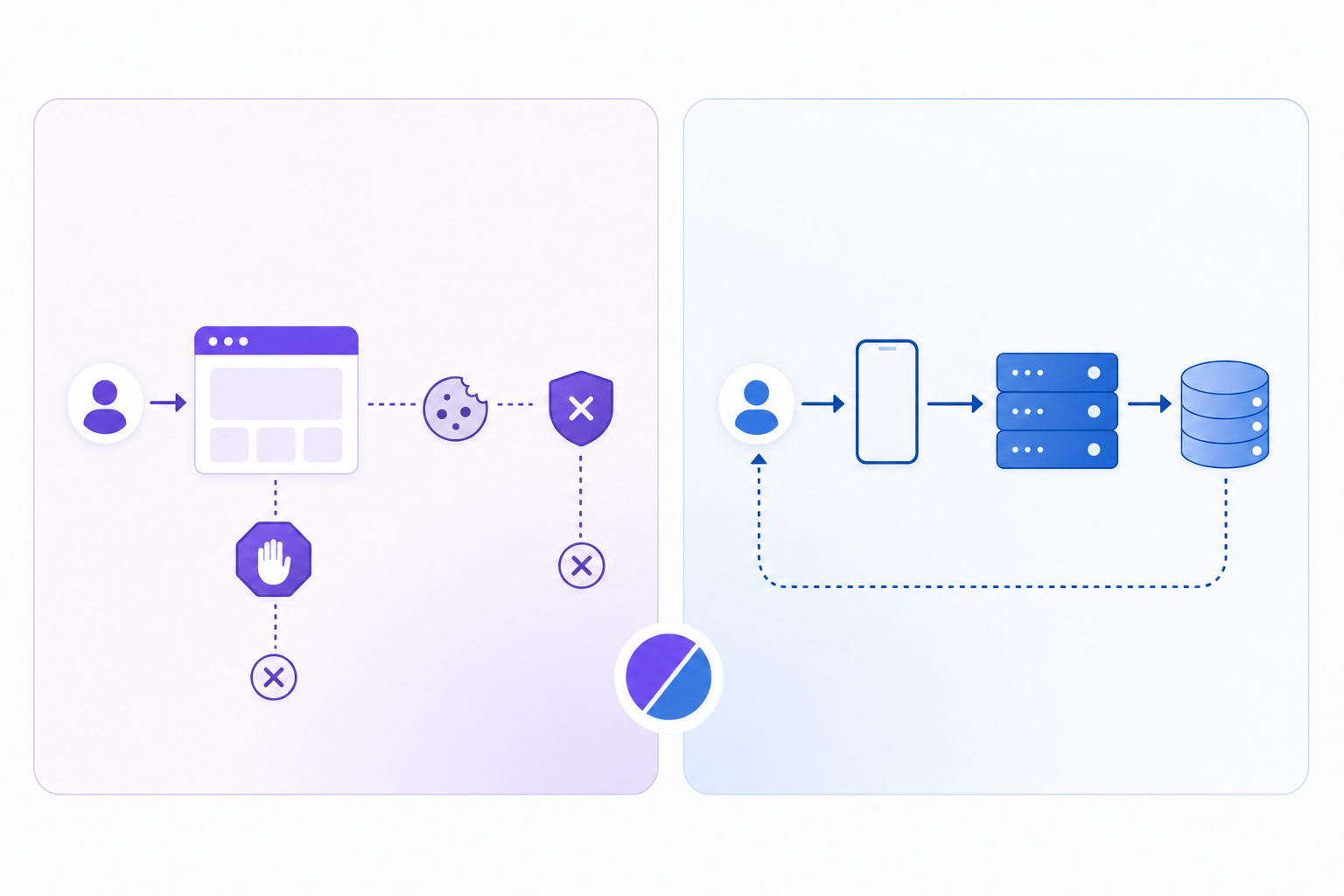
The structural case is short. Every other tool routes referrers to a separate portal and depends on cookies that Safari ITP, Firefox ETP and ad blockers actively break. Cello loads inside the product and attributes server-side, so the channel keeps working when browsers tighten privacy.
Customer proof tracks the architecture. VEED at 90.4% lower CAC. Hera went live in 2 days, Butter in under 5 hours.
Does server-side attribution still work if the referred user signs up weeks after clicking the referral link?
Yes — server-side attribution survives the full gap between click and conversion because the referral code (cello_ucc) is written to the billing customer object at the moment of the click, not at signup. Whether the prospect converts two days or two weeks later, the attribution is already present in the billing metadata and is read correctly when the payment event fires. Cookie-based tools break here: Safari's Intelligent Tracking Prevention (ITP) caps first-party cookies at 7 days, so any conversion that falls outside that window loses attribution entirely.
Which affiliate tracking software works best for early-stage SaaS under $10K MRR?
Rewardful offers a $49/mo entry point but caps revenue at $7,500/mo and charges a 9% commission fee on its Starter tier. Cello's User Referrals Grow tier is €200/month billed yearly or €300 monthly, has 0% transaction and currency conversion costs, and supports up to €50,000 in Referral ARR. For teams where budget is the primary constraint, Rewardful works as a starting point if the program stays Stripe-only and external-portal friction is acceptable; for teams expecting to scale past $7,500/mo in referred revenue, Cello's economics are more favorable from the outset.
Can I track mobile app referrals without relying on browser cookies?
Yes, but only if the tracking software ships native mobile SDKs. Mobile apps do not use browser cookies, so attribution must pass server-side through the app's authentication layer via iOS, Android, React Native, or Flutter SDKs. Cello ships all four. FirstPromoter, Tapfiliate, Rewardful, and PartnerStack have no native mobile SDK coverage, which means mobile app referrals either go untracked or require custom integration work that reintroduces the same cookie-dependency problem through a web view.
What is the difference between an in-product referral surface and an external portal, and does it matter for conversion?
An in-product surface renders inside the SaaS application itself via an SDK embed, so users share without leaving the product. An external portal sends users to a separate domain, breaking the sharing loop at the moment of highest intent. Softr recorded a 5x conversion lift after switching from PartnerStack's external portal to Cello's in-product component. The mechanism is straightforward: users who must navigate away from a product to participate in a referral program encounter friction at every step — login, navigation, and context-switching — that the in-product surface eliminates entirely.
How do payout transaction fees affect total referral program cost at scale?
Transaction fees compound across every commission payment and materially affect program economics once referral volume grows. Rewardful charges 3–9% on lower tiers; PartnerStack takes 3–15% (undisclosed structure). On $10K in monthly commissions, a 9% fee costs $900 versus $0 on a zero-fee platform. Cello User Referrals have 0% transaction and currency conversion costs. Partner Referrals have 0% currency conversion costs and tier-specific transaction costs: 5% on Free, 3.5% on Plus and Pro, and 2% on Enterprise. The headline price of a platform is rarely the right comparison point — total cost of ownership requires modeling transaction fees against projected commission volume before selecting a tool.
We're moving from PLG to enterprise. Which referral platforms handle both user referrals and partner programs in one system?
Cello runs user referrals and partner programs on a single attribution, fraud-detection, and payout infrastructure — no second platform required. The distinction matters operationally: PLG motion referrals originate inside the product from existing users via the in-product widget; enterprise partner programs involve external sales partners, resellers, or agency relationships tracked through a separate program type. Cello unifies both motions in one dashboard with shared reward logic, risk-factor monitoring, and automated payouts with 0% transaction and currency conversion costs on User Referrals. Partner Referrals have 0% currency conversion costs and tier-specific transaction costs: 5% on Free, 3.5% on Plus and Pro, and 2% on Enterprise. PartnerStack is built for channel and co-sell complexity but has no in-product SDK and carries 3–15% transaction fees, making it expensive as a unified system once user referral volume grows. FirstPromoter and Rewardful handle one motion only — external affiliates for FirstPromoter, Stripe-native link programs for Rewardful — and neither ships a native mobile SDK or in-product embed.
Which referral platforms provide real-time revenue attribution dashboards that link referral activity to revenue outcomes?
Cello's dashboard links referral events directly to billing outcomes — Referral ARR, conversion rate by partner, and CAC by acquisition channel — pulling from Stripe, Chargebee, Paddle, and Recurly webhooks in real time. Because attribution runs server-side, every conversion event is recorded at the billing layer rather than inferred from browser signals, which means the revenue figures in the dashboard match what the billing system shows. VEED reduced Customer Acquisition Cost (CAC) by 90.4% after switching to Cello's in-product referral infrastructure. FirstPromoter reports recurring commission tracking per affiliate but does not surface Referral ARR or CAC as native dashboard metrics. PartnerStack provides partner pipeline reporting, but the dashboard is built for channel managers, not for CFO-level revenue attribution.
Our referral tool is English-only and we're losing EU users. Which referral platforms support multiple languages and localised payout communications?
Cello's in-product widget ships with support for 10 interface languages, and payout communications are handled through Cello's Merchant of Record infrastructure, which covers localised tax handling — VAT and GST — across 40+ countries via PayPal. EU-hosted data infrastructure and GDPR-native data handling mean the platform is built for EU user bases by default, not retrofitted. Among the tools compared in this post, none of the others — FirstPromoter, Tapfiliate, Rewardful, and PartnerStack — are EU-hosted or document native multi-language widget support
We want to trigger a referral invite right after a specific in-product action. Which platforms support custom event-based triggers?
Cello's SDK supports custom event-based triggers — the referral widget can be surfaced programmatically after any defined in-product action, such as a user posting their first job, completing onboarding, or reaching a usage milestone. The trigger is wired through the SDK integration: the product fires the event, the SDK reads it, and the referral widget surfaces at that moment without a page redirect or external portal handoff. FirstPromoter, Tapfiliate, Rewardful, and PartnerStack route users to external portals, which means the trigger moment is decoupled from the product event by definition — without a native SDK that can respond to in-product events, custom trigger timing is not available in those tools.
Which referral platforms are GDPR-compliant and EU-hosted for SaaS companies with European users?
Cello is the only referral platform in this comparison built GDPR-native with EU-hosted infrastructure. Data processing stays within EU borders by default — no Standard Contractual Clauses (SCCs) required to cover a US-to-EU data transfer, because the transfer does not occur. Cello provides a Data Processing Agreement (DPA) and maintains a current subprocessor register, both required by enterprise procurement teams under GDPR Article 28. FirstPromoter, Tapfiliate, Rewardful, and PartnerStack are US-headquartered tools with retrofitted consent management — GDPR compliance in those cases depends on SCCs and DPA addenda that must be requested and negotiated, rather than flowing from the platform's base architecture.
How does Cello prompt referrals at the right moment rather than relying on passive widget discovery?
Cello surfaces referral prompts through behavioural triggers and event-driven nudges rather than relying on users finding a static launcher. Four distribution paths are available: (1) Behavioural milestone triggers — the referral widget or an announcement message fires automatically after a defined in-product event; (2) Intercom integration — Cello connects to Intercom workflows so account managers or automated sequences can push referral links directly to users; (3) Onboarding suppression — the widget can be configured to stay hidden during new-user onboarding flows, ensuring referral prompts only reach users with sufficient product exposure; (4) Sales-team or account-manager distribution — referral links can be generated and sent on behalf of users by your internal team.
How does a referral program work for infrastructure or API products where users rarely return to the dashboard after initial setup?
Infrastructure and API products face a structural challenge: the in-product widget requires an authenticated session to render, and users who complete setup and never return cannot see it. Cello addresses this through three mechanisms: (1) Sales-team or account-manager distribution — Cello supports generating referral links internally and distributing them via email, CRM workflows, or direct outreach on behalf of customers; (2) Email-based referral distribution — referral links can be embedded in automated email sequences triggered by billing events or lifecycle milestones; (3) Partner Portal as a standalone surface — for high-value users who do not return to the dashboard, the Partner Portal requires no in-product session and provides a standalone link, analytics, and payout experience.
Our referral program active rate is below benchmark — what are the most effective ways to increase user awareness and engagement?
A below-benchmark Active Rate almost always traces back to one of three root causes: launcher placement is too hidden, referral prompts are not reaching users at a high-intent moment, or the incentive is not compelling enough. Address them in order: (1) Launcher placement — move the launcher to a persistent, visible location (main navigation, dashboard homepage, or post-action screen); (2) Proactive distribution — use behavioural milestone triggers, connect Intercom to push referral invitations, and send email campaigns with embedded referral links; (3) Incentive alignment — recurring revenue share, drip-fed payouts, or dual-sided incentives consistently outperform single lump-sum offers in B2B SaaS. Cello's Performance Benchmarks module surfaces your Active Rate, Sharing Rate, Signup Rate, and Unique Views per Share against industry reference lines.
How do you position a referral incentive program to customers in trust-sensitive or compliance-driven industries who distrust financial reward?
Three positioning adjustments address this directly. First, frame the incentive as recognition, not compensation — the reward fires on a billing event, it is a commission on confirmed revenue, not a fee for endorsement. Second, configure non-cash reward structures — Cello supports account credits, subscription discounts, and access upgrades that reduce the appearance of financial conflict. Third, consider a non-incentivized advocacy track — for enterprise buyers where any financial incentive creates procurement friction, Cello's infrastructure can support customer advocacy programs (reference calls, case study participation, beta access) as a separate non-cash program track. The deeper positioning argument: referred customers arrive with higher trust and are worth roughly 16% more over their lifetime in B2B.
What payout methods does Cello support for international and European referral programs?
Cello's primary payout rails are PayPal and Venmo, processed through Cello acting as Merchant of Record — handling VAT, GST, and KYC compliance across 40+ countries. Because Cello is the Merchant of Record, tax form collection (W-9 for US referrers, W-8BEN for non-US individuals, W-8BEN-E for foreign entities), OFAC sanctions screening, and EU consolidated-list checks are handled by Cello's infrastructure rather than by your team. For programs requiring payout methods beyond PayPal and Venmo, account credit and subscription discount reward structures are available within Cello as alternatives to cash disbursement.
How do I choose between cookie-based and server-side attribution?
Safari ITP caps first-party cookies at 7 days and blocks third-party cookies entirely. If your target users run Safari, Firefox with ETP, or ad blockers, server-side attribution survives where cookies fail. Cello, FirstPromoter's S2S tier, and PartnerStack's cookieless claim address this; Tapfiliate and Rewardful rely on cookies.
What happens to affiliate commissions when a customer refunds or cancels?
Automated fraud detection cancels pending rewards when Stripe or Chargebee fires a refund event. Manual review workflows let you accept or reject flagged cases during a 30-day review window. Custom payout delays can be configured to mitigate fraud risk further.
What's the difference between fixed and recurring affiliate commissions?
Fixed commissions pay once per referred customer, typically on signup or first purchase. Recurring commissions pay on every subscription invoice for the customer's lifetime or a defined period. FirstPromoter, Tapfiliate and Cello support both structures; Rewardful caps recurring commissions behind higher tiers.
What integrations matter most for B2B SaaS affiliate tracking?
Billing system integrations (Stripe, Chargebee, Paddle, Recurly) are non-negotiable for accurate revenue attribution. CRM integrations (HubSpot, Salesforce) matter for sales-led funnels tracking demo-to-close conversions. Payout automation via PayPal, Venmo or banking rails removes manual reconciliation. Cello and FirstPromoter cover all three categories; Rewardful locks to Stripe and Paddle only
Should I replace an external affiliate portal with an in-product referral surface?
Yes, if your referrers are existing users rather than external publishers. In-product surfaces convert better because users share without leaving the product. Softr recorded a 5x conversion lift after switching from PartnerStack's external portal to Cello's in-product component. External portals fit content-driven affiliate programs recruiting bloggers; in-product surfaces fit user-led referral programs.