

Your test transfer worked, but finance still can’t match every commission to a completed bank payout. A successful payment proves one part of the system works, not that the referral program is ready. You still need clear records for earned rewards, blocked recipients and failed attempts. The build-or-buy decision gets clearer when you separate commission tracking from money movement and assign each job to your team or a vendor.
- How Stripe Connect referral payouts work
- What to build and what to buy
- Prepare recipient onboarding and payout eligibility
- Connect referral attribution to billing events
- Define commission rules before sending money
- Run individual and bulk payouts with clear status tracking
- Handle refunds, disputes and payout failures
- Validate international payment routes and tax responsibilities
- Compare total costs beyond payout fees
- Choose an architecture that fits your operating model
- Test the full payout lifecycle before launch
- Where Cello fits in a Stripe-billed referral program
- Key takeaways
TLDR:
- Buy repeatable referral workflows; build when your commission rules need custom control.
- Stripe Connect executes payments; you build referral attribution and commission logic.
- Keep earned commissions separate from payment attempts so failed transfers preserve balances.
- Compare engineering, maintenance and recipient support costs alongside payout fees.
- Cello's Stripe billing integration tracks rewards but does not imply Connect referral payouts.
How Stripe Connect referral payouts work
Stripe Connect referral payouts require your program to approve commissions before money moves. Here, you pay your own referrers, not earn commissions promoting Stripe.
The flow is customer payment, commission approval, connected-account transfer, then bank payout. With separate charges and transfers, charge and transfer calls are separate; you control transfer amounts and timing.
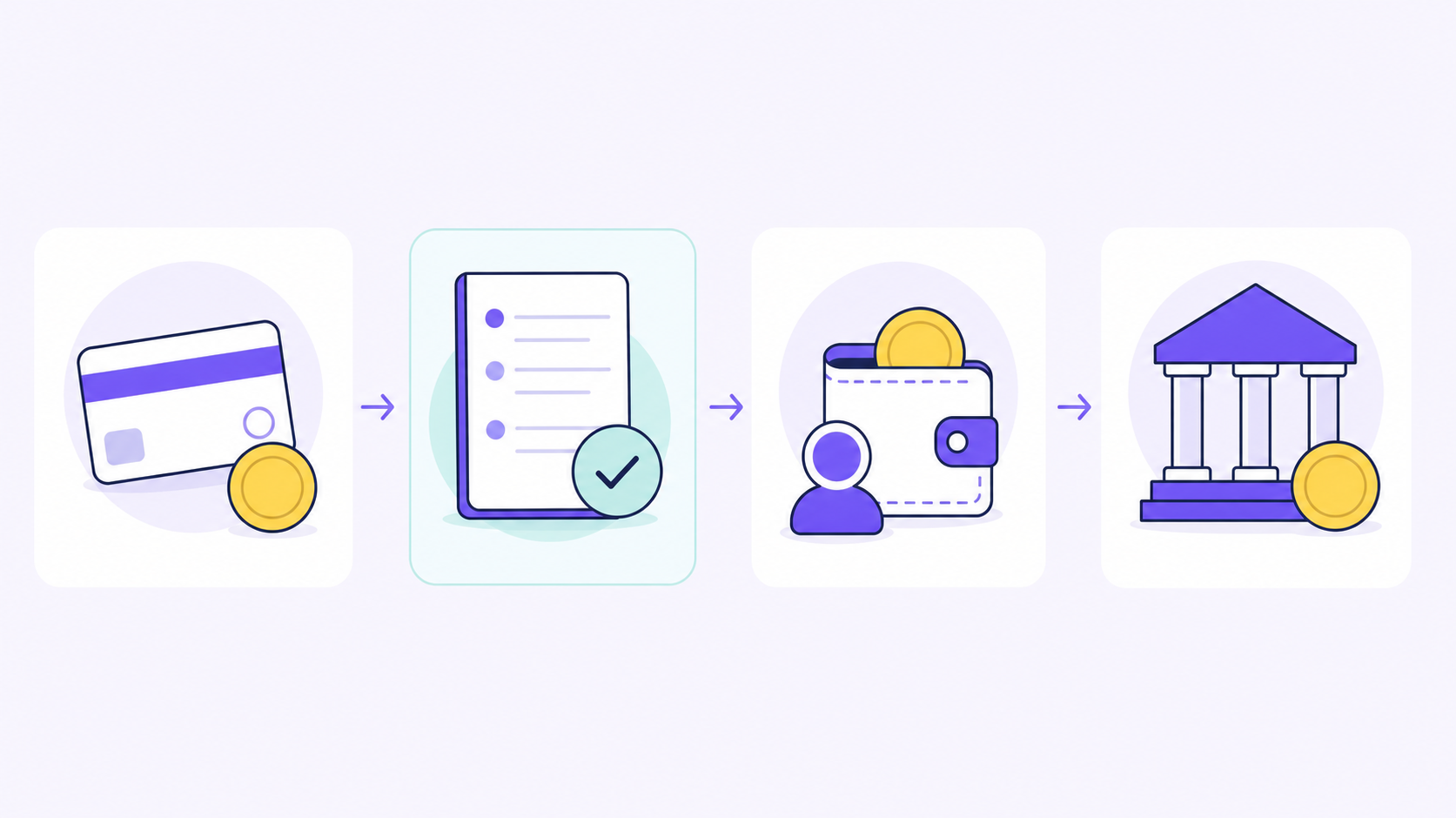
Define recipients before setting approval rules.
- User referrals come from existing product users.
- Partner introductions come through business relationships.
- Affiliate promotions come from publishers or creators sharing referral links.
What to build and what to buy
Buy repeatable referral workflows; build for custom control, the central referral program build vs buy decision. A small engineering team without capacity for ongoing payout maintenance should favor buying when a vendor supports its commission rules and recipient routes. Compare the launch deadline against the time needed to integrate and test purchased software versus building attribution, commission calculations and failure handling. Build only when control over reward calculations or payment approvals warrants dedicated engineering ownership after launch. Hybrid setups can retain Connect. Stripe Billing integration alone does not resolve Stripe Connect referral payouts.
|
Responsibility |
Connect build |
Referral software |
Hybrid |
|---|---|---|---|
|
Attribution |
You build |
Vendor tracks |
Shared integration |
|
Commissions |
Your engine |
Vendor configuration |
Custom rules |
|
Recipient onboarding |
You integrate |
Confirm scope |
Assign owner |
|
Payment execution |
Connect |
Confirm provider |
Connect |
|
Reporting |
Your dashboards |
Vendor reports |
Combined records |
|
Support |
Your team |
Contract-defined |
Written escalation |
Prepare recipient onboarding and payout eligibility
Confirm business eligibility for Stripe Connect referral payouts before inviting referrers. Select the connected-account configuration, map verification and bank-detail requirements and identify Stripe-supplied screens versus screens engineers must build. Assign ownership for verification exceptions.
Keep commission approval separate from payout eligibility.
- Incomplete onboarding should trigger reminders while payment stays blocked.
- Restricted accounts need a review queue and a recipient path to resolve missing requirements.
- Unclaimed rewards need a reminder, expiry and accounting policy reviewed by legal and finance.
Connect referral attribution to billing events
Persist referral identity before processing revenue, following similar logic to referral attribution setup without Stripe when a different billing provider is in play. Capture the referral code, write it against a known prospect or organization and map collected payments back to the referrer. Build this capture-and-write step explicitly; metadata cannot populate itself.
- Use organization IDs for shared accounts and purchasers other than registering users.
- Define precedence for competing referral claims.
- Verify webhook signatures, deduplicate events and make processing idempotent.
- Ingest verified manual invoice payments through a separate path.
Calculate rewards from each new payment amount, never cumulative revenue, an approach that lines up with staged payouts for sales-led SaaS referrals.
Define commission rules before sending money
Choose rewards around subscription margins and maintenance effort.
- Recurring revenue share requires renewal tracking.
- One-time percentage commissions scale with initial purchases.
- Fixed rewards simplify calculations but risk overpaying on cheaper plans.
Define eligible revenue after discounts, tax treatment, excluded charges, caps, upgrade adjustments and cancellation cutoffs.
Keep earned commission separate from payment status.
Use pending, approved, payable, paid and reversed commission ledger states. Store payment attempts separately so failed transfers leave earned balances intact.

Run individual and bulk payouts with clear status tracking
Process eligible commissions individually or in batches through the same checks.
- Apply minimum payment policies and confirm available funds before transfers.
- Track transfers through downstream payout results. Approval, fund availability and bank delivery follow separate timelines; avoid universal arrival promises.
- Notify recipients when payment starts, completes or needs action.
- Review failures before retrying to check whether money already moved.
Match commissions to transfer identifiers and payout records before marking obligations settled. Batch completion does not prove every recipient was paid.
Handle refunds, disputes and payout failures
Define payout rules for cancellations and refunds before releasing rewards. Adjust commissions proportionally for partial refunds; set eligibility cutoffs for chargebacks and early cancellations. For paid rewards, specify who absorbs losses and whether recovery is permitted.
Ledger adjustments change obligations; transfer reversals concern funds moved between accounts. Recovering delivered funds requires a separate process: accounting corrections do not retrieve cash.
- Screen for self-referrals and duplicate beneficiaries.
- Require approval and audit trails for manual overrides.
- Name an exception owner; document evidence and resolutions for missing-reward disputes and payout failures.
Validate international payment routes and tax responsibilities
- Validate Stripe Connect referral payouts by sender country, recipient location, account eligibility, settlement currency, payment method and foreign-exchange costs. Customer payment acceptance does not prove outbound payout eligibility.
- Have finance confirm payment classification, exceptions, state obligations and filing ownership with a tax adviser, which echoes the groundwork laid out for GDPR-compliant referral programs in European fintech SaaS.
Paylocity’s May 2026 compliance notice reports a federal threshold increase from $600 to $2,000 for applicable Form 1099-NEC and Form 1099-MISC payments effective January 1, 2026. Verify current IRS requirements before filing; this threshold does not cover every referral payment.
Compare total costs beyond payout fees
Stripe’s published US Connect pricing charges $2 per monthly active account plus 0.25% and 25¢ per payout when you handle pricing. Activity means payouts to a bank account or debit card that month. Those additional Connect fees do not apply when Stripe bills connected accounts directly for payment fees.
Compare engineering, maintenance, matching payouts to commissions, recipient support, subscriptions and applicable payment or currency-conversion fees. Use identical recipient activity and payout frequency assumptions to calculate your break-even point.
Choose an architecture that fits your operating model
|
Choose |
When it fits |
|---|---|
|
Custom development |
Unusual commission rules, existing payment infrastructure or control requirements warrant ongoing ownership. |
|
Purchased software |
Supported attribution, reward rules and payment routes match your program; subscription costs and configuration limits are acceptable. |
|
Hybrid |
You retain your commission ledger or payment execution while buying other workflows. |
Before signing, require usable data exports, preserved historical balances, records for matching commissions against payments and documented exit handling for unpaid rewards, questions any SaaS referral build vs. buy guide should raise early.
Test the full payout lifecycle before launch
- Test Stripe Connect referral payouts across referral capture, successful payments, duplicate events, incomplete recipient verification, insufficient funds, partial refunds and payout failures.
- Require technical validation and finance sign-off on ledger-to-payment matching and recipient-facing status messages.
- For migrations, set a cutover date, preserve referral identifiers and verify opening balances that separate paid rewards from outstanding obligations.
- Roll out gradually with named exception owners. One successful test payment does not prove launch readiness.
Where Cello fits in a Stripe-billed referral program
Cello handles attribution and reward workflows for B2B SaaS teams using Stripe billing, and sits among the Stripe referral program tools worth considering. Our Stripe webhook integration monitors transactions, checks campaign reward rules and notifies referrers about signups and rewards, supporting User-Led Growth.
Stripe supplies billing events; reward delivery uses a separate payment method. Cello’s billing integration does not imply Stripe Connect referral payouts.
Before choosing Cello, or any other referral tracking software for B2B SaaS teams, confirm supported payout methods, recipient country eligibility, custom reward requirements and configuration dependencies, including how payout delays are configured. Schedule a product review to check fit against those requirements.
Key takeaways
- Stripe billing support does not prove Connect payout support.
- Check your payment routes before you choose a tool.
What if only some of our referrers can use Cello’s payout methods?
A mixed-recipient program needs an explicit payment route for each eligible recipient before launch. If Cello’s methods cover everyone, use that confirmed route. If some recipients require a different method, retain a separate eligible payout process for them or exclude those routes from the launch scope. Assign each commission to one payment system so the same reward cannot be paid through both.
Can you keep Stripe Connect referral payouts while using Cello to calculate rewards?
Treat a Cello-and-Connect setup as a custom integration to validate, not an included feature of Cello’s Stripe billing connection. Ask Cello to confirm how approved reward amounts and later adjustments can reach your payment system, then assign ownership for transfer creation, failed payments and recipient support. Keep your current payout process until that complete flow passes testing.
How do you prevent duplicate referral payments when moving from Stripe Connect to Cello?
Assign each outstanding commission to exactly one payout system before the cutover. Preserve a shared commission identifier, separate paid balances from unpaid obligations and block the old system from paying commissions assigned to the new one. Test a delayed Stripe webhook and a retried payment request to check that neither can create a second payment.
Can Cello replace Stripe Connect entirely for referral payouts?
No, Cello replaces the attribution and commission layer, not the payment rail itself. Cello's automated payout infrastructure runs on PayPal, Venmo and UPI across 63 supported countries, so businesses already standardized on Stripe Connect accounts for payouts must treat a Cello migration as a payment-method change, not a drop-in replacement.
How does Cello's server-side attribution write the referral code to the Stripe customer object?
The unique campaign code (`cello_ucc`) is stamped onto the Stripe or Chargebee customer object metadata at the moment the referral link is clicked, not at signup or purchase. This write-at-click approach means attribution survives device switches, cookie expiry and long gaps between click and conversion, because the code is already sitting in the billing metadata when `invoice.paid` or `charge.succeeded` fires.
Can Cello trigger referral rewards from manual invoicing instead of automated Stripe billing?
Yes, Cello supports reward triggers from manual invoicing workflows through the Cello API, HubSpot deal stage changes or Salesforce Apex Trigger events on Opportunity stage transitions. This fits sales-led funnels where wire transfers or offline contracts close the deal outside standard subscription billing.
What is the minimum referral volume before a dedicated payout tool is worth it over manual Stripe Connect management?
There is no fixed threshold, but the break-even point depends on engineering time spent matching commissions to transfers, handling failed payouts and supporting recipients manually. Once a team is spending recurring engineering hours reconciling payout records instead of building product, that maintenance cost typically outweighs a vendor's subscription and reward-processing fees.
Does Cello charge a fee on top of the referral rewards paid to referrers?
Yes, Cello charges a 5% fee on rewards processed through the Partner Referrals product. This fee is a variable cost tied to payout volume and sits separate from the fixed monthly platform subscription.
Stripe Connect vs a referral platform like Cello: which should handle commission calculation?
Stripe Connect executes payment transfers; it does not calculate who earned a commission, verify referral eligibility or track attribution back to a specific referrer. A referral platform owns the commission logic, campaign rules and fraud checks, then hands off an approved payout amount to a payment rail, which is why most teams pair the two rather than choosing one over the other.
Can referral rewards be paid as free months or Stripe credits instead of cash?
Yes, Cello supports non-cash reward structures including free subscription months, trial extensions and in-app credits configured per campaign, alongside cash payouts via PayPal and Venmo. These rewards are processed outside the automated cash payout infrastructure, so businesses avoiding cash incentives for compliance reasons have a documented alternative.
How does attribution work when a referred customer creates multiple organizations under separate Stripe customer records?
Each organization needs its own `new_user_organization_id` passed in the Stripe or Chargebee metadata, mapped back to the same referral code where applicable. Org-level attribution runs independently of individual user IDs, so a referrer can be credited correctly even when a single referred contact spins up more than one paid account.
Why can't referral links be generated by our own internal system instead of Cello's?
Cello owns referral link generation because attribution is written server-side into the billing customer object at the moment of link click, a step that depends on Cello's SDK and webhook infrastructure firing in sequence. Routing link creation through an internal system breaks that write-at-click mechanism and reopens the same cookie-dependent attribution gaps server-side tracking is built to avoid.
Can referral rewards scale with recurring revenue instead of paying a single flat fee per conversion?
Yes, Cello supports recurring cash rewards calculated as a percentage of attributed new revenue on each billing cycle, in addition to one-time flat-fee or tiered structures. Tiered escalation based on cumulative referral counts is supported but requires manually moving top referrers into a higher-tier campaign, since automatic tier upgrades are not yet a self-serve feature.