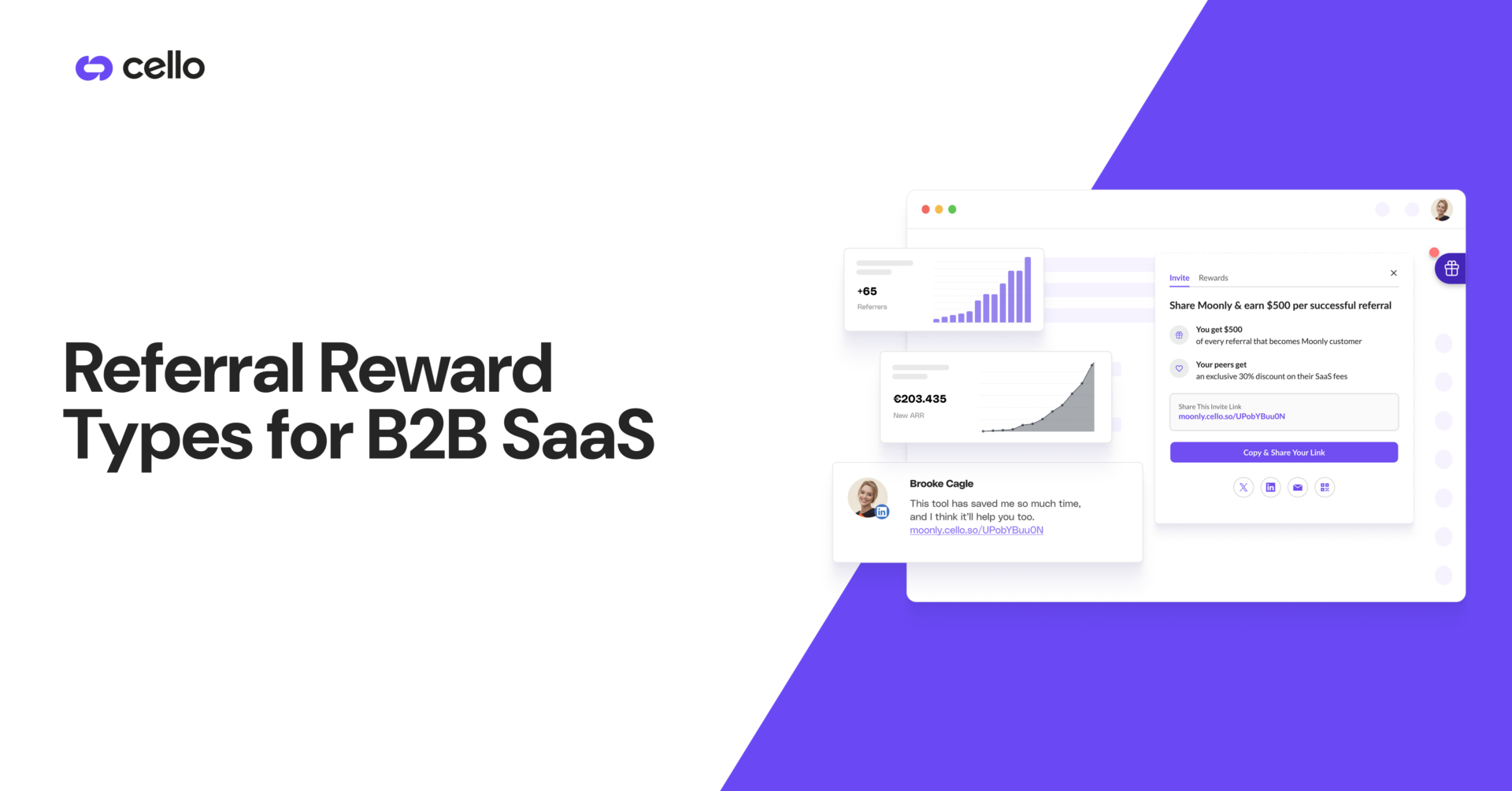

Picking a referral reward structure in B2B SaaS is more involved than it looks. The number matters, but so does the type, the trigger, whether there's a cap, and whether the same structure should apply to everyone in your user base. Get any of those wrong and the program either stalls or costs more than the customers it brings in. Here's a clear look at each structural decision, what drives it, and how to set it up in a way that actually holds.
- Why reward structure is the engine of your referral program
- The two primary reward types: percentage-based vs flat-fee
- Reward caps: protecting unit economics without killing motivation
- Tiered and progressive reward structures
- Non-cash reward options and when they outperform cash
- Calibrating reward size to your LTV and CAC ceiling
- Reward structures for different GTM motions
- Handling reward structures in trust-sensitive and compliance-driven industries
- How Cello handles referral reward structure configuration for B2B SaaS
TLDR:
- Reward structure determines whether your referral program generates sharing or silence; get it wrong and the program stalls or bleeds margin
- Percentage-based rewards fit high-ACV products with variable deal sizes; flat fees work better for uniform pricing and sales-led funnels where billing attribution is structurally cleaner
- Tie reward triggers to
invoice.paidnot signup: paying on signup means reward spend fires on signups that never convert to revenue - Cap percentage-based rewards at 20-30% of average customer lifetime value to keep cost-per-acquisition below your paid CAC ceiling
- Cello supports percentage-based, flat-fee, tiered and non-cash reward structures with triggers connected to billing events and Salesforce Opportunity stage transitions
Why reward structure is the engine of your referral program
The reward structure is not a detail you tune after launch. It is the mechanism that determines whether your referral program generates sharing or silence.
In B2B SaaS, a referral reward does three things at once: it motivates an existing user to act, signals to their contact that the recommendation is worth taking seriously, and has to align with your unit economics well enough that the program doesn't cost more to run than the customers it produces. Get any one of those wrong and the program either stalls or bleeds margin.
The mistake most growth teams make is treating the reward as an afterthought. A reward that's too low doesn't move behavior. One that's too high attracts low-quality referrals from users motivated by the payout over genuine fit. And a structure misaligned with your GTM motion creates reward economics that make no sense for either the referrer or the business.
The structure itself also carries a signal. Cash rewards communicate transactional value. Credits communicate product investment. Non-cash rewards communicate community and status. Before choosing a number, the structure type needs to match what your users actually care about and what your business can support across hundreds of payouts.
The two primary reward types: percentage-based vs flat-fee
Percentage-based rewards tie the payout directly to the revenue a referral generates. Pay 20% of the first invoice on a $500/month plan and the reward is $100; on a $2,000/month plan it's $400. That automatic scaling suits higher-ACV products where deal size varies and reward cost should stay proportional to customer value.
Flat-fee structures pay a fixed amount per converted referral regardless of what the customer pays. The math is simpler, referrers know exactly what they earn, and you don't need your billing system to expose per-invoice revenue to calculate the payout.
The practical trade-off comes down to three factors:
- ACV predictability: percentage structures make sense when plans vary widely in price; flat fees fit better when pricing is relatively uniform.
- Billing integration complexity: flat fees require only a confirmed conversion event, not a revenue figure pulled from your billing system.
- Referrer comprehension: flat fees are easier to explain in one sentence, which matters for in-product prompts where space is limited.
A $50/month SMB tool will likely overpay on percentage at typical commission rates. A high-ACV product with deal sizes ranging from $10K to $100K annually benefits from percentage alignment. Sales-led funnels with longer cycles and variable close values often fit flat-fee better, since attributing a precise revenue figure at payout time is simpler in practice.
Single-sided vs double-sided incentives
Single-sided programs reward only the referrer. Double-sided programs reward both the referrer and the referred prospect.
The case for going double-sided is straightforward: a referred prospect who receives an incentive has lower friction to convert. In B2B, where purchase decisions carry organizational accountability, a discount or trial extension reduces perceived risk. The referrer also shares more readily when they can offer their contact something concrete, and ReferralRock's analysis of B2B referral programs confirms that framing the reward around what the friend receives makes sharing feel generous instead of self-serving.
A few structural considerations:
- Referee rewards in B2B almost always work better as discounts or trial extensions than as cash. Cash to a referred buyer in a sales-led context creates compliance friction; a 20% discount on the first three months reads as a purchasing benefit, not a personal payment.
- Asymmetric designs offer a higher-value reward to the referrer and a smaller conversion incentive to the referee. This tends to fit B2B better since the referrer is doing more active work.
- Total cost-per-acquisition is the right ceiling to watch. If your customer acquisition cost (CAC) via paid is $800 and a double-sided program costs $150 combined, the economics favor the program even after referee costs are included.
Single-sided is simpler to configure and works well when organic satisfaction is high. Double-sided earns its added complexity when conversion rates on referred prospects are lower than expected, or when prospects need an extra reason to act.
Reward caps: protecting unit economics without killing motivation
Caps matter most in percentage-based programs. Without one, a 20% commission on a $50,000 annual deal pays out $10,000 per referral, likely more than your blended CAC and almost certainly outside any sensible reward budget.
The cap converts a percentage structure into something with a predictable ceiling. Set it too low and referrers stop caring, especially on larger deals where the cap cuts in early. Set it too high and you have negated the protection the cap was supposed to provide.
Setting a workable cap
A practical starting point: anchor the cap to roughly 20-30% of your average customer LTV, then compare that figure against your current paid CAC. If the cap lands well below paid CAC, the program stays margin-positive even on the highest-value referrals. At an average LTV of $8,000, a cap between $1,600 and $2,400 gives referrers a meaningful ceiling while keeping cost-per-acquisition inside defensible bounds.
One calibration to watch: if your pricing tiers are wide and most referrals come from your mid-market segment, set the cap relative to that tier's economics, not your average. A cap calibrated against enterprise LTV will be too generous for SMB conversions; one calibrated against SMB will feel punitive for mid-market referrers who land a larger account.
Tiered and progressive reward structures
Tiered structures increase the payout amount as a referrer crosses cumulative conversion milestones. A common design: $75 per referral for the first three conversions, $125 per referral after that. The logic is straightforward: active referrers who have already proven they can convert peers are worth incentivizing more aggressively.
The problem is mechanical. When someone crosses their third conversion, someone or something has to move them into the higher-paying campaign. Without that step, the escalation promise is just copy on a landing page.
Tiered designs make sense when your user base has a meaningful segment of highly connected users with real motivation to refer repeatedly. If your typical referrer makes one or two introductions and stops, the added complexity changes nothing.
Role-based segmentation
Role-based segmentation is a related lever worth separating from tier escalation. Instead of escalating users on volume, you assign different reward structures from the start based on user type. A senior account manager might receive a higher flat fee than an individual contributor because their network has higher ICP fit, not because they referred more. The same logic applies to subscription tiers: an enterprise customer can support a higher reward ceiling because their referrals are more likely to convert at higher ACV.
Both approaches require multi-campaign architecture: distinct campaigns targeting different user segments with different reward logic, as opposed to a single program serving everyone equally.
Non-cash reward options and when they outperform cash
Cash rewards are not always the strongest choice in B2B SaaS referral programs, and in some segments they create compliance problems instead of solving them.
Common non-cash structures include:
- Subscription credits or free months applied to the referrer's account, which sidestep procurement policies that prohibit employees from receiving personal payments for business referrals
- Feature unlocks or temporary access to a higher tier, useful when the referrer already has an upgrade on their radar
- In-app usage credits denominated in the product's own currency, which feel immediately valuable when the referrer was already approaching a usage limit
- Training vouchers or conference access, suited to professional development contexts where monetary rewards carry optics risk
Non-cash rewards also reduce fraud surface. A referrer chasing cash has more incentive to manufacture signups; one earning credits they can actually use is more likely to refer genuine contacts.
The core tradeoff: fungibility
The main limitation is that product credits are only as valuable as the product itself is to that specific referrer. A power user may value a credit above its face value because it displaces an upgrade they were already planning to buy. A casual user may never redeem it. Cash carries no such dependency.
|
Reward type |
Works best when |
Watch out for |
|---|---|---|
|
Subscription credit |
Referrer is an active, high-usage account |
Low-engagement users who let credits expire |
|
Feature unlock |
Referrer is close to a natural upgrade threshold |
Short unlock windows that feel token |
|
In-app usage credit |
Product has strong day-to-day utility |
Credits that don't map to any real need |
|
Training or event access |
Compliance-driven industry or enterprise procurement context |
Low perceived value outside core use case |
Reward timing and payout conditions
Timing is where referral economics either hold or fall apart. A reward that fires on signup looks generous until a third of those signups churn before their first invoice clears.
The four main trigger options, in order of increasing protection:
- On signup: simplest to configure, highest fraud and churn exposure. Works for products with zero free tier and negligible refund rates.
- On first paid conversion: the most common B2B default. Reward fires when
invoice.paidconfirms revenue is realized. Signup alone proves nothing; payment confirms intent. - After free trial converts: structurally identical to paid conversion but relevant when a trial period separates signup from billing. The reward waits for the
invoice.paidevent marking subscription activation. - After a retention period elapses: reward holds for 30, 60, or 90 days post-conversion, then releases. This absorbs early-churn and refund risk but delays referrer gratification.
Drip-fed schedules go further, releasing portions across multiple months tied to continued subscription activity. A referrer earns $30 at conversion, $30 at month three, $40 at month six. The total matches a lump-sum payout but cost distributes across the referred customer's verified lifetime.
If your average free-trial-to-paid conversion is 25%, paying on signup means 75% of reward spend produces no revenue. Tying the trigger to invoice.paid eliminates that liability structurally. A 30-day hold window also absorbs refund and chargeback exposure, cancelling a reward against a reversed transaction before it clears, not chasing recovery after the fact.
Calibrating reward size to your LTV and CAC ceiling
Reward spend is a CAC component. If your referral reward produces a customer at a cost below what paid channels would have charged, the reward is structurally sound regardless of whether it feels large.
A common starting point is to target a reward that represents a meaningful but sub-CAC fraction of first-year contract value. At $6,000 ACV, a reward in the low-to-mid hundreds stays well inside defensible bounds. If your blended paid CAC sits at $1,500, a $900 referral reward is the better deal (see the referral vs paid acquisition ROI comparison) before accounting for the higher retention referred customers tend to produce.
Recurring payouts change the math materially. A 15% recurring commission on a $500/month plan pays $75/month indefinitely, compounding to $900 after 12 months. Know your retention curve before committing: at an 18-month average customer lifetime value, lifetime commission exposure is $1,350; at six months, it's $450.
One-time payouts are easier to model. Take your target referral CAC, subtract processing fees and set the reward below that figure with margin to absorb outlier deal sizes. A $200 flat fee on a product with $1,800 ACV and 90% gross margin keeps economics well inside defensible bounds.
Reward structures for different GTM motions
The right reward structure depends on how your funnel actually works, not on preference.
In a self-serve PLG product, a user signs up, converts via Stripe, and the invoice.paid event fires automatically. Percentage-based or flat-fee rewards tied to that event require minimal manual intervention because the conversion happens in a predictable digital flow.
Sales-led funnels break that assumption. The deal closes in a CRM, often weeks after a referral link was clicked, so reward triggers need to connect to CRM milestone events: demo attended, SQL qualified or closed-won. Without that integration, the attribution chain breaks at handoff to a sales rep.
Hybrid GTM models
Hybrid models require separate campaign configurations for each motion. A monthly self-service cohort suits percentage-based recurring rewards tied to billing events; an annual sales cohort suits flat-fee rewards tied to deal closure. Running them as separate campaigns keeps analytics clean and reward logic accurate for each path.
For sales-led programs with long cycles, splitting the incentive across the funnel keeps referrer motivation active: a partial reward at demo completion, a larger payout at closed-won.
Handling reward structures in trust-sensitive and compliance-driven industries
Cash rewards create compliance friction in specific B2B contexts. Referral marketing for B2B SaaS operates under different constraints than consumer programs, and enterprise procurement policies often prohibit employees from receiving personal payments tied to business purchasing decisions. Compliance-sensitive verticals like financial services, healthcare tech and legal software compound this with industry-specific restrictions on referral compensation.
The objections cluster around two concerns: bribery perception (a personal cash payment to someone who influenced a software purchase looks problematic in a Fortune 500 audit) and gift-policy limits (many enterprise HR policies cap the value of gifts an employee can accept from vendor-adjacent parties).
Organizational-level rewards sidestep both. A subscription credit, a tier upgrade or a service extension credited to the company's billing record does not constitute personal compensation, which typically satisfies procurement review. When cash is genuinely off the table, non-cash structures also shift the reward signal from transactional to relational. A training voucher or conference ticket reads as professional development, carrying lower optics risk in contexts where personal gain from business decisions draws close review.
On disclosure, FTC Endorsement Guide requirements mandate that referrers disclose material connections when making recommendations. A reward, whether cash or non-cash, qualifies. GDPR adds data-handling obligations for any program processing personal data of EU residents, including a referred contact's email or identity. Switching from cash to credits does not remove the disclosure requirement.
Practical design choices that help in compliance-sensitive programs:
- Use opt-in enrollment instead of automatic participation, so referrers actively acknowledge the program terms before sharing.
- Make reward conditions visible at the point of sharing, not buried in a terms page the referrer is unlikely to read before acting.
- Avoid embedding reward messaging in contexts that could read as personal solicitation inside a professional relationship.
A/B testing reward structures and iterating on program performance
Reward structures are hypotheses, not conclusions. The only way to know whether $75 performs better than $50, or whether credits outperform cash for your specific user base, is to run both and measure what changes.
Run parallel campaigns targeted at segmented user cohorts where one segment receives the control reward and another receives the variant. Track four metrics across both:
- Sharing rate: the share of active users who generate at least one referral link click
- Signup rate: referred clicks that convert to new account signups
- Conversion rate: signups that reach a paid billing event
- Program ROI: revenue attributed to referrals against total reward spend
Watch sharing rate and conversion rate together. A high sharing rate paired with a low conversion rate often means the reward is attracting volume-motivated referrers, not users with genuinely relevant networks.
On observation windows: a two-week window rarely produces enough conversions in a B2B product with a multi-week sales cycle. Four to six weeks is a defensible minimum for self-serve programs; sales-led funnels may require eight to twelve weeks before closed-won data is sufficient.
Avoid testing reward amount and reward type simultaneously. Changing from $50 cash to $75 credits in a single variant makes it impossible to isolate which variable drove the outcome. Change one dimension at a time.
How Cello handles referral reward structure configuration for B2B SaaS
Cello supports the full range of structures covered in this article: percentage-based, flat-fee, tiered and non-cash rewards, all configurable within a multi-campaign architecture that runs distinct programs for different user segments simultaneously.
Reward triggers connect to billing events (invoice.paid, payment_succeeded) instead of signup, with configurable payout delays for refund protection and drip-fed schedules to distribute cost across a referred customer's verified lifetime. For sales-led funnels, triggers connect to Salesforce Opportunity stage transitions (SQL, demo-completed and closed-won) without requiring visibility into deal amounts.
Softr saw a 5x conversion lift after migrating to Cello. Moss achieved 650% YoY Referral ARR growth. Both outcomes came from programs where reward structure and attribution were configured for B2B SaaS billing mechanics, not retrofitted from e-commerce affiliate tooling. The structures covered in this article only produce the outcomes they promise when the attribution layer underneath them is accurate and the reward trigger fires on verified revenue, not vanity events.
Final thoughts on getting referral reward structures right
Your reward structure is a hypothesis until the data says otherwise, so build it to be testable. Pick a type that matches what your users care about, anchor the size to your LTV and CAC ceiling, and tie the trigger to a verified revenue event. That combination gives the program a real chance before you touch anything else. Sign up for Cello to get reward logic configured for B2B SaaS from the first conversion.
Flat-fee vs percentage-based referral rewards for B2B SaaS: which structure fits better?
Flat-fee rewards fit better when pricing is relatively uniform or when your billing system doesn't expose per-invoice revenue cleanly: the conversion event alone triggers the payout without needing a revenue figure. Percentage-based rewards scale automatically with deal size, making them the stronger fit for high-ACV products where contracts range from $10K to $100K+ annually and reward cost should stay proportional to customer value. If your GTM motion is sales-led with variable close values, flat-fee is cleaner to execute at payout time.
How should I structure referral reward triggers when my product has a free trial before paid conversion?
Tie the reward trigger to the `invoice.paid` billing event, not the signup event: the reward fires only when the referred user converts to a paid subscription, not when they start a trial. If 25% of trials convert to paid, paying on signup means 75% of reward spend produces no revenue; tying to `invoice.paid` eliminates that liability. For added protection against early churn, a 30 to 90-day hold window after conversion cancels the reward against any refund or chargeback before it clears.
How do I handle referral reward structures in compliance-driven B2B industries where cash incentives create procurement friction?
Replace cash payouts with organizational-level rewards: subscription credits, tier upgrades or service extensions credited to the company's billing record instead of the individual. This sidesteps enterprise HR gift-policy limits and bribery-perception concerns because the reward accrues to the business, not the employee who influenced the purchase. Training vouchers and conference access work well in compliance-sensitive verticals like financial services and healthcare tech where professional development framing carries lower optics risk than personal cash payments.
What's the right reward amount for a B2B SaaS referral program relative to CAC and LTV?
A practical starting range is 10 to 20 percent of first-year contract value, benchmarked against your current paid CAC. At $6,000 ACV, that puts the reward between $600 and $1,200. If your blended paid CAC sits at $1,500, a $900 referral reward is the better deal before accounting for the higher retention referred customers tend to produce. For percentage-based recurring commissions, model total lifetime exposure against your retention curve before committing: a 15% recurring commission on a $500/month plan compounds to $900 after 12 months at average retention and over $1,300 at 18 months
Can referral reward structures in B2B SaaS be A/B tested, and what metrics should I track?
Yes. Run parallel campaigns targeted at segmented user cohorts where one cohort receives the control reward and another receives the variant. Track sharing rate, signup rate, conversion rate and program ROI across both; a high sharing rate paired with low conversion typically signals the reward is attracting volume-motivated referrers, not users with genuinely relevant networks. Run tests for at least four to six weeks in self-serve products and eight to twelve weeks in sales-led funnels before drawing conclusions, as B2B sales cycles are too long for a two-week window to produce statistically meaningful closed-won data.
Should I use recurring percentage-based rewards or a one-time flat fee for a high-ACV B2B SaaS referral program?
Percentage-based rewards fit high-ACV products better because the payout scales with deal size, keeping reward cost proportional to the customer value a referral generates. A flat fee makes sense when pricing is uniform or when your billing system does not cleanly expose per-invoice revenue at payout time, since conversion confirmation alone triggers the reward without pulling a revenue figure from Stripe or Chargebee. For products with contracts ranging from $10K to $100K+ annually, a percentage structure with a cap set at 20–30% of average customer LTV keeps economics defensible across the full range.
How do referral reward triggers work in a sales-led B2B SaaS funnel with no self-serve checkout?
In a sales-led funnel, reward triggers connect to CRM milestone events rather than billing events: demo attended, SQL qualified or closed-won via Salesforce Opportunity stage transitions or HubSpot deal stages. Without that CRM integration the attribution chain breaks at handoff to a sales rep, because the invoice-paid event may fire weeks after the referral link was clicked and the original link context is lost. Splitting the incentive across funnel stages — a partial reward at demo completion and a larger payout at closed-won — keeps referrer motivation active across long cycles.
Can referral reward payouts be conditioned on the referred customer remaining active for a set period before the reward is released?
Yes. Cello supports configuring payout delays that hold the reward for 30, 60 or 90 days post-conversion before releasing it, which absorbs early-churn and refund risk. For longer retention requirements, drip-fed reward schedules distribute payouts across multiple months tied to continued subscription activity — for example, $30 at conversion, $30 at month three and $40 at month six — so reward cost aligns with realized customer lifetime value rather than front-loading the full commission at signup.
What referral reward structures work for B2B SaaS products with a freemium or free-trial acquisition model?
Tie reward triggers to the invoice.paid or charge.succeeded billing event, not the new-signup event: if only 25% of trials convert to paid, paying on signup means three-quarters of reward spend produces no revenue. A 30-day hold window after paid conversion adds a second layer of protection by cancelling the reward against any refund or chargeback before it clears. For freemium models with high trial volume, this structure keeps referral cost-per-acquisition inside defensible bounds regardless of trial-to-paid conversion rate.
Can different referral reward structures run simultaneously for different user segments within the same B2B SaaS product?
Yes, through a multi-campaign architecture where distinct campaigns target different user cohorts — paying customers vs trial users, enterprise accounts vs SMB, or different subscription tiers — each with its own reward type, amount and eligibility logic. Role-based segmentation lets you assign a higher flat fee to senior account managers whose networks carry higher ICP fit, while running a separate percentage-based campaign for individual contributors. Each campaign produces independent analytics, so you can measure which segment drives the highest-quality referrals without cross-campaign data contamination.
Why did our previous referral program fail to generate sharing behavior, and what reward type actually drives referrals in B2B SaaS?
The most common reasons B2B referral programs stall are launcher placement that makes the referral surface hard to find, reward triggers that fire on signup rather than verified revenue (creating economics that collapse under churn), and reward amounts too low to motivate action from users who have organizational credibility to protect. On reward type, cash rewards motivate transactional sharing while credits and subscription benefits motivate sharing from genuinely satisfied users — the right choice depends on whether your users value fungible cash more than they value product time, which is product-specific and worth A/B testing across parallel campaigns before committing.
How do I set a referral reward cap that protects unit economics without making the program unattractive to referrers on larger deals?
Anchor the cap to 20–30% of your average customer LTV and compare that figure against your current paid CAC: if the cap lands below paid CAC, the program stays margin-positive even on the highest-value referrals. At an average LTV of $8,000, a cap between $1,600 and $2,400 gives referrers a meaningful ceiling while keeping cost-per-acquisition inside defensible bounds. Calibrate the cap against your mid-market segment economics rather than enterprise LTV if most referrals come from that tier, since a cap set against enterprise deals will overpay on SMB conversions.
What non-cash referral reward structures does B2B SaaS have available when cash payouts create compliance or procurement friction?
Subscription credits, free months, feature unlocks, in-app usage credits, training vouchers and conference access all operate as non-cash reward structures that sidestep enterprise HR gift-policy limits and bribery-perception concerns common in Fortune 500 procurement reviews. Organizational-level rewards — a tier upgrade or service extension credited to the company's billing record rather than the individual employee — satisfy procurement review because the benefit accrues to the business rather than the person who influenced the purchase. Non-cash rewards also reduce fraud surface, since referrers earning product credits they can use have less incentive to manufacture signups than referrers chasing cash payouts.
How should a B2B SaaS company with a hybrid GTM motion configure referral reward structures for both self-serve and sales-led customers?
Run separate campaigns per GTM motion rather than applying a single reward structure across both: a monthly self-serve cohort suits percentage-based recurring rewards tied to Stripe invoice.paid events, while an annual sales cohort suits flat-fee rewards tied to Salesforce Opportunity closed-won transitions. Mixing both in one campaign produces analytically contaminated data and reward logic that fits neither motion cleanly. Separate campaigns keep attribution accurate per path and let you measure program ROI independently across each acquisition channel.
Can referrers earn a recurring percentage of referred revenue over time rather than a single payout at conversion?
Yes. Recurring reward structures pay a percentage of each successive invoice the referred customer generates — for example, 15% of a $500/month plan pays $75/month indefinitely. Before committing to a recurring structure, model total lifetime commission exposure against your retention curve: at an 18-month average customer lifetime, that same 15% recurring commission compounds to $1,350 per referral. Setting a cap on total recurring payouts per referral or a time limit on eligibility keeps lifetime reward exposure inside a pre-defined CAC ceiling.