

The Software as a Service (SaaS) business model has changed the way companies operate in the modern digital world. One important aspect that companies of this type need to understand is SaaS margins and their significance in assessing business performance and profitability.
In this guide, we will look into the basics of SaaS margins, review how to calculate them accurately, understand the factors that influence them, discuss strategies to improve this metric, and study the future trends in margin management.
TLDR:
- SaaS margins measure the difference between revenue and the costs of delivering your service, covering CAC, CRC and running expenses.
- Gross margin tracks revenue minus direct costs (COGS); net margin factors in all operating costs to show overall profitability.
- Three factors compress SaaS margins most: infrastructure and licensing costs, customer acquisition costs and customer retention costs.
- Reducing running costs, improving customer retention and adjusting pricing to reflect value are the three levers that move margins up.
- Cello offers a peer-to-peer referral program that SaaS companies can integrate to reduce customer acquisition costs.
|
Key Element |
Description |
|---|---|
|
Definition of SaaS Margins |
SaaS margins measure the profitability of a SaaS business, indicating the difference between revenue generated and the costs involved in delivering services. |
|
Importance of SaaS Margins |
Needed for assessing the financial health and sustainability of a SaaS business, helping to guide pricing strategies and running adjustments. |
|
Calculating SaaS Margins |
Involves analyzing revenues, direct costs (COGS), and running expenses to tell apart gross margin and net margin for a full profitability assessment. |
|
Strategies for Improving Margins |
Includes optimizing running efficiencies, enhancing customer retention, and refining pricing strategies to align with customer value and market demands. |
|
Future Trends in SaaS Margins |
Technological advancements and market dynamics predict a focus on value-driven offerings and cost-effective operations to maintain competitive SaaS margins. |
The basics
SaaS margins refer to the profitability measures that assess the financial health of such businesses. By calculating this metric, companies can determine the profit generated from their services relative to the costs incurred in delivering those services.
Understanding SaaS margins involves studying the financial picture of subscription-based software services. The focus goes beyond revenue and costs; it is about dissecting every aspect of the business model to uncover insights that drive strategic decisions and lead to sustainable growth.
What are SaaS margins?
📈 SaaS margins can be understood as the difference between the revenue generated by a SaaS product or service and the associated costs. These costs include direct expenses such as customer acquisition costs (CAC), customer retention costs (CRC), and running costs.
Calculating and analyzing SaaS margins helps understand the financial performance of businesses in the industry.
In addition, they show how value is created in the digital era. It's not simply about delivering a service, but it's about delivering value that resonates with customers, drives loyalty, and translates into sustainable profitability for the business.
Importance in business
SaaS margins play a key role in assessing the financial viability and sustainability of businesses in the industry. They provide insights into how well operations run and help businesses understand the profitability of their offerings.
Monitoring this value allows companies to identify areas of improvement, optimize pricing strategies, and make informed decisions for future growth.
What's more, SaaS margins serve as a compass for steering through the competitive world of the software industry. In a market driven by fresh ideas and customer-centric solutions, understanding and optimizing this metric can be the difference between a thriving and a merely surviving business.
Calculation
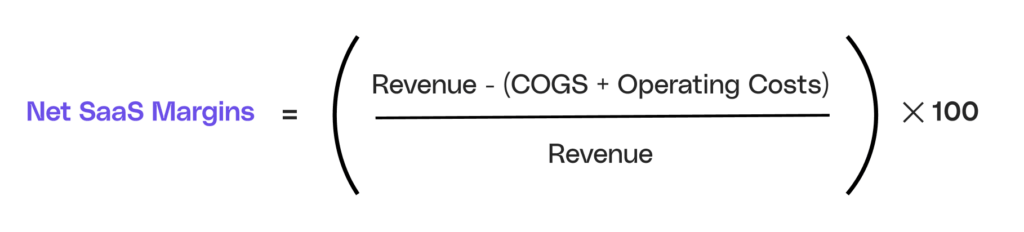
Calculating SaaS margins involves determining the revenues and costs associated with providing the product or service. Here are some key components to consider when calculating this value:
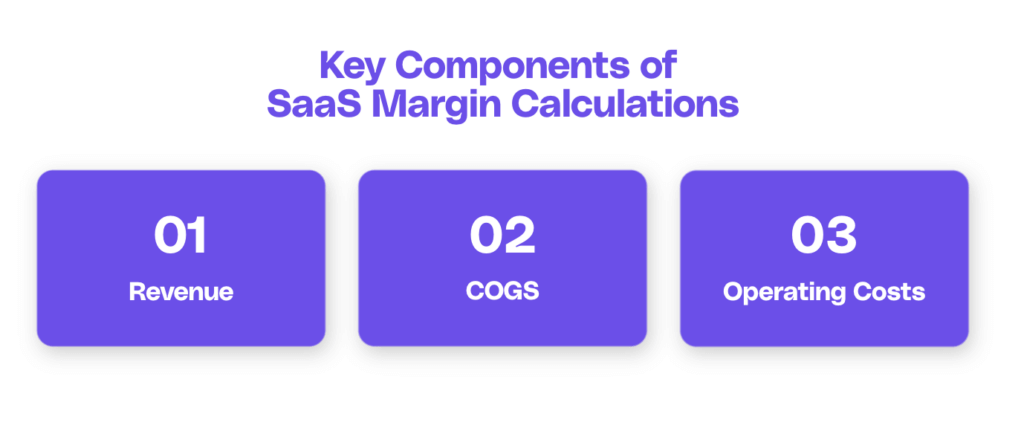
Key components in SaaS margin calculation
Source: Cello
- Revenue: Calculate the total revenue generated from the SaaS product or service over a specific period.
- Cost of Goods Sold (COGS): Identify the direct costs directly attributable to delivering the SaaS offering, including infrastructure costs, software licensing fees, and support expenses.
- Operating Costs: Consider the indirect costs associated with running the SaaS business, such as marketing expenses, salaries, and overheads.
Understanding gross margin vs net margin
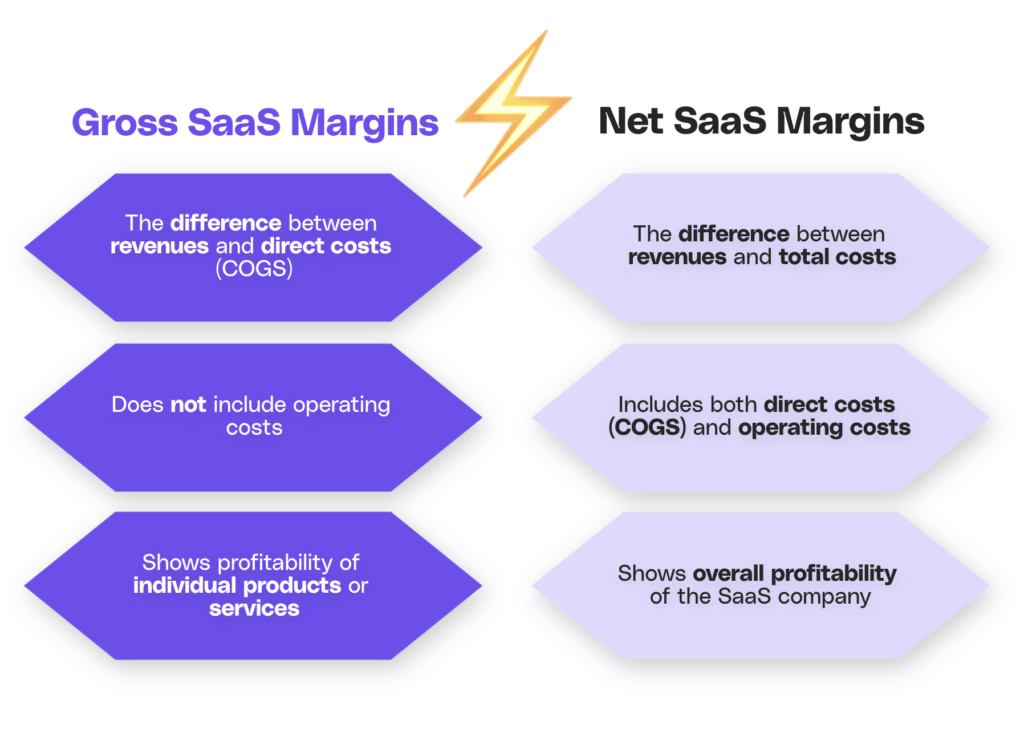
When calculating SaaS margins, it's important to distinguish between gross margin and net margin.
Source: Cello
Gross margin represents the difference between revenue and direct costs (COGS). It provides insight into the profitability of individual products or services. A healthy gross margin is indicative of a sustainable business model and allows for reinvestment and growth.

Source: Cello
Net margin, on the other hand, considers the operating costs in addition to the direct costs. It reflects the overall profitability of the SaaS business by factoring in all expenses associated with providing the service. A positive net margin indicates a profitable business that efficiently manages its costs.
Source: Cello
Influencing factors
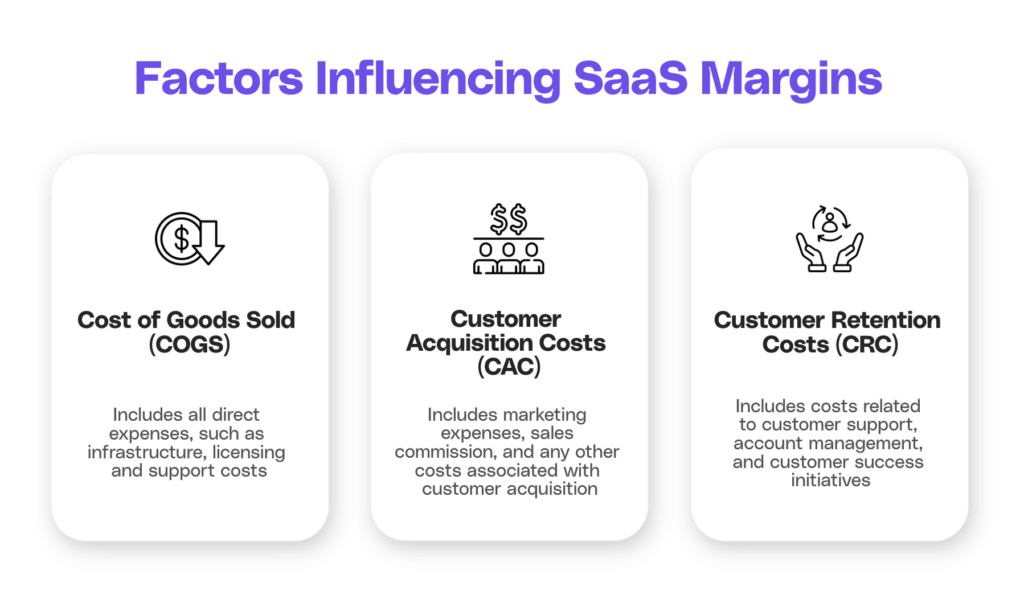
Several factors influence SaaS margins. Understanding these factors helps businesses identify areas of improvement and implement strategies to enhance their margins. Here are some critical factors to consider.
Source: Cello
Cost of goods sold (COGS)
The cost of goods sold includes all the direct expenses incurred in delivering the SaaS product or service. It encompasses infrastructure costs, licensing fees, and support costs. The ChartMogul gross margin guide lists hosting and infrastructure, customer support and third-party fees tied to delivering the product as the typical SaaS COGS items. Optimize and simplify these costs to improve SaaS margins.
Customer acquisition costs (CAC)
Acquiring new customers is important for SaaS businesses, but it comes at a cost. CAC includes marketing expenses, sales commissions, and other costs associated with attracting new customers. Reducing CAC or optimizing customer acquisition strategies can positively impact SaaS margins.
Customer retention costs (CRC)
Retaining existing customers is equally important for SaaS businesses. CRC includes expenses related to customer support, account management, and customer success initiatives. Enhancing customer retention through effective customer support and engagement can enhance SaaS margins.
In practice, CRC covers salaries for support agents and customer success managers, onboarding materials, help center software, in-app messaging tools, and loyalty perks like discounts or extended plan features. A company running a small support team plus a help desk tool such as Zendesk might spend a few dollars per customer each month, while a business with dedicated account managers for large accounts pays far more per seat.
To keep CRC in check, track it alongside churn rate and renewal rate by customer segment. Pair cheaper, scalable tactics such as knowledge bases and automated check-ins with higher-touch outreach reserved for accounts at risk of leaving, rather than applying the same support level to every customer.
Improvement strategies
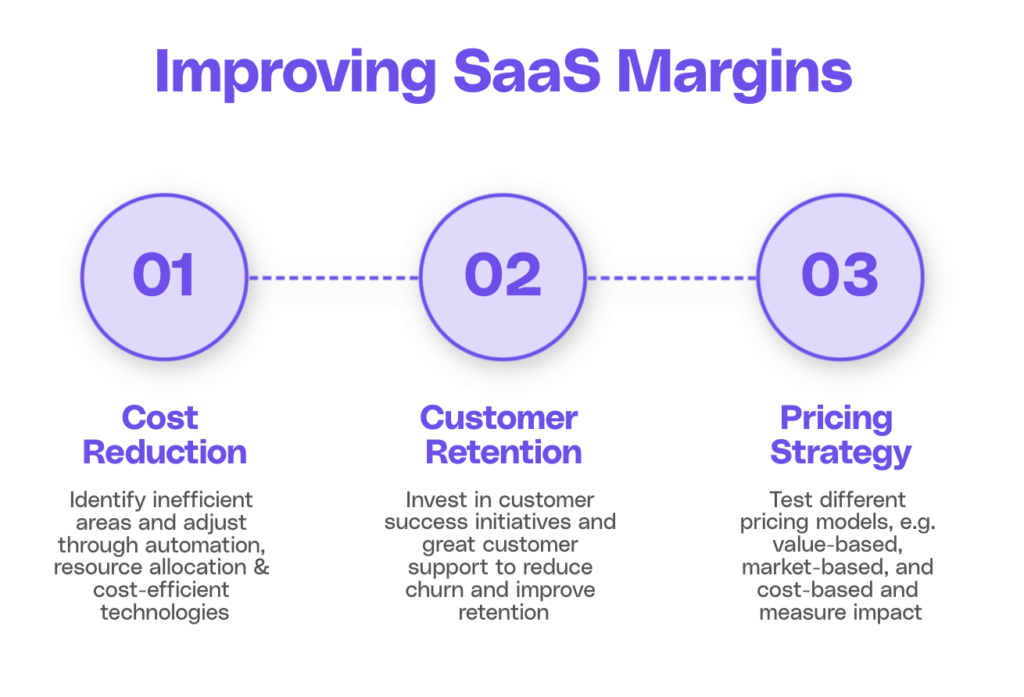
There are several ways to improve this metric.
Source: Cello
Reducing running costs
Identify areas of inefficiency and optimize running costs to improve SaaS margins. Look for opportunities to automate manual processes, improve resource allocation, and implement cost-effective technologies. Regular review of running expenses can help simplify operations and boost profitability.
Improving customer retention
Investing in customer success initiatives and providing top-notch customer support can enhance customer satisfaction and build long-term relationships. Happy and satisfied customers are more likely to renew subscriptions, reducing churn and improving SaaS margins. Tools such as Zendesk can be helpful for this.
Optimizing pricing strategy
Revisit your pricing strategy to make it align with customer value and market demand. Conduct market research, analyze pricing tiers, and adjust prices accordingly.
Experiment with different pricing models and measure their impact on SaaS margins. Consider value-based pricing or offering different tiers with additional features to increase average revenue per user.
Future trends
Impact of technological advancements
Advancements in technology, such as artificial intelligence, machine learning, and automation, will continue to shape the SaaS industry. These technologies can make operations run smoother, reduce costs, and enhance the overall customer experience, leading to improved SaaS margins.
Support automation shows the mechanism most clearly. An AI chatbot connected to a help center, such as the chatbot features in help desk tools like Zendesk, answers repeat questions like password resets, invoice copies and setup steps without a human agent. Fewer tickets reach the support team, so the same headcount covers more customers and customer retention cost (CRC) per customer falls. Automated onboarding emails work the same way on the COGS side: each new account needs less hands-on support time, which lifts gross margin as the customer base grows.
Predicted trends
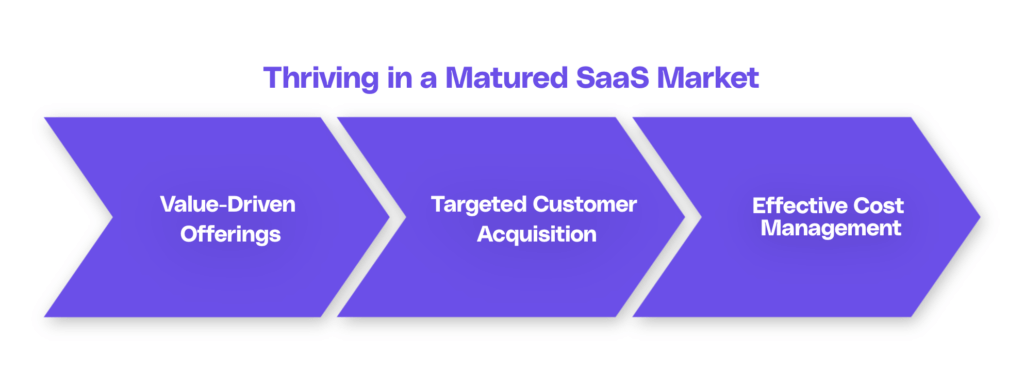
As the SaaS industry matures, we can expect increased competition and price pressure. In 2023, Gartner projected that by 2027, more than 50% of SaaS vendors would shift from seat-based pricing to usage-based or outcome-based models (Gartner, 2023). The target year has not arrived yet, so treat the figure as a forecast, not a confirmed outcome. To maintain healthy margins, companies will need to focus on value-driven offerings, targeted customer acquisition and cost management that reflects this pricing shift.
Source: Cello
On top of that, the rise of subscription-based business models in various industries will contribute to the ongoing importance of this metric. In conclusion, understanding this value is key for assessing the financial performance and profitability of businesses in the field.
By accurately calculating and analyzing this metric, companies can make informed decisions, optimize their operations, and steer through the evolving world of the industry.
With the strategies and insights discussed in this thorough guide, businesses can unlock growth opportunities and build sustainable and profitable SaaS ventures.
What are SaaS margins and why do they matter for financial health?
SaaS margins measure the difference between the revenue a SaaS business generates and the costs of delivering that service, covering infrastructure, customer acquisition costs (CAC) and customer retention costs (CRC). They show whether the business model is financially sustainable: a healthy gross margin leaves room for reinvestment, while a positive net margin confirms the business covers all operating costs and generates profit.
What is the difference between gross margin and net margin in SaaS?
Gross margin is revenue minus direct costs (COGS) such as hosting, software licensing fees and support expenses. Net margin subtracts all operating costs on top of COGS, including salaries, marketing and overhead, which gives the full picture of business-wide profitability.
What are the three biggest cost levers that compress SaaS margins?
Infrastructure and licensing costs (COGS), customer acquisition costs and customer retention costs are the three primary margin compressors in SaaS. The matching levers are reducing CAC through peer-trust channels such as referral programs, cutting churn through targeted customer success investment and keeping COGS lean by consolidating infrastructure.
How can a referral program reduce CAC and improve SaaS margins?
A peer-to-peer referral program lowers CAC by routing acquisition through existing users instead of paid media, because the trust transfer happens between peers and not through an ad network. Cello's in-product referral program integrates in approximately four hours of development time, so the cost of launching this channel stays low.
How does usage-based pricing affect SaaS margin calculations?
Shifting from seat-based to usage-based or outcome-based pricing, a move Gartner projects more than 50% of SaaS vendors will make by 2027, changes how COGS and reward structures must be calculated. Revenue becomes variable instead of fixed, so margin analysis has to track cost per unit of consumption and not cost per seat. Referral reward triggers should be tied to verified billing events so referral program economics stay positive.