
Marketing-Led Growth is a strategic approach that places marketing at the forefront of a company’s growth initiatives. It goes beyond traditional marketing strategies and focuses on drawing on customer-centricity, data-driven decision making, and the role of marketing as a growth driver. In this article, we will look deeper into the concept, its principles, implementation strategies, and how to measure its success.
TLDR:
- Marketing-Led Growth places marketing at the center of business growth, not as a support function to sales.
- The marketing flywheel drives sustainable growth through three stages: attract, engage and delight customers.
- Five principles guide MLG execution: brand identity, product visibility, top-of-funnel interaction, tailored engagement and data-driven optimization.
- Track MLG success through customer acquisition rates, revenue growth, conversion rates and customer lifetime value.
- Cello offers peer-to-peer referral infrastructure that integrates directly into SaaS products to support MLG motions.
Understanding the concept
In order to understand Marketing-Led Growth, we must first define what it involves and consider its importance in the business world.
In practice, every department, from product development to customer service, is aligned towards creating value for the customer.
Key principles
The success of a Marketing-Led Growth strategy hinges on adopting key principles that guide its implementation. This wide-reaching approach extends beyond traditional marketing strategies, prompting a fundamental mindset shift within organizations.
By stressing the alignment of marketing efforts with overarching business goals and objectives, this all-encompassing approach empowers businesses to attain sustainable growth and long-term success in today’s fiercely competitive market.
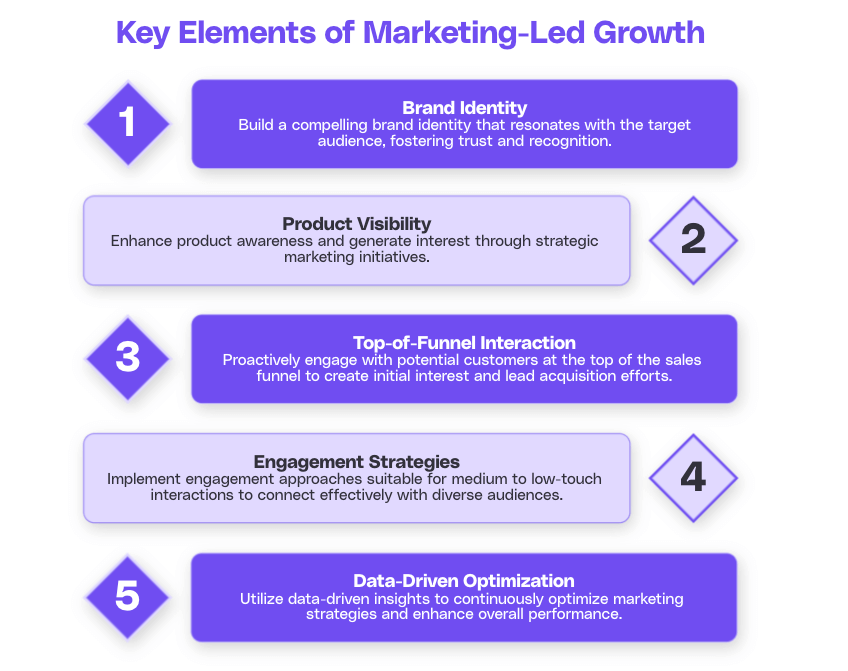
Several aspects need to be taken into consideration for effective marketing-led growth.
Implementing a marketing-led growth strategy
Implementing a Marketing-Led Growth strategy requires careful planning and execution. Here are some key steps to consider:
Measuring success
Measuring the success of a Marketing-Led Growth strategy is crucial to understand its impact on business performance and justify its implementation.
Start your referral program with Cello
Ready to transform your users into a powerful growth engine? Cello offers the simplest way to integrate a peer-to-peer referral program into your SaaS product, catalyzing your marketing-led growth strategy. With minimal development time, immediate payback, and seamless integration, Cello empowers your users to share your product effortlessly, turning their enthusiasm into your success. Experience the ease of automated rewards, real-time performance tracking, and compliance peace of mind. Witness how tl;dv achieved over 550 monthly referral signups rapidly with Cello. Embrace the future of user-led growth and book a Cello demo today today.
What is marketing-led growth and how does it differ from product-led or sales-led growth?
Marketing-led growth (MLG) is a strategy where marketing drives acquisition by building brand awareness, generating demand and guiding prospects through the funnel, so the user is a passive recipient of marketing activity. Product-led growth (PLG) lets the product itself convert users through free trials or freemium access, while sales-led growth (SLG) routes acquisition through a sales team and deal cycle. A fourth motion, User-Led Growth (ULG), sits alongside all three by turning existing users into the acquisition channel through structured referrals.
What KPIs should I track to measure whether my marketing-led growth strategy is working?
Track customer acquisition rate, revenue growth, conversion rate, customer lifetime value and brand awareness metrics together, because no single metric captures the full picture. Conversion rate tells you how well marketing is moving prospects through the funnel, while customer lifetime value reveals whether the customers marketing attracts are worth the cost of acquiring them
Should I run a referral program alongside my marketing-led growth strategy, or does one replace the other?
Referral programs complement MLG instead of replacing it; they run on peer trust inside your existing customer base, a channel that sits entirely outside the paid and organic acquisition loops MLG depends on. This matters because AI Overviews and zero-click search are cutting organic traffic pipelines for B2B SaaS, reducing the volume of prospects that content and SEO-driven MLG can reach; referred prospects arrive through a colleague's recommendation, not a search result an AI answer can intercept.
How do I turn satisfied customers into a referral channel without building a separate program from scratch?
Embed a referral surface inside your product at moments of high engagement, such as after a completed project, a feature milestone or a positive outcome event, so users share when intent is highest instead of after finding a standalone landing page. Platforms like Cello handle attribution, reward calculation, payout processing and fraud detection as a single layer, so the engineering lift is a one-time SDK integration instead of ongoing infrastructure maintenance.
What are the biggest implementation challenges when shifting from a sales-led to a marketing-led growth model?
The three most common blockers are internal resistance to repositioning marketing as a growth driver instead of a support function, difficulty aligning marketing objectives with measurable revenue goals, and keeping pace with changing digital marketing channels. Teams that clear these typically do so by tying marketing KPIs directly to pipeline and ARR, not merely to impressions or clicks.