
Pay-Per-Click (PPC) is a core component of growth marketing, a strategy focused on driving business expansion through customer acquisition, retention and revenue generation. This article breaks down how PPC works, its role in growth marketing, and how businesses can use it to reach their growth goals.
PPC is a model of Internet marketing where advertisers pay a fee each time one of their ads is clicked. Essentially, it’s a way of buying visits to your site instead of attempting to “earn” those visits organically. PPC is closely tied to search engine marketing (SEM), as most PPC ads appear on search engines like Google and Bing.
TLDR:
- PPC charges advertisers per click on ads, letting you pay only for actual site visits instead of organic reach.
- Ad Rank combines your maximum bid with Quality Score, so a well-optimized ad can outrank a higher-spending competitor at lower cost.
- Google Search average cost-per-click runs $2 to $4 across industries, but competitive B2B keywords routinely exceed $10.
- A 4:1 return on ad spend is a common baseline for a healthy campaign; B2B SaaS teams track cost-per-lead and pipeline contribution instead of raw ROAS.
- Cello is a referral platform that B2B SaaS teams pair with PPC to acquire customers through peer trust instead of paid auction dynamics.
Understanding pay-per-click
PPC is a digital marketing strategy that allows businesses to pay for their website to appear in the ‘sponsored’ results of search engines. The name ‘Pay-Per-Click’ comes from the fact that businesses only pay when a user actually clicks on their ad.
PPC can be a highly cost-effective way to drive traffic to your website, as it allows you to target specific demographics, locations, and times of day. Your ads are only shown to people who are likely to be interested in your product or service, increasing the chances of them clicking on your ad and visiting your website.
Types of ads
There are five main types of PPC ads, each suited to a different stage of the funnel or business objective.
- Search ads. Text ads that appear at the top or bottom of search engine results pages when a user types a matching query. They reach buyers at the exact moment of intent, making them the highest-converting format for in-market audiences.
- Display ads. Image, text or video ads served across websites in a search engine's partner network (for example, the Google Display Network spans over two million sites). They target users based on browsing history, interests and demographics, making them well suited to awareness and retargeting.
- Shopping ads. Product-level listings that appear in search results with an image, price and store name. Used by e-commerce brands to put products directly in front of shoppers who are comparing options before buying.
- Video ads. Skippable or non-skippable ads that run before, during or after video content on platforms like YouTube. Effective for brand awareness and product demos where visual storytelling matters.
- Remarketing ads. Ads shown to users who have already visited your site or app but did not convert. Remarketing lists let you re-engage a warm audience with tailored messaging, typically at a lower cost-per-click than prospecting campaigns.
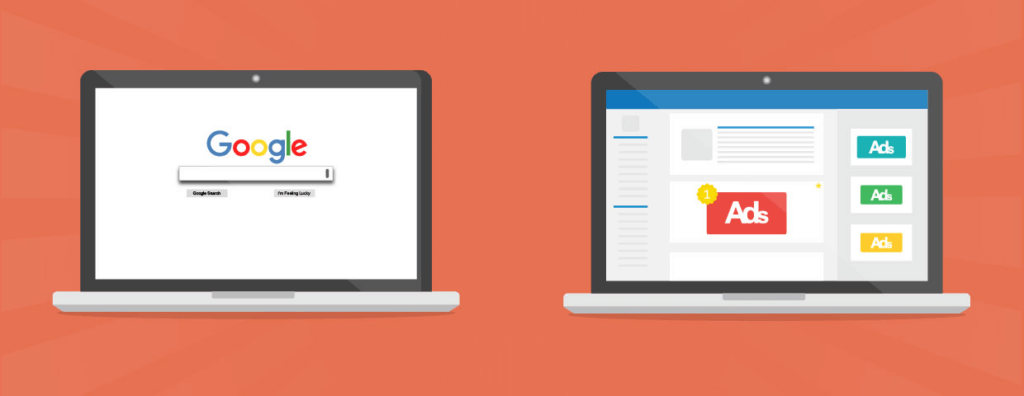
Search ads (L) and display ads (R) have different strengths
(Source: Tribute Media)
How it works
PPC works on a bidding system. Advertisers select keywords related to their business and set a maximum bid, the most they are willing to pay for a click. When a user searches for a keyword, the search engine’s algorithm determines which ads to display based on the relevance of the ad and the advertiser’s bid.
Bid amount is only half of the equation. Search engines rank ads using Ad Rank, which combines the maximum bid with a Quality Score. Quality Score reflects how relevant the ad, keyword and landing page are to the searcher, along with expected click-through rate. A higher Quality Score can win a better ad position at a lower cost, so a well-optimized ad can outrank a competitor who bids more.
If the user clicks on the ad, the advertiser is charged based on the Ad Rank of the ad below theirs divided by their own Quality Score, plus a small increment. This is the actual cost-per-click (CPC), and it means an advertiser often pays less than their maximum bid for a click.
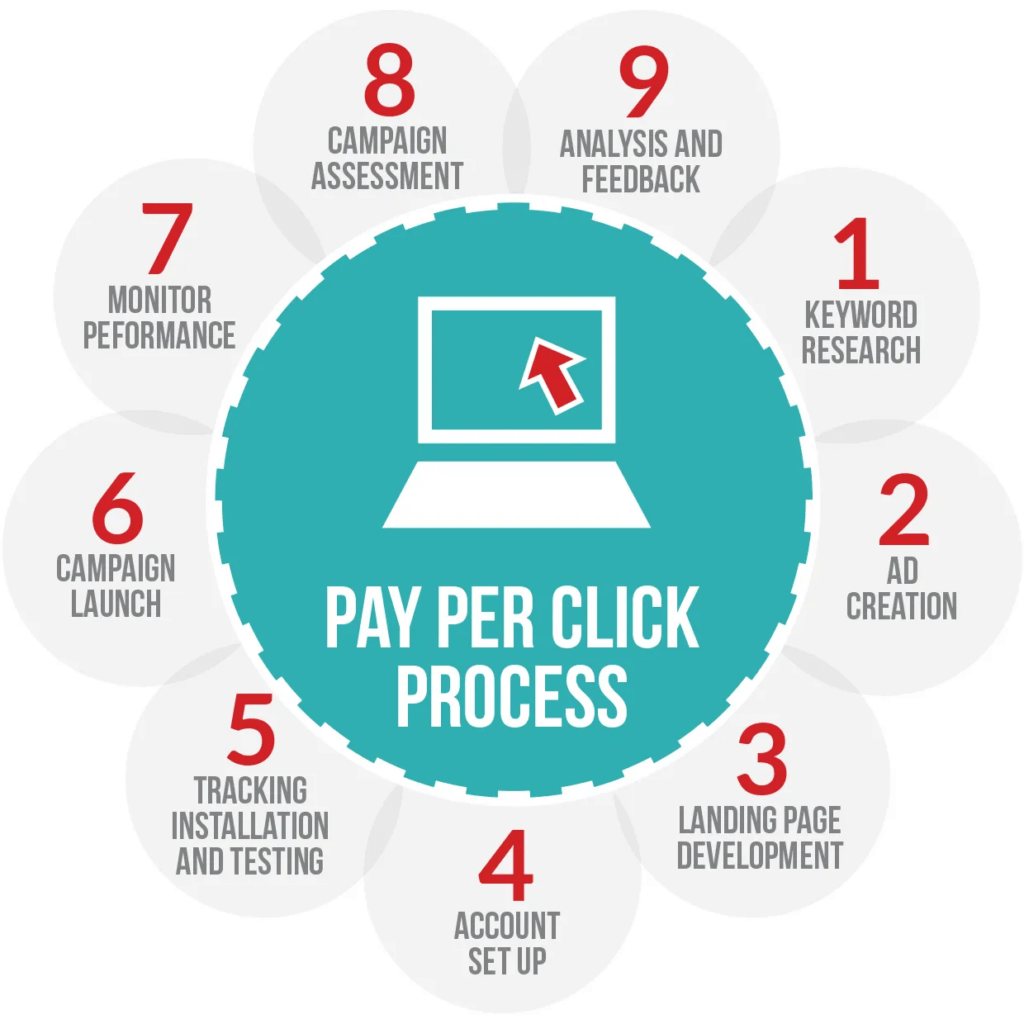
Some of the key steps of the PPC process
(Source: PJM Consulting)
How the PPC auction works
Every search triggers a real-time auction that runs in milliseconds before the results page loads. When a user types a query, the search engine collects every active bid for matching keywords and calculates an Ad Rank score for each advertiser. Ad Rank is the product of the advertiser's maximum bid, Quality Score and the expected impact of ad extensions. The advertiser with the highest Ad Rank wins the top position.
A high Quality Score lowers actual cost-per-click even when the maximum bid stays the same. Two advertisers bidding $5 on the same keyword can pay materially different amounts per click if their Quality Scores differ.
PPC bidding strategies
Advertisers can choose from manual and automated bidding strategies depending on their goals and the maturity of their campaign data.
- Manual CPC. You set the maximum bid for each keyword. Full control, but requires regular adjustment as competition and Quality Scores shift.
- Enhanced CPC (eCPC). Google adjusts your manual bids up or down based on the likelihood of conversion at each auction, within your stated maximum.
- Target CPA. Google sets bids automatically to hit a target cost-per-acquisition. Works best once the campaign has enough conversion data to train the algorithm, typically 30 or more conversions per month.
- Target ROAS. Google optimizes bids to hit a specific return on ad spend. Suited to e-commerce campaigns with consistent transaction values.
- Maximize conversions. Google spends your full budget to get the highest number of conversions. Useful for campaigns without a specific CPA or ROAS constraint.
- Maximize clicks. Google optimizes for click volume within your budget. Most useful in the early stages of a campaign when building impression and Quality Score data.
Keyword match types
Keyword match types control which searches trigger your ads. Getting the match type right determines how much of your budget reaches users with genuine purchase intent versus broad informational queries.
Broad match
Broad match lets your ad appear for any search the engine considers related to your keyword, including synonyms, misspellings and related concepts. It casts the widest net and helps surface new query variations, but it draws irrelevant traffic without disciplined negative keyword management alongside it.
Phrase match
Phrase match shows your ad on searches that include your keyword phrase in the intended meaning, with words added before or after. It sits between broad and exact on the reach-versus-relevance spectrum and works well for mid-funnel keywords where some query variation is acceptable.
Exact match
Exact match limits your ad to searches that closely match your keyword or its close variants. The targeting is narrow but the relevance is high, which typically means a lower cost-per-click and a higher conversion rate than broad or phrase on the same keyword.
Negative keywords
A negative keyword blocks your ad from showing on a query you do not want to target. Adding negatives matters as much as choosing positive keywords. A campaign bidding on "project management software" without a negative for "free" bleeds budget on users who will not convert.
Role in growth marketing
PPC plays a key role in growth marketing as it is a scalable and measurable way to drive traffic, leads, and sales. By paying only for clicks, businesses can control their advertising costs and make certain that they are effectively using their budget.
On top of that, PPC allows businesses to reach their target audience at the right time with the right message. By targeting specific keywords, demographics, and locations, businesses can make sure that their ads are being seen by potential customers who are likely to be interested in their products or services.
One caveat worth planning for: as PPC campaigns mature, competition on high-intent keywords drives cost-per-click up, which pushes customer acquisition costs higher over time. Many B2B SaaS teams pair PPC with lower-cost channels like referral programs, which acquire customers through peer trust inside the existing user base instead of paid auction dynamics. VEED, for example, reported a 90.4% lower CAC from its referral program compared to paid acquisition, a gap that widens as PPC costs climb.
Driving traffic and leads
One of the primary roles of PPC in growth marketing is to drive traffic and leads. By appearing at the top of the search results, PPC ads can increase visibility and attract more visitors to your website. These visitors can then be converted into leads through forms, subscriptions, or other conversion methods.
PPC can also target users at different stages of the buying cycle. By using different keywords and ad copy, businesses can attract users who are in the research phase, the consideration phase or the decision phase, increasing the chances of conversion.
Increasing sales and revenue
PPC can also play a big role in increasing sales and revenue. By targeting high-intent keywords, keywords that indicate a strong intention to purchase, businesses can attract users who are ready to buy. These users are more likely to convert, leading to increased sales and revenue.
PPC can also retarget users who have visited your website but did not convert. By showing these users ads that remind them of their interest in your product or service, businesses can increase the chances of these users returning to their website and making a purchase.
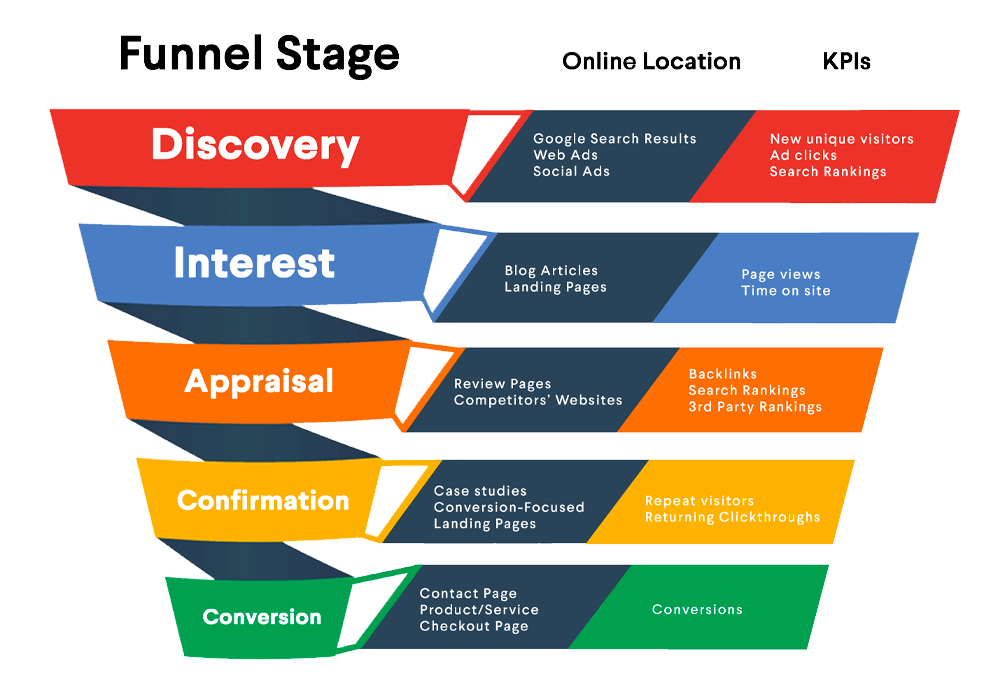
Web ads, including PPC, play a key role in the discovery process, in the end boosting sales and revenue (Source: First Page Sage)
Advantages of PPC
- Immediate results. Campaigns can drive traffic the same day they go live, with no waiting period for organic authority to build.
- Precise targeting. You can target by keyword, location, device, time of day and audience segment, putting ads in front of users most likely to convert.
- Measurable ROI. Every click, conversion, and dollar spent is tracked, making it straightforward to calculate return on ad spend and adjust budgets accordingly.
- Budget control. You set daily and monthly caps, so spend never exceeds what you have approved. Campaigns can be paused or scaled at any time.
- Testable at low cost. Short-run tests on ad copy, landing page variants or new keyword lists give fast feedback without a long-term commitment.
Disadvantages of PPC
- Traffic stops when spend stops. Unlike SEO, PPC delivers no residual traffic once the budget runs out. It requires ongoing investment to maintain results.
- Rising costs on competitive keywords. Cost-per-click on high-intent B2B keywords rises as more advertisers bid, pushing customer acquisition costs up over time.
- Click fraud risk. Invalid clicks from bots or competitors can drain budget without producing real conversions, though platforms have fraud detection in place.
- Requires ongoing management. Campaigns need regular bid adjustments, keyword reviews, and copy refreshes to stay efficient. Neglected campaigns tend to deteriorate in Quality Score and cost.
- Steep learning curve. Getting the most from PPC requires familiarity with bidding strategies, match types, Quality Score, and attribution. Mistakes in any of these areas can waste budget quickly.
Top PPC advertising platforms
PPC advertising runs across search engines, social networks and e-commerce marketplaces, with each platform reaching buyers at a different stage of the funnel.
Google Ads is the largest PPC platform, placing text ads at the top of Google Search results and display ads across millions of partner sites via the Google Display Network. Its broad reach and high purchase intent make it the default starting point for most advertisers. Google Ads also supports Shopping and Performance Max campaigns for e-commerce brands.
Microsoft Advertising (Bing Ads) serves PPC ads on Bing, Yahoo and DuckDuckGo. Its audience skews older and more affluent than Google’s, and average cost-per-click tends to be lower due to less competition, making it a cost-effective complement to Google campaigns.
Meta Ads (Facebook and Instagram) use interest- and behavior-based targeting instead of keyword intent. This makes Meta well suited to awareness and retargeting campaigns where precise demographic or lifestyle targeting matters more than capturing active search demand.
LinkedIn Ads are the go-to platform for B2B advertisers. Targeting by job title, seniority, industry and company size lets teams reach decision-makers directly, though cost-per-click is typically higher than on other platforms.
Amazon Ads place sponsored product listings within Amazon search results, targeting buyers with strong purchase intent at the point of transaction. They are most relevant for brands selling physical or digital products directly on the Amazon marketplace.
PPC costs and ROI benchmarks
Two numbers decide whether a PPC campaign pays off: what you pay per click and what each click returns. Cost-per-click varies widely by platform and industry, so benchmarks are best read as starting points instead of fixed targets.
On Google Search, average cost-per-click across industries sits in the $2 to $4 range, but competitive B2B and finance keywords routinely run $10 or higher. Meta Ads tend to be cheaper per click because they target interest instead of active demand, while LinkedIn carries the highest cost-per-click of the major platforms due to its precise B2B targeting.
On the return side, the metric that matters is return on ad spend (ROAS), the revenue generated for every dollar spent. A 4:1 ROAS (four dollars back per dollar spent) is a common baseline for a healthy campaign, though the right target depends on your margins and customer lifetime value. For B2B SaaS, where deals close over weeks and involve multiple touchpoints, cost-per-lead and pipeline contribution are usually more useful than raw ROAS.
The table below shows typical cost-per-click and conversion rate ranges by platform and vertical. Use these as orientation points and not hard targets, since your actual numbers will vary by keyword competition, ad quality, and audience size.
|
Platform / Vertical |
Avg. CPC Range |
Avg. Conversion Rate |
Best For |
|---|---|---|---|
|
Google Search (B2B SaaS) |
$8 to $20+ |
3% to 6% |
Capturing active search demand from in-market buyers |
|
Google Search (e-commerce) |
$0.50 to $3 |
2% to 5% |
Product-level keyword targeting, Shopping campaigns |
|
Google Search (finance / legal) |
$10 to $50+ |
2% to 4% |
High-intent queries in regulated, high-LTV verticals |
|
Meta Ads (Facebook / Instagram) |
$0.50 to $2 |
1% to 3% |
Awareness, retargeting, and interest-based audience reach |
|
LinkedIn Ads (B2B) |
$6 to $15+ |
1% to 3% |
Reaching decision-makers by job title, seniority, and company size |
|
Microsoft Advertising (Bing) |
$1.50 to $6 |
2% to 4% |
Cost-effective complement to Google, older and more affluent audience |
PPC vs SEO vs SEM
PPC, SEO, and SEM are often used interchangeably, but they describe different things. SEM is the umbrella term for all paid and organic activity on search engines, PPC is the paid side of SEM, and SEO is the organic side. The table below breaks down how they compare.
|
Factor |
PPC |
SEO |
SEM |
|---|---|---|---|
|
What it is |
Paid ads charged per click |
Organic ranking through content and technical optimization |
Umbrella term covering both paid and organic search |
|
Cost model |
Pay per click, ongoing budget |
No cost per click, investment in content and time |
Mixed, depending on the tactics used |
|
Time to results |
Immediate once campaigns go live |
Months to build authority |
Varies by channel mix |
|
Traffic when spend stops |
Stops when the budget runs out |
Continues over time |
Depends on the paid vs organic balance |
Best practices for PPC growth marketing
To maximize the effectiveness of PPC in growth marketing, there are several best practices that businesses should follow. These include keyword research, ad creation, landing page optimization, and performance tracking.
Keyword research is the process of finding and analyzing the keywords that potential customers use when searching for your products or services. By targeting these keywords in your PPC campaigns, you can make certain that your ads are being shown to the right audience.
Ad creation
Ad creation involves writing clear ad copy and designing attractive ad visuals. The goal is to create ads that stand out from the competition and entice users to click. This involves understanding your audience’s needs and wants and showcasing the benefits of your product or service.
On top of that, it’s important to include a clear call-to-action (CTA) in your ads. This tells users what action they should take after clicking on your ad, whether it’s to buy now, sign up, or learn more.
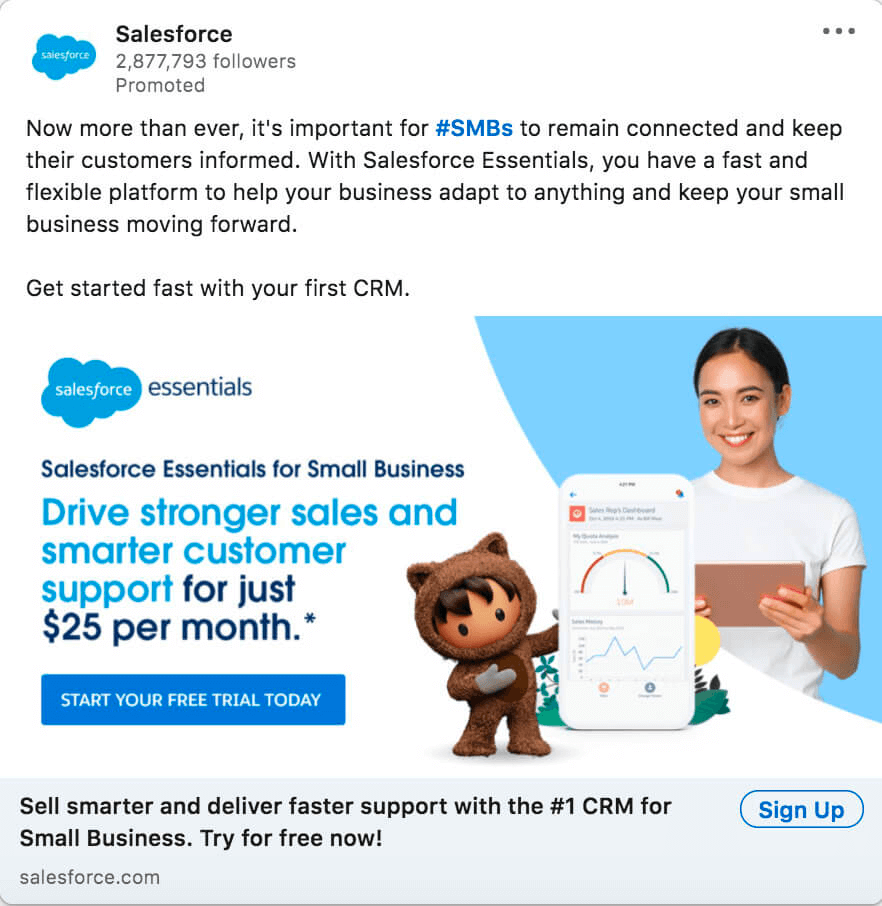
Salesforce advertisements include attractive visuals and clear CTAs (Source: CXL)
Landing page optimization
Landing page optimization involves improving the design and content of your landing pages to increase conversion rates. This includes making your landing pages mobile-friendly, reducing page load times and using clear and concise messaging.
On top of that, it’s important to align your landing page with your ad. If your ad promises a free trial, for example, your landing page should deliver on that promise. This consistency can increase trust and improve conversion rates.
Performance tracking
Performance tracking involves monitoring and analyzing the results of your PPC campaigns to identify areas for improvement. This includes tracking metrics like click-through rate (CTR), conversion rate and return on ad spend (ROAS).
By tracking these metrics, businesses can identify which ads, keywords, and landing pages are performing well and which ones need improvement. This allows businesses to continuously optimize their PPC campaigns and maximize their growth potential.
What is the difference between PPC search ads and display ads?
Search ads appear on search engine results pages and target users based on their active search query, reaching buyers at the moment of intent. Display ads appear across websites in a search engine's partner network and target users based on browsing history and interests, making them better suited to awareness and retargeting than capturing active demand
How does Google Ads Ad Rank determine what you pay per click?
Your cost-per-click is calculated as the Ad Rank of the competitor below you divided by your own Quality Score, plus a small increment, which means you often pay less than your maximum bid. Quality Score reflects the relevance of your ad, keyword, and landing page, so a well-optimized ad can outrank a higher-spending competitor at a lower cost.
What is the best PPC platform for B2B SaaS?
For B2B SaaS, the right platform depends on your funnel stage. LinkedIn Ads give you the most precise targeting by job title, seniority, and company size, making them the strongest option for reaching decision-makers directly, though cost-per-click runs higher. Google Ads captures active search demand at scale and works well across the full funnel. Microsoft Advertising reaches a smaller but often more senior audience at lower cost-per-click and works best as a complement to Google.
How do I improve my PPC conversion rate without increasing my ad budget?
Focus on landing page alignment first. Your landing page must deliver exactly what your ad promises, whether that is a free trial, a demo, or a specific piece of content, because inconsistency between ad copy and landing page is the most common source of conversion loss. From there, run keyword research to eliminate low-intent terms drawing clicks that will not convert, and tighten your call-to-action so users know precisely what action to take after clicking.
When does PPC make sense compared to referral programs for B2B SaaS growth?
PPC is strong for capturing in-market demand quickly and testing messaging at scale, but cost-per-click on competitive B2B keywords pushes customer acquisition costs up as campaigns mature. Referral programs generate acquisition through peer trust inside your existing customer base, a channel that does not depend on paid auction dynamics or search traffic. For SaaS teams already facing rising paid CAC, referrals offer a lower-cost, trust-driven complement to PPC.