
When you run a pay per action affiliate program, your cost per acquisition should map directly to a Stripe charge or Chargebee subscription event. Instead, most programs leak attribution between the referral click and the billing event because cookies fail, partners dispute credit and fraud detection happens after the payout posts. Moving the verification step to server-side metadata and holding payouts for 30 days closes both gaps before your next commission run.
- What pay per action is and why it matters for SaaS in 2026
- How pay per action works in four steps
- Common pay per action types in SaaS programs
- Pay per action vs other pricing models
- PPA in user referral programs vs affiliate programs
- How to choose the right PPA action for your SaaS program
- Pay per action benchmarks and payout ranges for SaaS
- Tracking and attribution mechanics for PPA programs
- Fraud detection and prevention in PPA models
- PPA program operations and payout infrastructure
- How Cello automates PPA payouts for B2B SaaS user referral programs
TLDR:
- Pay per action (PPA) rewards partners only after a verified event: signup, trial, paid conversion or demo
- B2B SaaS blended CPL averages $237 per First Page Sage's 2026 report, with affiliate acquisition running 62% cheaper than paid search when fraud controls are in place
- Server-side attribution through Stripe or Chargebee metadata survives ad blockers and ITP
- Moving payouts from signup to paid conversion cuts fraud exposure while raising partner commission
- Cello automates PPA tracking, fraud detection and payouts for B2B user referral and partner programs
What pay per action is and why it matters for SaaS in 2026
Pay per action (PPA) is a performance model where partners earn only after a user completes a defined action: a signup, trial start, paid conversion, booked demo or in-product activation. No action, no payout.
PPA and cost per action (CPA) describe the same transaction from two sides. PPA is the partner's earned rate. CPA is the vendor's booked cost. Identical mechanics.
Roughly 99% of affiliate programs run on CPA, per data aggregated by CartMango from Influencer Marketing Hub, IAB, Up Promote, and World Metrics, not pay per click or impression.
For B2B SaaS leaders in 2026, with paid CAC rising and AI search compressing organic reach, every PPA dollar maps to a verified conversion in your billing system, making it a core acquisition strategy with predictable unit economics.
How pay per action works in four steps
Every PPA program runs on the same four-step loop, whether the action is a signup, paid conversion, or booked demo.
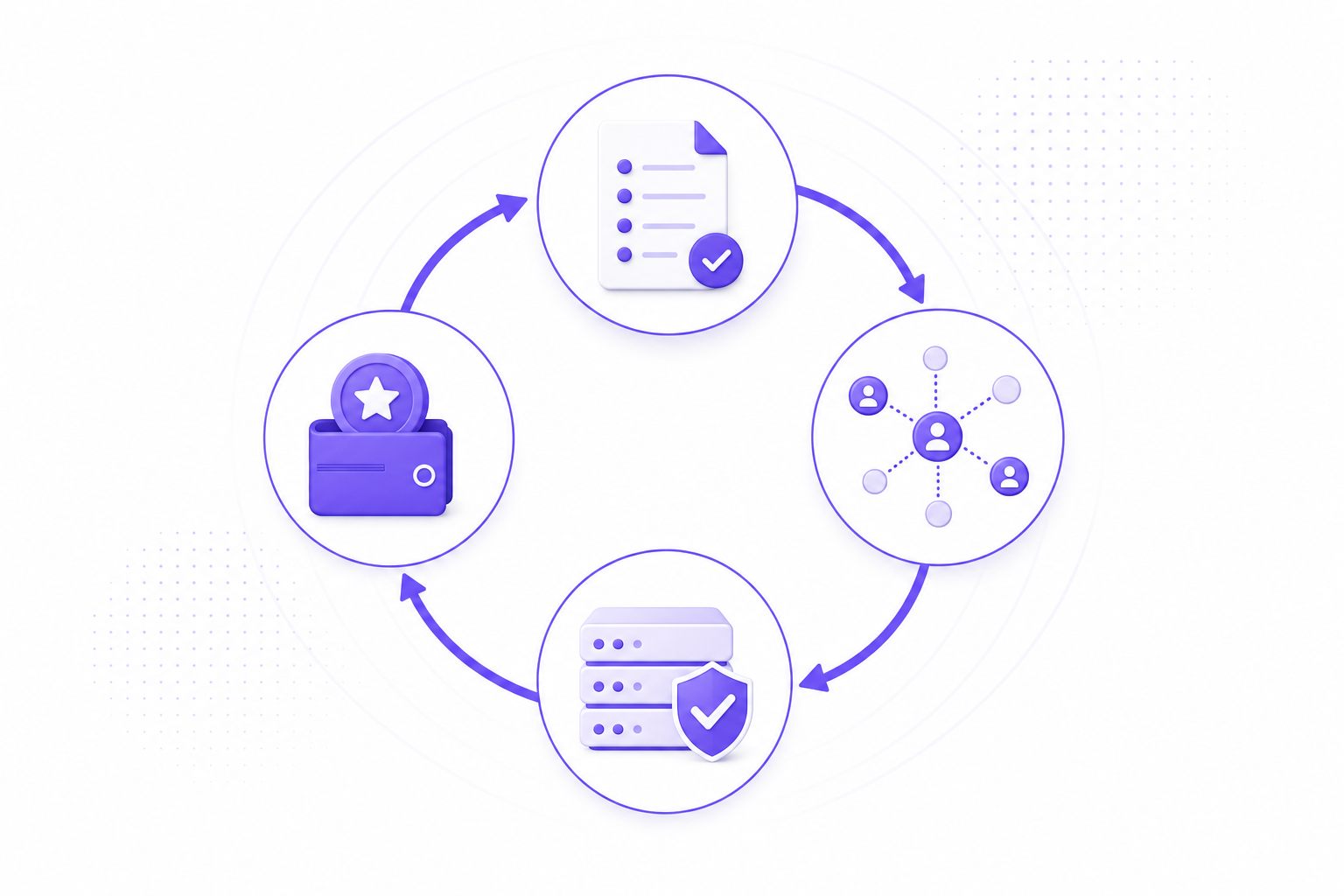
- Define the qualifying action. Pick the event that triggers payout: signup, trial start, paid subscription, qualified lead, demo booked or in-product activation. Document the rule before launch.
- Drive tracked traffic. The partner shares a referral link carrying a unique identifier (in Cello's model, an 11-character UCC) so every click ties back to the referrer.
- Verify the action. Server-side attribution confirms the event through webhooks and metadata on customer objects in Stripe, Chargebee, Paddle or Recurly, or via direct API call. Cookies act as fallback, not the system of record.
- Trigger the payout. Once the action clears qualification and the fraud review window, the reward is calculated and paid automatically.
Each step closes a gap: definition removes ambiguity, tracking removes attribution loss, verification removes disputes, automated payout removes manual ops drag.
Common pay per action types in SaaS programs
SaaS programs typically run on six PPA action types, chosen by funnel stage, fraud exposure, and revenue confidence.
- Pay per signup: rewards new account creation. Lowest payout, highest volume, highest fraud surface.
- Pay per trial: compensates when a referred user starts a free trial or product-led experience.
- Pay per paid conversion: the SaaS default, since payout ties directly to verified billing events.
- Pay per qualified lead: fits sales-led funnels where an SDR or AE qualifies the lead first.
- Pay per demo booked: rewards scheduled demos in enterprise motions with longer cycles.
- Pay per activation event: pays when a referred user hits an in-product milestone like connecting an integration or inviting a teammate.
Deeper funnel actions carry higher payouts and lower fraud risk.
Pay per action vs other pricing models
PPA sits inside a wider family of affiliate pricing models, each defined by what triggers payout and who carries the risk.
|
Model |
Trigger event |
Risk holder |
Fraud risk |
SaaS use case |
Example payout |
|---|---|---|---|---|---|
|
PPA / CPA |
Defined action (signup, trial, paid) |
Vendor |
Medium |
Default for performance programs |
$20 to $500 per action |
|
CPL |
Form fill or lead capture |
Vendor |
High |
Sales-led pipeline |
$10 to $200 per lead |
|
CPS |
Completed purchase |
Vendor |
Low |
Self-serve subscription SaaS |
20% to 30% first payment |
|
CPC |
Click on referral link |
Vendor |
Very high |
Rare in SaaS, common in display |
$0.10 to $5 per click |
|
CPM |
1,000 impressions |
Vendor |
Highest |
Brand awareness |
$1 to $20 per 1,000 |
|
RevShare |
Ongoing customer revenue |
Partner |
Low |
Long-LTV B2B partnerships |
15% to 30% recurring |
|
Flat fee |
Contract signature |
Partner |
None |
Sponsorships, fixed placements |
$500 to $10,000 per deal |
CPS is a PPA subtype where the qualifying action is purchase. RevShare extends that logic across the customer's lifetime, pushing risk onto the partner who earns only while the account stays active.
PPA in user referral programs vs affiliate programs
PPA is the shared payout mechanic, but it sits underneath two motions with different audiences, surfaces, and risk profiles.
|
Dimension |
User referral programs |
Affiliate programs |
|---|---|---|
|
Who refers |
Existing paying customers |
External publishers, influencers, agencies |
|
Per-action payout |
$10 to $100 |
$50 to $500 |
|
Sharing surface |
In-product, authenticated |
External sites, links, content |
|
Conversion rate |
Higher (trust, product fit) |
Lower (cold traffic) |
|
Fraud exposure |
Low (verified users) |
Higher (network-mediated) |
User referrals run on warm trust and small payouts. Affiliate programs trade larger payouts for cold reach. Same PPA logic, different execution surface.
How to choose the right PPA action for your SaaS program
Five criteria decide which action to reward. Run each candidate through them before launch.
- Revenue confidence: can you pay before billing posts (signup, trial) or only after a verified charge?
- Fraud exposure: paid conversion sits lowest, signup highest. Match payout size to manipulation risk.
- Payout simplicity: how much manual verification does the action need before disbursement?
- Partner motivation: is the action realistic for the partner's traffic, audience and intent quality?
- Attribution clarity: can Stripe, Chargebee or your CRM tie the action back to the referrer server-side?
A paid conversion trigger works for most B2B SaaS programs: it ties payout to a verified Stripe or Chargebee charge, cuts fraud surface area, and removes the need for manual review before disbursement. Move to a trial or signup trigger only if your LTV exceeds $1,000 and you have automated fraud detection in place to absorb the higher manipulation risk.
Pay per action benchmarks and payout ranges for SaaS
Pure PPA payouts in B2B SaaS scale with funnel depth:
- Qualified signups: $25 to $75
- Free trials: $50 to $150
- Mid-market demos booked: $75 to $200
- Enterprise demos: $200 to $500
- Paid conversions: $500+ when LTV supports it
For context, B2B SaaS blended CPL averages $237 per First Page Sage's 2026 report, though deal size and sales cycle move that figure, which directly affects your customer acquisition costs. Affiliate acquisition runs 62% lower than paid search, which keeps PPA attractive once fraud controls and clean attribution are in place.
Tracking and attribution mechanics for PPA programs
Attribution decides who gets credit when a referred visitor completes the action. Four paths handle that decision:
- Cookie-based: first-party cookies with 30 to 90 day windows. Vulnerable to ITP, ad blockers, and consent refusal.
- Server-side: metadata passed on customer objects in Stripe, Chargebee, Paddle or Recurly. Immune to browser restrictions.
- API-driven: direct server-to-server postback fired the moment the action occurs.
- Hybrid: client-side tracking with server-side fallback when the cookie path fails.
B2B attribution adds one more layer. When the buyer is a company rather than a seat, orgId metadata alongside userId credits the account, not the individual.
Fraud detection and prevention in PPA models
affiliate fraud statistics, costing programs an estimated $3.4 billion per year. Four fraud types drive most of the exposure:

- Self-referral fraud: users or partners refer accounts they control.
- Cookie stuffing: tracking codes dropped without real referral intent.
- Click fraud: bots or click farms inflating link traffic.
- Fake signup fraud: fabricated accounts triggering pay-per-signup payouts.
Four mitigation layers contain exposure:
- Automated detection flags duplicate IPs, botnet traffic and abnormal conversion velocity.
- Manual review applies a 30-day hold, with chargebacks cancelling pending rewards.
- Payout delays hold commission until a retention milestone clears.
- Move the trigger deeper (paid conversion over signup) when fraud risk climbs.
PPA program operations and payout infrastructure
Running PPA at scale rests on four core layers:
- Tracking: capture referral codes, attribute actions server-side, feed conversion data into analytics.
- Campaign management: define payout rules, eligibility logic, reward amounts, and notification triggers per action type.
- Payout disbursement: automate reward calculation and send payments via PayPal, Stripe, wire transfer or partner invoicing.
- Tax and compliance: collect W-9 and W-8 forms, handle EU VAT, file 1099s and issue credit notes.
Build in-house and you spend four to twelve weeks of engineering time. Adopt a referral tool (Cello, PartnerStack, Rewardful, Impact, Trackdesk) and that work compresses to days.
How Cello automates PPA payouts for B2B SaaS user referral programs
We run PPA payouts on four structural choices:
- Server-side attribution reads metadata from Stripe, Chargebee, Paddle and Recurly customer objects, so conversions survive ITP, ad blockers and consent refusal.
- The in-product embed places the referral surface inside your authenticated app. Miro reports an 8x higher activation rate against external portals.
- Automated fraud detection flags self-referrals, botnet traffic and abnormal velocity across a 30-day window. Pending rewards cancel when Stripe fires charge.refunded.
- EU-hosted AI infrastructure and GDPR-native data handling fit strict procurement requirements.
User referrals and partner programs run on one ledger, one campaign engine, one fraud model and one payout pipeline.
What is pay per action affiliate marketing?
Pay per action affiliate marketing is a performance model where affiliates earn commission only after a referred user completes a specific action: a signup, trial start, paid conversion, booked demo, or in-product activation. The vendor pays for verified conversions, not impressions or clicks, which keeps CAC predictable and fraud exposure controlled.
Cost per action vs cost per acquisition — what's the difference?
CPA (cost per action) and cost per acquisition describe the same transaction from opposite sides. Cost per action is the vendor's internal cost metric per tracked conversion event. Cost per acquisition is often used interchangeably but sometimes refers only to full customer acquisition, while cost per action can include earlier funnel events like signups or trials.
Can I build a pay per action program without engineering headcount?
Yes. Cello automates tracking, attribution, fraud detection, payout calculation, and disbursement through native Stripe and Chargebee integrations. Hera went live in two days, Butter in under five hours, and Smoobu via the plug-and-play widget — all without engineering roadmap drag.
Pay per action pricing for affiliate programs vs user referrals?
Affiliate programs run $50 to $500 per paid conversion because traffic is cold and fraud risk is higher. User referral programs pay $10 to $100 per conversion since referred traffic comes from verified customers who already trust the product, which drives higher conversion rates at lower payout thresholds.
How do pay per action companies prevent self-referral fraud?
Automated fraud detection flags duplicate IPs, botnet patterns, and abnormal conversion velocity. Pending rewards are held for 30 days while risk factors evolve, and Stripe charge.refunded webhooks automatically cancel payouts when chargebacks occur. Moving the trigger event deeper into the funnel — from signup to paid conversion — cuts manipulation surface area by up to 80%.
How does server-side attribution work versus cookie-based tracking in B2B SaaS?
Server-side attribution reads metadata directly from Stripe, Chargebee, Paddle or Recurly customer objects when conversions occur, tying each purchase back to the referrer through webhooks and documented metadata fields (cello_ucc, new_user_id, new_user_organization_id). Cookie-based tracking uses first-party cookies as a fallback but fails when users block cookies, switch devices or clear browser data. Server-side attribution survives those breaks because the conversion event passes through your billing system where the referrer identifier is already written.
What's the fastest way to ship a pay per action program in 2026?
Adopt a referral platform with native billing integrations (Stripe, Chargebee) rather than building custom. Hera launched in two days and Butter in under five hours using Cello's JavaScript SDK and pre-built webhooks. The time difference comes from skipping attribution logic, payout pipelines, fraud detection and tax compliance that take weeks or months to build in-house.
Should I reward signups or paid conversions in a B2B SaaS affiliate program?
Reward paid conversions when fraud risk and operations complexity matter more than partner volume. Signup payouts generate higher traffic but expose you to self-referral fraud and manipulation. Paid conversion payouts tie directly to verified billing events in Stripe or Chargebee, which cuts fraud exposure by up to 80% and removes attribution disputes.
Can I run user referrals and affiliate programs on the same platform?
Yes, and you should. Running both motions on one platform gives you unified attribution, one fraud detection model, one payout ledger and one analytics surface. Cello tracks user referrals and affiliate conversions through the same server-side attribution model, so you avoid the integration debt of stitching two separate systems together.
What payout delay should I set for new affiliate conversions?
Hold payouts for 30 days when fraud risk is material. This window lets refunds, chargebacks and self-referral patterns surface before disbursement occurs. Stripe's charge.refunded webhook automatically cancels pending rewards when chargebacks post, which protects you from paying for reversed transactions.
How do I attribute B2B purchases at the company level instead of per seat?
Pass the buying organization's ID alongside the user ID when signups or subscriptions occur. In Cello's model, you send new_user_organization_id on the Stripe or Chargebee customer object or via the JavaScript SDK's payload.newUserId parameter on signup. This credits the referrer when any user from that company converts, not just the first seat.
Pay per action vs pay per click for SaaS acquisition — which works?
Pay per action works for SaaS because you only pay when a verified conversion occurs (signup, trial, purchase). Pay per click forces you to pay for every click regardless of whether the visitor converts, which means you carry all the fraud risk and attribution breakage. CPC is rare in SaaS programs for that reason.
When does it make sense to move from manual payouts to automated disbursement?
Move to automated payouts when you're processing more than 10 to 20 referrals per month or when payout calculation takes more than an hour of manual work per cycle. Automated systems handle reward calculation, partner invoicing, PayPal transfers and tax compliance without touching each transaction individually, which matters once volume climbs past hobby-project scale.
How do I stop partners from gaming pay per signup campaigns?
Move the payout trigger deeper into the funnel (trial start or paid conversion instead of signup) or apply automated fraud detection that flags duplicate IPs, botnet traffic and abnormal conversion velocity. Holding payouts for 30 days gives you time to review flagged accounts before disbursement posts, and server-side attribution removes the cookie-stuffing surface that click fraud depends on.
What's the difference between cost per lead and pay per action in SaaS programs?
Cost per lead pays when a form is filled or contact information is captured, regardless of whether that lead qualifies or converts. Pay per action pays when a deeper event occurs (trial start, demo booked, paid subscription). CPL fits sales-led funnels where SDRs qualify leads before handoff. PPA fits product-led or self-serve motions where conversions are automatic and verifiable through billing webhooks.