
- TL;DR
- What is 1st-level referral program visibility?
- Why does launcher placement make or break your referral program?
- What does the data say about referral program launcher placement?
- VEED: The power of the permanent gift icon
- Smoobu: The effect of two simultaneous visibility placements
- How to implement 1st-level visibility in your product
- Why Cello is the only referral platform built for this
TL;DR
- 1st-level visibility drives 4.4x higher activation, the strongest single lever in referral program setup
- 2nd-level-only programs achieve below 1% activation regardless of reward size or reward structure
- Smoobu: 25% monthly activation rate, +10% monthly revenue growth; achieved with a simple 10% two-sided reward made visible
- VEED: -90.4% CAC versus paid channels with a single gift icon permanently added to primary navigation
- Setup requires no dev post-integration: configure through the Cello Portal in under 30 minutes
You have a referral program. Your users have never thought about it.
This is the most common failure mode in B2B SaaS referral programs, not bad rewards, not a broken flow. The program is simply invisible. Users log in, navigate your product, and never encounter the one feature that turns passive users into your cheapest and highest-converting acquisition channel.
Placing your referral launcher at 1st-level visibility, always present in your primary navigation, drives a 4.4x higher activation rate. That’s +21 performance points on your program health score (out of 100 on Cello's Recommendations dashboard), based on Cello’s data from over 4 million referral program users.
This is Part 1 of Cello's Activation Mini Series; a breakdown of the exact recommendations that move referral program performance, backed by real customer results.
What is 1st-level referral program visibility?
1st-level referral program visibility means your referral launcher is permanently placed in your primary navigation. Thus, visible to every user on every screen without a single additional click. Any placement that requires users to open a submenu, visit their profile, or navigate to a settings page is 2nd-level visibility. The performance gap between the two is not marginal: Cello’s data shows 2nd-level-only placements achieve activation rates below 1%.
The concept applies across product types. In a web SaaS product, 1st-level means the main sidebar or top navigation bar. On the other hand,in a mobile app, it means native placement in the tab bar or hamburger menu. In both cases, the requirement is identical: the referral program must be as visible as your core product features.
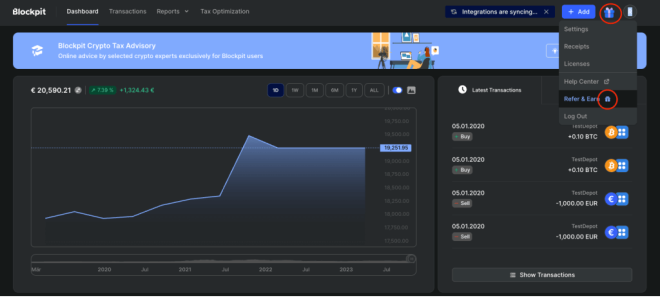
Blockpit referral launchers
Why does launcher placement make or break your referral program?
💡 Launcher placement determines whether your referral program builds a habit or gets forgotten. A launcher in the primary navigation is seen on every login, every session — creating the repeated exposure habits require. A launcher buried in a settings menu is seen once. Cello’s data confirms this: 2nd-level-only placements achieve below 1% activation, regardless of reward structure or program quality.
That habit gap explains why referral programs are habitual, not transactional, and why habits require repeated exposure to form. A launcher buried in a 2nd-level menu is seen once during onboarding and never again. A launcher in the primary navigation is seen on every login, every workflow, every session. That repetition is what converts passive awareness into active sharing behavior.
The UX principle at work is Nielsen’s ‘Visibility of System Status’ heuristic: key actions must be findable without deliberate search. Most referral tools violate this rule by design, they default to hosted pages and external widgets that sit entirely outside your product navigation.
That gap has measurable consequences: Forrester Research found that seamless, well-positioned UX can increase conversion rates by up to 400%.
What does the data say about referral program launcher placement?
Cello’s analysis of 4M+ referral users, as of 2026, shows that launcher placement is the strongest single predictor of activation rate, stronger than reward size, reward structure, or program branding.
| Launcher Configuration | Activation Rate | Cello Score Impact |
|---|---|---|
| 2nd-level menu only | 1x (baseline) | 0 pts |
| 1st-level menu (always visible) | 4.4x | +21 pts |
| 1st-level + 1 custom launcher | +3.5x additional uplift | +14 pts |
| 1st-level + multiple custom launchers | 8.8x combined | +35 pts |
| Figures based on Cello's analysis of 4M+ referral program users. Individual results vary by product type and context. Source: docs.cello.so | ||
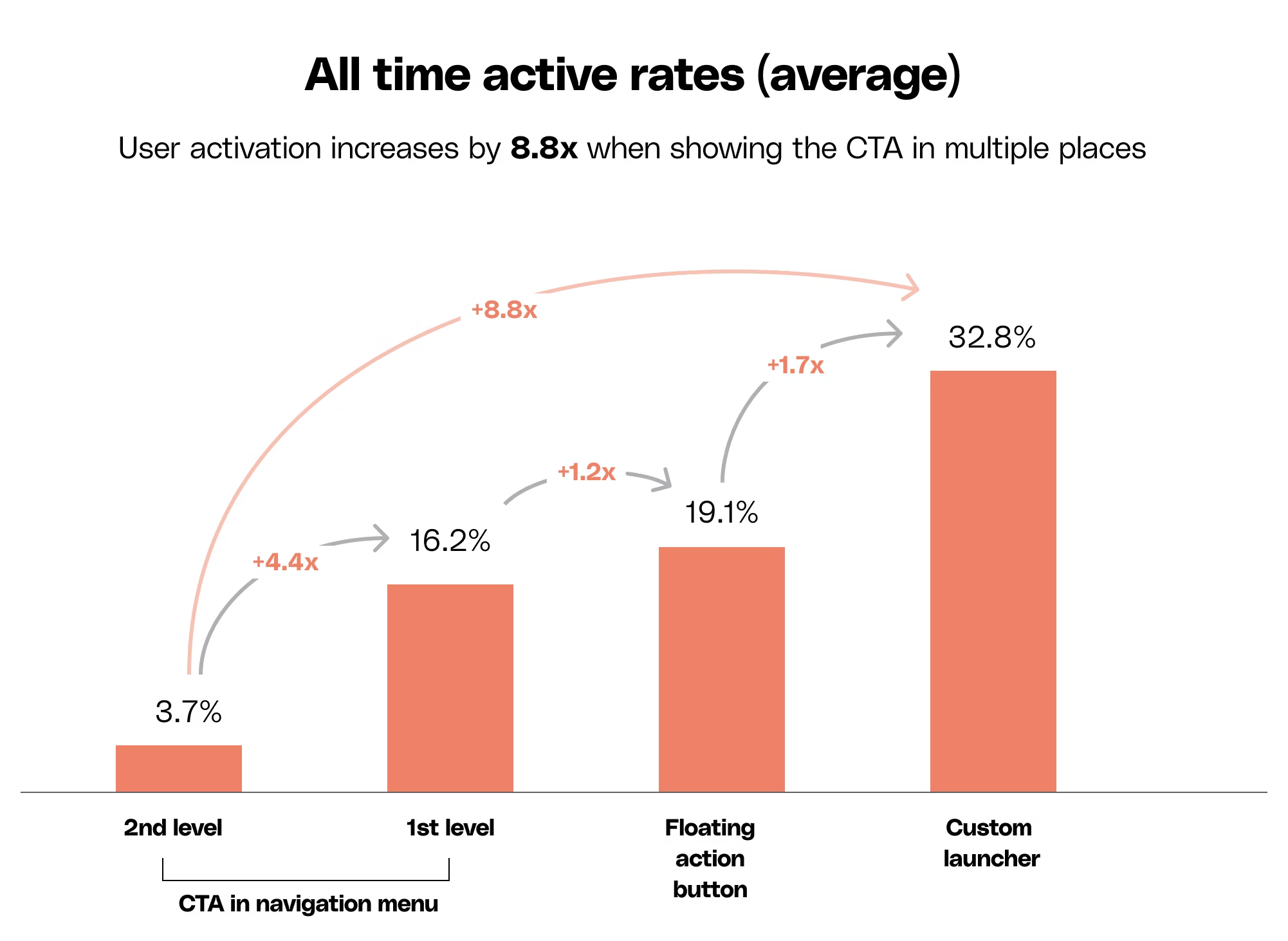
Performance impact bar chart from Cello's 'Increase Discoverability'
The numbers bear this out: Cello's data across 4M+ users shows that customers adding a 1st-level action to an existing 2nd-level menu see weekly referrer activation increases of 200%+, with no reward structure change required.
Across Cello's customer base, the pattern is consistent: when users can see the program, they use it. When they can't, they don't.
VEED: The power of the permanent gift icon
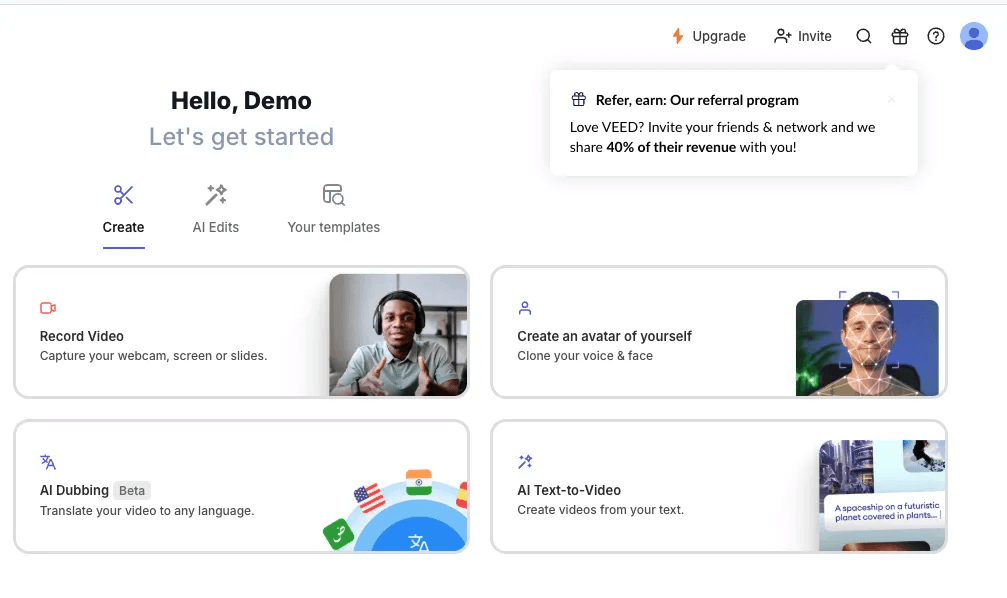
VEED is an AI-powered video editing platform based in London, and a Cello customer since 2024. They integrated a gift icon permanently into their primary navigation menu, a direct 1st-level launcher implementation that was brand-consistent and required no product redesign.
As of 2024, VEED's referral program achieved:
- -90.4% CAC compared to paid acquisition channels
- +14.5% sign-up rate from referred users
- +19.7% freemium-to-paid conversion among referred users
- +1.3M enabled users enrolled in the referral program
"Cello boosted our referral program with their integrations, automated payouts and smart notifications." Anthony Hanbury-Williams, Growth & Acquisition, VEED
VEED’s case demonstrates the compounding effect of visibility: when users see the referral program on every screen, activation becomes ambient rather than deliberate. The -90.4% CAC figure is the direct downstream consequence of one upstream decision, putting the program where users already look.
Smoobu: The effect of two simultaneous visibility placements
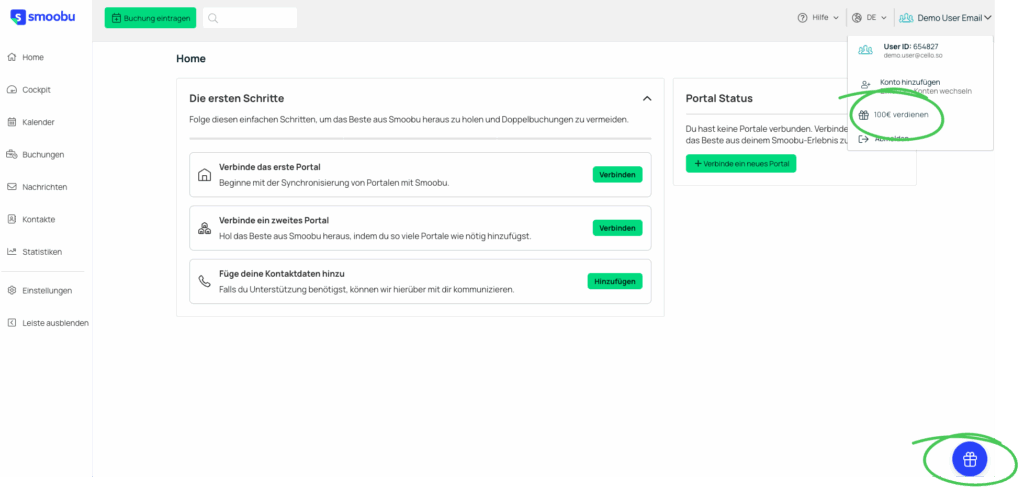
Smoobu's floating action button + menu integration
The same principle played out in a different vertical. Smoobu, a Berlin-based vacation rental management SaaS acquired by HomeToGo, launched their Cello referral program in 2023. Their setup was deliberately straightforward: a symmetrical 10% two-sided reward paired with two simultaneous visibility placements.
- A floating action button (FAB) permanently embedded in the product UI
- A direct in-menu integration in the main navigation
No complex reward tiers. No special launch campaigns. The differentiation was entirely placement.
| Metric | Result |
|---|---|
| Monthly activation rate | 25% |
| Sharing rate | 17% |
| Free-trial-to-paid conversion (referred users) | 54.8% |
| Monthly additional revenue growth from referrals | +10% |
| Source: cello.so/customers/smoobu/ | |
"Cello's Plug & Play widget has saved us valuable time and effort, making it easy to get started and see results quickly." Jannik Abraham, Managing Director, Smoobu
The Smoobu case confirms the core principle: a visible program with a simple reward outperforms an invisible program with a generous one. The 54.8% trial-to-paid conversion rate among referred users is the downstream consequence of one upstream decision, making the program impossible to miss.
How to implement 1st-level visibility in your product
Implementing 1st-level visibility requires three decisions: position, label, and reward mention.
- Choose a 1st-level position. The primary navigation sidebar is the highest-performing placement. A top navigation bar is the second option. Profile menus, settings pages, and help sections are 2nd-level by definition, do not use them as the primary launcher.
- Add a clear label or reward signal. A label like 'Refer & Earn' or 'Earn 20% per referral' communicates value before users commit. Including the reward amount in the launcher text increases activation by an additional 1.5x and adds +6 performance points.
- Configure in Cello Portal (no dev required after initial integration) through the Cello Portal. Assign a unique HTML identifier to your navigation element. Cello opens the referral widget when the element is clicked. Most customers complete this in under 30 minutes.
For mobile products, the same logic applies: Cello's native SDKs for iOS, Android, and React Native embed the referral launcher directly into mobile navigation patterns. Based on Cello's internal data, mobile referral sharing achieves up to 200% higher sign-up rates compared to web-only implementations.
Why Cello is the only referral platform built for this
💡 Most referral tools default to hosted landing pages and third-party widgets that sit outside your product. Cello is built specifically for in-product embedding. Thanks to native Custom Launcher, mobile SDKs, and a real-time Recommendations dashboard that scores your program health. This is what makes genuine 1st-level integration achievable without custom development.
To be specific: Cello is the only B2B SaaS referral platform that treats launcher placement as a core product requirement. Every other referral tool defaults to a hosted landing page or third-party widget that lives outside your product, making genuine 1st-level integration technically complex or structurally impossible.
The capability gap is direct:
| Capability | Cello | Most Referral Tools |
|---|---|---|
| Native 1st-level menu integration | Configurable in Cello Portal — no dev needed post-integration | Requires custom development; hosted externally |
| Floating Action Button | Fully styled to match your brand | Fixed widget, often third-party branded |
| Custom launcher selector | Match any HTML element in your UI | Not available |
| Activation performance score | Real-time Recommendations dashboard with point scoring | Not available |
| Mobile SDK (iOS / Android / React Native) | Native mobile referral experience | Web-only or JS widget |
| Personalized referee landing page | Built-in — referrer name, reward, product USPs | Requires custom build |
In practice, that translates to real-time scoring: Cello's Recommendations dashboard scores every customer's program health in real time. The 1st-level visibility recommendation is worth +21 performance points, the single highest-value individual action in the Activation category.
Adding multiple launchers (+14 points) means 35 total points from discoverability alone, before any reward or notification optimization.
1st-level visibility is not a growth hack; it is the baseline condition for a referral program to function. Without it, the best reward structure and the most polished UX will underperform, because users will never encounter the program consistently enough to act. Every other optimization in the Cello Activation Mini Series builds on this foundation, starting with the questions below.
Frequently Asked Questions
What is 1st-level referral program visibility?
1st-level visibility means your referral launcher is permanently placed in your product's primary navigation, sidebar, top bar, or main menu, visible on every screen without additional clicks. It is the opposite of placing your referral program in a settings dropdown or user profile menu, where activation rates drop below 1%.
How much does launcher placement affect referral program activation?
According to Cello's data from 4M+ referral program users, a 1st-level launcher drives 4.4x higher activation compared to programs with no prominent placement. When combined with additional custom launchers at key product touchpoints, the effect reaches 8.8x higher activation.
What is the difference between a 1st-level and 2nd-level launcher?
A 1st-level launcher is visible in the primary navigation at all times, no interaction required. A 2nd-level launcher is nested inside a submenu, settings page, or profile dropdown. Cello's data shows that 2nd-level-only programs achieve activation rates below 1%, regardless of reward size.
Does the reward amount matter as much as placement?
No. Placement is the primary driver of activation. Smoobu achieved a 25% activation rate and 10% monthly revenue growth with a simple 10% two-sided reward, because that reward was visible. Adding the reward amount to the launcher text increases activation by an additional 1.5x on top of placement gains.
How long does it take to implement 1st-level visibility with Cello?
Once the initial Cello integration is live, the custom launcher is configured in Cello Portal under Referrer Experience settings with no additional development. Most customers complete the configuration in under 30 minutes.
Can 1st-level visibility be implemented in a mobile app?
Yes. Cello's native mobile SDKs for iOS, Android, and React Native embed the referral launcher directly into mobile navigation. Mobile referral sharing achieves up to 200% higher sign-up rates versus web-only setups. VEED and Ordio are Cello customers who have implemented mobile-native referral placement.
Do I need to redesign my navigation to add a 1st-level launcher?
No. The Cello custom launcher attaches to any existing HTML element in your navigation, a sidebar link, menu item, or navigation button. You assign a unique identifier to the element and configure it in Cello Portal. No navigation redesign is needed.
What metrics should I track after implementing 1st-level visibility?
Track three metrics: Activation rate: percentage of your user base that has opened the referral program at least once. Sharing rate: percentage of activated users who shared at least one referral link. Cello program health score: tracked in real time on your Recommendations dashboard. A well-implemented 1st-level launcher should move activation above 15% within 30–60 days.


Cello amplifies our existing word-of-mouth, leading to double digit freemium-to-paid rate
Learn how Veed amplifies existing word-of-mouth leading to double digit freemium-to-paid rate.


Smoobu significantly activates user base via referrals
Smoobu, a pioneer in the B2B SaaS vacation rental management system and acquired by HomeToGo in ...
Best B2B Referral Software for SaaS (2026): Features, Pricing & Picks
TL;DR Scenario Why Cello wins (concrete proof-points) Early-stage SaaS (ARR < $10 M) ...