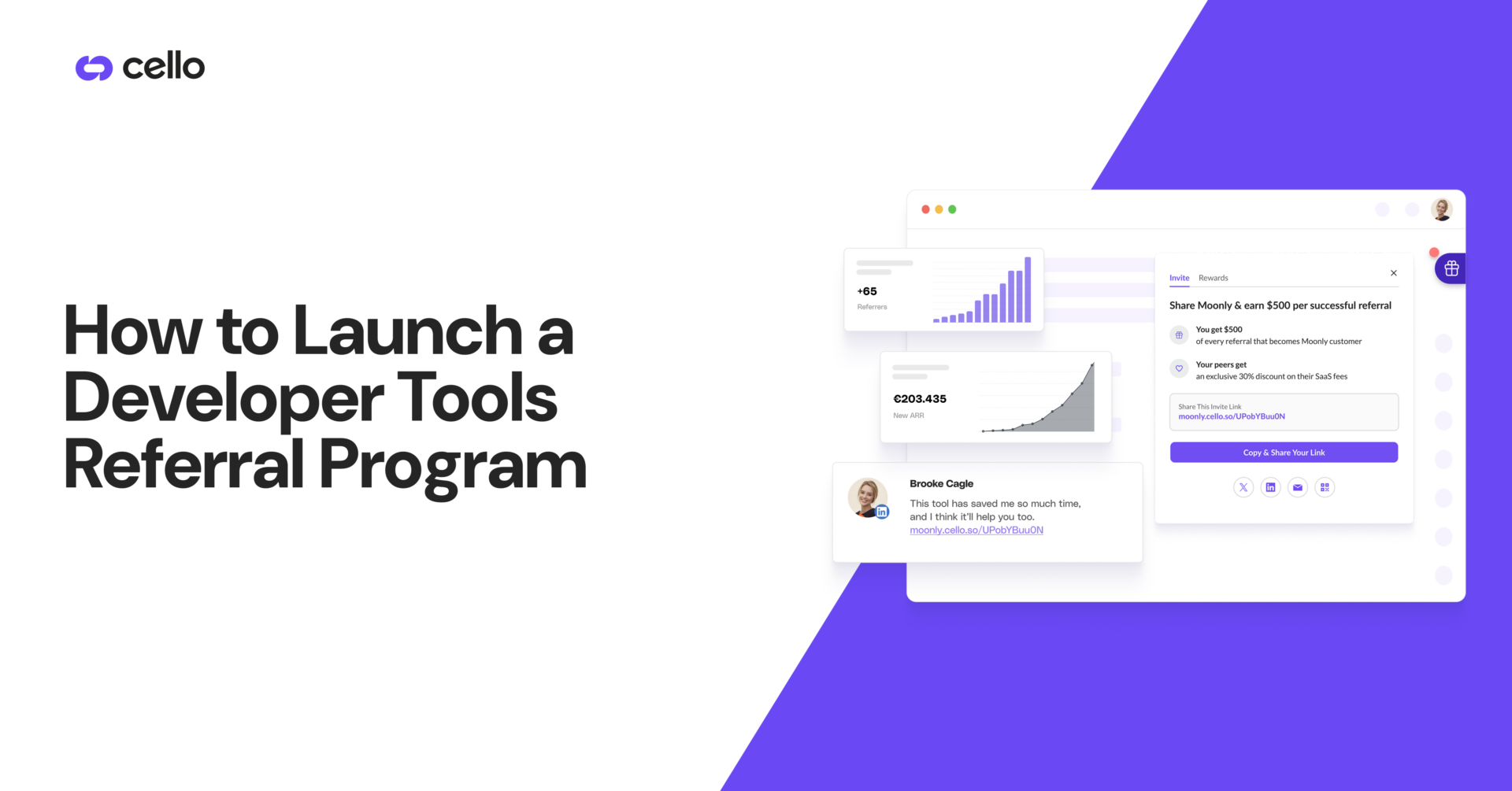

Most referral programs for developer tools companies arrive broken on day one: a generic B2C-style widget, cash rewards developers ignore, a launcher buried three clicks deep in settings and cookie attribution that falls apart across a long evaluation. Cello fixes this by giving developer tools teams an in-product option built around how engineers actually evaluate and buy software.
- Why developer tools SaaS is built for peer-led acquisition
- The readiness check: when word of mouth is worth capturing
- Choosing the right program type for a developer tools company
- Reward structures that work for a developer audience
- Attribution that survives the developer sales cycle
- Surfacing your referral program inside the product
- Promoting referrals beyond the in-app widget
- Handling freemium-to-paid conversion in your reward logic
- Fraud prevention basics for developer tool referral programs
- Metrics that tell you whether your program is working
- How Cello supports developer tools companies running referral programs
- Final thoughts on referral program strategy for developer tools SaaS
TLDR:
- Cello puts the referral surface inside the authenticated product session, attributes on
invoice.paidtriggers using server-side tracking and supports credit-based rewards built for usage-based tools. - User referrals are the starting point for most developer tools companies because engineers referring engineers carries built-in credibility that partner and affiliate channels can't match early on.
- Product-native rewards like usage credits and API quota extensions land better with developers than cash, and two-sided structures consistently beat one-sided incentives on participation.
- Cookie-based attribution breaks across long developer sales cycles, so server-side attribution writes the referral code to the billing object at click and survives device switches and multi-month evaluations.
- Referral programs capture word of mouth that already exists, so if developers aren't sharing your tool organically, a structured program won't manufacture that behavior.
Why developer tools SaaS is built for peer-led acquisition
Here's the quotable version: developers adopt tools by trying them, asking a trusted peer or acting on a recommendation from someone whose technical judgment they respect, not by sitting through an RFP or a vendor committee.
Developers tend not to take claims at face value. Before committing, they read source code, run their own benchmarks and check GitHub issue trackers for unresolved problems. Once a tool earns that trust, word moves through the places developers already spend time in, community forums, Discord servers, open-source threads and internal engineering chat.
Paid CAC keeps climbing and AI Overview style zero-click search is shrinking the traffic other channels used to rely on, while peer trust is one asset a team already owns without buying it back each quarter. That makes developer tools SaaS one of the highest-signal categories for peer-led acquisition, where a referral from a respected engineer carries more weight than an ad ever could. Structured referral programs, treating your user base as a growth channel, let you capture and reward that behavior instead of leaving it to chance.
The readiness check: when word of mouth is worth capturing
A referral program can only capture word of mouth that already exists. It cannot manufacture that behavior from nothing. If developers aren't already talking about your tool on their own, launching a structured program won't change that reality.
Look for these four signals before you build anything:
- Users are mentioning your tool in Slack, Discord or GitHub without being asked
- Inbound signups arrive with "I heard about this from..." in the source field
- NPS scores are consistently high, particularly among power users
- Retention past the first 30 days is solid, because referrers need enough product experience to recommend authentically
When those signals show up, you have something worth building on. When they don't, put the effort into the product experience instead.
How often people use the tool matters as well. Frequent sessions give you more natural openings to surface a referral prompt. A tool opened once a month offers far fewer of those openings, so the same result takes more work to reach.
Here's the test that cuts through the noise: would your best users refer a colleague without being prompted? If the answer is yes, even for a small group, start there. If the answer is no, hold off on the program and go fix what's driving that no.
Choosing the right program type for a developer tools company
Most developer tools scenarios fall into three referral program categories, and picking the wrong one costs setup time you won't get back.
|
Program type |
Who refers |
Best fit |
|---|---|---|
|
User referrals |
Existing product users |
PLG tools with active daily or weekly users |
|
Partner programs |
External partners, agencies, integration builders |
Sales-assisted tools or ecosystem-driven distribution |
|
Affiliate programs |
Content creators, newsletter operators, influencers |
Awareness-stage tools with broad developer audiences |
For most developer tools companies, user referrals are the place to start. Engineers trust other engineers, so a referral carries built-in credibility that a partner link or an affiliate post can't match. The referral prompt also sits inside the product itself, in the session where your users already spend their time, rather than on a page they'd need a reason to visit.
Partner programs fit a different situation: tools with longer sales cycles, or ones with agencies and integration partners already passing along warm leads on an informal basis. A structured program gives those partners a tracked link and a reason to keep sending business your way.
Affiliate programs make sense when distribution runs through developer-focused content, things like technical blogs or newsletters. Affiliates aren't using your product day to day, so attribution rests entirely on external link tracking rather than anything happening inside the app.
Hera went live with an in-product referral program in two days, a proof point for how quickly the user-referral motion can stand up. Start there, confirm it's working and layer in partner or affiliate programs once that foundation is steady.
Reward structures that work for a developer audience
The verdict on rewards for a developer audience is simple: the incentive has to feel useful, not promotional. Developers see through reward programs built like marketing campaigns.
Product-native rewards beat cash with technical audiences. Usage credits, API quota extensions, feature unlocks and free months extend the product experience the referrer already values. Cash works too, but it comes with a PayPal account, a payout flow and a tax form, friction that product credits skip entirely. For tools priced on usage, credits fit particularly well, since the referrer simply gets more of what they already pay for.
A rough guide for which reward type fits which context:

- Usage credits or API quota: fits consumption-based tools, where the referrer sees the added value land in their account right away
- Feature unlocks or tier upgrades: fits tools with a paid tier the referrer hasn't tried yet
- Free months: fits most subscription models, simple to explain and simple to fulfill
- Cash: fits when the reward amount is large enough to matter, or when users have already hit their plan limits
Two-sided reward structures, where both referrer and referee get something, consistently beat one-sided incentives on participation. For developer tools this often plays out as "one month free for you, one month free for them," an offer that needs no extra explanation.
On sizing, many B2B SaaS programs aim to keep total reward cost below 20% of first-year customer value as a rough working target. For a tool with a $600 annual contract value, that puts the reward budget around $120.
Attribution that survives the developer sales cycle
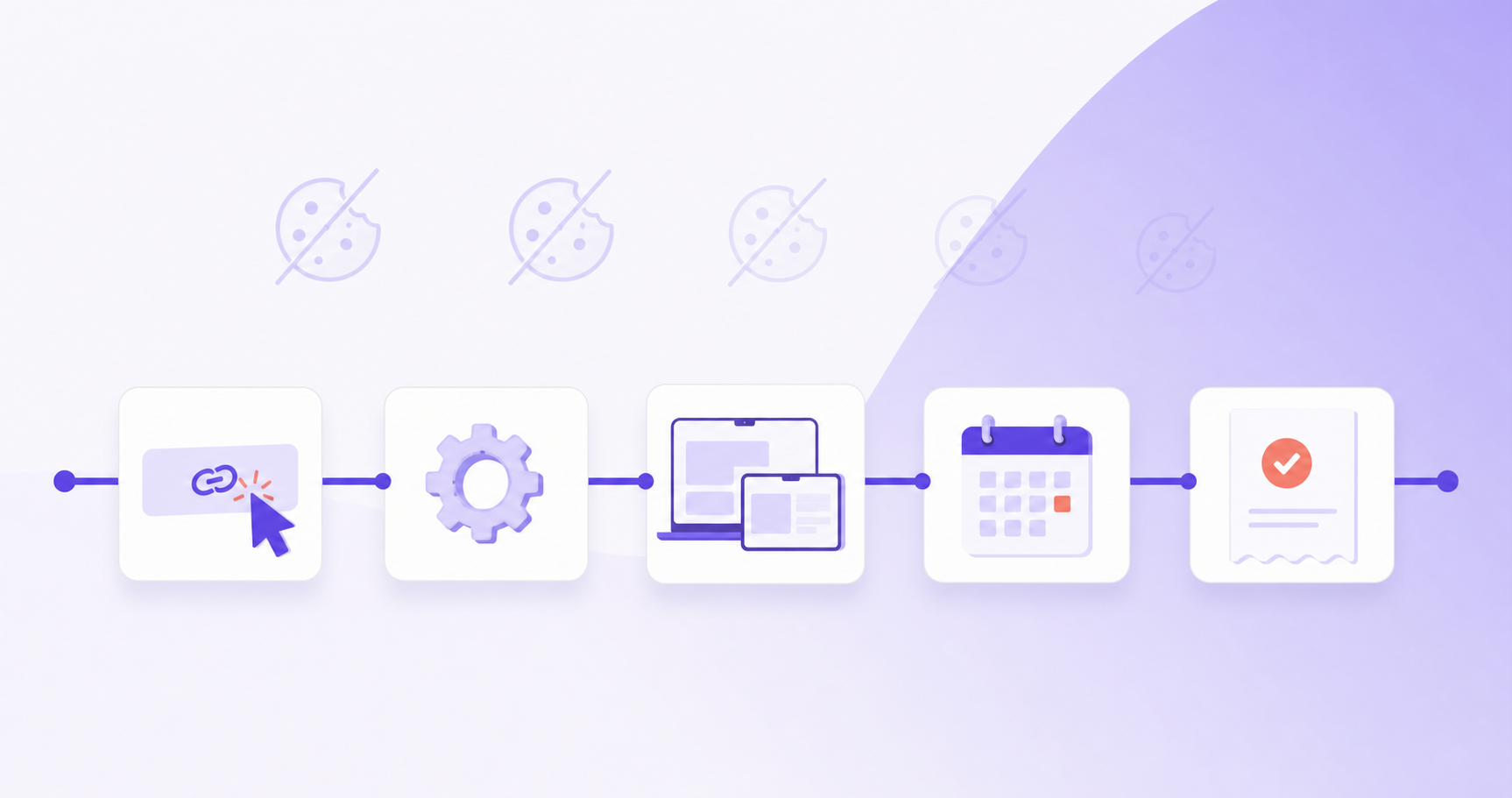
Cookie-based attribution breaks across developer evaluation cycles, and the chain usually snaps well before a deal closes. An engineer clicks a referral link on Monday, spins up a trial Friday, switches to their work laptop the following week and converts two months later after getting budget approval. Cookies expire, ad blockers strip them on first load and Safari's Intelligent Tracking Prevention (ITP) clears cross-site state within 24 hours of the referral click, so by the time a contract gets signed the browser has already lost the thread.
Server-side attribution gets around the problem by writing the referral code straight to the billing customer object the moment the link is clicked, rather than waiting for a cookie to survive until conversion. Weeks later, when the invoice actually gets paid, that code is sitting in the billing metadata ready to use. A device switch or a long evaluation window has no effect, since nothing about the attribution depends on what the browser remembers.
Two other wrinkles show up specifically for developer tools:
- The person clicking the referral link is often not the person who signs the contract. An individual contributor refers a colleague, but procurement completes the purchase weeks or months later.
- Teams frequently sign up under an organization account, which makes user-level attribution thin. What's needed is org-level attribution tied to a company identifier instead of merely a user ID.
Inside a well-built in-product referral loop, reward triggers should fire on confirmed revenue events rather than activity proxies. An invoice.paid event confirms payment, while a signup event only confirms account creation. For freemium tools with meaningful trial-to-paid drop-off, rewarding on signup means paying out for users who never convert at all.
Surfacing your referral program inside the product
When a referral program underperforms, placement is the most common cause. A generous incentive tucked into a settings dropdown still won't generate shares if nobody finds it.
Where the launcher sits is a first-order activation decision, not an afterthought. Navigation menus, dashboard headers and post-action confirmation screens beat settings pages by a wide margin. A widget hidden inside a dropdown or a secondary settings menu produces critically low engagement no matter how strong the reward is.
Static placement alone rarely does the job. Combine it with event-triggered referral prompts timed to moments when sharing intent peaks, such as after a successful deploy, after a project milestone or after a user crosses a usage threshold.
Two practical rules apply for developer tools:
- Put the referral entry point inside the authenticated product session, not on a marketing page
- Trigger prompts once a user has enough product experience to recommend it authentically, not at first login
If your activation rate (active referrers divided by enrolled referrers) is low, audit placement before touching rewards or messaging. Cello supports behavioral milestone triggers and multiple launcher placements, so teams can test these variables without rebuilding the widget each time.
Promoting referrals beyond the in-app widget
Users who don't log in daily still need a path to share, and the in-app widget alone won't reach them. A lifecycle email triggered after a meaningful product event closes that gap: the referral link sits inside the message, and because attribution happens server-side, tracking holds even though the click happens outside the authenticated session.
Developer tools also carry distribution surfaces most SaaS companies don't have. Documentation pages, changelog announcements, CLI output and API response footers are places where engaged users already spend time. A referral mention placed in a "what's next" docs section, similar to turning new users into active referrers through onboarding moments, reaches the users reading closely enough to act on it.
Community channels behave differently again. Discord servers, Slack communities and GitHub Discussions are where developers already pass tools along to each other. Give active community members their own referral link and let sharing happen when a recommendation comes up on its own, rather than pushing a campaign into the channel.
For episodic users, timing beats placement. Outreach lands better after a completed integration, a billing renewal or a feature adoption event than on a fixed schedule. A referral ask tied to one of those moments converts better than a generic campaign sent on a calendar cadence.
Handling freemium-to-paid conversion in your reward logic
Paying a reward on signup is the most common unit economics mistake inside word-of-mouth growth for freemium SaaS referral programs. Picture a 15% trial-to-paid conversion rate. A flat $50 payout on every signup turns into $333 of reward spend for each paying customer that shows up, before you even layer in other acquisition costs. Point reward triggers at invoice.paid billing events instead of new-signup events.
Getting there is simple with a billing-event-driven attribution setup. Drop the signup event from your reward logic and wait for the first confirmed payment instead. Referrers end up waiting longer for their payout, so spell out that timeline up front. A line like "You'll earn $X once your referral upgrades to a paid plan" keeps expectations clear.
Referee rewards call for their own math. A discount or a free month gives trial users a reason to convert. Offering "first month free on any paid plan" gives up one month of revenue in exchange for removing the price barrier that holds back conversion. As an illustrative example, if that extra free month pushes conversion up by five percentage points, the reward covers its own cost across most pricing tiers.
A basic model looks like this:
- Referrer reward: $X paid on
invoice.paidconfirmation - Referee incentive: one free month on first paid subscription
- Total reward cost per converted customer: referrer payout plus the foregone month of revenue
- Acceptable range: stay under 20% of expected first-year contract value
Spreading the reward out adds another layer of protection. Paying it across the referred customer's first three billing cycles means a customer who cancels after month one costs you far less in reward liability than a single upfront payout would have.
Fraud prevention basics for developer tool referral programs
Developer audiences produce a fraud pattern most other SaaS verticals don't see at the same scale. An engineer who can spin up throwaway accounts, generate disposable email accounts and trigger webhooks on demand has every skill needed to game a referral program, so the controls you put in place need to account for that baseline technical ability. A set of guardrails, the kind built into dedicated fraud detection referral software, keeps program economics intact while leaving legitimate referrers alone.
Start with self-referral blocking, which is the baseline check any program needs. The developer-specific twist shows up as account duplication, where someone spins up a second workspace under a different email just to collect both sides of a two-sided reward.
Rewarding on invoice.paid rather than on signup cuts out most disposable email abuse on its own, because farming a reward this way still means attaching a working payment method.
Three more controls worth setting up before launch:
- A 30-day payout delay after conversion builds in time to spot chargebacks and rapid cancellations before any reward clears
- A retention-period gate, where the reward only fires once the referred customer has kept an active subscription for a set stretch of time, guards against churn-and-collect behavior
- Risk-factor monitoring for unusual usage patterns flags edge cases for a manual look instead of auto-rejecting conversions that turn out to be legitimate
When two people refer the same prospect, write into your program terms that the first referrer gets credit. Developer communities are small and connected enough that duplicate referrals happen often, and skipping this rule just invites disputes later.
Metrics that tell you whether your program is working
Four numbers tell you most of what you need to know about a referral program.
- Active rate (active referrers divided by enrolled referrers): shows whether people who joined the program are doing anything with it. When this number is low, look at placement before touching the reward.
- Sharing rate (sharing referrers divided by active referrers): shows whether people who opened the widget actually sent a link. A weak sharing rate often traces back to a reward that doesn't feel worth the effort or a pitch that's hard to understand.
- Signup rate (new signups divided by unique link views): shows how well the page someone lands on after clicking a referral link does its job. Plenty of views paired with few signups points to a landing page or offer that isn't persuading anyone.
- Unique views per share: shows how much reach a single shared link gets. A weak number usually means referrers are posting links where few people will ever see them.
Check these in order, starting with active rate, then sharing rate, then signup rate. Tuning the bottom of the funnel before the top is fixed wastes effort.
Two program-level figures round out the picture: referral ARR as a share of total new ARR, and referral CAC measured against paid acquisition cost. Referred customers tend to convert at higher rates and stick around longer than customers brought in through paid channels. A landmark Journal of Marketing study tracked roughly 10,000 bank customers and found this pattern directly. Referred customers showed at least 16% higher lifetime value. They also churned less than matched customers who hadn't been referred. Even when CAC lands about the same across channels, the lifetime economics usually favor referrals.
Review these numbers every month. Referral programs react fast to changes in placement and rewards, so a monthly check catches a dip in active rate before it drags down an entire quarter.
How Cello supports developer tools companies running referral programs
Cello builds the referral surface directly into the authenticated product session, right where developer tools users already work. There is no external portal redirect and no separate login. The widget triggers at the high-intent moments your team sets up, such as after a successful deploy, a usage milestone or a completed integration.
Server-side attribution covers the long evaluation cycle. The referral code gets written to the billing customer object the moment someone clicks the link, so a conversion six weeks later on a different device still ties back correctly. invoice.paid events replace signups as the reward condition, which keeps program economics intact across freemium-to-paid funnels.
For usage-based tools, Cello supports credit-based reward structures so payouts come in the currency your users already care about. Teams that prefer cash can pay out through PayPal, with compliant SaaS referral payouts covering the tax and compliance side.
Two customer results show what this looks like outside of theory. VEED reduced CAC by 90.4% after moving to an in-product referral program, and Hera went live in 2 days.
For AI-native engineering teams, Cello also offers its referral infrastructure through a Model Context Protocol (MCP) Server at https://mcp.cello.so/mcp. Engineers can wire it up, debug it and run health checks straight from Cursor, Claude Code or VS Code Copilot without leaving their editor.
Final thoughts on referral program strategy for developer tools SaaS
Peer trust drives acquisition here, and a referral program is simply the infrastructure that turns it into something you can measure and repeat. If organic sharing already shows up in your Discord or in signup source fields, that is enough signal to build on. Tie rewards to invoice events, place the widget where your users already spend their time in the product, and check your active rate before adjusting anything else. Create a free Cello account to get the attribution and reward logic running without the engineering lift.
What reward structure works best for a developer tools SaaS: cash payouts or in-product credits?
In-product credits, API quota extensions and feature unlocks typically outperform cash for developer audiences because they extend the product experience the referrer already values, without the PayPal account, payout flow and tax-form friction that cash requires. A working sizing heuristic: keep total reward cost below 20% of first-year customer value, so a $600 annual contract supports roughly a $120 reward budget. If you want to validate which structure performs better before committing, run parallel campaigns targeting segmented user cohorts with distinct reward configurations and compare sharing rates and conversion rates across variants.
How does referral attribution survive a developer's evaluation cycle across device switches, cookie blockers and months between click and conversion?
Server-side attribution solves this by writing the referral code to the billing customer object at the moment of the link click, not at signup or purchase. When the conversion event fires weeks or months later on a different device, the code is already present in billing metadata, so Safari's Intelligent Tracking Prevention, ad blockers and device switches cannot break the chain. For developer tools in particular, org-level attribution via a company identifier handles the common scenario where the engineer who clicked the referral link is not the person who signs the contract.
Why is our referral program active rate low, and what should I audit first?
Low active rate is almost always a placement problem before it is an incentive problem. Audit launcher visibility first: navigation menus, dashboard headers and post-action confirmation screens consistently outperform settings dropdowns. When teams move a buried widget to a dashboard header or post-action confirmation screen, active rate typically recovers within the first billing cycle, with no change to the reward structure required. If placement is correct, add event-triggered prompts at high-intent moments: after a successful deploy, a usage milestone or a completed integration. Do not rely on passive discovery alone.
How do referral programs work for B2B developer tools with long sales cycles and multiple decision-makers?
Referral programs do work in long-cycle B2B developer tools, but two configuration decisions determine whether they hold up. First, tie reward triggers to `invoice.paid` billing events, not signups. Paying out on account creation in a funnel with meaningful trial-to-paid drop-off creates negative-margin economics. Second, use org-level attribution tied to a company identifier so the attribution holds when procurement completes the purchase months after the original referral click from an individual contributor.
How can I drive referral program participation outside the in-app widget for developer tools users who don't log in daily?
Embed referral links in lifecycle emails triggered after meaningful product events such as a completed integration, a billing renewal, or a feature adoption milestone, since server-side attribution keeps tracking intact outside the authenticated session. Developer tools also have distribution surfaces most SaaS products don't: documentation pages, changelog announcements, CLI output and API response footers reach the engaged users most likely to refer. For community-active products, giving members their referral link in Discord, Slack or GitHub Discussions at the moment a recommendation comes up naturally converts better than any fixed-schedule campaign.
Should we build our developer tools referral program around the self-serve sign-up flow or the sales-led demo request flow?
Build the program around whichever flow actually produces your paying customers, and many developer tools companies need both running in parallel with distinct reward triggers. For self-serve signups, tie the reward to a Chargebee or Stripe `invoice.paid` event; for sales-led deals, tie it to a HubSpot or Salesforce closed-won stage transition so referrers in longer-cycle accounts aren't left waiting on a billing event that never fires on its own.
Can referral reward triggers fire on non-subscription events like wallet top-ups or onboarding completion instead of standard billing events?
Yes, reward triggers can be configured around conversion events beyond standard subscription billing, including first-charge events, demo-call-attended milestones and custom usage thresholds rather than only `invoice.paid`. Multiple trigger points can run within a single program, which matters for developer tools with usage-based or credit-based pricing where a monthly subscription invoice isn't the real signal of value delivered.
How does a referral program work for a white-label or API-first developer tool where end users never see our dashboard?
The referral surface still needs an authenticated session to attach to, so API-first and white-label products typically surface referrals through a developer portal, CLI output, or the dashboard of the party who does log in, rather than inside an end-user-facing UI that doesn't exist. If no customer-facing login surface exists anywhere in your stack, a standalone partner portal that requires no SDK embed is usually the more realistic launch path.
Can I launch a referral program through a standalone partner portal before doing any in-app SDK integration?
Yes, a standalone partner portal that requires no SDK integration can serve as a complete first-phase launch, collecting referral activity, managing partner enrollment and processing payouts immediately. Referral activity and partner data captured during this phase carry over when you later add the in-app widget, so there's no rework required when you're ready for full product integration.