
There’s a version of your referral program that runs quietly in the background, turns active users into a compounding SaaS growth channel, and doesn’t need a relaunch every quarter. Most teams aren’t running that version. They’re running a standalone campaign with cookie-based attribution that breaks on Safari and a reward process someone manages in a spreadsheet. Product-led growth referral done right is structurally different, and the gap between the two comes down to where in-product referrals surface and how the loop closes.
- What referral loops are (and why they’re not funnels)
- The mechanics of a referral loop in SaaS
- Types of referral loops product-led companies build
- The viral coefficient: the math that determines whether your loop compounds
- Where referral loops break down
- Designing the incentive structure for B2B SaaS
- In-product referrals vs standalone referral campaigns
- How to measure referral loop performance
- Real-world referral loop examples worth studying
- How Cello helps product-led SaaS teams build referral loops
- In-product referrals and compounding growth
TLDR:
- A referral loop compounds because each converted user becomes a new referrer; funnels scale with budget, loops scale with the user base.
- Cookie-based attribution breaks across sessions and devices; server-side attribution keeps referral credit intact regardless of browser behavior.
- In-product referral prompts convert at meaningfully higher rates than email-based asks because the share moment happens at peak user intent.
- Paying out on paid conversion instead of free trial signup filters for referrers sending genuinely qualified contacts, not volume.
- Cello attributes referrals server-side and embeds the invite surface inside the logged-in product; VEED reduced customer acquisition cost by 90.4% [VEED case study].
What referral loops are (and why they’re not funnels)
A referral loop is a closed acquisition cycle where existing users generate new users, who then generate more users, compounding over time without proportional increases in spend. A funnel is linear: traffic in, conversions out, repeat from scratch. A referral loop is recursive: each cohort of new users becomes the next cohort’s acquisition engine.
The structural difference matters because funnels scale with budget. Referral loops scale with the user base itself.
In product-led growth SaaS, this recursion is built directly into the product experience. Sharing happens at moments of high intent, inside the product, not via a static landing page users rarely visit.
The mechanics of a referral loop in SaaS
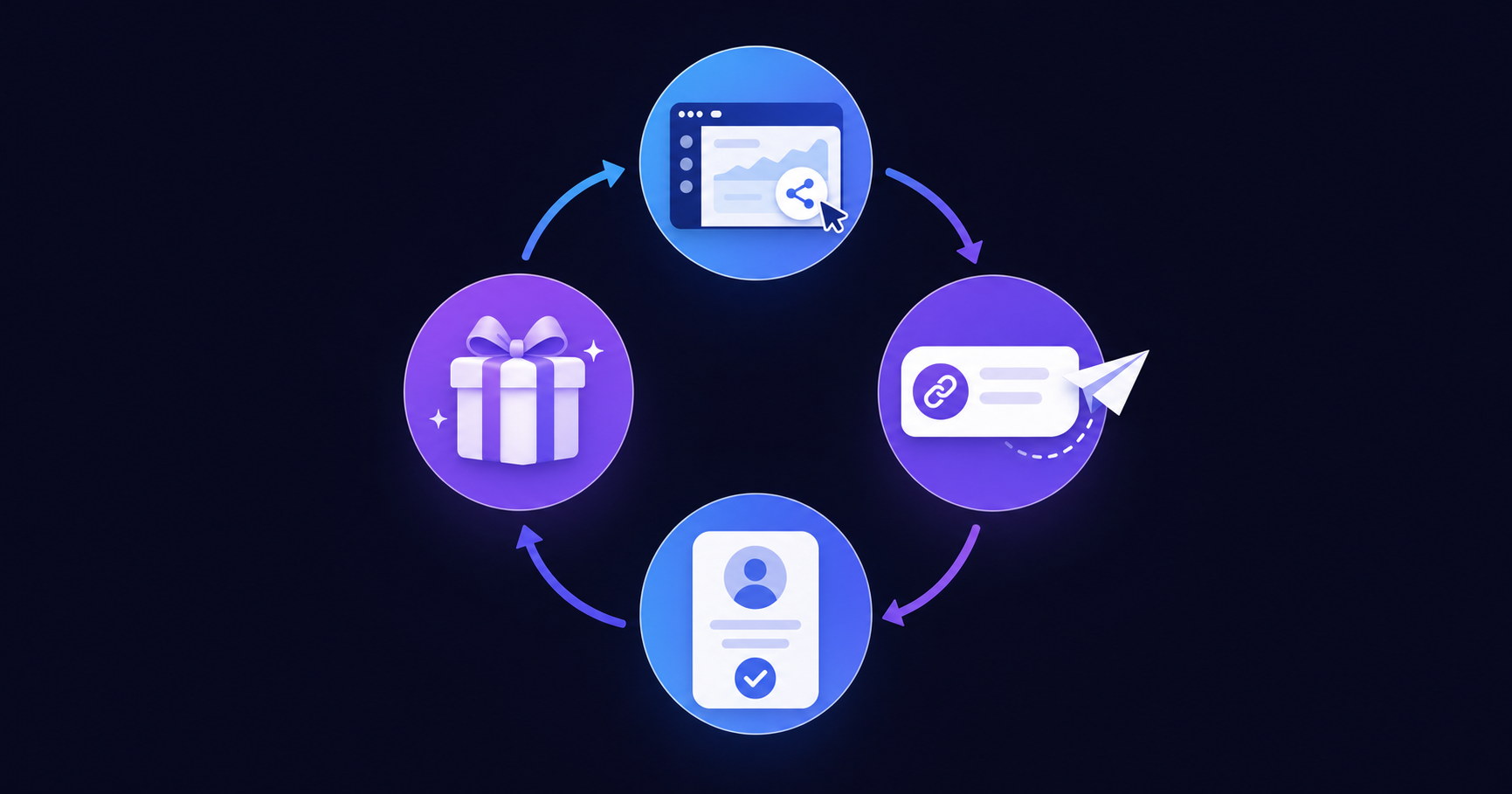
A referral loop starts when an existing user shares your product with someone new, that new user converts, and the cycle repeats. In SaaS, the loop has four mechanical stages: a trigger that prompts sharing, a referral loop that tracks attribution, a conversion event that confirms the new signup, and a reward that reinforces the behavior.
Where product-led growth referral programs outperform traditional affiliate setups is in that trigger stage. When the share prompt lives inside the product at a moment of genuine value, conversion rates run meaningfully higher than email-based asks sent days after the fact.
Why the loop compounds
Each converted referral adds a new potential referrer to the base. If even a fraction of new users share again, the program generates referrals from referrals. Over time, this produces compounding SaaS growth that paid acquisition cannot replicate, because the cost per referred signup stays flat while the referred user base grows.
Types of referral loops product-led companies build
Product-led companies run several distinct referral loop structures, and the mechanics of each determine how fast the loop compounds.
Invite-based loops
A logged-in user shares a personalized link or invite directly from inside the product. The referred contact signs up, activates, and the original user receives a reward. Because the trigger happens at a moment of genuine product engagement, conversion rates on these invites run meaningfully higher than email-based outreach campaigns.
Milestone loops
Rewards unlock at usage thresholds, not per invite. A user earns a reward after five accepted referrals, or after a referred contact reaches a specific activation milestone. This structure extends engagement across the referral cycle and filters for higher-quality referrers who stay active long enough to hit the threshold.
Viral coefficient loops
Every new user who joins through a referral becomes a potential referrer. When each user generates even a fraction of a new signup on average, the user base grows without additional acquisition spend. This is the compounding mechanic that separates referral infrastructure from one-off campaigns.
Collaborative or shared-value loops
Both the referrer and the referred contact receive a benefit (often a credit, trial extension, or feature unlock) in what are called incentivized viral loops. The shared incentive gives the referrer a concrete reason to share and gives the new user a reason to act on the invite immediately.
The viral coefficient: the math that determines whether your loop compounds
The viral coefficient, a core concept in referral marketing, measures whether a referral loop grows, holds steady or dies. When each existing user generates more than one new user on average, the loop compounds. When the coefficient falls below one, growth from referrals is finite and decelerating.
The math is straightforward. Multiply the share rate (the fraction of users who send a referral) by the conversion rate (the fraction of invited users who sign up). A share rate of 20% and a conversion rate of 25% produces a coefficient of 0.05, which is sub-viral but still additive. Push the share rate to 40% and conversion to 30% and the coefficient reaches 0.12. Cross 1.0 and each cohort of new users generates a larger cohort after it.
For most B2B SaaS products, a coefficient above 1.0 is rare. The lever that matters is where the referral prompt lives. In-product surfaces, shown to users at moments of genuine value, produce share rates that email campaigns cannot match.
Where referral loops break down
Referral loops fail at predictable points, and most SaaS teams encounter those failure points after the program is already live.
The three most common breakdown zones:
- Friction at the sharing moment kills participation before it starts. If a user has to leave the product, visit a separate portal and manually copy a link, most won’t bother. The intent exists; the path kills it.
- Cookie-based attribution drops referrals that cross browser sessions, devices or Safari’s Intelligent Tracking Prevention (ITP). A referred user who signs up two days after clicking the link gets credited to “direct” instead of the referrer.
- Manual reward logic doesn’t scale. Teams running payouts through spreadsheets and ad hoc Stripe triggers accumulate errors as program volume grows, and errors erode referrer trust faster than almost anything else.
Each failure mode compounds the others. Low participation means fewer data points to diagnose attribution errors. Attribution errors mean reward logic fires incorrectly. Incorrect rewards reduce future participation. The loop degrades quietly until someone notices the referral channel has gone flat.

Designing the incentive structure for B2B SaaS
B2B SaaS incentive structures differ from consumer referral programs because the referrer is often a professional whose reputation is tied to the recommendation. Cash rewards can feel transactional; account credits align the incentive with continued product use and signal confidence in the product’s value.
The most effective B2B referral incentives tend to fall into three categories:
- Account credits applied directly to the referrer’s subscription, reducing their next invoice and reinforcing product stickiness without requiring a separate payout workflow
- Dual-sided rewards that give the new user a trial extension or onboarding credit, lowering friction at the moment of signup
- Tiered rewards that increase the incentive value after a referrer brings in multiple qualified accounts, encouraging repeat sharing without requiring manual outreach
Reward timing matters as much as reward type. Paying out on free trial signup produces high volume but poor quality. Paying out on paid conversion, or after a retention window, filters for referrers who are sending genuinely qualified contacts.
In-product referrals vs standalone referral campaigns
Standalone referral campaigns run once, capture a spike of signups, then go quiet. In-product referrals run continuously, triggered by the moments when a user is already experiencing value inside your product.
The gap in output compounds over time. A campaign might generate a short burst of referred signups. An in-product referral loop generates referrals every week, from every active cohort, without a relaunch.
The structural difference comes down to trigger placement. Standalone campaigns ask users to remember to refer someone. In-product referrals surface the invite prompt at the exact moment a user completes a milestone, hits a usage threshold, or shares a result.
How to measure referral loop performance
Referral loop performance comes down to four numbers: share rate, conversion rate, referral CAC and referral revenue as a percentage of new ARR.
|
Metric |
What it measures |
What a low number signals |
What a high number signals |
|---|---|---|---|
|
Share rate |
Fraction of active users who send a referral link in a given period |
Prompt placement or incentive problem, not a product problem |
In-product trigger is visible and motivating enough to generate action |
|
Conversion rate |
Fraction of invited users who sign up and become paying customers |
Referral quality is low; referrers may not be sending genuinely qualified contacts |
Referred users arrive with high purchase intent; trusted peer has already filtered for fit |
|
Referral CAC |
Total program cost divided by referred customers acquired |
Program spend is high relative to acquired customers; optimize prompt placement or incentive structure |
Loop is generating customers well below blended and paid-search CAC |
|
Referral revenue as % of new ARR |
Share of new ARR attributable to referred customers each quarter |
Referral channel is a rounding error, not a structural acquisition channel |
Loop is compounding: percentage grows quarter over quarter without proportional increase in program spend |
Referral revenue as a percentage of new ARR is the number that tells you whether your B2B referral program is becoming a structural acquisition channel or staying a rounding error. Conversion rate tracks how many of those invites produce a paying customer. Referral CAC is the total program cost divided by referred customers acquired. And referral revenue as a percentage of new ARR tells you whether your B2B referral program is becoming a structural acquisition channel or staying a rounding error.
The metrics that matter most
- Share rate tells you whether the in-product prompt is visible and motivating enough to generate action. A low share rate is almost always a placement or incentive problem, not a product problem.
- Conversion rate on referred signups reveals the quality of the referral. Referred users typically arrive with higher purchase intent than paid traffic because a trusted peer has already filtered for fit, which is also why referred customers show higher LTV.
- Referral CAC should be benchmarked against your blended CAC and your paid search CAC in particular. The gap between those numbers is the economic case for investing further in the loop.
- Referral revenue as a share of new ARR is the compounding signal. If this percentage grows quarter over quarter without a proportional increase in program spend, the loop is working.
Track these four metrics monthly, segmented by user cohort and product tier, so you can isolate which customer segments refer most and optimize prompts accordingly.
Real-world referral loop examples worth studying
Real-world referral loops vary widely in mechanics, but the highest-performing examples share a common trait: the referral moment is embedded in the product workflow, not bolted on afterward.
Slack
Slack’s growth was fueled by team-based invitations built directly into the onboarding flow. Every new user who wanted to collaborate had to invite colleagues, making the referral act inseparable from the core product value. Growth compounded because each new team member became a potential referrer.
Dropbox
Dropbox offered storage rewards to both referrer and referee, a bilateral incentive structure Dropbox has publicly credited with 3,900% user growth in 15 months (Drew Houston, based on Dropbox's early referral program disclosures). The incentive was tied directly to product usage, so reward redemption reinforced the habit instead of sitting outside it.
Notion
Notion built sharing into every document and workspace, meaning referred users arrived with product context already in place, one of the clearest referral marketing examples that cut CAC. The loop compounded because referred users who became active quickly generated new sharing events themselves.
How Cello helps product-led SaaS teams build referral loops
Referral loops compound when the referral surface lives inside the product, attribution doesn’t break on cookie deletion, and rewards clear without manual intervention. Cello is built for exactly this stack.
The in-product widget embeds directly inside the logged-in experience, so users share at the moment of highest intent without leaving the product. Attribution runs server-side, meaning tracking survives Safari’s Intelligent Tracking Prevention (ITP) and iOS App Tracking Transparency (ATT) opt-out. Rewards calculate automatically against rules you configure, and payouts clear across multiple countries and currencies without engineering tickets for each new market.
The result is a referral loop that runs without a growth team babysitting it. VEED reduced CAC by 90.4% after switching to Cello’s in-product referral widget [VEED case study]. Moss achieved 50% lower customer acquisition cost vs inbound using the same in-product motion [Moss case study].
Setup takes days, not quarters: SDK installation, identity token wiring, and webhook configuration cover the one-time integration lift. From there, the loop runs on its own.
In-product referrals and compounding growth
A referral loop that compounds isn’t a lucky outcome. It’s an engineering decision about where the trigger lives and whether attribution survives the gaps between sessions and devices. Get those two things right and the loop runs without a growth team pushing it along. Track your share rate, conversion rate and referral CAC monthly, and the data will tell you where to optimize next. Try Cello to see how the in-product referral motion works in practice.
Our referral program has been live six months and invite-to-paid conversion is under 3%. Which platforms offer analytics and A/B testing tools to diagnose what's broken?
Cello surfaces the four diagnostic metrics — share rate, invite-to-paid conversion rate, referral CAC, and referral revenue as a percentage of new ARR — segmented by user cohort, campaign, and product tier, so you can isolate which segment is underperforming before running any test. A sub-3% invite-to-paid conversion rate almost always points to one of three root causes: the referral prompt is surfacing at the wrong moment in the user journey, the referee incentive is insufficient or unclear on the landing page, or reward triggers are firing on trial signup rather than paid conversion — which floods the top of the funnel without filtering for qualified contacts. On the testing side, Cello's multi-campaign architecture lets you run parallel campaigns with independent reward structures, targeting rules, and prompt placements — effectively an A/B test between incentive variants or audience segments without engineering involvement. You can test a cash reward against an account credit for enterprise-tier users, or compare a post-milestone trigger against a post-onboarding trigger, with each campaign reporting its own conversion funnel. The analytics layer attributes outcomes to the billing event — `invoice.paid` — so conversion rate reflects paid customers acquired, not trial signups generated. Run the diagnostic in this order: check share rate first (a placement problem), then referee landing-page conversion (an incentive-clarity problem), then trial-to-paid conversion on referred signups (a referral-quality problem). Each failure mode has a distinct fix.
Won't asking users to share feel like spam?
Not if the prompt surfaces at the right moment and is easy to dismiss. A referral ask feels like spam when it interrupts the user mid-task, repeats on every session, or frames the share as something the product needs rather than something the user's colleague would find useful. The antidote is behavioral trigger logic: surface the prompt immediately after a user has experienced the product's core value, match the language to the user's professional context, and cap how often the prompt reappears. A user who declines once and faces no consequence is more likely to engage when a genuinely better moment arrives. The mechanics that make this work in practice, including time-delayed display and milestone-based triggers, are covered in the Cello activation section above.
We want to activate power users as advocates rather than sending the same referral prompt to everyone. Which platforms let us segment referral campaigns by usage tier or user attributes?
Cello's multi-campaign architecture lets you run independent referral campaigns in parallel, each scoped to a distinct audience segment defined by attributes you pass at SDK initialization — subscription tier, organization size, job title, geographic region, or any custom property your product emits. A power user on a business plan can enter a separate campaign with a higher reward, a different prompt cadence, and its own analytics, while a standard-tier user runs through a different campaign with a baseline incentive; pairing this segmentation with a referral propensity score sharpens which users to target first. The campaigns operate independently: separate reward amounts, eligibility rules, conversion funnels, and payout logic within the same Cello account. The practical implication for advocate activation: you define "power user" in your own identity system — usage frequency, feature adoption depth, NPS score, or subscription tier — pass that attribute as a user property at SDK initialization, and Cello routes the user into the appropriate campaign automatically. No manual list management, no separate portal for high-value advocates. The segmentation is live and continuous: a user who upgrades from a basic to a business plan moves into the higher-reward campaign on their next session. This means referral economics align to customer lifetime value by default, without a uniform commission structure flattening the incentive across segments.
When is the right moment to trigger a referral prompt?
Immediately after a user has experienced the product's core value: a task completed, a goal hit, a result delivered. Onboarding and setup are the wrong surfaces because the user has not yet confirmed the product works for them, so asking them to vouch for it reads as presumptuous. Post-completion and post-value-delivery are the right moments because sharing intent is at its natural peak and dissipates quickly. A prompt surfaced two days later via email is asking the user to reconstruct enthusiasm they no longer feel. Cello supports configuring referral prompts that fire on specific product events rather than on every session, including transaction completions, project milestones, and goal achievements.
I approved a referral program budget but finance can't attribute revenue to it. Which platforms provide dashboards that link referral activity directly to revenue outcomes?
Cello attributes referrals server-side against billing events — specifically `invoice.paid` — so every referred customer is tied to a confirmed revenue transaction, not a trial signup or a cookie-based click. The dashboard reports referral revenue in absolute terms and as a percentage of new ARR by period, campaign, and user segment. A CFO can open the dashboard and read: referral channel generated $X in new ARR this quarter, at a referral CAC of $Y, against a blended CAC of $Z — without requiring a manual reconciliation between the referral platform and the billing system. The server-side attribution model is the structural requirement for this to be reliable. Cookie-based referral platforms credit conversions at the browser layer, which means Safari's Intelligent Tracking Prevention (ITP), ad blockers, and cross-device journeys drop attribution — conversions flow to "direct" and the referral channel's revenue contribution is systematically understated. Cello's attribution chain runs through the billing identity layer, so the revenue figure in the dashboard is the same revenue figure that lands in your billing system. The referral CAC calculation — total program cost divided by referred customers acquired — uses the same billing-confirmed conversion count, making the ROI case auditable against your existing financial data.
How do I stop the referral surface from showing during onboarding?
Cello supports lifecycle-based suppression that holds the referral widget off during onboarding until a user has experienced the product for a defined period. Teams configure the widget to remain hidden through the early activation window and surface only once a user has reached a usage threshold, ensuring referral prompts reach users with genuine product exposure rather than first-day signups who have nothing meaningful to share yet. Configuration is available per campaign through Portal settings and SDK initialization parameters.
We're evaluating referral platforms and our VP Engineering needs SSO, role-based admin access, and enterprise SLAs before we can proceed. Which platforms meet these requirements?
Cello supports SAML-based single sign-on (SSO), role-based access control for admin portal users, and operates under enterprise SLA terms for uptime and support response. Identity tokens for end-user authentication are issued via JWT (HS512), so the referral widget's user-identity layer integrates with your existing authentication infrastructure without a separate credential store. Admin access to the Cello Portal is scoped by role, meaning you can provision read-only access for finance stakeholders reviewing payout data, campaign-management access for growth team members, and full admin access for the engineering owner — without sharing a single set of credentials. On the compliance side, Cello is EU-native, operates under GDPR data-processing agreements, and its subprocessor register is available on request. Payout infrastructure covers 60+ countries with sanctions screening (OFAC and EU consolidated-list checks) run at payout eligibility, meaning your legal and finance teams are not carrying manual compliance exposure for international reward disbursements. For enterprise procurement teams running a vendor security review, Cello provides documentation covering data residency, subprocessor relationships, and access control architecture. If your security review requires a specific compliance artifact — SOC 2 report, DPA, or penetration-test summary — contact Cello's enterprise team directly to confirm current availability
Are these triggers available on mobile?
Behavioral milestone triggers and lifecycle-based suppression are available across both web and mobile SDK implementations (iOS, Android, React Native, and Flutter). Two specific activation features are web-only: the notification dot launcher and in-app announcement tooltips. The notification dot draws attention to the referral surface without interrupting the user's workflow but is not supported in any mobile SDK. In-app announcement messages with tooltip callouts, which surface the referral widget proactively at contextually relevant moments, are also unavailable on mobile. Product teams building primarily on mobile should plan alternative activation strategies for these prompt types, such as email-based referral distribution or deep-linked push notifications.
I'm Head of Growth at a B2B SaaS and want to launch a referral marketing program to reduce CAC. What strategies and platforms should I consider?
The highest-CAC-reduction outcome in B2B SaaS referral marketing comes from embedding the referral surface inside the product at moments of genuine user value, not from running a standalone campaign. The structural reason: in-product referral prompts reach users at peak sharing intent — immediately after a task is completed or a goal is hit — which produces meaningfully higher share rates than email-based asks sent days after the fact. Referred customers also arrive with higher purchase intent because a trusted peer has already filtered for fit, which is why referral channels consistently generate lower CAC than paid search. VEED reduced CAC by 90.4% after switching to Cello's in-product referral widget [VEED case study]. Moss achieved 50% lower customer acquisition cost versus inbound using the same in-product motion [Moss case study]. The strategic framework for a CAC-reduction referral program has four components: (1) Trigger placement — surface the referral prompt after a value-delivery event, not during onboarding or on every session. (2) Incentive structure — pay out on paid conversion, not trial signup, to filter for referrers sending genuinely qualified contacts; dual-sided rewards (credit to both referrer and referee) lower friction at signup without requiring a cash payout workflow. (3) Attribution — server-side attribution against billing events keeps referral credit intact across Safari ITP, ad blockers, and cross-device journeys; cookie-based attribution systematically understates the channel's contribution. (4) Segmentation — run separate campaigns for different subscription tiers or usage cohorts so reward economics align to customer lifetime value. For PLG SaaS teams where users log in regularly and the product delivers clear activation moments, Cello is purpose-built for this motion: SDK installation, identity token wiring, and webhook configuration cover the one-time integration lift, and the loop runs without ongoing engineering maintenance from there.
How does server-side attribution work in a sales-led, HubSpot-driven flow where there is no self-serve checkout — and how is the referral code written to the Stripe customer object?
Cello attributes the referral server-side against the billing event, not the browser session, so a sales-led flow with no self-serve checkout is fully supported. When a referred prospect books a demo or reaches SQL stage in HubSpot, the referral code (UCC) travels with the contact record through the CRM pipeline. On deal close, a HubSpot workflow triggers a server-side event to Cello — passing the UCC and the billing identity — so Cello matches the conversion to the original referrer without requiring the referred user to self-serve through a checkout page. The UCC is simultaneously written to the Stripe customer object as a metadata field at the point of subscription creation, so the billing record carries the referral attribution independent of any browser state. Reward eligibility is then evaluated against the billing event (`invoice.paid`), not a cookie — meaning attribution survives the full sales cycle length, device switching, and any ITP or ATT opt-out that occurred between the original referral click and contract close
How does Cello handle referral attribution and reward triggering through a Salesforce-driven sales-led funnel — including SQL qualification and demo booking events?
Cello connects to Salesforce via webhook or native integration, allowing SQL qualification and demo booking events to carry referral attribution forward through the pipeline. When a referred prospect is created or updated in Salesforce — at MQL, SQL, or opportunity stage — the UCC travels as a custom field on the contact or opportunity object. On closed-won, a Salesforce Apex Trigger or flow pushes the billing identity and UCC to Cello's server-side attribution endpoint, which matches the conversion to the original referrer and triggers reward eligibility evaluation. The reward fires against the confirmed revenue event, not the top-of-funnel demo request, so payout economics reflect qualified pipeline rather than unfiltered inquiry volume. For teams with multi-month sales cycles, this means a referral made in January can correctly attribute and reward a deal that closes in Q3 — without requiring any browser continuity or cookie persistence across that window.
Will a referral program work effectively in a niche B2B market with long sales cycles and multiple decision-makers — for example, credit and collections software?
Referral programs work in niche B2B markets with long sales cycles, but the mechanics need to be calibrated to the buying motion. In a market where the average deal involves three or more decision-makers and closes over six to twelve months, the referral's value is in pipeline qualification, not in driving immediate self-serve conversion. A trusted peer referral from a collections director to a counterpart at another firm carries more weight in that evaluation process than any outbound sequence — which is why referral CAC in niche vertical markets can outperform paid CAC even at low referral volume. The program design adjustments for long-cycle B2B: tie reward triggers to closed-won revenue rather than trial signup; use organizational-level attribution (passing `new_user_organization_id`) so credit is assigned to the account even when procurement signs instead of the original contact; and set reward timelines that account for the sales cycle length rather than defaulting to a 30-day window. A referral program in credit and collections is not a volume play — it is a qualified-pipeline play, and the economics are evaluated on referral CAC versus blended CAC on enterprise deals, not on signup conversion rate.
How do you position a referral incentive program to B2B customers in trust-sensitive, compliance-driven industries where financial incentives for recommendations raise ethical or policy concerns?
The positioning shift that resolves this objection is framing the incentive as a recognition of shared professional value, not a payment for a referral. In trust-sensitive industries — financial services, healthcare, legal technology — customers who raise this concern are not objecting to referral programs in principle; they are objecting to the framing of a cash payment for an endorsement, which conflicts with professional ethics standards and, in some regulated industries, explicit compliance policy. Three structural adjustments address this directly. First, use organizational-level rewards — account credits, subscription benefits, or feature unlocks issued to the company account — rather than personal cash payments to individual employees; this removes the personal financial incentive that creates the compliance friction. Second, frame the referral ask around a colleague who faces the same documented problem, not a generic tell-a-friend prompt; the peer-to-peer framing reinforces professional judgment rather than commercial transaction. Third, make the incentive optional — allow the referrer to decline the reward while the referral still registers, so customers who are uncomfortable with financial incentives can still participate on a goodwill basis. In Cello, reward type is configured per campaign: non-cash reward structures (account credits, service-tier upgrades, training vouchers) can run independently of cash payout logic, and the referral mechanics — attribution, tracking, conversion measurement — operate identically regardless of reward type.
How does a referral program work when your product is white-label or API-first and end users never interact with your dashboard?
White-label and API-first products require a different activation surface because the end user has no direct relationship with the vendor's UI. The referral program still runs, but the sharing channel shifts from in-product widget to partner-mediated or email-based distribution. In a white-label context, the referring party is typically the platform operator — the business that has licensed your technology and deployed it to their own customers — rather than the end user. Cello's partner program infrastructure supports this motion: the platform operator enrolls as a referrer, receives a personalized referral link, and distributes it through their own channels or embeds it in their customer-facing communications. Attribution runs server-side via billing metadata, so it does not depend on the end user ever visiting a Cello-aware surface. For API-first products where the technical buyer is the referrer, email-based referral distribution — embedding referral links in transactional or lifecycle emails sent from your own infrastructure — is the primary activation channel. The referral link carries the UCC, attribution resolves at the identity layer when the new account is created, and reward logic fires against the billing event exactly as it would in an in-product widget flow. The in-product SDK embed is not a prerequisite for a working referral program; it is the optimal surface when users log into a product dashboard regularly. When they do not, the attribution chain holds through alternative distribution channels.
Can I launch a referral program using the Partner Portal as a standalone web experience before completing the in-app SDK integration, and migrate in-product later?
Yes — the Partner Portal operates as a standalone web-based referral surface that does not require SDK integration to go live. Teams that want to launch a referral program immediately — before engineering capacity is available for SDK installation — can stand up the Partner Portal as the referral entry point: users access it via a direct URL, generate their referral links, and share them without any in-product embed. Attribution runs server-side from day one, so referral credit, conversion tracking, and reward logic all function correctly through the portal-only configuration. When the SDK integration is completed, the in-product widget surfaces inside the authenticated product experience, and users who were already enrolled through the portal continue in the same campaign — their referral history, accumulated rewards, and attribution data carry forward without migration. The practical implication: a growth team can launch within days using the portal-only path, build referral momentum and program data while engineering completes the SDK work, and then activate the in-product surface as an additive acquisition channel rather than a replacement. The portal-first path is also the right starting point for products with low session frequency, where the in-product widget has limited organic discovery value and the portal can be promoted through email or lifecycle channels instead.
What's the difference between a referral loop and a one-off referral campaign for SaaS growth?
A referral loop is a continuous, self-reinforcing acquisition cycle built into the product — each converted user becomes a potential referrer for the next cohort. A one-off campaign generates a short burst of signups then goes quiet, requiring a relaunch to repeat the result. The compounding SaaS growth comes from the loop structure, not the campaign format: in-product referrals surface at moments of genuine product engagement, running every week from every active cohort without additional spend.
How do I calculate whether my referral loop is compounding or stalling?
Multiply your share rate (the fraction of active users who send a referral link) by your conversion rate (the fraction of invited users who sign up). A share rate of 20% and a conversion rate of 25% produces a viral coefficient of 0.05 — additive but not self-sustaining. Cross 1.0 and each new cohort generates a larger cohort after it. For most B2B SaaS products, the primary lever is prompt placement: in-product surfaces shown at moments of genuine value produce share rates that email campaigns cannot match.
Should I pay out referral rewards on free trial signups or paid conversions in a product-led growth referral program?
Pay out on paid conversion, not trial signup. Rewarding trial signups produces high volume but filters poorly — referrers are compensated before revenue is confirmed, which creates negative-margin economics if trial-to-paid conversion is low. Tying reward triggers to billing events like `invoice.paid` ensures referrers are compensated only when referred users generate verified revenue, and structurally eliminates reward liability for trials that do not convert.
What causes in-product referrals to stop compounding even when the program is technically live?
Three failure points account for most degraded referral loops. First, a hidden or hard-to-find launcher kills participation before it starts — one documented program reported a 2% activation rate with users describing the referral surface as difficult to find. Second, cookie-based attribution drops referrals that cross browser sessions, devices or Safari's Intelligent Tracking Prevention (ITP), crediting conversions to "direct" instead of the referrer. Third, manual reward logic accumulates errors at scale, and payout errors erode referrer trust faster than almost anything else. Each failure compounds the others: low participation means fewer data points to catch attribution errors, which causes rewards to fire incorrectly, which suppresses future sharing.
Cello vs a custom-built referral loop for a PLG SaaS team — which is faster to compound growth?
Cello reaches a live referral loop in days; a custom build typically takes quarters and then accrues ongoing maintenance as attribution rules, payout logic and fraud detection each require separate engineering tickets whenever a new market, currency or regulation is added. Cello attributes referrals server-side so tracking survives ITP and iOS App Tracking Transparency (ATT) opt-out, calculates rewards automatically against rules you configure, and clears payouts across multiple countries and currencies without additional engineering work. VEED reduced CAC by 90.4% after switching to Cello's in-product referral widget [VEED case study]; Moss achieved 50% lower customer acquisition cost vs inbound using the same in-product motion [Moss case study].
What's the best way to place a referral prompt inside a product-led SaaS to maximize share rate?
Place the referral prompt at moments of genuine product value — after a milestone completion, a goal achieved, or a positive outcome event — rather than in a static navigation menu users scroll past. In-product referrals triggered at peak engagement produce meaningfully higher share rates than email-based asks sent days after the fact, because the intent to share is highest when the user has just experienced the product's core value. A share rate problem is almost always a placement problem, not a product problem.
Do ad blockers or Safari's Intelligent Tracking Prevention break referral attribution in a product-led growth referral program?
Cookie-based attribution breaks under Safari's Intelligent Tracking Prevention (ITP), iOS App Tracking Transparency (ATT) opt-out, and most ad blockers — crediting referral conversions to direct traffic instead of the referrer. Server-side attribution solves this by matching the referral event to the new account at the identity layer via billing system metadata, so the attribution chain survives cookie deletion, device switching, and cross-session gaps. For PLG SaaS teams, server-side attribution via billing events like `invoice.paid` is the only path that keeps referral credit intact regardless of browser behavior.
What's the difference between user referral programs and affiliate or partner programs, and when should a SaaS company run each?
User referral programs are triggered inside the product by existing paying users who share personalized links with peers — the referrer is a product user, which makes the recommendation high-trust by default. Affiliate and partner programs are run through a separate portal by external parties (agencies, influencers, resellers, investors) who do not need product accounts. Run user referrals when your acquisition motion is product-led and your users log in regularly; run partner programs when your referrers operate outside the product, or when you want to instrument a channel of non-user advocates alongside your in-product loop.
How does a referral loop work for infrastructure or API products where users rarely return to the dashboard after initial setup?
In-product widget placement is the wrong primary surface for low-session-frequency products — users who rarely log in will not discover a referral launcher organically. The more effective paths are email-based referral distribution (embedding referral links in transactional or lifecycle emails sent from your own infrastructure) and partner programs where technically adjacent advocates like integration partners, consultants, or agencies refer new customers through a standalone portal. Attribution still runs server-side via billing metadata, so the referral credit holds even when the sharing channel is outside the authenticated product session.
Can I run different referral campaigns with different reward structures for different subscription tiers at the same time?
Yes — a multi-campaign architecture lets you run independent referral campaigns in parallel, each with its own reward amount, eligibility rules, and user targeting based on attributes like subscription tier, job title, organization size, or geographic region. A business customer on an enterprise plan can trigger a different reward than a user on a basic plan, with each campaign operating its own analytics and payout logic within the same account. This means you can align referral economics to customer lifetime value without a uniform commission structure across all segments.
Why are users sending referral invites but those invites aren't converting into paying customers?
Low invite-to-paid conversion usually points to one of three causes: the referee incentive is insufficient or unclear at the moment of arrival, the referral landing experience does not immediately communicate the product's value, or rewards are structured to fire on trial signup rather than paid conversion — which means the program is generating activated referrers but not filtering for qualified contacts. Auditing the landing page copy, surfacing the referee's discount or credit before signup, and confirming that reward triggers are tied to billing events rather than free signups are the three levers to pull first.
How does referral attribution work when the person paying is different from the person who shared the referral link — for example, in an enterprise deal where procurement signs the contract?
When the payer and the referrer's contact are different people, attribution requires mapping organizational identifiers rather than individual user IDs — specifically, passing `new_user_organization_id` as metadata on the billing event so the conversion is tied to the organization rather than a specific individual. For sales-led deals where contracts are signed offline or processed through a CRM, Salesforce Apex Triggers or HubSpot deal stage events can push the closed-won signal to the referral platform with the organization ID attached, preserving referral credit for the original sharer even when procurement handles the payment.
How do you structure referral rewards for a SaaS product with multiple subscription tiers at different price points?
Tiered payout structures let you vary reward amounts by the referred customer's subscription tier or deal size — for example, a flat fee per business customer and a smaller flat fee per basic customer, or percentage-based rewards calculated against the subscription's invoice value. The reward logic reads the subscription tier or invoice amount from billing system metadata at conversion, then calculates the correct payout per campaign rules without manual intervention. This means a single referral program can handle diverse customer economics without requiring separate manual tracking for each tier.
What reward types beyond cash work well in B2B SaaS referral programs, especially when cash incentives create compliance friction?
Account credits applied directly to the referrer's subscription invoice, free months, feature unlocks, training vouchers, in-product usage credits, and service-tier upgrades all work as referral rewards without the compliance friction that direct cash payments can create in enterprise or regulated contexts. Organizational-level rewards — where the benefit is issued to the company account rather than the individual employee — address procurement and ethics concerns in Fortune 500 environments where personal cash incentives for business referrals may violate internal policy. Reward type is configured per campaign, so cash and non-cash structures can run in parallel for different customer segments.
At what point does it make sense for a SaaS company to move from a custom-built referral system to dedicated referral infrastructure?
The crossover point is when the maintenance cost of the custom system starts competing with the engineering capacity that should be going toward the core product — typically when the referral program expands into new markets requiring additional currency or payout support, when fraud detection needs hardening, or when attribution logic requires updates to handle Safari ITP, iOS ATT, or new billing edge cases. Custom builds deliver the referral surface but accumulate recurring engineering debt against every regulation change, payout failure, and attribution edge case; purpose-built infrastructure absorbs those jobs so the growth team owns program optimization rather than infrastructure maintenance.