

Conversion rate is the percentage of visitors who take a desired action, such as buying, signing up or booking a demo. It sets how much revenue each visit produces, so it is a core number for anyone running a website or a marketing campaign.
Understanding conversion rate (CR) matters for businesses of all sizes, because it directly affects their success, growth and profitability.
TLDR:
- Conversion rate measures the percentage of visitors who take a desired action, calculated by dividing conversions by total visitors and multiplying by 100.
- Benchmark your conversion rate against industry standards, since what counts as high in one sector may be below average in another.
- A/B testing, landing page optimization and personalization are the primary techniques for improving conversion rates across any funnel stage.
- AI search has compressed click volume: Pew Research found users clicked a link in 8% of visits with an AI summary present versus 15% without, so report raw conversions alongside the rate.
- tl;dv reached a 30.3% monthly freemium-to-paid conversion rate through its Cello referral program [tl;dv case study].
|
Key Element |
Description |
Tips for Optimization |
|---|---|---|
|
Defining Conversion Rate |
Percentage of visitors who take a desired action. |
Regularly analyze conversion paths and optimize for user behavior. |
|
Importance in Business |
Directly impacts success, growth, and profitability. |
Focus on continuous improvement and benchmark against industry standards. |
|
Calculating Conversion Rate |
Dividing conversions by total visitors and multiplying by 100. |
Check tracking accuracy and attributing conversions correctly. |
|
Strategies to Boost Conversion Rate |
Includes A/B testing, landing page optimization, and personalization. |
Implement targeted strategies and test extensively to identify what works best. |
|
Industry-Specific Conversion Rates |
Differ by industry, which means improvement goals need to be set per sector. |
Benchmark your rates against industry averages to set realistic improvement goals. |
Understanding the concept of conversion rate
The concept of conversion rate refers to the percentage of visitors or users who take the desired action, such as making a purchase, filling out a form, subscribing to a newsletter or downloading a resource.
By tracking and analyzing conversion rates, businesses can gain valuable insights into the effectiveness of their marketing efforts and make data-driven decisions to improve their results.
Conversion rate is a core metric for businesses that sell or recruit online. It provides a clear measure of how well a website or marketing campaign turns visitors into customers or leads. Understanding and optimizing conversion rates can have a measurable effect on a company’s revenue and growth.
For online businesses, conversion rates play a key role in determining the success of various marketing strategies. Whether it’s optimizing landing pages, improving website design or refining the checkout process, businesses rely on conversion rate data to make informed decisions and drive meaningful improvements.
Definition of conversion rate
The conversion rate is defined as the ratio of the number of conversions divided by the total number of visitors, expressed as a percentage. For example, if a website has 1,000 visitors and 100 of them make a purchase, the conversion rate would be 10%.
Conversion rates vary widely by industry, target audience and business goal. What counts as a high conversion rate in one industry may be below average in another, so benchmark your conversion rate against industry standards and competitors to understand your performance.
Conversion rates can also be calculated for different stages of the funnel. For instance, businesses may track the conversion rate of visitors who sign up for a free trial, the conversion rate of trial users who upgrade to a paid subscription or the conversion rate of email subscribers who make a purchase. This allows businesses to identify specific areas of improvement and adjust their strategies for each stage.
Importance of CR in business
Conversion rate is a key performance indicator (KPI) that directly affects a business’s bottom line. It determines the return on investment (ROI) of marketing campaigns and helps identify areas that need improvement or optimization. By tracking conversion rates, businesses can allocate resources more effectively and adjust their strategies to maximize customer acquisition and revenue.
Conversion rates also provide insights into the effectiveness of different marketing channels and campaigns. By analyzing conversion rates across various channels, such as organic search, paid advertising, social media or email marketing, businesses can identify which channels are driving the most valuable conversions and allocate their marketing budget accordingly.
Conversion rates also help businesses identify bottlenecks or barriers in the buying path. By analyzing the drop-off points in the conversion funnel, businesses can see where visitors abandon the process and optimize those stages. This could involve improving website usability, reducing friction in the checkout process or resolving concerns and objections that prevent conversions.
Components of conversion rate
Conversion rate is influenced by various factors within a website or marketing campaign. Two components that shape conversion rate most are visitor engagement and successful transactions.
Visitor engagement
Engaging visitors is necessary to keep them on a website and guide them towards conversion. Factors such as user-friendly navigation, intuitive interface design, relevant content and personalized experiences contribute to higher visitor engagement.
By providing a smooth and enjoyable user experience, businesses can increase the likelihood of conversions.
Successful transactions
In order to achieve a high conversion rate, businesses need to focus on optimizing their sales funnel and checkout process.
Simplifying the purchasing path, providing multiple payment options, offering secure transactions and using persuasive copy and visuals can all contribute to a higher number of successful transactions. Baymard Institute checkout research surveyed 1,083 US adults in 2026 and found that 18% abandoned an order because they had to create an account, 17% because checkout was too long or complicated and 9% because there were not enough payment methods. Guest checkout, fewer form fields and more payment methods remove each of these drop-off points directly.
Calculating CR
Calculating conversion rates involves a straightforward formula and considering various influencing factors.
Basic formula
The basic formula for calculating conversion rate is:
- Divide the number of conversions by the total number of visitors
- Multiply the result by 100 to obtain a percentage
For example, if a website has 1,000 visitors and 100 of them make a purchase, the calculation would be: 100 / 1,000 * 100 = 10%.
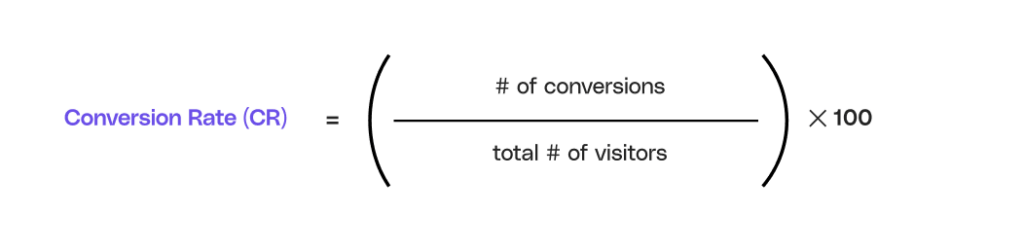
Conversion Rate Formula (Source: Cello)
Factors influencing conversion rate
Several factors can influence conversion rates:
- Website design and user experience, such as page load time, mobile layout and navigation clarity
- Content quality and its match to the visitor's search intent or ad message
- Calls to action with clear wording, visible placement and one primary action per page
- Pricing and promotions, including how clearly the total cost shows before checkout
- Brand trust signals such as customer reviews, security badges and recognizable customer logos
By assessing and optimizing these factors, businesses can improve their conversion rates and achieve better results.
Improving your conversion rate
To enhance conversion rates, businesses can implement various optimization techniques and avoid common mistakes.
Optimization techniques for higher conversion rates
Some effective techniques to boost conversion rates include:
- Performing A/B testing to compare and refine different strategies
- Optimizing landing pages to align with specific marketing campaigns
- Implementing persuasive copywriting techniques
- Offering incentives, such as discounts or free trials
- Using customer testimonials and social proof
By continuously testing and optimizing these techniques, businesses can achieve higher conversion rates and drive more revenue.
|
Optimization Technique |
Potential Impact on Conversion Rates |
Examples of Implementation |
|---|---|---|
|
A/B Testing |
Allows for data-driven decisions by comparing two versions to identify the more effective one. |
Testing two different call-to-action (CTA) buttons to see which generates more clicks. |
|
Landing Page Optimization |
Improves user experience and relevancy, leading to higher engagement and conversions. |
Redesigning a landing page to simplify the layout and feature key information. |
|
Personalization |
Increases relevance and engagement by matching content and offers to individual users. |
Displaying personalized product recommendations based on user browsing history. |
|
Speed Optimization |
Enhances user experience by reducing website load times, potentially lowering bounce rates. |
Compressing images and using content delivery networks (CDNs) to improve page load speed. |
|
Mobile Optimization |
Responds to the growing number of mobile users by making the website mobile-friendly, which improves accessibility and engagement. |
Making sure the website is responsive and easy to use on smartphones and tablets. |
Common mistakes to avoid
In conversion rate optimization, avoiding these common pitfalls protects your results:
- Overcomplicating the purchasing process
- Having unclear or misleading calls to action
- Ignoring the importance of mobile optimization
- Not paying attention to website loading speed
- Underestimating the power of trust and credibility
By avoiding these mistakes, businesses can create a smoother and more persuasive conversion path for their customers.
The metric in different industries
Conversion rates can vary across different industries due to factors such as customer behavior, product complexity and competition. Two industries that experience unique conversion rate patterns are e-commerce and the service industry.
E-commerce conversion rates
In the e-commerce industry, conversion rates are a critical measure of a website’s performance and revenue potential.
Factors like website design, product presentation, customer reviews, shipping options and return policies heavily influence the decision-making process. E-commerce businesses often focus on optimizing their conversion rates to drive more sales, lower cart abandonment and a higher repeat-purchase rate.
Service industry
In the service industry, conversion rates are equally important and often involve a different buying process. Service-based businesses need to focus on building trust, showcasing expertise and communicating the value of their offerings.
A consulting firm might track this in two stages: the rate at which inquiry form submissions turn into booked discovery calls, then the rate at which proposals turn into signed contracts. Conversion rates in the service industry can be influenced by factors such as lead quality, customer testimonials, service pricing and the ability to deliver on promises.
How AI search changes conversion rate reporting in 2026
Conversion rate now has to be read against smaller search traffic. Pew Research Center's analysis of 68,879 Google searches found that users clicked a traditional result link in 8% of visits to pages with an AI summary and in 15% of visits to pages without one.
Lower click volume changes the denominator in the conversion rate formula. If visits fall while signups hold steady, the rate rises without any funnel improvement, so report conversions and revenue next to the rate.
Referral programs sit outside this shift because the recommendation reaches the prospect before any search happens. Measure them on their own funnel, from referred visits to signups and then from signups to paying customers.
How do you calculate conversion rate?
Divide total conversions by total visitors, then multiply by 100. If 100 out of 1,000 visitors make a purchase, that is a 10% conversion rate. Track conversion rate alongside absolute conversion volume and revenue so a rising rate caused by shrinking traffic does not mask a real acquisition problem.
What's the fastest way to improve conversion rate for a B2B SaaS product without rebuilding the whole funnel?
Start with the two highest-leverage fixes: simplify the purchasing path to remove friction, and test a single call-to-action change using A/B testing before touching anything else. Adding social proof (customer testimonials, case study results) and offering a time-limited incentive like a free trial reduce hesitation at the decision point without a funnel rebuild, and the A/B test shows which change produced the lift.
How does Google AI Overview traffic affect conversion rate benchmarks in 2026?
AI Overviews cut click volume sharply. Pew Research Center's analysis of 68,879 Google searches found click rates drop from roughly 15% to 8% on pages where an AI summary appears. That smaller denominator inflates your conversion rate even when nothing in the funnel has improved, so report raw conversions and revenue next to the rate to avoid misreading the signal.
Should I use referral programs or paid search to drive conversions when organic traffic is declining?
Referral programs are structurally insulated from AI search disruption because the recommendation reaches the prospect before any search happens. tl;dv reached a 30.3% monthly freemium-to-paid conversion rate through its Cello referral program [tl;dv case study], and referral funnels are measured as referred visits to signups, then signups to paying customers. Paid search operates on the traffic layer being compressed by AI Overviews, so its conversion economics worsen as click volume falls. Measure each channel on its own funnel instead of applying a single site-wide conversion rate across both, and compare referral and paid acquisition ROI using the same cost and revenue definitions.
Our referral program converts under 3% six months after launch. Which referral software has analytics and testing tools to fix that?
Look for referral software that reports each funnel stage separately and supports parallel campaigns with different rewards, because a single blended conversion rate hides where the program loses people. Cello benchmarks active rate (enabled users who open the referral widget), sharing rate (active users who share), signup rate (unique link views that become signups) and unique views per share. Its performance benchmarks documentation explains that benchmarks are segmented by go-to-market model (free trial, freemium or demo only) and show a median line and a top-quartile line, so you can see which stage trails comparable programs. Cello also runs multiple campaigns in parallel with distinct reward settings for different user segments, which lets you compare reward structures before rolling one out program-wide. With any software on your shortlist, ask how referrers are assigned to test variants, whether results are reported by variant and whether fraudulent or reversed referrals are excluded from conversion counts.
What is a good conversion rate by industry?
There is no single answer. What counts as strong in e-commerce differs from what is expected in B2B SaaS or professional services. The practical approach is to benchmark your rate against competitors and industry averages specific to your category, then track directional improvement over time instead of chasing a universal target number.
Our referral program's active rate is below benchmark. How do we raise awareness and engagement?
Check launcher visibility before changing rewards, because active rate counts only enabled users who open the referral widget. A low rate usually points to a widget users cannot find. Move the referral entry into the main navigation instead of a secondary menu, add contextual prompts after high-intent moments such as a completed project or a plan upgrade, and use in-app announcements on web to point users to the launcher. Cello's discoverability guidance covers these placements. Track widget openings, shares and referred signups as separate numbers so a rise in participation is not mistaken for better purchase conversion.