

Attribution modeling is a key tool for marketers, allowing them to accurately measure the effectiveness of their marketing channels and campaigns. By tracking and assigning credit to each touchpoint in a customer's journey, attribution modeling provides valuable insights into customer behavior and helps optimize marketing strategies.
TLDR:
- Attribution modeling assigns credit to each touchpoint in a customer's journey to identify which channels drive conversions and ROI.
- Five models exist: First-Click, Last-Click, Linear, Time-Decay and Position-Based, each distributing credit differently across touchpoints.
- Position-Based assigns 40% credit to the first and last touchpoints, distributing the remaining 20% across middle interactions.
- Choose a model based on four factors: business goals, customer journey complexity, data availability and resource constraints.
- Cello's peer-to-peer referral infrastructure adds a trackable word-of-mouth touchpoint that attribution models can measure alongside paid and owned channels.
|
Key Component |
Description |
|---|---|
|
Understanding Attribution Modeling |
Determining how credit is assigned to marketing channels and touchpoints. |
|
Importance of Attribution Modeling |
Provides insights into customer behavior and optimizes marketing strategies. |
|
Different Types of Attribution Models |
Include First-Click, Last-Click, Linear, Time-Decay, and Position-Based models. |
|
Choosing the Right Attribution Model |
Factors: business goals, customer journey complexity, data availability, resource constraints. |
Understanding attribution modeling
In order to fully grasp the significance of attribution modeling, it is important to understand its definition and the importance it holds in the field of marketing.
Attribution modeling refers to the process of determining how credit is assigned to different marketing channels and touchpoints in the customer journey. It helps marketers identify which channels and campaigns are driving the most conversions and generating the highest return on investment.
The importance of attribution modeling lies in its ability to provide a clear and accurate view of the customer journey. By attributing credit to each touchpoint, marketers can identify the strengths and weaknesses of their marketing efforts, make informed decisions based on data, and allocate resources effectively.
Definition and importance of attribution modeling
Attribution modeling is the practice of assigning credit to various touchpoints in a customer's journey. It allows marketers to understand the impact of each touchpoint, which lets them make data-driven decisions and optimize their marketing strategies. This helps improve the overall effectiveness of marketing campaigns and maximizes ROI.
Key components of attribution models
There are several key components of attribution models that marketers should be aware of. These components include touchpoints, conversion events, weights and algorithms, data sources, and attribution windows.
Touchpoints
Touchpoints represent the interactions or points of contact between a customer and a marketing channel. They can range from a customer clicking on an ad, visiting a landing page or engaging with social media content. Each touchpoint contributes to the customer's journey through the acquisition funnel and plays a role in their decision-making process.
Conversion events
These are the actions taken by customers that indicate their engagement or intent to purchase. Conversion events can include making a purchase, filling out a form, subscribing to a newsletter, or downloading a whitepaper. These events are key in understanding the effectiveness of marketing efforts and attributing credit to the touchpoints that led to the conversion. They also set the baseline for calculating your conversion rate by channel.

FIlling out a sign-up form is a key conversion event (Source: SparkLayer)
Weights and algorithms
Attribution models use different weights and algorithms to assign credit to various touchpoints, based on their perceived importance in the customer journey. For example, a first touch attribution model may assign all the credit to the first touchpoint a customer interacts with, while a linear attribution model may distribute credit equally among all touchpoints.
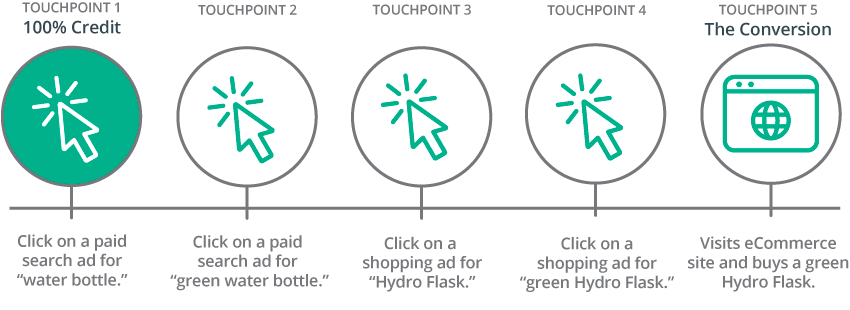
Algorithms can assign credits to touchpoints, depending on their importance (Source: Finch)
Data sources
Attribution models draw on data from various sources, including web analytics, CRM systems, and marketing automation platforms. These data sources provide valuable insights into customer behavior, allowing marketers to analyze and attribute credit accurately
Attribution window
This refers to the timeframe within which touchpoints are considered for attribution. The length of the attribution window can vary depending on the industry and the complexity of the customer journey. A longer attribution window allows for a more complete view of the customer journey, while a shorter window focuses on immediate touchpoints.
By understanding these key components, marketers can build effective attribution models that provide valuable insights into the customer journey and help optimize marketing strategies. Attribution modeling is a powerful tool that lets marketers make data-driven decisions, allocate resources effectively, and in the end drive better results.
Different types of attribution models
There are several types of attribution models that marketers can choose from, depending on their specific needs and goals. Each model has its own strengths and weaknesses, and it is key for marketers to understand these differences in order to make the right choice.
First-click attribution model
The first-click attribution model attributes 100% of the conversion credit to the first touchpoint in the customer journey. This model is useful in understanding the initial touchpoint that attracted the customer and drove them to take action.
Last-click attribution model
The last-click attribution model assigns all the conversion credit to the final touchpoint before the conversion event. This model is often used to determine the marketing channel that directly led to the conversion.
For example, a sale closed after a branded search click gets full credit, even if a display ad and an email opened the journey weeks earlier.
Linear attribution model
The linear attribution model evenly distributes the conversion credit among all touchpoints in the customer journey. This model provides a balanced view of the impact of each touchpoint and is useful for campaigns with multiple touchpoints.
For example, if a customer clicks a social ad, opens an email and reads a blog post before buying, each touchpoint gets one-third credit, which suits teams running paid, email and content campaigns together.
Time-decay attribution model
The time-decay attribution model assigns more credit to touchpoints that occurred closer to the conversion event. It recognizes that touchpoints closer to the conversion are likely to have a greater influence on the customer's decision-making process.
For example, if a tool sets a seven-day half-life (a configurable setting that varies by tool), a demo request a day before signup earns more weight than a blog visit a month earlier. This model suits longer B2B sales cycles with several nurture emails and retargeting ads.
Position-based attribution model
The position-based attribution model assigns 40% of the credit to the first and last touchpoints, and distributes the remaining 20% among the touchpoints in between. This model acknowledges the importance of both the initial and final touchpoints.
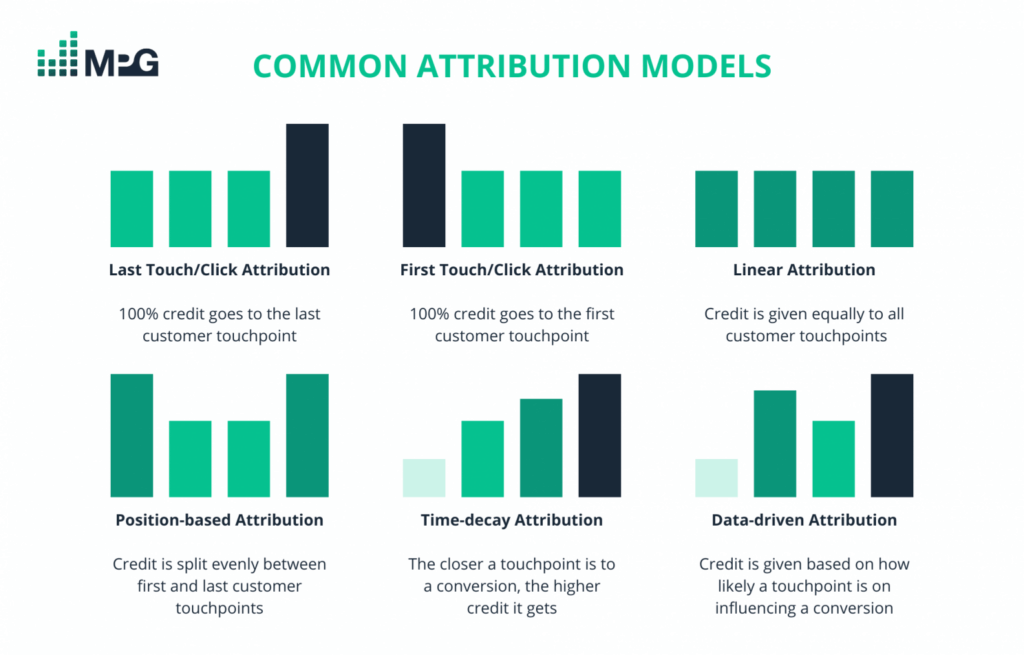
Attribution models help marketers gain better insights (Source: MPG)
Choosing the right attribution model
Choosing the right attribution model for your marketing strategy is key for gaining accurate insights and making informed decisions. Here are some factors to consider when selecting an attribution model:
Factors to consider
Consider the following factors when choosing an attribution model:
- Business Goals: Align the attribution model with your business objectives and goals.
- Customer Journey Complexity: Assess the complexity of your customer journey and choose a model that captures the subtleties effectively.
- Data Availability: Assess the availability and quality of data needed to support the attribution model.
- Resource Constraints: Consider the resources required to implement and maintain the selected attribution model.
Pros and cons of each model
Each attribution model has its own advantages and disadvantages. By understanding these pros and cons, you can make an informed decision regarding the right attribution model for your marketing strategy.
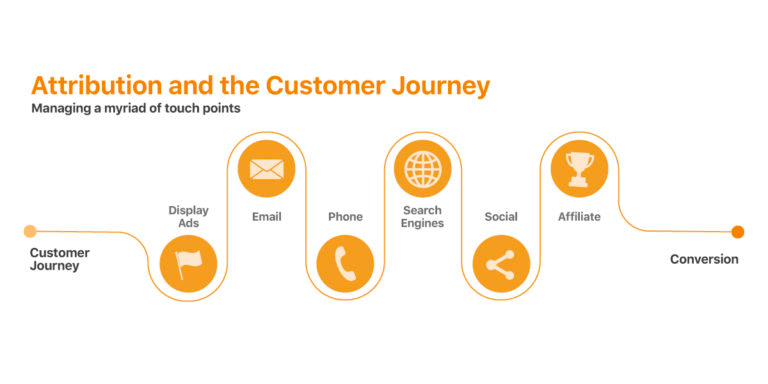
Given the many customer touchpoints, choosing an appropriate model is key (Source: Trevant, formerly adparlor)
Attribution modeling in 2026
GA4 limits reporting to data-driven attribution and two last-click variants, so rule-based views such as first-click or time-decay now live in CRMs and custom setups. In October 2026, the practical question is which tool answers which question: GA4 for channel-level credit, your CRM for pipeline and revenue.
AI answers and zero-click search add a second pressure. When an AI summary resolves a query on the results page, fewer visits reach your site, and last-click reports then over-credit branded search and direct visits that follow the real influence. Peer recommendations sit outside that search path, so they rarely appear in search-based reports unless you record them as their own touchpoint.
Implementing attribution modeling in marketing strategy
Implementing attribution modeling in your marketing strategy can be a complex process, but the benefits are well worth the effort. Here are the steps to add attribution modeling effectively:
Steps to add attribution modeling
To effectively bring attribution modeling into your marketing strategy, follow these steps:
- Define Your Conversion Events: Identify the specific actions taken by customers that indicate their engagement or intent to purchase.
- Choose an Attribution Model: Select the attribution model that best aligns with your business goals and customer journey complexity.
- Collect and Analyze Data: Gather data from various sources and analyze it to gain insights into the customer journey.
- Assign Credit: Apply the chosen attribution model to allocate credit to the different touchpoints in the customer journey.
- Track and Optimize: Continuously monitor the performance of each touchpoint against your SaaS metrics that matter and use the insights to optimize your marketing strategy.
Tools for effective attribution modeling
There are several tools available to help marketers implement and analyze attribution models effectively. The three below cover web analytics, CRM reporting and referral tracking.
Google Analytics 4 reports conversion credit by channel under data-driven and last-click models, which makes it a practical starting point for comparing how paid, organic and email traffic contribute to signups.
HubSpot's multi-touch revenue attribution reports apply models such as first touch, last touch, linear and time decay to contacts and deals stored in its CRM, so teams with longer B2B sales cycles can trace revenue back to specific marketing touchpoints.
Cello attributes peer-to-peer referrals server-side, so a referred signup or paid invoice is credited to the referring user even when the browser blocks cookies. It tracks new-signup, invoice-paid and demo-call-attended conversion events, which adds word-of-mouth as a measurable touchpoint next to your paid and owned channels.
By using these tools, marketers can gain a deeper understanding of their customers' behavior and make data-driven decisions to enhance their marketing strategies.
How much engineering work does a referral program need, and who owns it?
Cello needs a one-time integration from your engineering team and then runs without a standing engineering owner. The integration covers three jobs: embedding the SDK with a few lines of code, wiring the identity token that tells Cello who each user is and configuring the signup and billing events (a Stripe or Chargebee webhook) that Cello reads for server-side attribution. Teams typically finish this in days, not quarters. After launch, attribution, reward calculation, fraud checks and payouts run inside Cello, so your growth or partnership lead manages the program from the dashboard. If engineering time is the constraint, a partner program can start on the standalone Partner Portal, which needs no SDK integration, and add the in-product widget later.
How do I credit the right partner when a deal closes in HubSpot?
Cello supports HubSpot deal stages in partner attribution, so a partner introduction can be credited from the first contact through closed-won. Partners see whether a referred lead is in negotiation, disqualified or lost without seeing deal amounts. The integration work is mapping the partner's referral code to the HubSpot contact or deal and choosing which deal stage triggers the reward. Confirm the exact property mapping with Cello before launch, because it depends on how your sales team records deals.
How does attribution work when there is no self-serve checkout?
Cello attributes sales-led referrals through CRM events instead of a checkout event. Its conversion events include demo-call-attended, and the Salesforce integration uses Apex triggers to track SQL qualification and later Opportunity stage changes, from demo completed to closed-won, without exposing deal amounts. A reward can then fire on a CRM stage instead of a Stripe invoice. This suits sales-led teams that need to credit the original referrer even when a different person signs the contract.