
Did you know that 72% of consumers are more likely to spend with brands whose loyalty program they belong to, and 56% spend more because of it? That’s what Deloitte research says in 2026. PwC found that 29% leave after a poor experience. That is where customer loyalty management gets real for growing brands. And the most underused part of loyalty management isn't points or tiers. It's turning your loyal customers into a referral engine, where every retained customer also becomes an acquisition channel.
This guide pulls together my customer service and marketing teams' insights from working with real companies. You’ll get:
- a practical view of customer loyalty
- how smart loyalty management shapes repeat revenue
- which rewards people want, why points sit unused, and 10 ways to build something customers come back for
But first, let's check if we are on the same page about the basics.
What is customer loyalty management?
Customer loyalty management is the system a business uses to turn one-time buyers into repeat buyers by tracking behavior, shaping follow-up, and giving people a reason to come back.
Done well, it connects your strategy to real actions: what a customer buys, when they come back, what they ignore, and which moments actually build customer loyalty.
Here’s how that looks in practice:
- A shopper places a first order from a small coffee brand.
- Two days later, they get a brew guide tied to what they bought.
- After 21 days, they receive an invite to a loyalty program with simple rewards, like free shipping or early access, instead of generic discounts.
- The team tracks repeat purchase rate, redemption, and time to second order.
That’s loyalty management in action. Real loyalty supports customer retention because it is built around behavior, instead of the perks people forget exist.
5 key benefits of customer loyalty management
The right customer loyalty management can change how a business grows, what it spends to keep momentum, and how often people come back. I’ve seen this many times. Below I collected the most meaningful benefits when customer loyalty turns from a brand idea into real loyalty management leverage.
Loyal customers are worth up to 10x their first purchase and cost up to 25x less to retain than acquire
Loyal customers can be worth up to 10x their first purchase over time. And that’s not just me saying that, but a real statistic from Harvard Business Review. They also note that acquiring a new buyer can cost 5 to 25 times more than retaining an existing one, depending on the industry.
Why does that gap get so wide?
- You already paid for awareness, the first click, the first conversion, and that early trust
- An existing customer needs less persuasion to buy again
- Repeat buyers usually lift customer lifetime value faster than constant new-customer chasing.
That’s why retention is vital for a smaller business. Strong customer loyalty means future sales do not depend entirely on paying to replace churn.
A structured loyalty program can lower CAC by turning referrals into a repeatable acquisition lever
Businesses running referral programs effectively see an average 13% decrease in Customer Acquisition Cost. The reason is simple. A loyalty program gives you a clearer referral trigger. You can ask for a referral after a successful second order, a five-star review, or a member redeeming a reward and feeling the value.
The timing is crucial for referrals to work effectively, and the advocate's engagement is essential. Put that structure in place, and word of mouth will no longer be a matter of marketing luck. It becomes a lower customer acquisition cost lever you can run on purpose.
Reviews from loyalty program members generate trust that paid marketing cannot buy
94% of respondents say verified-purchase reviews increase consumer trust. That is the part worth paying attention to. A loyalty program member’s review carries more weight because it reads like proof from someone who actually bought, used, and came back.
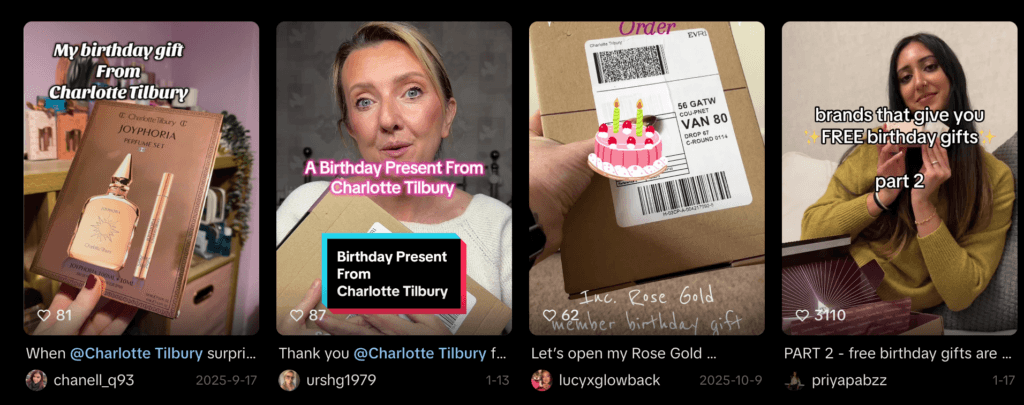
Reviews from people who got a birthday gift from the Charlotte Tilbury loyalty program on TikTok.
Such reviews:
- reduce hesitation before purchase
- give future shoppers believable detail
- add credibility that paid marketing cannot manufacture.
Ask your best customers for feedback after a real purchase, while the experience is still fresh, and let that trust do work your ad budget cannot.
Customer data from alLoyalty program enables personalized marketing that actually converts
75% of consumers are more likely to purchase from brands that deliver personalized content. A customer loyalty program gives you customer data with context:
- what they bought
- when they bought
- what they came back for
Feed that data into your marketing, and your loyalty program gets sharper fast.
The same data layer powers behavior-triggered referral prompts. Surfacing the share moment to the customer right after they've experienced value, instead of asking cold.
Subscription-based loyalty tiers drive disproportionate revenue and sustain retention at scale
Starbucks said if just half of its 35.5 million active members made one extra purchase per year, that would add $150 million in annual revenue. That is the case for subscription models and tiers in one line: a small shift in repeat behavior can create outsized sales.
For a smaller brand, keep the benefits practical, the rewards visible, and the value stronger than extra points alone.
And here are the best customer loyalty management ideas on how to make these benefits real. 👇
10 best practices for successful loyalty program management
Successful loyalty program management usually looks less glamorous than people expect. The work is in the setup.
Together with my team, we’ve collected these customer loyalty management practices from ecommerce and service brands building repeat revenue in the real world.
1. Segment your customer base before designing any loyalty program
Start with the customer base you already have. Look at the data and split people into useful customer segments:
- first-time buyers
- repeat buyers
- high-margin shoppers
- price-sensitive consumers
- lapsed customers
Then build the strategy around their behavior.
Most brands do this backwards. They design the loyalty program first, then try to force every customer into it. That is how you end up with generic perks and a weak response.
Here is what better looks like:
- an ecommerce store might give replenishment reminders to repeat buyers and early access to higher-value customers
- a local service brand might reward referrals, offer prepaid packages, or provide priority booking
- a company can introduce the marketing strategy adjustments by segment because the reason to return changes by segment, too.
The systems behind segmentation matter too, especially when your team needs to turn customer groups into different follow-up flows, support paths, and retention messages.
2. Give customer service teams real-time visibility into every member's loyalty status
Put loyalty context inside the customer service workflow, not in a separate tab someone forgets to open. When a loyal buyer reaches out, the rep should see the relationship instantly:
- current tier
- points balance or usable value
- expiry risk
- last qualifying stay, order, or action
Thus, if a customer asks why a reward is missing, the rep should see the answer in one place.
In practice, this means keeping loyalty program information directly within the customer service platform. In these tools, there is an information card for every single customer, listing their data, including the loyalty program details. Chances are, your team will look into Help Scout vs. Intercom, as these are two popular customer service solutions used to handle customer questions and organize customer data.
Having such information changes the tone of the conversation fast. The service feels informed. The member does not need to repeat their story.
That is how correct loyalty program management protects trust at the exact moment it could break.
3. Build a points system to reward customers for more than just purchases
Most brands give points only for spending money. But that’s too weak for habit-building. A better move is to tie rewards to actions beyond the purchase, especially the ones that strengthen loyalty, increase trust, or bring in new customers without extra acquisition spend.
If you only reward customers at checkout, you train them to care about discounts. If you also reward the behaviors around the purchase, you shape loyalty.
Give points for:
- leaving a review after the product arrives
- referring a friend
- reordering on time
- choosing store credit over refunds.
Put the highest value on actions that improve retention, trust, or acquisition efficiency. Smaller incentives can sit on low-impact behavior.
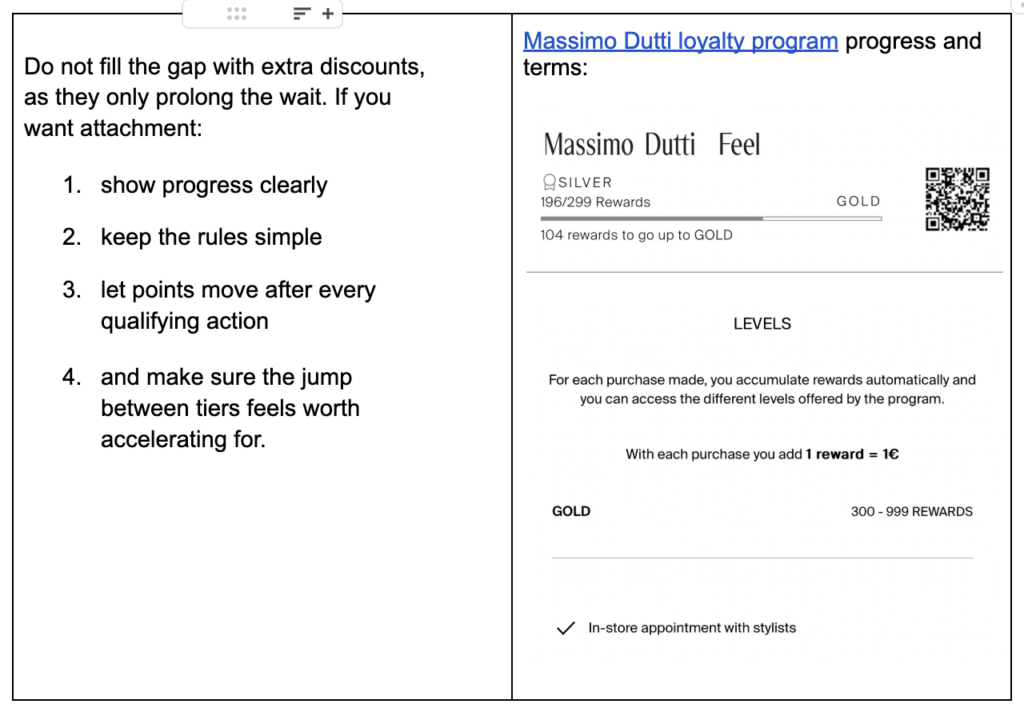
4. Design a tiered loyalty program where the middle tier feels reachable within 90 days
Build your tiered loyalty program around the second win, not the top prize. The first level gets people in. The middle one teaches momentum.
Set the middle tier so that an average buyer can reach it in 60 to 90 days through natural behavior instead of a heroic spend. For a skincare brand, that could be one starter order plus a refill. For a pet supply shop, maybe two food purchases and one add-on.
Then make the loyalty program upgrade visible and useful:
- earlier access
- faster support
- a better redemption rate
- or exclusive bundles.
5. Offer subscription-based loyalty benefits to convert top spenders into committed members
The paid layer should remove friction, which your best buyers feel often enough to care about.
Walmart+ is a good example of this logic. The membership is built around everyday utility: free delivery from the store, free shipping with no order minimum, and fuel savings.
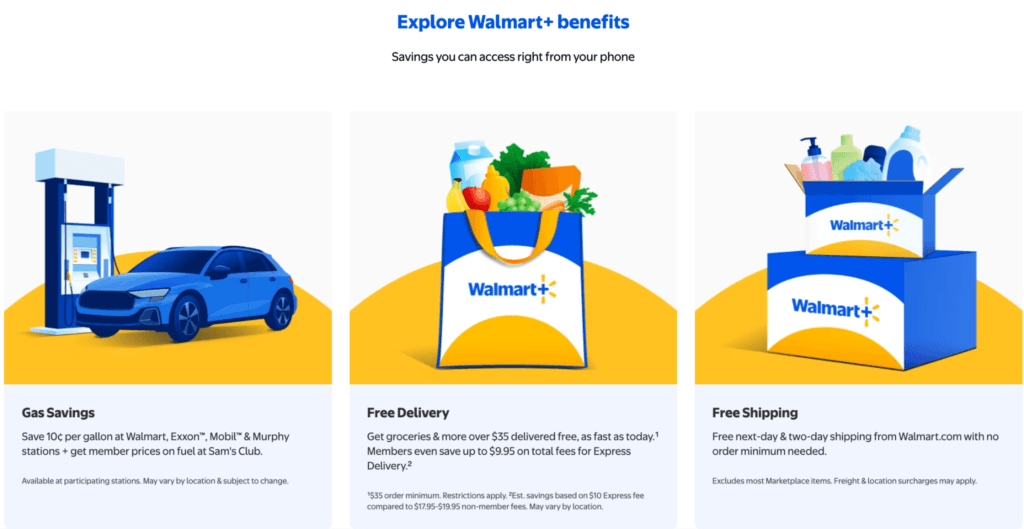
That works because the value shows up again and again, not once a quarter.
What to copy from that model:
- lead with practical benefits
- keep discounts secondary
- add perks people would genuinely miss
- use trusted referral partners only when they strengthen the core offer
A subscription rewards program should make repeat purchases easier, faster, or less risky. If your best customers already buy often, give them smoother delivery, earlier access, priority support, or protected service windows. Those are the rewards that hold attention.
6. Use customer data to personalize rewards at the individual level
Most brands send the same perk to everyone and call it relevance. That is where the program starts losing energy.
Instead, look at three signals first:
- last product bought
- reorder timing
- which offer someone actually uses
Feed that data into marketing, and your rewards stop feeling random.
With lead routing, you can connect new leads with the right brand representative (customer representative, sales manager, etc.) to give potential customers what they actually need. Not only does it grow customer loyalty, but it also helps to understand your customers better and find the best incentives they seek.
Connect your marketing data and use customer data once you have it. For example, if a buyer usually comes back every six weeks, time the perk around that window. If another one only responds to launches, lead with access.
A variation of this approach lies in Starbucks’s customer loyalty personalization:
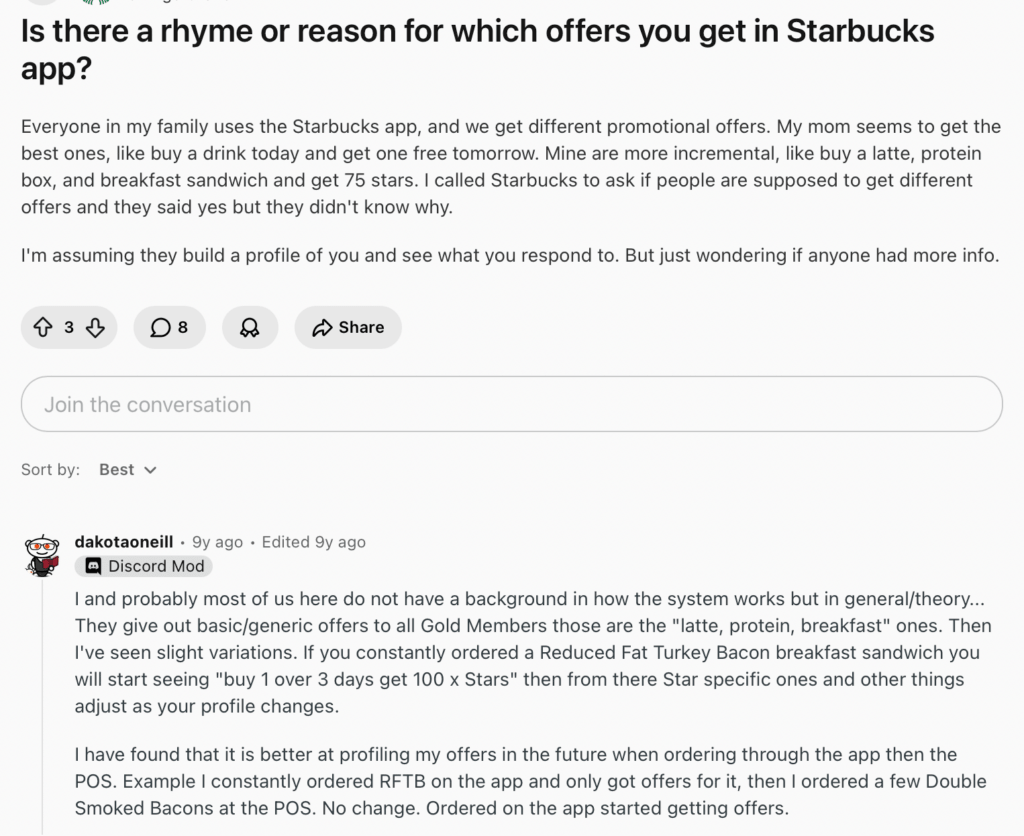
Special offers may be customized based on purchase behaviors and preferences, including discounts and Bonus Stars.
For SaaS, the equivalent is triggering the referral or reward prompt at the user's individual aha-moment. For example, Typeform reached a 27% sharing rate by gradually rolling out triggers tied to product engagement, not blanket campaigns."
7. Automate five core loyalty program management triggers before building anything else
Start building your loyalty program with timing, like the moments customers
- join
- make the first purchase
- reach a checkpoint
- are at an inactivity or expiry risk
- have their birthday
For example, a birthday gift works because it feels personal without being complicated.
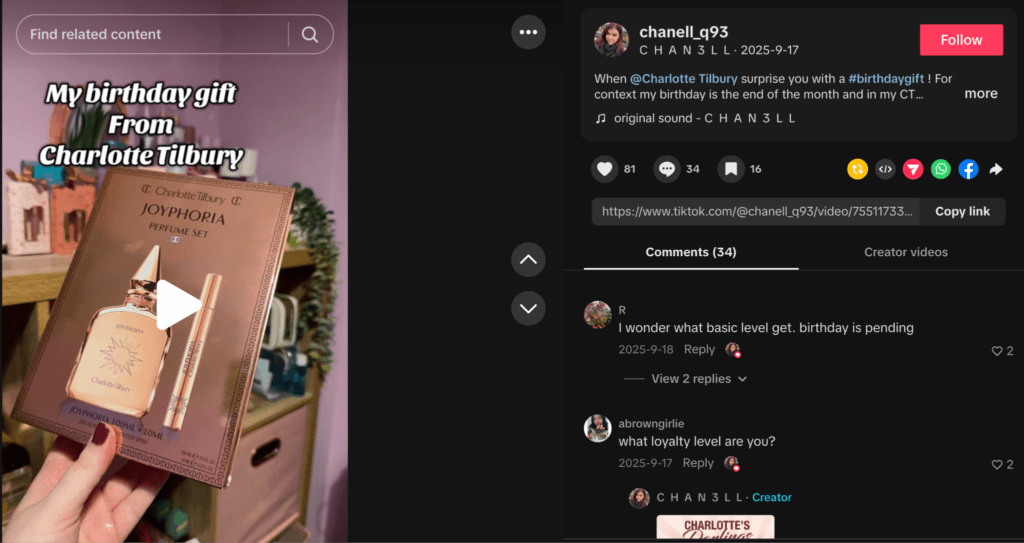
Example of a birthday gift from Charlotte Tilbury. Image source.
Automate the moments that keep a member from drifting. Welcome them fast. After the first purchase, show the shortest path to value. When they are close to the next level, make the gap obvious.
A good loyalty management system alerts users when points are in danger before they vanish. Train your customer service team to know the right timing for offering the loyalty program to your customers. Whether you have an in-house team of customer service representatives or if you rely on the outsourced customer support, you should teach the team members to contact your customers at the right time and remind them about the gained points.
8. Set the minimum redemption threshold at a value reachable within 60 days of joining
Early redemption is the moment the program becomes believable.
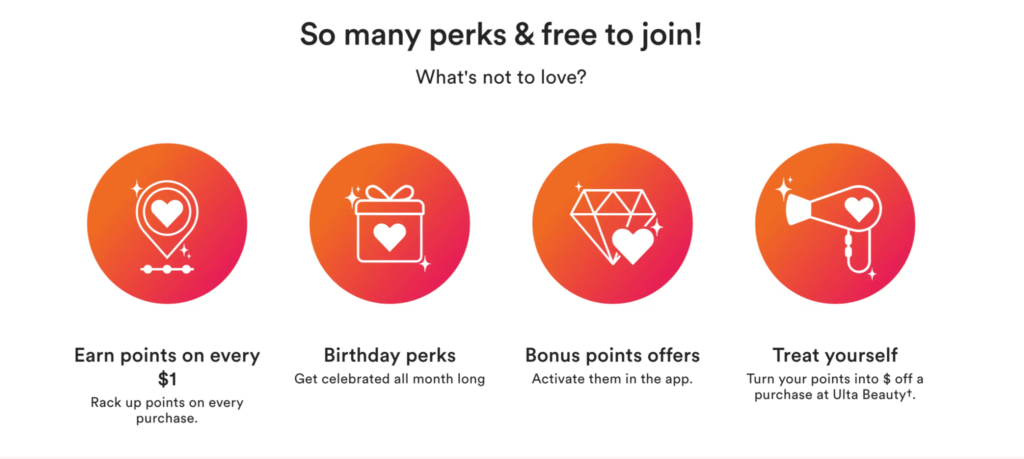
Make the first win happen fast. If a new member has to wait four or five months to use anything, the program starts feeling theoretical. For instance, Ulta Beauty Rewards Program members earn 1 point per $1 spent on qualifying purchases, and they can start redeeming at 100 points, which equals $3 off.
Do you work globally? Consider offering international payment methods to your customers so that they could quickly complete the purchase. Not only does it drive loyalty, but it also makes them spend more! A customer who spends around $50 twice in the first couple of months can get to value quickly.
If you are a smaller brand, set the initial rewards low enough so that a typical buyer can achieve success in one buying cycle. However, check out the email deliverability to make sure that your offer gets into the inbox. For instance, collect verified emails with a tool like SignalHire and verify them in one place.
9. Send a 3-question pulse survey to loyalty members every 90 days and publish what changed
Every 90 days works because it gives you enough fresh behavior to review without waiting so long that small frustrations turn into churn.
Send it to:
- members who bought or redeemed in the last 90 days
- high-value members at risk of going quiet
- people who joined recently and have already used the program once
Keep the customer satisfaction survey brutally short:
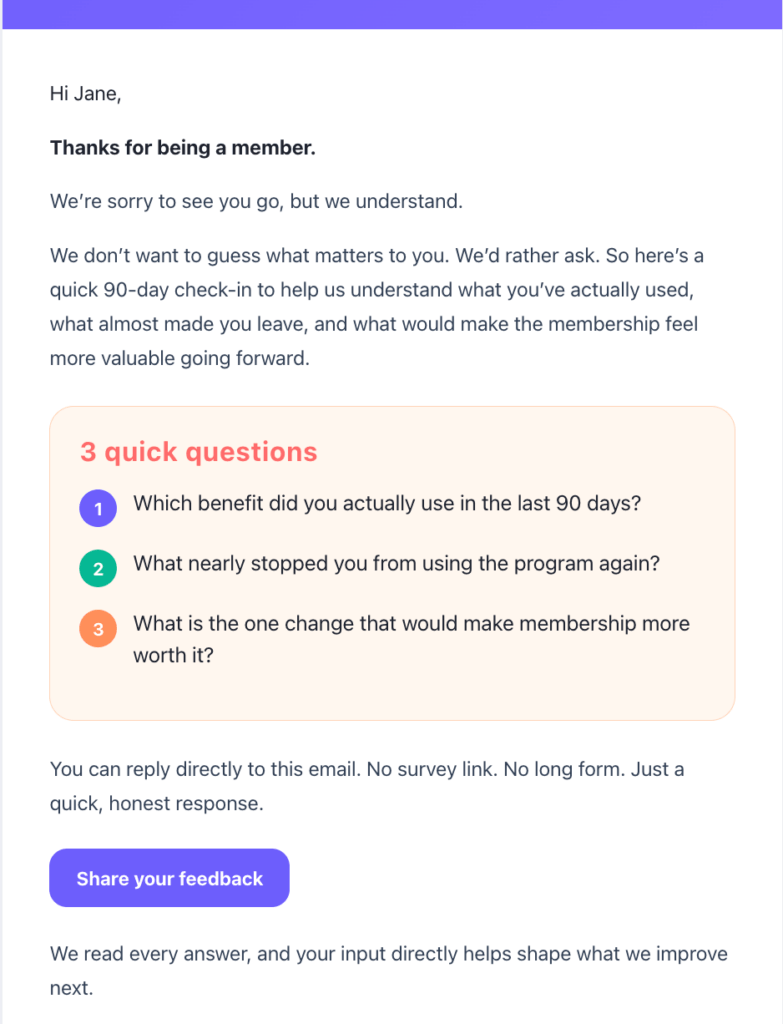
Conduct reviews of answers within 10 business days.
If the same friction shows up in 15% or more of responses, treat it as a priority. Pick one change you can ship inside 30 days, then tell members exactly what changed.
That is how customer feedback starts earning trust.
10. Run a quarterly loyalty management audit across four dimensions
A smart loyalty management strategy needs a quarterly check. Every 90 days, review four things:
- Value. Can a member reach something worth using fast enough to care?
- Behavior. Are people earning, redeeming, and moving through the program, or are they stalling after sign-up?
- Operations. Check whether points post when they should, balances update correctly, tier changes trigger on time, and expiration rules are clear and applied consistently.
- Experience. Which perks do people actually use? Which ones does support keep hearing about? Which ones look good on paper but disappear in real life?
A successful loyalty program gets stronger when each quarterly review cuts through the noise and forces decisions from real data instead of hope.
Choosing the right loyalty management solution for your business
Picking the wrong customer loyalty management tool gets expensive fast. You end up bending your team around software that looked clever in the demo and clumsy in real life.
A good loyalty management system should support your strategy, fit the way your business actually sells, and make it easier to run week after week.
Consider these criteria when choosing your customer loyalty tools:
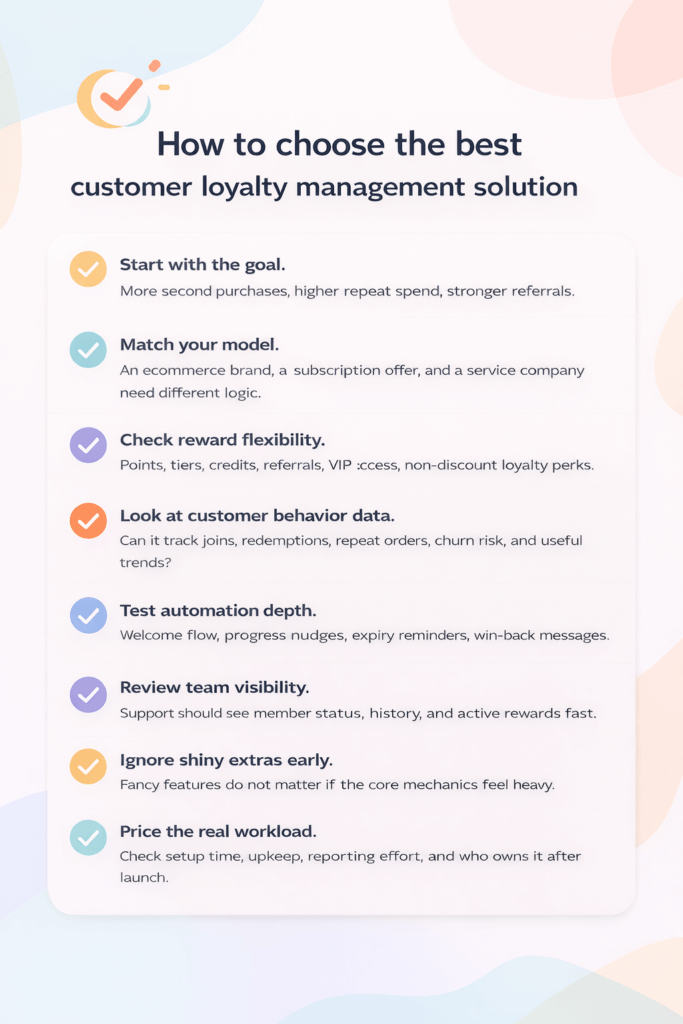
If referrals are part of your loyalty mix, and for B2B SaaS, they should be, evaluate tools that embed natively in your product instead of bolt-on widgets.
To summarize
Customer loyalty management works when the strategy is simple enough to run and strong enough to matter. The customer loyalty management key practices show where success comes from: fast first value, useful rewards, smart automation, visible fixes, and regular audits.
Watch trends, but do not chase them before the basics work.
Start with one business goal, one loyalty management workflow, and one customer loyalty behavior you want to change first.