
Impact Advocate starts at $2,500 per month with setup fees and a 2.5% cut on every payout, and the module is not sold standalone. To access it, you buy into the full impact.com partnership suite. Teams running a focused user-referral program pay for affiliate-network depth they never touch. When you need an in-product widget, days-to-live implementation, and server-side attribution that survives ITP, you look at impact.com/advocate alternatives purpose-built for referral infrastructure without the affiliate layer underneath.
TLDR:
- Impact Advocate starts at $2,500 per month with setup fees and a 2.5% transaction fee on every payout, pricing teams out of referral-only programs.
- Teams running referrals in-product need server-side attribution that survives ITP and days-to-live implementation. Impact's external-portal model does not fit.
- Cello embeds referral surfaces inside the product through native SDKs, charges 0% on user-referral revenue and handles global payouts as Merchant of Record across 130+ currencies.
- Impact.com holds a 1.2 out of 5 Trustpilot rating with 93% one-star reviews citing reversed commissions and months-late payouts.
What is Impact Advocate and how does it work?
Impact Advocate is the customer referral module inside impact.com's affiliate and partnership suite. It traces back to impact.com's acquisition of SaaSquatch, folded into the broader product as the advocacy and refer-a-friend layer alongside affiliate, influencer, and B2B partnership tracking.
The module gives brands a way to build referral programs with configurable reward logic, gamification elements like leaderboards and reward exchanges, and analytics sitting inside the same reporting surface as affiliate performance. Programs run across web and mobile, with eligibility, reward type, and payout cadence handled through impact.com's campaign engine.
Pricing starts at $2,500 per month for the Pro plan. Setup fees apply on top of the subscription, and impact.com takes a 2.5% transaction fee on every payout processed through the product. Advocate is not sold standalone. To access it, a brand has to buy into the full impact.com partnership suite.
The positioning targets enterprise teams running affiliate networks and customer referral programs in parallel, where the appeal is unified reporting across motions and the service depth of a single vendor managing both sides of the partner stack.
Why consider Impact Advocate alternatives?
The cost stack is usually the first trigger. At $2,500 monthly minimum plus 2.5% transaction fees, Impact Advocate carries enterprise-affiliate economics that outsize what a referral-only program needs. Teams running a focused user-referral motion pay for affiliate network depth they will never use.
Complexity is the second trigger. Tekpon cites unintuitive design and high cost. The third trigger is service. Impact.com's 1.2 Trustpilot score with 93% one-star reviews.
Alternatives come into scope when the operating model does not match. Teams needing a native in-product widget, server-side attribution that survives ITP, days-to-live implementation or global payout coverage outside the US outgrow Advocate's external-portal model. Impact Advocate still fits large enterprises consolidating affiliate and referral reporting under one vendor. For everyone else, purpose-built referral tooling returns more per dollar.
Best Impact Advocate alternatives in June 2026
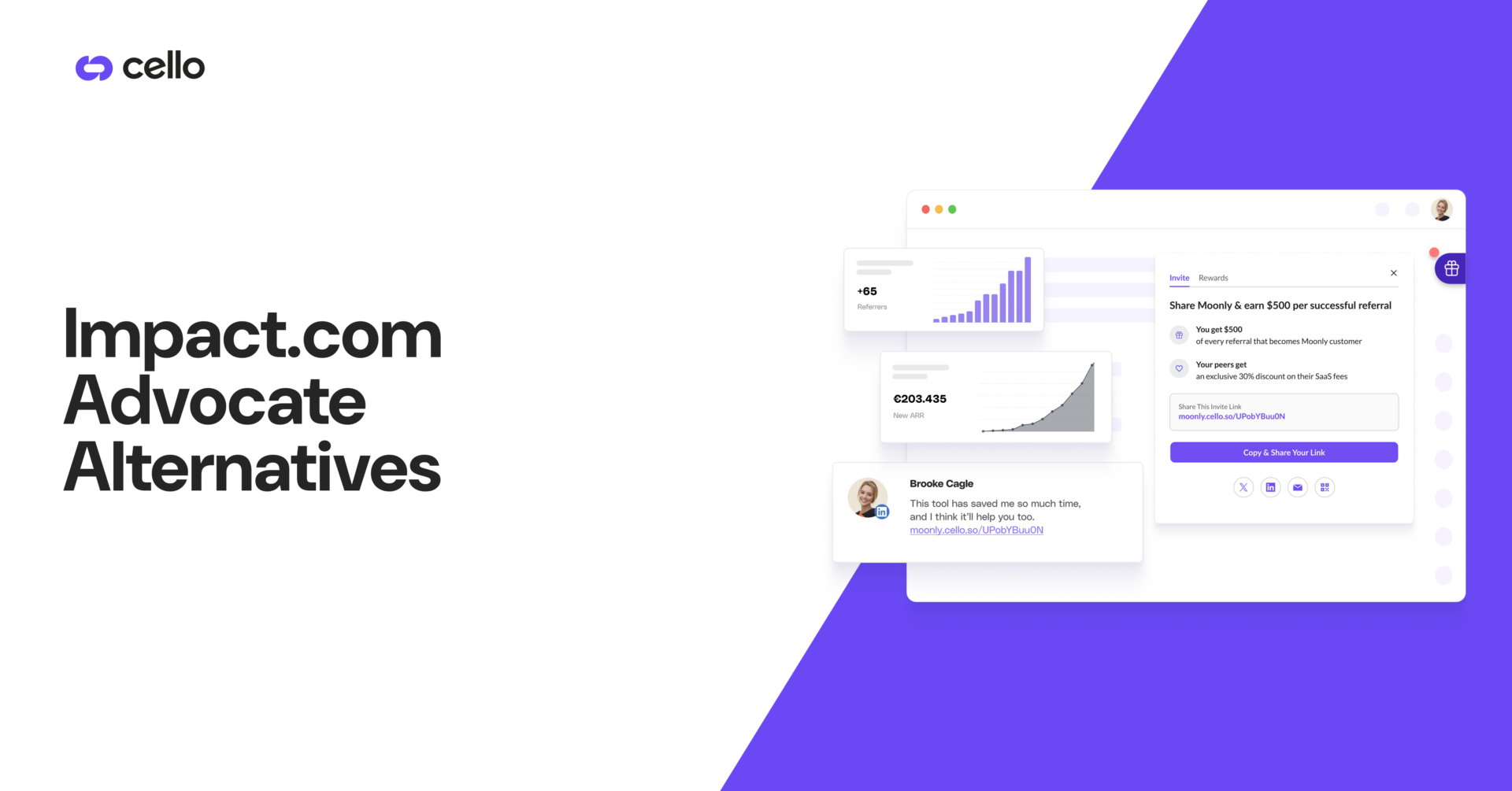
For B2B SaaS teams running referrals inside the logged-in product, Cello is purpose-built for that motion. VEED cut paid CAC by 90.4% after replacing an external portal with Cello's in-product widget, and Moss attributes 50% lower CAC versus inbound to the same in-product surface.
Where Impact's Advocate sits on an affiliate-network backbone, Cello embeds the referral surface inside the product itself through an SDK that goes live in days, not quarters. Attribution runs server-side, so tracking survives Safari's Intelligent Tracking Prevention (ITP) and iOS App Tracking Transparency (ATT) opt-out.
- In-product widget: native components match your product's design tokens, no third-party styling shipped to end users
- Server-side attribution: conversion credit assigned at the server layer, not the browser, so cookie deletion does not break the chain
- Unified user and partner data: referrers, partners and affiliates sit in one schema with payouts in 60+ countries
- EU-first, GDPR-native: data residency in the EU with a SOC 2 audit in progress
- 0% advertising fee on referral revenue, with 21 native integrations including Stripe and HubSpot
Choose Cello if the referral surface must live inside the product and the reader owns a PLG motion.
Feature comparison: Impact Advocate vs top alternatives
The table below maps Impact Advocate against the four most-considered alternatives across the dimensions that drive switching decisions: where the referral surface lives, how long implementation takes, what the program costs at the floor, and which tax and mobile coverage ships out of the box.

|
Feature |
Impact Advocate |
Cello |
PartnerStack |
Rewardful |
GrowSurf |
|---|---|---|---|---|---|
|
In-product widget |
Requires custom development |
Native SDKs (web, iOS, Android, React Native, Flutter) |
External portal |
External portal |
Embeddable widgets (web only) |
|
Implementation time |
Months (enterprise onboarding) |
Hours (five-step setup) |
2+ weeks |
Days |
Days |
|
Base pricing |
$2,500+ per month |
$200 per month (Grow tier) |
$500+ per month |
$49+ per month |
$95+ per month |
|
Transaction fees |
2.5% on every payout |
0% (user referrals) |
Yes, scales with volume |
No |
No |
|
Mobile SDK support |
Third-party attribution required |
Native iOS, Android, React Native, Flutter |
No |
No |
No |
|
Server-side attribution |
Yes |
Yes (primary path) |
Yes |
Stripe-dependent |
Yes |
|
Global tax compliance |
US-only tax reporting |
Merchant of Record (130+ currencies) |
Manual |
Manual |
Manual |
|
Partner marketplace |
Yes (250,000+ partners) |
No |
Yes (100,000+ partners) |
No |
No |
Two splits matter most. Impact Advocate and PartnerStack carry partner marketplaces but route referrers through external portals. Cello inverts that trade, swapping marketplace reach for an in-product surface and Merchant of Record coverage across 130+ currencies. Rewardful and GrowSurf clear the pricing floor but stop at web widgets and leave tax handling to the operator.
Why Cello is the best Impact Advocate alternative
Impact Advocate's 1.2 out of 5 Trustpilot rating, with 93% of reviews citing reversed commissions and months-late payouts, becomes your brand problem the moment a referrer claims a reward through the vendor's portal. Cello removes that exposure by embedding the referral and reward surface under your own brand, with the Powered by Cello badge optionally hidden, so end users never see a third party in the loop.

Pricing aligns with that posture. Where Impact stacks a $2,500 floor, setup fees and 2.5% on every payout, Cello charges 0% on user-referral revenue and absorbs tax-form collection, withholding and indirect tax remittance as Merchant of Record across the supported payout corridors.
The result is referral infrastructure priced as B2B SaaS, not an add-on inside an affiliate suite. Hera went live in two days on exactly that model.
When to switch from Impact Advocate
Impact Advocate fits a narrow band of enterprise buyers consolidating affiliate and referral reporting under one roof. Outside that cohort, the cost structure and external-portal model create more drag than the unified dashboard removes. Teams switching cite three triggers: pricing that assumes affiliate-network scale, implementation timelines measured in quarters, and vendor reliability issues documented across 93% one-star reviews. Cello collapses those three by pricing referrals as SaaS infrastructure, shipping in days and keeping the referral surface under your brand.
When should you consider moving away from Impact Advocate?
Consider switching when Impact's $2,500 monthly minimum, setup fees and 2.5% transaction fees outsize your referral program economics, when you need an in-product widget instead of an external portal, or when you require server-side attribution that survives Safari ITP and iOS ATT opt-out. Teams running focused user-referral programs typically overpay for affiliate network depth they never use.
What features should you prioritize when comparing Impact Advocate alternatives?
Prioritize in-product widget placement over external portals, server-side attribution that survives cookie deletion, implementation timelines measured in days instead of months, and 0% transaction fees on user referrals. Mobile SDK support and global tax compliance coverage matter most for teams operating across devices and geographies.
Does Cello handle tax reporting and payout compliance across different countries?
Cello acts as Merchant of Record for referral payouts across 130+ currencies, handling W-9, W-8BEN and W-8BEN-E tax forms, withholding per jurisdiction, VAT and GST remittance, and 1099-NEC filing. Impact Advocate provides US-only tax reporting, leaving international compliance to the operator.
How long does it take to implement Cello compared to Impact Advocate?
Cello installs via SDK and goes live in hours to days through a five-step setup process. Impact Advocate requires months-long enterprise onboarding with dedicated solutions architects. Hera went live on Cello in two days; VEED completed setup in under five hours.
What happens to referral tracking when users decline cookies or switch devices?
Cello's server-side attribution matches referral events to new accounts at the identity layer through billing system webhooks, not browser sessions. Conversion credit survives Safari ITP, Firefox ETP, iOS ATT opt-out and device switching because attribution reads from Stripe or Chargebee metadata instead of cookies.
Can you run referral programs for both individual users and external partners in the same platform?
Cello unifies user referrals and partner programs on a single platform with shared attribution, fraud detection, analytics and campaign management. User Referrals tier handles peer-to-peer customer referrals through the in-product widget, while Partner Referrals tier manages affiliates, influencers and integration partners through a separate portal. Both motions share the same payout infrastructure, reporting surface and compliance layer without requiring separate vendor contracts or data schemas.
Impact Advocate vs Cello for B2B SaaS in-product referrals
Impact Advocate starts at $2,500 per month with setup fees and a 2.5% transaction fee on every payout, requires months-long enterprise onboarding and routes referrers through an external portal. Cello starts at $200 per month, charges 0% on user referral revenue, installs via SDK in hours to days and renders the referral surface inside the product through native iOS, Android, React Native and Flutter SDKs. Impact fits enterprises consolidating affiliate and referral reporting under one vendor; Cello fits PLG SaaS teams running referrals as in-product infrastructure.
What happens to referral attribution when users sign up from different devices or browsers?
Cello's server-side attribution matches referral events to new accounts at the identity layer through billing system webhooks, not browser sessions or device fingerprints. Conversion credit survives device switching, browser switching and cross-platform signups because attribution reads from Stripe or Chargebee customer-object metadata instead of cookies or local storage. The referral code is stamped onto the new user record at account creation regardless of which device or browser they used to complete signup.
Does Cello work for sales-led B2B SaaS where deals close through manual contracts instead of self-service checkout?
Cello supports sales-led attribution through Salesforce Apex Triggers and HubSpot deal stage tracking, enabling referral programs where conversion occurs through manual contract signatures rather than automated billing events. Businesses can configure reward triggers tied to CRM deal stages including demo completion, SQL qualification and closed-won status without requiring visibility into deal amounts. Payouts can be delayed until payment confirmation through invoice.paid events to prevent negative-margin referrals on unpaid contracts.
How do you handle referral payouts in countries where PayPal adoption is low?
Cello supports UPI for India, Cash App and ACH for the US, bank transfers for select European markets and PayPal across 60+ countries as payout methods. For markets not covered by these rails including Russia, Brazil and other South American regions, businesses face a geographic constraint where available payment infrastructure does not align with local adoption patterns. Cello acts as Merchant of Record across 130+ currencies, handling tax forms, withholding and indirect tax remittance where payout coverage exists.
Can you customize the referral widget to match your exact design system without showing third-party branding?
Cello provides advanced custom CSS capabilities enabling full style overrides to match exact spacing, typography and component patterns from existing design systems, and the Powered by Cello badge can be hidden entirely so the referral surface reads as a native product feature with no third-party attribution visible to users. Every widget element including cards, buttons, reward-state labels and share-channel icons accepts scoped CSS for complete visual alignment with your product's design tokens.
What's the fastest way to validate whether your users will actually share referral links before committing to a full program build?
Install Cello's SDK in Sandbox, configure a basic reward structure and enable the referral widget for a small user cohort through User Whitelisting to test activation and sharing rates before launching publicly. Hera went live in two days using exactly this validation path, and the first $5,000 in referral-generated ARR is free on User Referrals tier, removing upfront financial commitment during the validation phase. The Event Feed interface enables real-time testing of whether invoice.paid events fire correctly and rewards are attributed as expected before program launch.
Can you exclude specific enterprise customers from your referral program when their procurement policies prohibit employee compensation?
Cello supports blacklisting specific organizations from accessing the referral program and configuring differentiated reward structures by customer segment, enabling businesses to exclude enterprise accounts with referral compensation restrictions while maintaining programs for other customer tiers. Customers can configure organization-level exclusion rules that prevent the referral launcher from appearing for users belonging to blacklisted companies, and set segment-specific reward amounts including zero-reward tracking-only configurations for compliance-restricted accounts.
How do mobile referral programs survive iOS App Tracking Transparency opt-out when most attribution tools rely on IDFA?
Cello's server-side attribution operates independently of IDFA and App Tracking Transparency consent because conversion credit is assigned through billing system webhooks reading customer-object metadata, not device identifiers or in-app tracking. Industry ATT opt-in averages around 35 percent, meaning roughly 65 percent of users decline tracking by default, but Cello's attribution path survives this opt-out entirely by matching referral events to new accounts at the identity layer rather than the device layer.
When should you choose a flat-fee referral reward instead of percentage-based commission?
Configure flat-fee one-time payouts per referral when billing systems do not expose granular revenue data, when reward economics are structured around acquisition cost rather than customer lifetime value, or when simplifying payout calculations reduces integration complexity. Fixed dollar amounts work well for businesses with opaque revenue attribution, annual premium models or products where percentage-based rewards create margin pressure on low-ticket conversions.