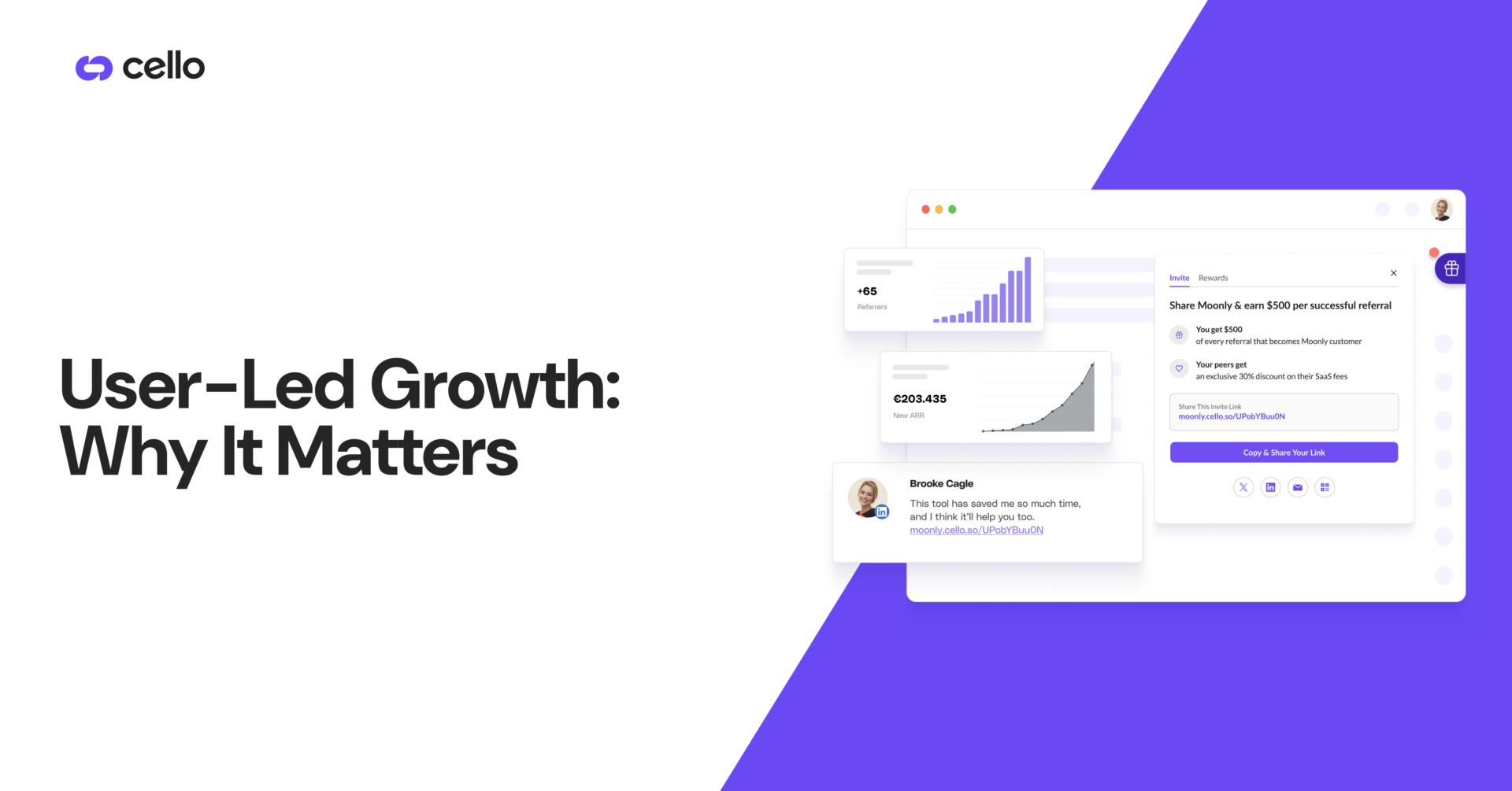

Most B2B SaaS teams measure acquisition through paid search, outbound, and product-led growth motions, but they leave the fourth acquisition surface untouched: the existing user base. User-led growth (ULG) turns paying customers into the distribution layer through instrumented referral programs where each referrer is measured, attributed and rewarded against the same metrics a growth team applies to paid channels. Three structural forces have moved ULG from optional to load-bearing for SaaS growth in 2026: paid acquisition keeps getting more expensive, AI search has restructured organic discovery, and B2B buyers prefer peer signal over cold outreach.
- What is user-led growth?
- How user-led growth differs from product-led growth
- Why user-led growth matters for SaaS in 2026
- The economics of user-led growth
- Core metrics for measuring user-led growth programs
- How to build a user-led growth strategy
- Common mistakes that kill user-led growth programs
- How Cello turns user-led growth into an automated channel
TLDR:
- User-Led Growth (ULG) turns paying customers into acquisition infrastructure through instrumented referral programs where rewards trigger on verified billing events, not impressions or clicks.
- ULG differs from Product-Led Growth by asking what happens after a user converts: the paying customer becomes the next acquisition surface, with each conversion producing a referrer who generates the next at near-zero marginal cost.
- Rising paid CAC and AI search disruption have made ULG load-bearing for sub-$20M ARR SaaS in 2026, as paid channels scale linearly with spend while ULG scales with the user base.
- Track five metrics weekly: referral rate, share rate, conversion rate, referral CAC and program ROI. Stalled programs fail on share rate first, signaling broken launcher placement or reward design.
- Cello automates ULG infrastructure with in-product placement, server-side attribution through Stripe and Chargebee webhooks, and automated payouts across 60+ countries. Softr saw a 5x conversion lift after migrating from an external portal.
What is user-led growth?
User-Led Growth (ULG) turns the existing user base into the primary acquisition channel through instrumented referral programs. The user becomes the distribution layer, not the endpoint. Each paying customer who refers a peer is measured, attributed and rewarded against the same metrics a growth team applies to paid search or outbound.
ULG sits alongside three motions SaaS operators already recognize:
- Marketing-Led Growth (MLG): acquisition driven by paid and organic marketing.
- Sales-Led Growth (SLG): acquisition driven by outbound and deal cycles.
- Product-Led Growth (PLG): acquisition driven by the product itself via freemium and self-serve onboarding.
- User-Led Growth (ULG): acquisition driven by existing users bringing in new users.
What separates ULG from generic word-of-mouth is instrumentation. The referrer is a verified product user, the referral is generated inside the product and conversion events feed billing webhooks so attribution holds at the revenue layer.
How user-led growth differs from product-led growth
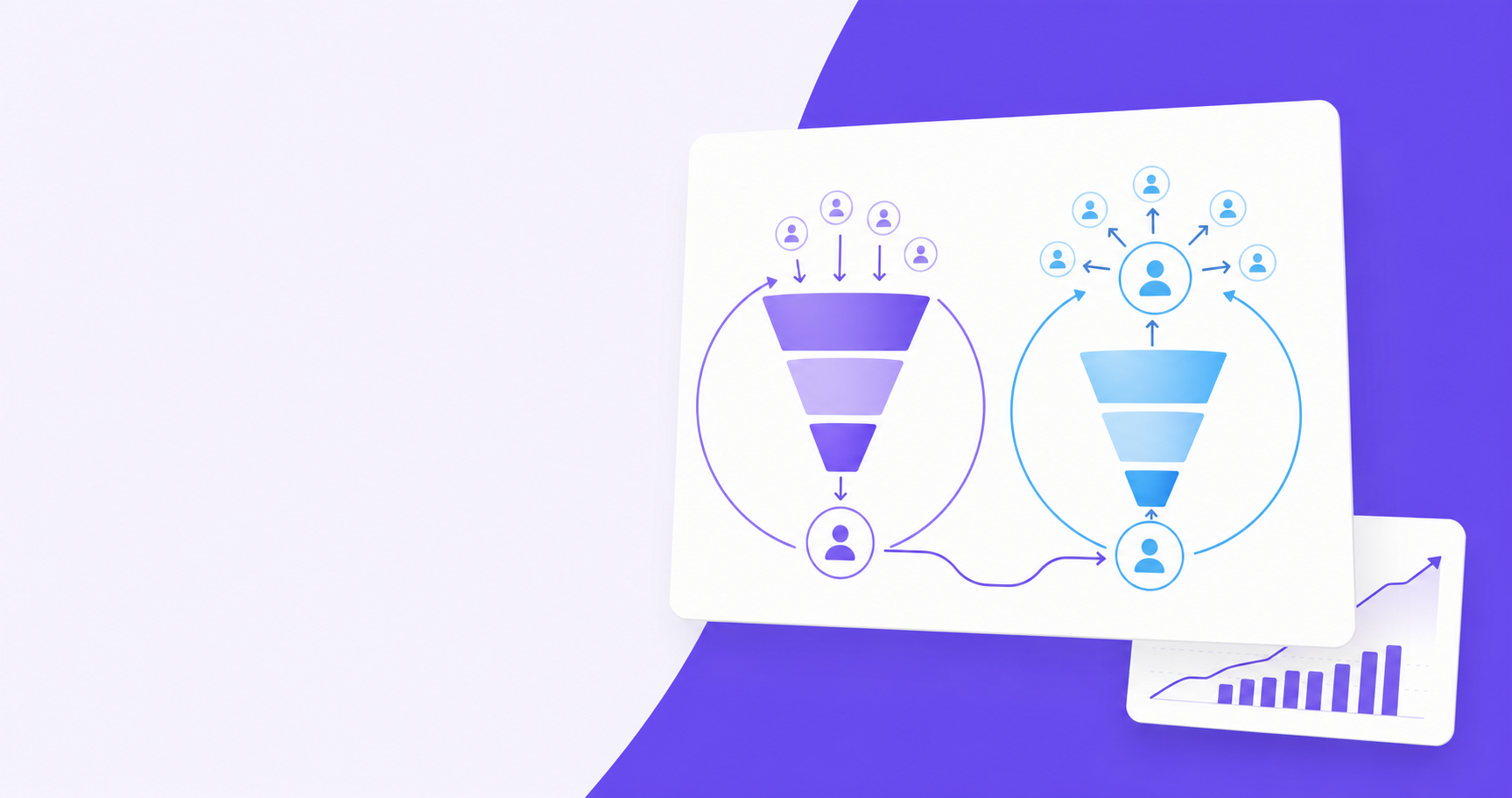
PLG and ULG answer different questions. PLG asks how the product converts a stranger into a paying user through free trials, freemium tiers and self-serve onboarding. ULG asks what to do once that user is paying and engaged: turn them into the next acquisition surface.
|
Dimension |
Product-Led Growth |
User-Led Growth |
|---|---|---|
|
Driver |
The product experience |
The existing user base |
|
Acquisition mechanism |
Free trial, freemium and self-serve signup |
In-product referrals |
|
Conversion event |
Trial to paid |
Referrer brings paying peer |
|
Primary metric |
Activation rate and free-to-paid |
Referral ARR, viral coefficient |
The two motions stack. PLG widens the funnel top and gets users to activation. ULG routes activated users' trust outward, so each paid conversion produces a referrer who generates the next. Teams running PLG without a referral layer leave the highest-trust acquisition surface unmeasured.
Why user-led growth matters for SaaS in 2026
Three structural forces have moved ULG from optional to load-bearing for SaaS growth in 2026.
Paid acquisition keeps getting more expensive. Rising auction competition on paid search and social has compressed margins for sub-$20M ARR SaaS, and channels that absorbed budget several years ago now return a smaller share of pipeline per dollar. Teams are shifting toward channels where reward cost ties to realized revenue, part of a broader move to reduce CAC.
AI search has restructured organic discovery. Answer engines collapse multi-page research into a single response, shrinking the click surface content-led acquisition relied on.
B2B buyers prefer peer signal, as detailed in our complete guide to B2B referral programs. Tremendous' analysis of B2B referral marketing documents referred prospects entering the funnel with higher intent and shorter cycles than cold leads.
Paid scales linearly with spend; ULG scales with the user base through growth loops, so each conversion produces a referrer who generates the next without buying a new impression or click, since reward cost only fires on a verified billing event.
The economics of user-led growth
Paid acquisition pays for impressions, clicks and form fills. Most of that spend resolves before anyone converts, so the channel carries cost on uncertainty. ULG inverts the cost shape: rewards fire only when a referred user crosses a verified billing event, making the channel structurally self-funding.
Industry benchmarks back this out. GrowSurf's SaaS referral statistics catalog the CAC gap between referral marketing for B2B SaaS and paid search across the B2B SaaS base, and Venturz's B2B referral analysis documents referrers absorbing the prospecting work paid channels pay agencies to approximate.
Three economic properties separate ULG from paid:
- Contingent reward cost. Payout triggers on
invoice.paidor equivalent, never on click or impression. - Aligned incentives. A referrer sending low-quality leads earns nothing, so the channel filters itself.
- Compounding base. Each paid conversion adds a potential referrer, so unit economics improve as the program runs.
Core metrics for measuring user-led growth programs
Five metrics tell you whether a referral program is compounding or stalling. Track them weekly, benchmark them quarterly, and tie each one to a named owner.
|
Metric |
Definition |
Working target for B2B SaaS |
|---|---|---|
|
Referral rate |
Share of paying users who have generated a referral link |
20-30% of activated users |
|
Share rate |
Share of active referrers who actually share |
5-15% as a rough working target |
|
Conversion rate |
Referred clicks that turn into paying customers |
10-20% on referred traffic |
|
Referral CAC |
Reward cost plus tooling per acquired paying customer |
Typically 5-10x cheaper than paid acquisition |
|
Program ROI |
Referral ARR divided by total program cost |
3x or higher within 12 months |
Two reads matter most when tracking B2B referral metrics. Share rate diagnoses launcher visibility and reward design; if activated users see the surface but never share, the offer or placement is wrong. Referral CAC against blended paid CAC tells you whether the channel deserves more budget. Stalled programs fail on share rate first.
How to build a user-led growth strategy
Four execution steps separate programs that compound from programs that stall.
- Segment for referrer fit using referral marketing principles. Activated users on a paid tier, with at least one core product action in the last 30 days, are the cohort worth activating first. Free-trial users skew toward reward farming.
- Match reward shape to motivation. Cash works for individual operators; account credits work for buyers whose procurement bars personal payouts; and tiered structures suit power users who refer in clusters.
- Place the launcher where intent peaks. After a successful export, a completed onboarding step, or a billing renewal, not in a settings sub-menu.
- Tie payouts to billing events. Reward triggers on
invoice.paidorcharge.succeeded, with attribution carried server-side through customer-object metadata so cookie loss does not break the chain.
Common mistakes that kill user-led growth programs
Four failure modes account for referral programs converting under 3%. Each has a clean fix.
- One-sided rewards. Paying the referrer while ignoring the referee suppresses conversion on the receiving end. Symmetric offers, where both sides get a discount, credit or trial extension, lift referred-traffic conversion without doubling cost.
- Email-only placement. Burying the program in a monthly newsletter hides it from the users most likely to share. In-product surfaces anchored to high-intent moments outperform email asks on click-through.
- Vague payout terms. "We'll process rewards soon" kills trust on the first cycle. State the trigger event, the payout window and the rail (PayPal, ACH, account credit) on the program page.
- Campaign thinking. Running a referral push for a quarter then sunsetting it prevents compounding. ULG works as an always-on channel with steady reward economics.
How Cello turns user-led growth into an automated channel
Every failure mode above has an infrastructure answer. Cello ships that infrastructure as a drop-in layer for B2B SaaS.
- In-product placement. The referral surface loads inside the authenticated product through web and native mobile SDKs, anchored to high-intent moments. Softr saw a 5x conversion lift after migrating off an external portal.
- Server-side attribution. Conversion events flow through Stripe and Chargebee webhooks via
cello_uccmetadata, so attribution holds when cookies drop. - Automated payouts. Rewards trigger on
invoice.paidand clear through PayPal, ACH, Venmo or UPI across 60+ countries, with fraud detection on every tier. - AI-grounded recommendations. The in-portal AI Assistant reads program metrics against benchmarks and surfaces what to fix next.
Hera went live in two days. Butter in under five hours.
Product-led growth vs user-led growth: what's the actual difference?
PLG converts strangers into paying users through free trials and self-serve onboarding; ULG converts paying users into the next acquisition surface by instrumenting their referrals. PLG widens the funnel top, ULG routes activated users' trust outward so each paid conversion produces a referrer who generates the next. The two motions stack rather than compete.
Can you measure user-led growth the same way you track paid channels?
Yes. ULG becomes measurable when you track five core metrics: referral rate (share of paying users who generate a link), share rate (enabled referrers who actually share), conversion rate (referred clicks that turn into paying customers), referral CAC (reward cost plus tooling per acquired customer), and program ROI (referral ARR divided by total program cost). Track them weekly, benchmark quarterly, and tie each to a named owner.
What kills most user-led growth programs before they compound?
Four failure modes: one-sided rewards that pay the referrer but ignore the referee, suppressing conversion on the receiving end; email-only placement that hides the program from users most likely to share; vague payout terms that kill trust on the first cycle; and campaign thinking that runs referrals as a quarterly push then sunsets it, preventing compounding. Each has a clean infrastructure fix.
Why does server-side attribution matter for B2B SaaS referral programs?
Server-side attribution survives Safari ITP, Firefox ETP, ad blockers, strict CSP, and mobile ATT opt-out by reading conversion events from billing webhooks via customer-object metadata rather than relying on browser cookies. On mobile, industry ATT opt-in averages around 35 percent, meaning the majority of users decline tracking by default—server-side attribution captures those conversions where cookie-based tools lose the attribution chain.
How is user-led growth different from running an affiliate program?
User-led growth turns existing product users into referrers through in-product surfaces and server-side attribution tied to billing events. Affiliate programs route external publishers through link tracking and commission structures. The referrer in ULG is a verified product user sharing from inside the authenticated experience; the referrer in affiliate programs is an external content publisher driving traffic from outside. Cello unifies both motions on one platform but is purpose-built for the user-led motion.
Can you run a referral program for a B2B SaaS product with a sales-led motion and long sales cycles?
Yes. ULG works in sales-led funnels when you trigger rewards on verified billing events rather than self-service signups. Cello tracks conversions through Salesforce Apex Triggers or HubSpot deal associations, so referrers earn rewards when referred leads reach closed-won status and payment clears. Demo attendance and SQL qualification can also serve as intermediate reward triggers to maintain referrer engagement through extended sales cycles.
What's the difference between user referrals and partner programs in a ULG strategy?
User referrals turn existing product users into referrers through in-product surfaces, while partner programs route external non-users like affiliates or investors through a separate portal. The referrer in user referrals is a verified product user sharing from inside the authenticated experience; the referrer in partner programs is an external party driving traffic from outside. Cello unifies both motions on one platform but is purpose-built for the user-led motion.
How do you measure whether a user-led growth program is actually compounding or just generating noise?
Track viral coefficient weekly. A viral coefficient above 1.0 means each referred user becomes a new referrer who generates more than one additional user, creating exponential growth. Below 1.0 means the program stalls. Measure it as (number of new referrers generated by cohort) divided by (size of original cohort), calculated monthly. Programs that compound show increasing viral coefficient over time as referrers activate and share rates climb.
Does user-led growth work for freemium products or only paid tiers?
ULG works in freemium models when you align reward triggers with freemium-to-paid conversion rather than trial signups. Configure reward payouts to fire on verified billing events like invoice.paid or subscription activation, not on free-tier signups, so referrers are compensated only when referred users generate revenue. This prevents negative-margin programs where reward costs exceed realized revenue from high-churn freemium users.
Can referral programs work when your users are competitors who don't want to share leads with each other?
Yes, through segmentation and zero-reward tracking. Configure organization-level exclusion rules to blacklist competitive accounts from the referral program, or set segment-specific reward amounts including zero-reward tracking-only configurations for segments where sharing creates channel conflict. You can also structure rewards as organizational benefits rather than individual payouts to address procurement restrictions in enterprise accounts.
What causes most B2B SaaS referral programs to stall before they reach 3x ROI?
Low share rate kills programs first. When activated users see the referral surface but never share, the problem is launcher visibility or reward design. If users can't find the launcher or the offer doesn't match their motivation, activation dies at the share step before any conversion activity can occur. Fix placement first by moving the launcher to high-intent moments like successful exports or billing renewals, then test reward structures.
How does ULG compare to product-led growth as an acquisition strategy?
PLG converts strangers into paying users through free trials and self-serve onboarding; ULG converts paying users into the next acquisition surface by instrumenting their referrals. PLG widens the funnel top, ULG routes activated users' trust outward so each paid conversion produces a referrer who generates the next. The two motions stack rather than compete, and teams running PLG without a referral layer leave the highest-trust acquisition surface unmeasured.
Can you run user-led growth without requiring engineering resources for ongoing maintenance?
Yes, when the vendor absorbs the infrastructure jobs that decay. Buying moves engineering work from infrastructure to integration: the one-time lift is SDK installation, identity token wiring and webhook configuration. The vendor owns recurring jobs like cookie-blocked attribution handling, payout retry logic, fraud rule updates and tax-form validation. Your engineering lift after go-live is program optimization, not plumbing maintenance.
What's the fastest way to validate whether a referral program will work for your SaaS product before committing budget?
Run a three-month pilot with a whitelisted user segment. Enable the referral surface for your highest-engagement paid users, track share rate and conversion rate weekly, and measure referral CAC against blended paid CAC. If share rate climbs above 5 percent and referral CAC lands below half your paid CAC within 90 days, the channel is viable. If share rate stays flat, the placement or reward design is wrong.
Should you reward both the referrer and the referee in a B2B SaaS referral program?
Yes. Symmetric rewards where both sides get a discount, credit or trial extension lift referred-traffic conversion without doubling cost. One-sided rewards that pay the referrer but ignore the referee suppress conversion on the receiving end because the referred user has no immediate incentive to complete signup. Two-sided structures align both parties' incentives and produce higher conversion rates than referrer-only programs.