
An affiliate program is a performance-based marketing arrangement where a merchant pays a third-party promoter a commission only after a referred visitor converts. The merchant sets the offer and commission rate, the affiliate promotes a unique tracking link through content or paid media, and the tracking layer attributes the conversion and calculates the payout. No conversion, no cost. That mechanic is why acquisition spend becomes a variable cost tied directly to revenue. Whether you are launching a program or joining one, the details decide whether it works: commission rates cluster by vertical, with SaaS and digital goods paying 20 to 50 percent because marginal cost per sale is near zero, while physical products sit at 5 to 15 percent since margins absorb the reward directly.
- What is an affiliate program?
- How affiliate programs work
- Types of affiliate programs
- Affiliate commission rates by industry
- Affiliate program vs referral program
- Benefits of running an affiliate program
- How to start an affiliate program
- Common affiliate program mistakes
- Affiliate programs for B2B SaaS companies
- Referral programs as automated acquisition channels for B2B SaaS
- Final thoughts on affiliate marketing infrastructure
TLDR:
- Affiliate programs pay third-party promoters only after a conversion lands, turning acquisition into a variable cost tied directly to revenue.
- SaaS commission rates run 20% to 50% (often recurring), while physical products sit at 5% to 15% due to margin constraints.
- Server-side attribution closes the gap cookie-only tracking leaves when Safari ITP and ad blockers drop attributable conversions.
- Most programs fail on commission rates set above gross margin, vague terms or delayed payouts past 60 days from conversion.
- Cello's Referral Component runs server-side attribution against Stripe, Chargebee, Paddle and Recurly webhooks, surviving ITP and ATT opt-out where cookie setups collapse.
What is an affiliate program?
An affiliate program is a performance-based marketing arrangement where a business pays third-party promoters a commission for driving sales, leads or other agreed actions. The affiliate receives a unique tracking link tied to their account. When a click converts into the merchant's defined action, the system credits the affiliate and triggers a payout.
Three pieces hold the model together:
- The merchant, who sets the offer, commission rate and qualifying action.
- The affiliate, who promotes the link through content, email, social channels or paid media.
- The tracking layer, which attributes the conversion and calculates the reward.
Affiliate marketing drives roughly 16 percent of all online orders in the US and Canada. The merchant only pays after the conversion lands.
How affiliate programs work
The mechanics run in a predictable sequence:
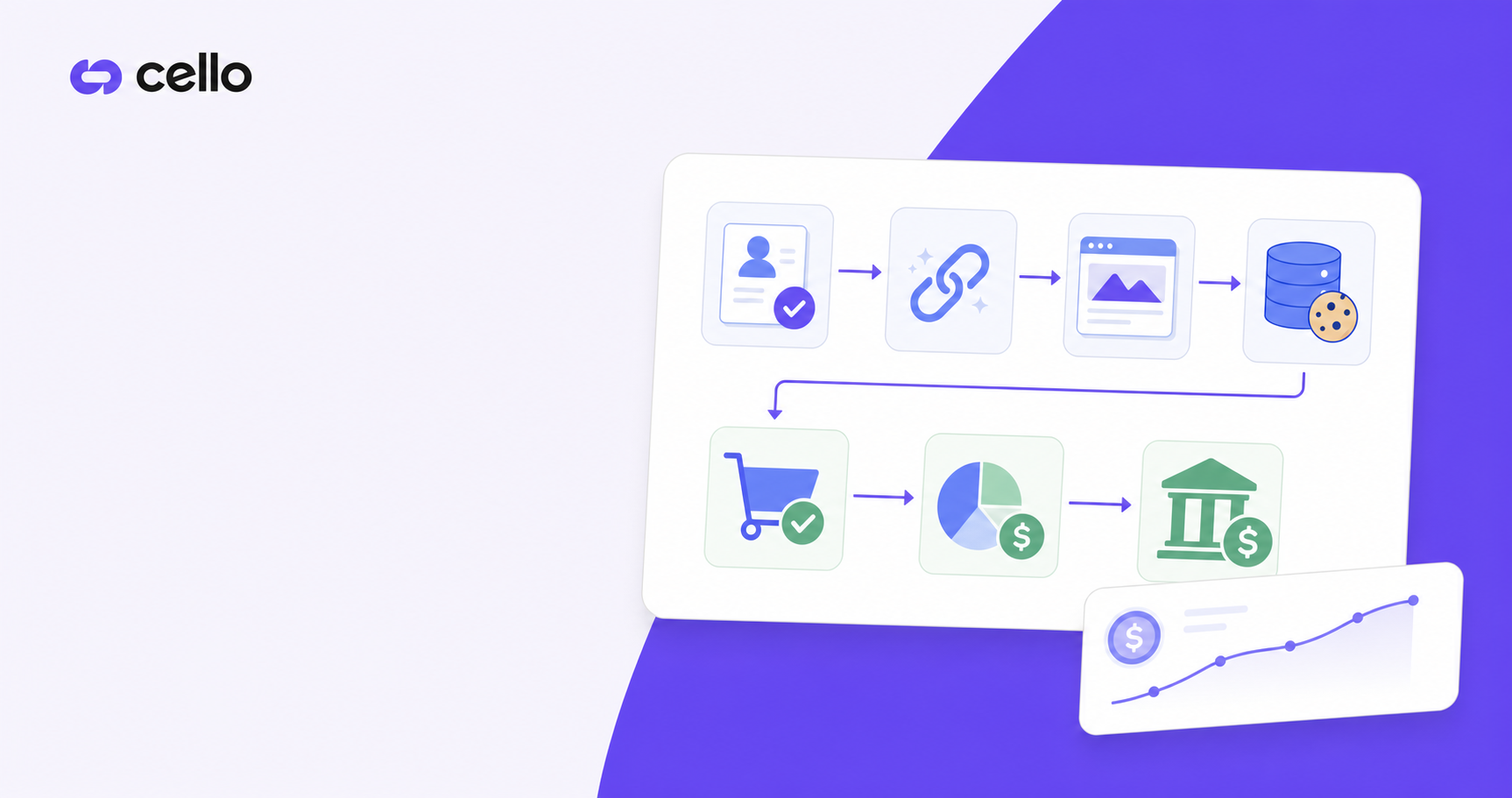
- Affiliate applies. The merchant reviews the application against program criteria (audience fit, content type, geography) and approves or rejects.
- Tracking link issued. Each approved affiliate receives a link carrying a unique identifier that maps clicks back to their account.
- Promotion. The affiliate places the link in blog posts, YouTube descriptions, newsletters, social bios or paid ads.
- Click and cookie drop. A first-party cookie stores the affiliate ID for a defined window, typically 24 hours to 90 days. Server-side tracking captures the same event without depending on browser cookies.
- Conversion attribution. If the visitor converts inside the window, the merchant's billing system fires a webhook that credits the affiliate.
- Commission calculation. Reward logic applies the agreed rate (percentage of revenue, flat fee per sale, or tiered amount).
- Payout. After a holding period covering refunds and fraud review, the commission moves to the affiliate via PayPal, bank transfer or store credit.
Types of affiliate programs
Affiliate programs split along payout triggers. The trigger you pick shapes which affiliates apply, how much fraud you absorb, and how cleanly the program ties to revenue.
- Pay-per-sale (PPS). Commission fires only when a referred visitor buys. Lowest risk, dominant in SaaS and ecommerce.
- Pay-per-lead (PPL). Payout triggers on a qualified action: form fill, demo booked, trial started. Fits sales-led funnels.
- Pay-per-click (PPC). Affiliates earn on raw traffic. Rare today due to fraud exposure.
- Recurring commission. A percentage of every renewal across the customer's lifetime or a defined window. Subscription products favor it.
Pay-per-sale carries the lowest fraud risk and dominates ecommerce and one-time SaaS. Pay-per-lead sits at medium fraud risk and fits sales-led B2B, insurance and finance. Pay-per-click exposes high fraud risk and is rare today outside brand awareness pushes. Recurring commission carries low fraud risk and is the standard for subscription SaaS. Hybrid structures (flat bonus plus recurring percentage or tiered rates that escalate with volume) layer on top. Shopify's commission breakdown documents the trade-offs across models.
Affiliate commission rates by industry
Commission rates cluster by vertical. SaaS and digital goods (courses and ebooks) pay 20 percent to 50 percent, often recurring, because marginal cost per sale is near zero. Subscription services sit at 15 percent to 30 percent. Physical products (DTC and retail) pay 5 percent to 15 percent since margins absorb the reward directly. Finance and insurance pay flat fees of $50 to $500 per qualified lead. Figures pulled from Shopify's commission benchmarks and Linkjolt's 2026 rate survey. Amazon Associates anchors the floor at 1 percent to 10 percent by category, which is why serious affiliates diversify beyond it.

Affiliate program vs referral program
The two models share a payout mechanic and diverge on who promotes the product. Affiliate programs recruit external marketers (publishers, creators, coupon sites) who often have no first-hand product experience and treat the link as inventory. Referral programs activate existing customers sharing with peers, where trust drives conversion.
|
Dimension |
Affiliate program |
Referral program |
|---|---|---|
|
Promoter |
External marketer |
Existing customer |
|
Trust signal |
Publisher reach |
Peer recommendation |
|
Reward |
Cash commission |
Cash, credit or discount |
|
Channel |
Blogs, paid ads, YouTube |
In-product share, email, peer messaging |
|
Best fit |
Top-of-funnel reach |
Lower-CAC acquisition |
A fuller breakdown sits in GrowSurf's comparison guide. Pick affiliate for scale; pick referral when users are engaged to vouch for you.
Benefits of running an affiliate program
Affiliate programs convert acquisition spend into a variable cost tied directly to revenue. The merchant absorbs no media risk, since payout fires after the conversion lands.
- Performance-based economics. Commission is a known percentage of realized revenue, so CAC stays bounded.
- Reach without headcount. Each approved affiliate extends distribution into audiences the in-house team does not own.
- Compounding content. Blog posts and videos carrying affiliate links keep driving traffic years after publication.
- Channel diversification. Affiliate revenue reduces dependence on paid search and paid social, where bid costs climb every quarter.
How to start an affiliate program
A workable launch sequence runs in five steps:
- Set commission economics. Decide PPS, PPL or recurring, then anchor the rate to gross margin (SaaS lands 20% to 30% recurring; physical goods 5% to 15%).
- Write the program terms. Cookie window, qualifying events, refund clawback period, prohibited promotion methods (trademark bidding, incentivized clicks).
- Pick tracking infrastructure. Server-side attribution tied to billing webhooks beats cookie-only setups, since browser tracking degrades under ITP and ad blockers.
- Recruit the first cohort. Target publishers ranking for your category, then layer in newsletter operators and YouTube reviewers.
- Automate payouts. Connect PayPal, ACH or bank transfer to a holding period covering refunds.
Most programs go live in two to four weeks if billing data sits in Stripe or Chargebee.
Common affiliate program mistakes
Five mistakes recur often enough to predict program failure before launch:
- Commission rates set above gross margin. A 40 percent payout on a product with 30 percent margins guarantees losses. Anchor the rate to contribution margin after refunds and processor fees.
- No affiliate support. Approved affiliates left without creative assets, performance data or a contact point churn inside 60 days.
- Vague terms. Missing clauses on trademark bidding, coupon stacking and refund clawback invite disputes that consume operator time.
- Cookie-only tracking. Safari ITP and ad blockers drop a material share of attributable conversions; server-side attribution against billing webhooks closes the gap.
- Delayed payouts. Pushing payment past 60 days from conversion erodes affiliate trust faster than any other program decision.
Affiliate programs for B2B SaaS companies
B2B SaaS affiliate economics run on different math than retail. Lifetime values in the thousands let merchants pay 20% to 50% of first-year revenue, with recurring percentages stretching across renewals. The reward moves from a one-time bounty into an annuity, which changes who applies and how long they keep promoting.
Three structural differences shape the model:
- Sales cycles span weeks to months. Attribution must survive multi-touch journeys: a podcast mention, a comparison post, a demo booking, then a closed-won event 60 days later. Last-click cookies collapse; CRM-tied attribution against deal stages holds up.
- Integration partners are the strongest affiliate cohort. A Zapier or HubSpot connector vendor already owns the audience and credibility, and the reward maps cleanly to their customer base.
- Qualifying events sit deeper than purchase. Demo attended, trial activated and SQL stages all matter, since revenue lags signup by a quarter or more.
Referral programs as automated acquisition channels for B2B SaaS
Referral programs sit closer to billing infrastructure than to traditional affiliate networks. Cello's Referral Component embeds inside web and mobile apps via JS and native SDKs, so the share surface lives where engaged users already are. Attribution runs server-side against Stripe, Chargebee, Paddle and Recurly webhooks, holding up under Safari ITP, ad blockers and ATT opt-out where cookie-only setups collapse.
The pieces that usually consume engineering time ship in the box:
- Automated reward calculation tied to
invoice.paidandcharge.succeededevents. - Multi-currency payouts via PayPal, Venmo, ACH and UPI across 60+ countries.
- Native fraud detection with a 30-day review window and refund clawback.
- User referrals and partner programs unified on one system.
Published outcomes anchor the model: VEED cut CAC 90.4% versus paid, Moss reduced CAC 50% versus inbound, and Softr recorded a 5x conversion lift after migrating from an external portal.
Final thoughts on affiliate marketing infrastructure
Affiliate programs convert media spend into a variable cost tied to realized revenue, but only if the tracking layer survives cookie deletion and the payout system runs without operator babysitting. Cello was built for B2B SaaS teams running referrals as acquisition infrastructure, not a side project. Server-side attribution holds when browsers block cookies, and reward logic fires automatically against your billing webhooks. You define the offer; the system executes it.
Can I run an affiliate program without building my own tracking infrastructure?
Yes. Server-side attribution platforms tie directly to billing webhooks from Stripe, Chargebee, Paddle or Recurly, so conversion tracking, reward calculation and payout triggers run automatically without custom engineering. Cello attributes referrals server-side against `invoice.paid` and `charge.succeeded` events, which means tracking survives Safari ITP, ad blockers and ATT opt-out where cookie-only setups collapse.
What's the difference between an affiliate program and a referral program for B2B SaaS?
Affiliate programs recruit external marketers who treat the link as inventory and often have no product experience, while referral programs activate existing customers sharing with peers where trust drives conversion. Affiliate programs fit top-of-funnel reach; referral programs deliver lower-CAC acquisition when your user base is engaged enough to vouch for you.
Affiliate program vs partner program—which model fits sales-led B2B SaaS?
Partner programs work best when integration partners or strategic resellers already own your target audience and credibility. Commission structures in B2B SaaS run 20% to 50% of first-year revenue with recurring percentages across renewals, and attribution must survive multi-touch journeys spanning weeks to months—last-click cookies collapse, but CRM-tied attribution against deal stages holds up
How do I prevent affiliate fraud without hiring a dedicated analyst?
Automated fraud detection at the attribution layer flags self-referrals, duplicate signups and reward-threshold manipulation before a payout clears. Cello runs fraud detection automatically on all tiers with a 30-day review window, refund clawback on Stripe `charge.refunded` events, and a manual review workflow for edge cases—no dedicated headcount required.
What's the difference between pay-per-sale and pay-per-lead affiliate models for B2B SaaS?
Pay-per-sale triggers commission only when a referred visitor completes a purchase, which minimizes fraud risk and aligns payout directly with revenue. Pay-per-lead pays on qualified actions such as demo bookings or trial signups before revenue lands, fitting sales-led funnels where conversion happens weeks or months after the initial signup event.
Can I run an affiliate program if my product uses annual contracts instead of monthly subscriptions?
Yes. Attribution tracks conversions across annual billing cycles by processing the qualifying event when the contract closes or the first payment clears, not when renewal charges fire monthly. Server-side attribution tied to billing webhooks captures the invoice.paid or charge.succeeded event regardless of billing frequency.
Do I need to handle tax forms and 1099 filing myself when running an affiliate program?
Not if the platform acts as Merchant of Record for referral payouts. When Cello operates as MoR, it collects W-9, W-8BEN and W-8BEN-E forms at partner enrollment, applies withholding per jurisdiction, files 1099-NEC and DAC7 documentation, and books itself as payer of record on credit notes.
Affiliate program vs influencer partnership—what's the structural difference?
Affiliate programs recruit external marketers who treat the link as inventory and promote across owned channels, while influencer partnerships typically involve fixed sponsorship fees or product seeding before performance tracking begins. Both can use affiliate tracking infrastructure, but influencer deals often layer brand partnerships on top of the performance component.
How do I prevent affiliates from bidding on my brand name in paid search?
Program terms must explicitly prohibit trademark bidding, brand-name keyword purchases and direct-navigation ad placements. Enforcement requires monitoring search results for unauthorized ads and suspending affiliates who violate the policy after a single warning
What commission rate should I set for SaaS affiliate programs?
SaaS commission rates run 20% to 50% of first-year revenue because marginal cost per sale is near zero and lifetime values justify higher upfront payouts. Anchor the rate to gross margin after refunds and processor fees, then decide whether to pay one-time or recurring across renewals.
Can affiliate tracking survive when users block cookies or use Safari?
Server-side attribution tracks conversions independently of browser cookies by reading referral parameters at the server layer and matching them to billing events from Stripe, Chargebee or Paddle webhooks. This architecture holds when Safari ITP blocks cookies, ad blockers strip tracking scripts and mobile users decline ATT opt-in.
How long should the cookie window be for B2B SaaS affiliate programs?
B2B sales cycles span weeks to months, so attribution windows of 60 to 90 days are standard. Shorter windows lose conversions from prospects who click a referral link, evaluate alternatives and convert later; longer windows increase the risk of crediting affiliates for unrelated conversions.
Do I need a dedicated fraud analyst to run an affiliate program?
Not if fraud detection runs automatically at the attribution layer. Automated systems flag self-referrals, duplicate signups and reward-threshold manipulation before payouts clear, with manual review workflows for edge cases and a holding period covering refunds.
What's the fastest way to launch an affiliate program for a B2B SaaS product?
Server-side attribution tied to existing billing webhooks from Stripe or Chargebee collapses launch time to days instead of quarters. The tracking layer reads conversion events from your billing system without requiring custom engineering, and automated reward calculation triggers payouts when invoice.paid events fire.