

TL;DR
- Referral marketing is a structured strategy where companies incentivize existing customers to refer new ones, distinct from word-of-mouth, which is organic and unprompted.
- 83% of customers are willing to refer a brand they love, but only 29% actually do without a prompt or incentive (Extole, 2024).
- Referred customers tend to have higher lifetime value and convert at higher rates than outbound-sourced leads (CustomerGauge).
- For B2B SaaS, in-product referral programs outperform email-based referral programs by 3-5x in participation rate.
Referral marketing has become an important strategy for businesses looking to grow and expand their customer base. In this guide, we cover referral marketing's definition, importance, mechanics, and different types. We will also discuss how businesses can implement a successful referral marketing strategy and measure its success through key performance indicators (KPIs). So, let’s jump right in and uncover the power of referral marketing!
Key Element | Description | Tips for Implementation |
|---|---|---|
Understanding Referral Marketing | Draws on the influence of existing customers to acquire new customers through word-of-mouth. | Identify target customers, create compelling incentives, develop a referral program, promote the program, and track results. |
Importance of Referral Marketing | High conversion rate due to trust in recommendations, driving customer acquisition and building loyalty. | Set clear objectives, understand target audience, provide compelling incentives, offer easy-to-use referral tools, reward both referrers and referees, and promote the program. |
Role in Business Growth | Maximizes lifetime value of existing customers, expands reach, and enhances customer satisfaction leading to overall business growth. | Implement strategies to encourage referrals, focus on customer satisfaction, and measure ROI. |
Mechanics of Referral Marketing | Involves structured processes with incentives for successful referrals, often initiated by businesses. | Create a clear referral program with easy processes, provide user-friendly referral tools, offer attractive rewards, promote the program, and track results. |
Types of Referral Marketing | Customer Referral Programs, Affiliate Referral Programs and Partner Referral Programs. | Choose the type that aligns with business goals, build partnerships, incentivize referrers and track performance. |
Understanding the concept
Referral marketing is a powerful technique that draws on the influence of existing customers to acquire new customers. It uses the trust and recommendation of satisfied customers, who promote a product or service to their friends, family, or colleagues. This positive peer endorsement is the driving force behind referral marketing's effectiveness.
Definition and importance
Referral marketing can be defined as a strategy that encourages and incentivizes individuals to refer others to a particular product or service. It draws on the natural inclination of people to share positive experiences and recommendations with their social network.
Word-of-mouth is organic, unsolicited and untracked. It happens when a customer naturally mentions a product to a contact with no formal program involved. Referral marketing is deliberate, structured and measurable: the business designs a program with defined incentives, tracks each referral through unique links or codes, and ties rewards to verified conversions. Referral marketing is built to capture and scale what would otherwise be casual word-of-mouth.
Referrals are highly valuable for businesses because they tend to have a higher conversion rate compared to other marketing channels. When potential customers receive recommendations from their trusted sources, they are more likely to trust the product or service being endorsed. Trust plays a fundamental role in the buying decision-making process, making referral marketing a powerful tool for driving customer acquisition and building loyalty.
Key benefits of referral marketing
- Lower customer acquisition cost, because rewards are paid only on successful conversions, not on impressions or clicks, making cost per acquisition a fraction of paid channels.
- Higher conversion rates, because referred prospects arrive with a trust signal from someone they know, so they convert at higher rates than cold leads.
- Higher customer lifetime value, since referred customers tend to generate higher lifetime value than non-referred ones (CustomerGauge), making each referral worth more over time.
- Built-in loyalty loop, since referring deepens the referrer's own commitment to the brand, reducing churn among your most active advocates.
- Scales with low overhead, because once the program is live, sharing and attribution run without constant manual input, compounding over time.
- Works at any budget, because cost scales with results instead of upfront spend, so referral programs are viable for teams of all sizes.
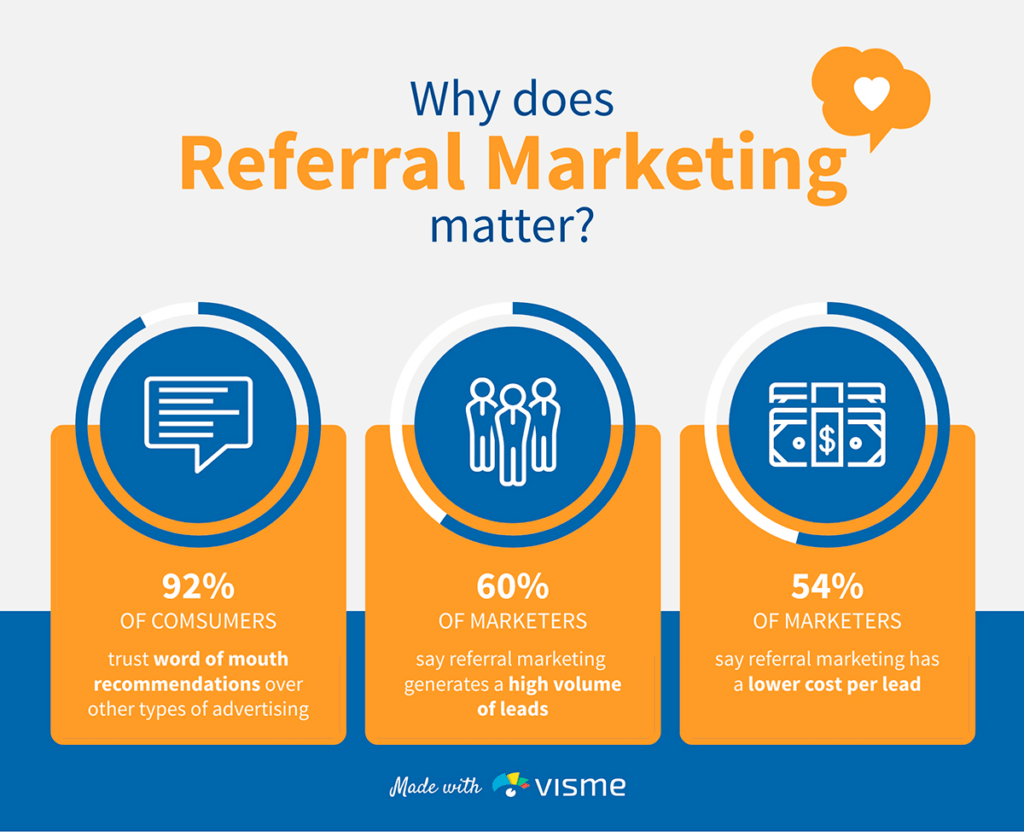
Referral marketing supports the customer acquisition process (Source: Visme)
Role in business growth
Referral marketing covers more than acquiring new customers. It also works to maximize the lifetime value of existing customers. By encouraging customers to refer others, businesses can tap into a network of potential customers who share similar interests and characteristics with their existing customer base.
When customers refer others, they are essentially vouching for the brand. This creates a ripple effect, expanding the reach of the business and attracting customers who are more likely to have a positive experience, leading to increased customer satisfaction and overall business growth.
The mechanics
Now that we have a clear understanding of referral marketing's definition and importance, let's look at how it works and the key components that make up a successful referral marketing strategy.
How it works
Referral marketing typically involves a structured process that encourages customers to refer others. This process is often initiated by the business, which provides customers with incentives or rewards for successful referrals.
The mechanics of referral marketing can vary depending on the business and industry, but the underlying principle remains the same. Customers are given a unique referral link or code that they can share with their contacts. When someone uses this link or code to make a purchase or sign up for a service, the referrer is rewarded. This normally happens through discounts, freebies, or other desirable benefits.
A few well-known cases illustrate this pattern clearly. Dropbox rewarded both the referrer and the new user with extra storage space, which grew signups by 60% during its early growth phase. Uber gave ride credits to both parties after each successful referral. Airbnb offered travel credits to referrers and new guests alike, building a referral engine that drove notable early user growth across markets.
Key components of a referral marketing strategy
In order to create an effective referral marketing strategy, businesses need to have a clear plan in place. Here are some key components that should be considered:
- Step 1: Identify your target referrers by pinpointing the users most likely to share. Analyze your most satisfied, active customer segment; these are your most likely advocates. Look at usage frequency, support ticket history and NPS signals to find the right cohort.
- Step 2: Design the incentive by picking a reward that matches the product's value. Discounts, account credits and cash payouts all work; the best choice aligns with what your users already value. Two-sided rewards (for both referrer and referee) consistently raise participation.
- Step 3: Build your referral program by defining the mechanics before writing a line of code. Decide on eligibility rules, reward triggers and attribution logic; document them so the program is repeatable and auditable from day one.
- Step 4: Choose your referral mechanics by deciding between a referral link, a code and an in-app widget. In-product referrals drive 3-5x higher participation than email-only flows; referral codes suit checkout-heavy funnels; links work across both surfaces. Pick the mechanic that fits where your users spend the most time.
- Step 5: Promote the program by actively telling users it exists. Email your most active users on launch day, add an in-product announcement and link the program from onboarding. Low visibility is the top reason programs underperform.
- Step 6: Optimize over time by treating the program as a live growth channel, not a one-time launch. A/B test reward amounts and messaging, monitor participation and sharing rates against benchmarks, and iterate every 30-60 days.
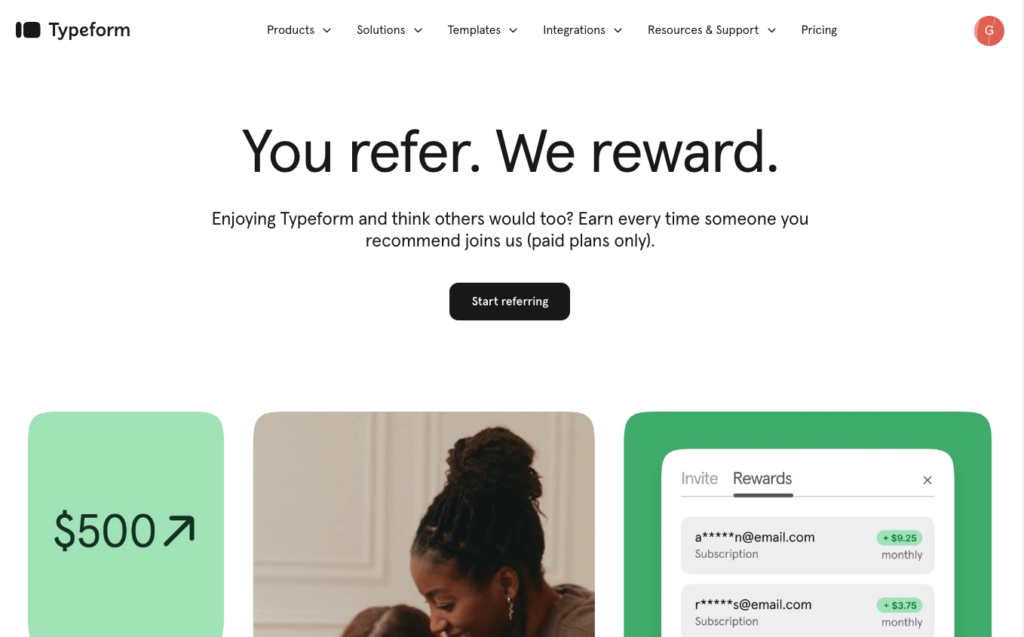
Major SaaS firms such as Typeform rely on referral marketing for their growth (Source: Typeform)
Different types
Referral marketing comes in various shapes and forms. Here are the three main types:
Customer referral programs
Customer referral programs are the most common and straightforward type of referral marketing. They involve incentivizing existing customers to refer others to the business. By rewarding customers for successful referrals, businesses can tap into their loyal customer base and benefit from their positive experiences.
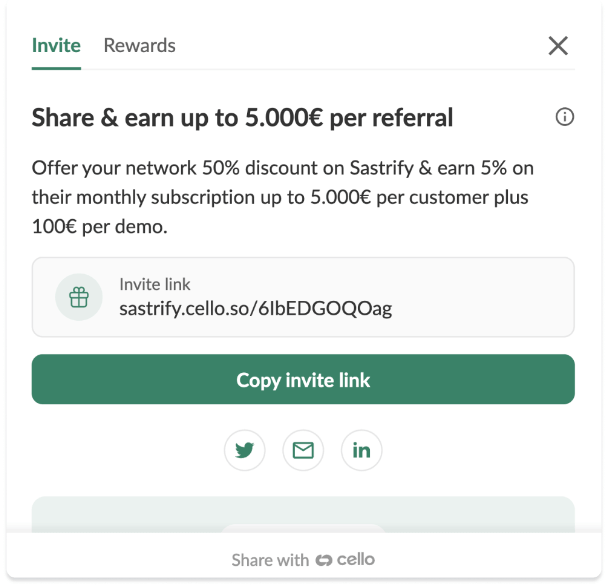
Sastrify makes it easy for its users to share their product (Source: Sastrify)
Affiliate referral programs
Affiliate referral programs engage individuals or organizations outside of the business as referrers. These individuals or organizations, known as affiliates, are motivated to promote the business in exchange for a commission or a percentage of sales generated through their referrals. Affiliate referral programs can be particularly effective for businesses with an online presence, as they can tap into the network and reach of these affiliates. For a detailed look at how the two approaches compare, see our guide on referral vs affiliate programs.
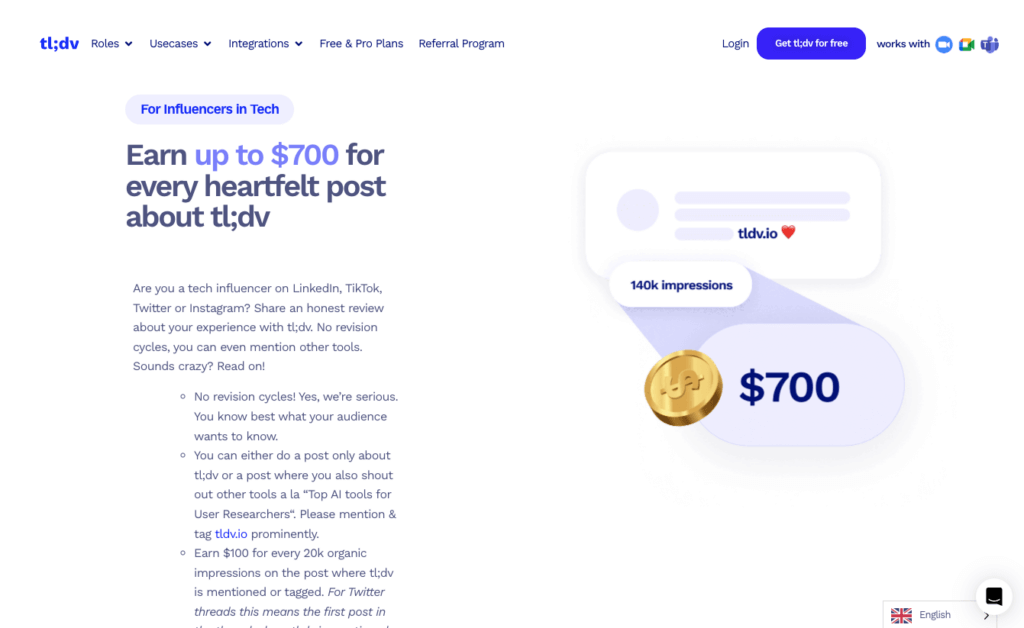
Working with affiliates and influencers can increase the reach of your product (Source: tl;dv)
Partner referral programs
Partner referral programs involve collaborating with other businesses or organizations to refer customers to each other. This type of referral marketing is highly beneficial when there is a a natural fit between complementary products or services. By referring customers to trusted partners, businesses can enhance their offering and provide additional value to their customers.
Implementing a referral marketing strategy
Now that we have covered the mechanics and different types of referral marketing, let's discuss how businesses can successfully implement a referral marketing strategy.
Steps to create a successful referral program
Creating a successful referral program requires careful planning and execution. Here are some essential steps to follow:
- Set clear objectives: Define your goals and objectives for the referral program. Are you aiming to increase customer acquisition, improve customer retention, or drive sales? Having clear objectives will guide your decision-making process throughout the program’s implementation.
- Understand your target audience: Gain a deep understanding of your target audience, including their preferences, motivations, and communication channels. This will help you tailor your referral program to resonate with your customers.
- Create compelling incentives: Develop incentives that are valuable to your target audience and align with the overall customer experience. Consider offering exclusive discounts, free upgrades, or even access to VIP events.
- Provide easy-to-use referral tools: Make it effortless for customers to refer others by providing user-friendly referral tools, such as customizable referral links, social sharing buttons, or email templates.
- Offer rewards for both referrers and referees: To encourage participation and make the program mutually beneficial, consider providing rewards for both the referrer and the referred customer. This can create a win-win situation and further motivate customers to participate.
- Promote your referral program: Spread the word about your referral program through various marketing channels, including email campaigns, social media posts, and dedicated landing pages. You can also use an infographic creator to create engaging visuals that highlight the benefits of joining the program and encourage participation. Communicate the benefits of participating and share success stories to generate excitement and engagement.
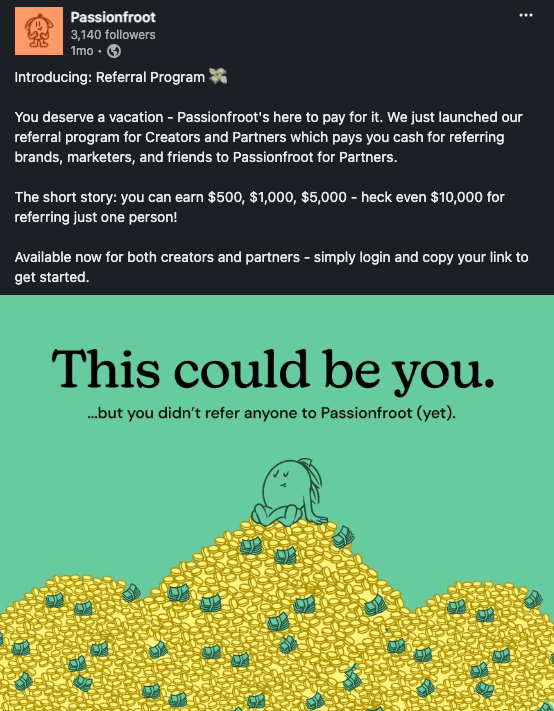
Promoting your referral program on your website and social media is key to its success.
Tools and software
To simplify the implementation and management of a referral marketing strategy, businesses can use a wide range of tools and software. These platforms offer features such as automated referral tracking, customizable referral workflows and analytics to measure the performance of the referral program. Some popular referral marketing tools include ReferralCandy, Cello, Refersion and Ambassador. For a broader comparison, see our roundup of referral program software options.
Measuring success
Measuring the success of your referral marketing strategy matters for understanding its impact on your business. By tracking key performance indicators (KPIs), you can assess the effectiveness and ROI of your referral program.
Key performance indicators
Here are some important KPIs to consider when measuring the success of your referral marketing efforts:
- Referral conversion rate: Measure the percentage of referrals that result in a successful conversion, such as a purchase or sign-up.
- Referral traffic: Monitor the amount of website traffic generated through the referral program to assess its impact on your overall web performance.
- Customer lifetime value: Analyze the value generated by referred customers over their lifetime to determine the long-term impact of your referral program.
- Customer satisfaction: Collect feedback from both referrers and referees to gauge their satisfaction levels and assess the overall effectiveness of your referral program.
Industry estimates for well-run programs give the following benchmark ranges.
KPI | Typical benchmark |
|---|---|
Referral participation rate | 5-15% of active customers (well-designed in-product programs, industry estimates) |
Referral conversion rate | 10-30% of referred leads convert, vs. 2-5% for cold outbound (industry estimates) |
Referred customer LTV uplift | ~25% higher than non-referred (CustomerGauge, 2026) |
Cost per referred acquisition | 50-75% lower than paid channels (industry estimates) |
Analyzing and improving your referral marketing strategy
Continuous analysis and improvement are key to improving your referral marketing strategy. Regularly review the performance of your program, identify areas for improvement, and implement necessary adjustments. Test different incentives, messaging, and promotional tactics to find what resonates best with your audience.
Remember, referral marketing is an ongoing process that requires dedication and adaptation. With the right strategy and tools in place, referral marketing can be a powerful driver of growth for your business. So, tap into the potential of word-of-mouth and start activating the power of referrals today! To see how referral cost stacks up against paid channels, read our comparison of referral vs paid acquisition ROI.
What is the difference between referral marketing and word-of-mouth marketing?
Word-of-mouth is organic and unprompted. It happens when a satisfied customer tells a friend with no formal program in place. Referral marketing is a structured, incentive-driven program the business actively runs, using unique links or codes to track each referral and reward referrers on successful conversion.
How much does referral marketing cost?
Referral marketing is typically lower-cost than paid acquisition because rewards are paid only on successful conversions, not on impressions or clicks. The main costs are the reward value itself and the platform used to run the program. For in-product programs, cost per acquisition is often a fraction of paid search or social.
What types of incentives work best in referral programs?
Discounts, account credits, cash rewards and free product tiers all perform well. The best incentive aligns with the product's core value: a storage tool offering extra storage, a SaaS tool offering free months. Two-sided incentives (rewarding both referrer and referee) consistently outperform one-sided structures in participation rate.
How long does it take to see results from a referral program?
In-product referral programs can see early participation within weeks of launch. Sustained, compounding results typically build over 2-3 months as more users share and referred users convert. Programs launched without visible in-product placement or without promoting the program to existing users take longer to gain traction.
Is referral marketing suitable for B2B companies?
Yes. B2B referral programs often take the form of partner or customer advocacy programs rather than simple cash rewards. They tend to produce high-value leads because B2B referrers are recommending to peers with similar job roles and budget authority, resulting in faster sales cycles and stronger retention.
What is the difference between a referral program and an affiliate program?
A referral program asks your existing users to invite people they know personally, typically through an in-product sharing experience. An affiliate program recruits external publishers or content creators to promote your product to their audience for a commission. Referral programs tend to produce higher-quality leads because the referrer has a direct relationship with the prospect. Affiliate programs extend reach further but require vetting and managing a network of external partners.
How do I choose a referral tool for a PLG product?
For a product-led growth product, the most important factor is whether the referral tool can embed inside your product instead of routing users to an external portal. In-product referral widgets drive 3-5x higher participation than email-only approaches. Look for server-side attribution (to survive ad-blockers and browser privacy restrictions), fast setup timelines measured in days, not months, and support for two-sided rewards. A tool that handles both user referrals and partner referrals from one program saves you running separate systems.
How do I increase participation in my referral program?
Low participation usually comes from low visibility. Add in-product prompts at high-intent moments: after a successful action, at the end of onboarding, or when a user hits a usage milestone. Email your most active users directly on launch day and again after 30 days. Two-sided rewards (where both referrer and new user get something) consistently raise participation versus one-sided structures. If participation is still low, survey users about what reward would motivate them.
Can a non-technical team manage a referral program?
Yes, once the initial integration is live. Most modern referral tools offer a no-code dashboard for adjusting reward amounts, viewing participant data, approving payouts, and editing sharing copy. The technical setup (embedding the widget, connecting the API) typically takes a developer one to two days. After that, a marketing or growth manager can run the day-to-day program without engineering support.
How do I keep a referral program top-of-mind for existing users?
Schedule regular touchpoints: a 30-day re-engagement email to users who viewed the program but have not shared yet, a monthly update showing top referrers or total rewards paid out, and in-product milestone prompts when a user reaches a usage threshold. Seasonal incentive boosts (for example, a doubled reward for two weeks) also reactivate dormant referrers without requiring a permanent reward increase.