

A referral fee is a commission paid to an individual or company for directing a new customer, client, or business opportunity to another party. Referral fees appear across real estate, SaaS, legal services, e-commerce, financial services, and recruiting.
However, implementing a referral fee program requires careful planning and adherence to best practices to ensure its success. In this article, we’ll explore the concept of referral fees, their importance, challenges, strategies for setting them up, and the tax and legal implications, all while integrating best practices throughout.
TLDR:
- Referral fees are commissions paid for directing new customers to a business, taking forms from flat fees to subscription-based recurring payouts depending on industry and model.
- B2B SaaS referral fees typically run 10 to 20% of first-year contract value, often recurring for the subscription lifetime; real estate commonly pays 25% of agent commission.
- Linking rewards to generated revenue protects against fraud and removes payback periods, making fees sustainable without straining profitability.
- Referral fees carry income tax, VAT and withholding tax obligations that vary by jurisdiction, requiring contractual agreements and regulatory compliance to avoid legal liability.
- Cello lets operators outsource KYC and tax regulation checks, handling compliant payouts across the countries and currencies it supports.
|
Key Element |
Description |
Tips |
|---|---|---|
|
Understanding Referral Fees |
Compensation provided to individuals or entities for directing new customers to a business. |
Regularly analyze referral activity to identify trends. |
|
Importance of Referral Fees |
Crucial role in incentivizing word-of-mouth marketing and expanding the customer base. |
Offer fair and attractive referral fees. |
|
Types of Referral Fee Incentives |
Extrinsic, intrinsic, or social rewards used to incentivize referrals. |
Match incentives to referrer motivations. |
|
Types of Referral Fees |
Various forms including flat fee, percentage of sale, reciprocal, tiered, performance-based, and subscription-based. |
Consider industry, audience, and legal requirements. |
|
Strategies for Determining Referral Fees |
Crafting meaningful rewards, linking rewards to revenue generation, and personalizing incentives. |
Experiment with different structures and monitor their impact. |
|
Challenges of Offering Referral Fees |
Determining appropriate amounts, tracking and managing referrals, mitigating fraud, and compliance. |
Implement robust systems and ensure compliance. |
Understanding referral fees
Definition
📈 Referral fees are a form of compensation provided to individuals or entities for directing new customers or clients to a business. These fees serve as incentives for referrers to actively promote the products or services of a company within their network.
The point of referral fees is rewarding individuals for their role in generating new business opportunities.
Understanding the concept
Referral fees represent a monetary reward or other incentives offered in exchange for successful referrals. They are a common practice in various industries and are designed to use existing relationships and networks to expand a company’s customer base.
More specifically, referral fees and incentives are accelerants for growth loops. Such loops are one of the best ways for companies to scale, as they create virtuous cycles of growth, often with low marketing costs.
Referral fees can take various forms, including cash payments, discounts, credits, or other rewards, depending on the agreement between the referrer and the business.
They offer a cost-effective way for businesses to acquire new customers while rewarding existing customers or partners for their contributions to the company’s growth.
Referral fees can also help build loyalty among customers and strengthen relationships with partners or affiliates. However, setting appropriate referral fee structures and keeping agreements transparent are key to the success of referral programs.
Importance of referral fees
Referral fees serve as powerful incentives that can meaningfully impact a business’s growth and success. They play a central role in word-of-mouth marketing and in using existing relationships to drive new business opportunities.
The importance of referral fees lies in their ability to incentivize individuals to actively promote a company’s products or services within their network, ultimately leading to increased sales and revenue.
Key benefits
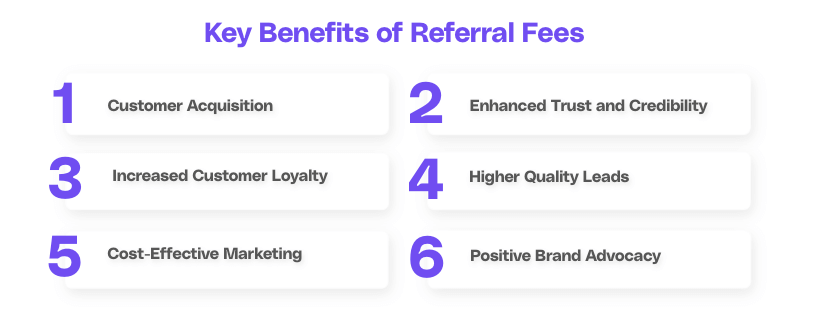
There are several benefits related to using referral fees.
Source: Cello
- Customer acquisition: Referral fees provide a cost-effective way for businesses to acquire new customers. By rewarding existing customers, partners, or affiliates for successful referrals, companies can tap into new markets and expand their customer base without incurring significant marketing expenses.
- Enhanced trust and credibility: Referrals from trusted sources carry more weight than traditional advertising or marketing efforts. By incentivizing referrals, businesses can draw on the trust and credibility of existing customers or partners to influence purchasing decisions and drive conversions.
- Increased customer loyalty: Offering referral fees demonstrates appreciation for customer loyalty and advocacy. By rewarding customers for their referrals, businesses can strengthen relationships, increase customer retention, and encourage repeat business.
- Higher quality leads: Referral fees tend to result in higher quality leads compared to other marketing channels. Individuals looking to earn rewards from referrals are more likely to refer the product or service to friends, family, or colleagues who are genuinely interested, as this increases the likelihood of a paid sign up. This leads to higher conversion rates and improved customer satisfaction.
- Cost-effective marketing: Referral fees are a cost-effective alternative to traditional marketing strategies. Instead of spending large sums on advertising campaigns, businesses can allocate resources to incentivize referrals, resulting in a higher return on investment and lower customer acquisition costs.
- Positive brand advocacy: Referral fees can turn satisfied customers into brand advocates. By incentivizing referrals, businesses can encourage customers to become ambassadors for their brand, actively promoting products or services to their network and generating positive word-of-mouth publicity.
By implementing referral programs and offering attractive incentives, businesses can turn satisfied customers into a repeatable growth channel that fuels sustainable success.
Types of incentives
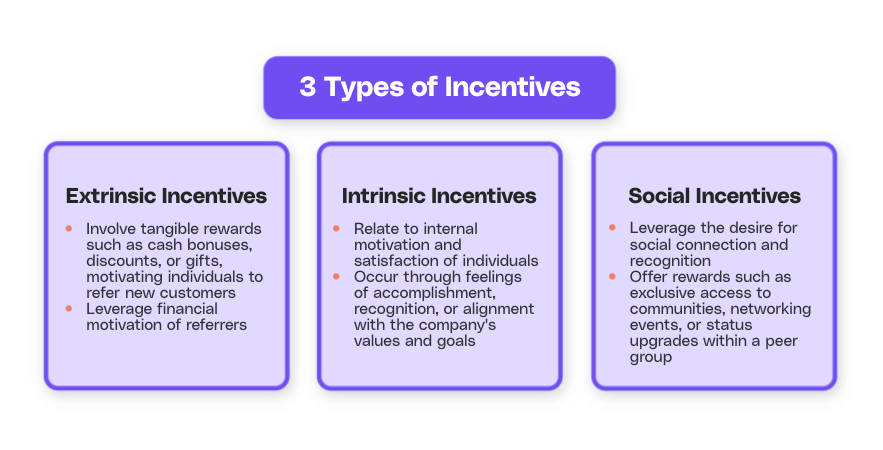
At its core, an incentive serves as a motivating force, promising a future reward in return for a specific action. In the realm of software products, incentives take on various forms, each designed to appeal to different aspects of human motivation. They are fundamental to boosting growth loops.
Source: Cello
Extrinsic incentives
These include tangible rewards, such as cash bonuses like Wise’s “Give $ and Get $”, in-product discounts like those offered by Dropbox, or points systems that can be redeemed for rewards within or outside the product experience.

Wise offers attractive rewards, incentivising its users to refer the app (Source: Cloudsponge)
Intrinsic incentives
These tap into individuals’ inner motivations, driving actions through the satisfaction of learning a new skill or achieving personal goals. Platforms like Vena exemplify this by donating $2,000 for every referred customer, aligning the incentive with ethical values and personal fulfillment.

Incentives such as contributing to a good cause can motivate users, depending on the reward and audience
(Source: Vena)
Social incentives
Such incentives leverage the power of social interaction, providing rewards through recognition from colleagues, friends, or the broader public. LinkedIn’s “Top Voice” badge is a prime example, granting acknowledgment for posting valuable content that garners high engagement.

LinkedIn’s “Top Voice” badges are a coveted social incentive (Source: Alberto Di Risio)
By understanding the diverse nature of incentives, businesses can craft effective growth strategies that resonate with their target audience’s motivations and drive sustainable growth.
Types of referral fees
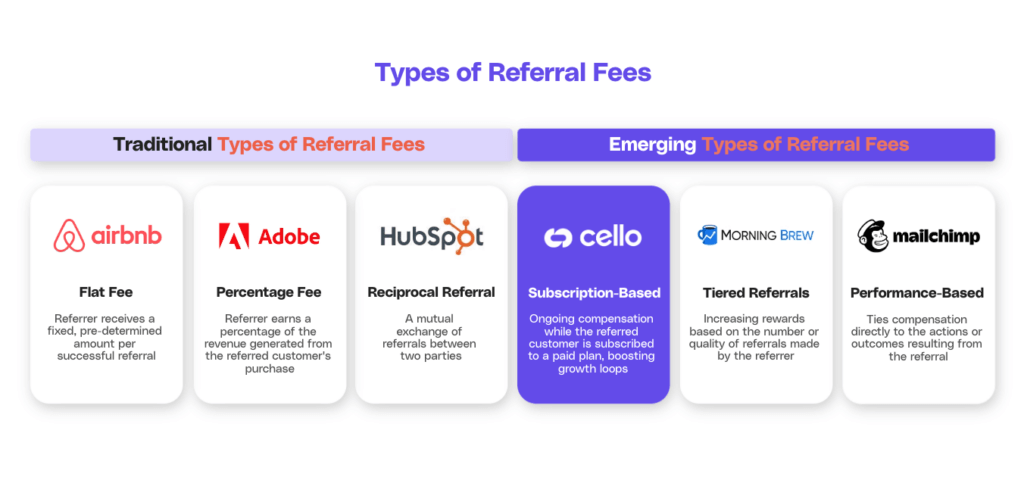
Referral fees are extrinsic incentives and come in various forms, each tailored to suit different industries, business models, and legal requirements. Understanding the nuances of each type can help businesses navigate referral agreements more effectively.
Rates vary by industry, deal size, and regulatory environment. The table below captures the ranges operators most commonly encounter.
|
Industry |
Typical fee structure |
Typical rate / amount |
Notes |
|---|---|---|---|
|
Real estate |
% of agent commission |
20 to 35% (commonly 25%) |
Must be paid to a licensed agent or broker. |
|
B2B SaaS / software |
% of first-year contract value |
10 to 20% |
Often recurring for the subscription lifetime. |
|
E-commerce (Amazon marketplace) |
% of total sales price |
6 to 20% depending on category |
A minimum referral fee applies per unit. |
|
Legal / attorney |
% of total fee earned |
10 to 40% |
Governed by bar rules; both parties must be licensed. |
|
Recruiting / staffing |
% of placed candidate salary |
15 to 25% of first-year salary |
Paid on successful placement. |
Source: Cello
Flat fee
A flat fee referral is a straightforward arrangement where the referrer receives a predetermined amount for each successful referral.
This type of fee structure is commonly used in real estate, legal services, and financial advising. It provides a clear incentive for referrers and is easy to administer.
Airbnb, for instance, offers a flat fee referral program where referrers earn a fixed amount (e.g. $25) for each successful referral who starts hosting on the platform.

Airbnb uses a flat referral fee (Source: Medium)
Percentage of sale
In this model, the referrer earns a percentage of the revenue generated from the referred customer’s purchase. This approach is popular in e-commerce, affiliate marketing, and sales-based industries.
The percentage may vary depending on the product or service being sold and can range from a small fraction to a significant portion of the sale.
One example is Adobe’s affiliate program, which rewards referrers with a percentage of the revenue generated from referred customers’ subscription fees or transactions on the platform.

Adobe offers percentage commissions to its affiliates
(Source: Adobe)
Reciprocal referral
Reciprocal referral agreements involve a mutual exchange of referrals between two parties. Each party agrees to refer clients or customers to the other in exchange for similar referrals in return.
This type of arrangement is common among professionals such as lawyers, accountants, and consultants who serve similar client bases.
This is the case for HubSpot’s partner program. It involves a reciprocal referral arrangement where certified partners refer clients to HubSpot’s marketing, sales, and service platforms, while HubSpot refers clients to its partners for implementation and consulting services.

HubSpot’s reciprocal referral program (Source: HubSpot)
Tiered referral program
Tiered referral programs offer increasing rewards based on the number or quality of referrals made by the referrer. As referrers reach certain milestones or achieve specific targets, their referral fees escalate accordingly.
This incentivizes referrers to continually generate referrals and can lead to exponential growth in referral activity.
Morningbrew operates a tiered referral program where referrers earn escalating rewards based on the number of successful referrals they make. Referrers unlock better rewards and more merchandise as they reach specific referral milestones.
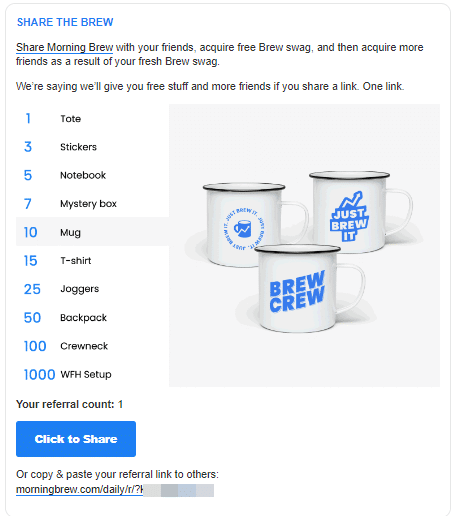
In a tiered referral program, more sharing equals better rewards (Source: Morningbrew)
Performance-based referral
Performance-based referral fees tie compensation directly to the actions or outcomes resulting from the referral. For example, a referrer may only receive payment if the referred customer completes a specific action, such as making a purchase, signing up for a subscription, or attending an event.
This model ensures that referrers are incentivized to deliver high-quality referrals that result in meaningful outcomes for the business.
Mailchimp’s referral program is performance-based, rewarding referrers only when their referred customers upgrade to a paid plan or meet certain engagement criteria, such as signing up for a paid monthly plan.

Mailchimp’s referral fee is conditional on the outcome of the referral
(Source: Mailchimp)
Subscription-based referral
In subscription-based referral programs, referrers receive ongoing compensation for as long as the referred customer remains active or subscribed to a service.
This approach is common in industries such as software as a service (SaaS), where companies aim to maximize customer retention and lifetime value. Referrers benefit from a steady stream of passive income as long as their referrals continue to use the service.
Typeform’s referral program offers referrers ongoing compensation for as long as their referred customers maintain an active subscription to one of its paid plans. Referrers receive a percentage of the subscription revenue generated by their referrals on a recurring basis.
Each type of referral fee has its advantages and considerations, and businesses should carefully evaluate their goals, target audience, and resources when selecting the most appropriate model for their referral program.
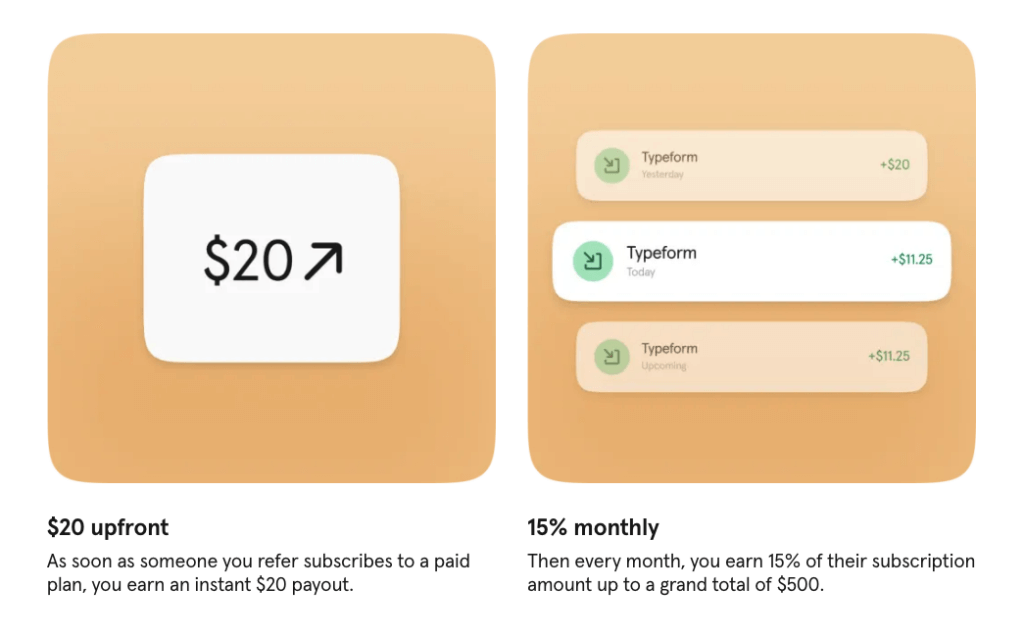
Typeform allows referrers to earn up to $500 through recurring payments
(Source: Typeform)
Cello’s choice: subscription-based referral
Subscription-based referral programs offer several compelling advantages.
Recurring revenue
Subscription-based referrals provide a consistent stream of passive income for referrers.
Unlike one-time referral fees, which provide a single payout per successful referral, subscription-based models offer ongoing compensation for as long as the referred customer remains active or subscribed to a service.
This ensures a more sustainable revenue stream for referrers, making it an attractive option for those seeking long-term financial benefits from their referral efforts.
Effective marketing
The recurring revenue model also serves as a potent marketing tool. By paying out referrers on a monthly basis, these programs create an enticing hook for potential referrers, often using lines like “earn up to $1000”, spread across monthly payments.
Such statements carry a strong appeal, motivating referrers to actively participate in the program and maximize their earnings.
Retention and growth loops
Additionally, subscription-based programs incentivize referrers to focus on referring customers who are likely to remain engaged with the service, thus promoting higher customer retention rates and increasing the overall value of the referral program for the business.
A strategic use of extrinsic, intrinsic and social incentives can boost the impact of viral growth loops, meaningfully improving a company’s reach.
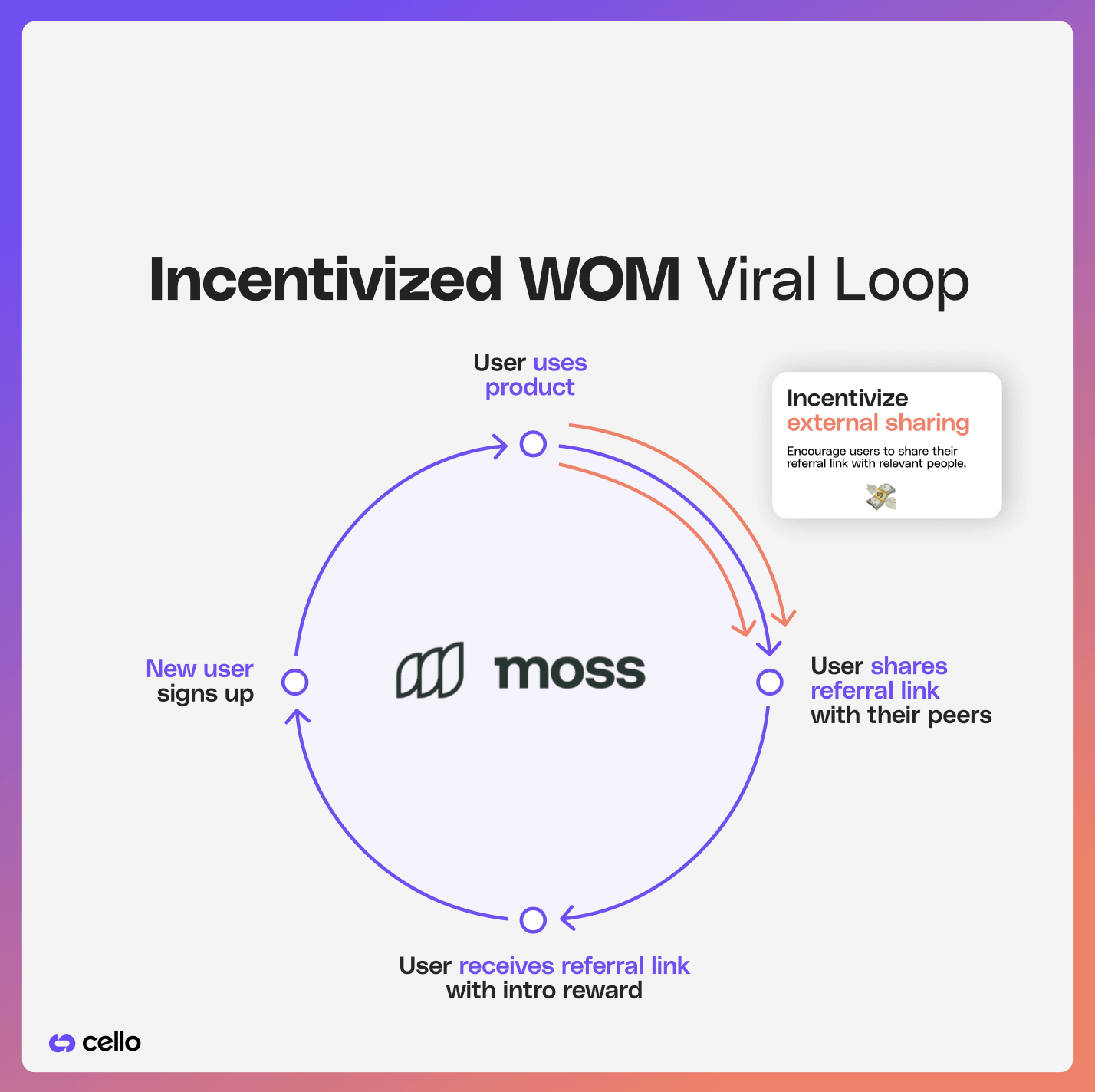
Subscription-based referral fees can spark viral loops
(Source: Cello)
Strategies to determine the right referral fees
Creating effective incentives for software products involves a nuanced approach that considers both the motivations of referrers and referees. Here’s how to set up incentives that leverage the two-sided nature of referral programs:
Crafting meaningful rewards
Setting meaningful rewards in B2B SaaS involves considering the high Annual Contract Value (ACV) and creating incentives that surpass any reluctance to share.
Start by determining a reward cap based on ACV, offering flexibility to cater to diverse motivations among referrers. Experimentation is key to finding the most effective approach. Generally, a high ACV allows companies to give out higher referral fees.

ACV is a good indicator for referral reward caps (Source: Cello)
Moreover, understanding the expected return on investment of your referral program can be helpful in guiding and determining your rewards. One useful tool is Cello’s free PLG SaaS Referral ROI Calculator.
Understanding the dual role of incentives
Recognize that referral programs involve two parties—the referrer and the referee. Referrers are motivated to make referrals by the promise of rewards, while referees are enticed to engage with the product through incentives offered by the referrer.
This two-sided dynamic should inform the design of the incentive structure to ensure it appeals to both parties and encourages participation from both sides.
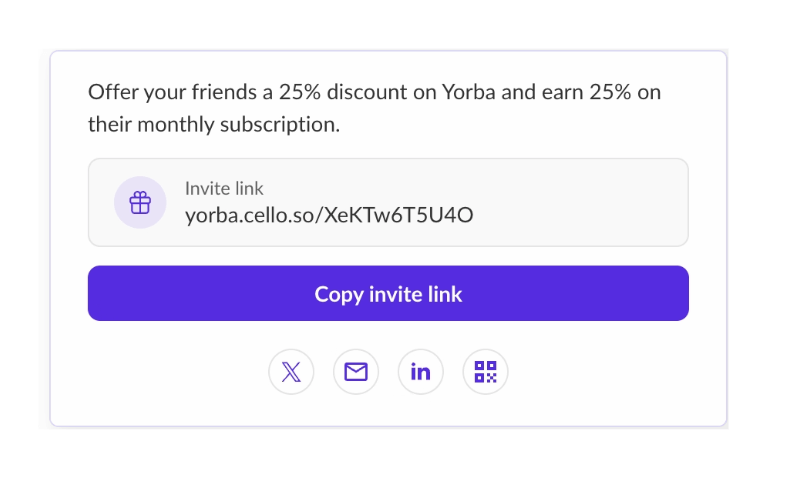
Referral fees work best when referrers know they are also benefitting referees (Source: Yorba)
Personalizing rewards
While direct monetary rewards are effective, personalizing incentives is crucial in B2B scenarios. Tailor rewards to resonate with decision-makers and end users beyond direct expenses.
While in-product rewards like account credits can be impactful, consider the accessibility and perceived value for all users.
Encouraging habit creation
In B2B, sustaining referral programs relies on transforming referrers into brand advocates and incentivizing ongoing influence.
Leverage the higher contract values to distribute rewards over time, reinforcing sharing habits and building a steady revenue stream.
Linking rewards to revenue generation
While higher referral fees may attract more referrers and drive increased customer acquisition, they must be sustainable in the long term and not overly burden the company’s profitability. As such, referral fees should be set in a way that aligns rewards with generated revenue.
This offers fraud protection and eliminates payback periods. Consider rewarding intermediate milestones to expedite the referral process while maintaining a focus on revenue generation for sustainable growth.
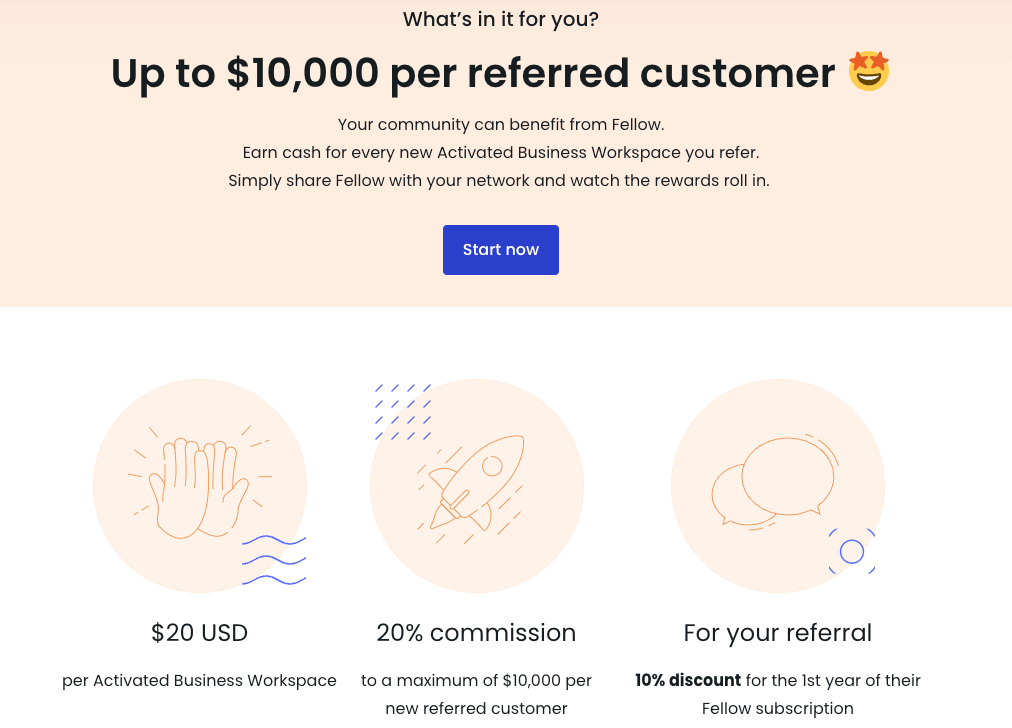
Fellow links its referral fee to revenue generation by referred customers
(Source: Fellow)
Effective communication of rewards
Communicate rewards clearly and compellingly to users, using a reward cap that combines one-time incentives with a percentage of monthly recurring revenue. Highlight larger headline numbers to influence user behavior, emphasizing tangible benefits and captivating messaging to encourage sharing.
Best practices for setting up referral fees
To ensure the success of a referral fee program, it’s essential to adhere to some best practices:
- Clearly Define Terms: Outline the terms of the referral program, including eligibility criteria and payment structure, to avoid misunderstandings.
- Transparent Communication: Clearly communicate the referral program to all parties involved, ensuring everyone understands how it works and what’s expected.
- Fair Compensation: Offer fair compensation for successful referrals, balancing incentives with the value of the customer referred.
- Timely Payments: Process referral fee payments promptly and efficiently to maintain trust and satisfaction among referrers.
- Track Referrals: Implement a robust system for tracking referrals accurately, capturing essential information for analysis.
- Compliance with Regulations: Ensure compliance with relevant laws and regulations, particularly regarding payment and data privacy.
- Regular Reviews and Updates: Continuously review and update the referral program to keep it effective and aligned with business goals.
- Provide Support: Offer support to referrers throughout the process, addressing any questions or concerns they may have.
- Encourage Quality Referrals: Emphasize the importance of quality over quantity when making referrals, focusing on customers likely to convert.
- Recognition and Appreciation: Recognize and appreciate referrers for their contributions, providing incentives and acknowledgment for their efforts.
By incorporating these best practices into their referral programs, businesses can maximize the effectiveness of their referral efforts and drive sustainable growth.
Challenges of offering referral fees
Offering referral fees can be a powerful strategy for businesses to incentivize customer acquisition and expand their reach, but it also comes with its fair share of challenges. These include:
- Determining the appropriate amount to offer as a referral fee. Setting the fee too low may fail to motivate referrers, while setting it too high could strain the company’s finances.
- Tracking and managing referrals can be complex, especially as the volume of referrals increases. Ensuring fairness and accuracy in attributing referrals to the correct referrers becomes crucial to maintaining trust and credibility in the program.
- Referral fraud, where individuals may attempt to manipulate the system for personal gain, leading to wasted resources and potential reputational damage.
- Compliance with legal and regulatory requirements, particularly regarding disclosure and transparency, is essential to avoid legal liabilities and maintain ethical business practices. We will explore these in depth below.
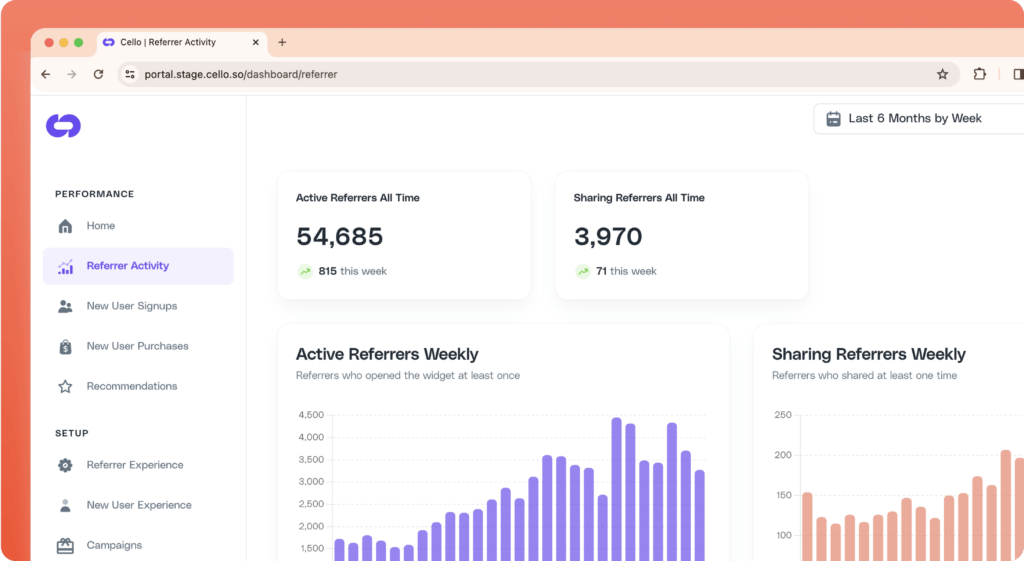
User performance dashboards are useful to track and manage referrals
(Source: Cello)
Balancing these challenges while maximizing the effectiveness of the referral program requires careful planning, monitoring, and adaptation over time.
Tax and legal implications
When implementing referral fee programs, businesses must navigate various tax and legal considerations to ensure compliance with relevant regulations.
Taxation issues
Referral fees are subject to taxation depending on jurisdiction and the nature of the arrangement. Businesses must account for income tax, value-added tax (VAT) and withholding tax obligations, and maintain proper documentation throughout. Tools such as Cello let operators outsource KYC and tax regulation checks, removing a compliance burden and handling compliant payouts across the countries and currencies Cello supports.
Contractual agreements
Referral fee arrangements should be clearly outlined in contractual agreements between the parties involved, including the referrer, referee, and the business offering the referral program.
These agreements should specify the terms and conditions of the referral arrangement, including the amount of the referral fee, payment terms, and any restrictions or limitations on referrals.
Clear contractual agreements help mitigate legal disputes and ensure that all parties understand their rights and obligations.
Regulatory compliance
Businesses offering referral programs must comply with relevant regulatory requirements, such as consumer protection laws, privacy regulations, and anti-corruption laws.
Referral programs should be transparent and fair to participants, with clear disclosure of the referral fee structure and any potential conflicts of interest.
Additionally, businesses operating in regulated industries, such as finance or healthcare, must ensure that referral programs adhere to industry-specific regulations and guidelines.
Antitrust and competition law
Referral fee arrangements should not violate antitrust or competition laws by unfairly restricting competition or creating anti-competitive behavior. Businesses should avoid engaging in price-fixing or collusion with competitors through referral programs.
It’s essential to conduct thorough legal review and due diligence to ensure that referral fee arrangements comply with antitrust and competition laws.
Navigating the tax and legal implications of referral fees requires careful attention to detail and compliance with applicable regulations.
By consulting with legal and tax professionals and implementing clear contractual agreements and compliance measures, businesses can mitigate the risks associated with referral fee programs and build sustainable and legally compliant referral strategies.
What referral fee percentage should B2B SaaS companies pay?
B2B SaaS referral fees typically run 10 to 20% of first-year contract value, often recurring for the subscription lifetime. Your Annual Contract Value (ACV) is the most reliable guide: higher ACV products can sustain larger absolute payouts, while subscription-based recurring structures tend to outperform flat fees because they align referrer incentives with customer retention instead of one-time acquisition.
Subscription-based vs flat-fee referral programs for SaaS: which structure drives better results?
Subscription-based referral programs outperform flat-fee structures for most SaaS companies because they pay out as long as the referred customer stays active, turning referrers into retention advocates instead of one-time promoters. Flat fees are simpler to administer and work well when billing systems don't expose granular revenue data, but they create no ongoing incentive for referrers to send high-quality, long-retention customers.
How do you prevent referral fraud without penalizing legitimate high-volume programs?
Effective fraud prevention evaluates multiple risk signals (self-referrals, duplicate signups, chargeback patterns, and unusual usage behavior) instead of applying rigid rate thresholds that cap legitimate sharing activity. Cello's fraud detection runs risk-factor monitoring for unusual usage patterns across a 30-day review window, so programs with genuine high referral volumes aren't penalized while real abuse signals are still caught and reviewed.
What tax obligations apply when paying referral fees?
Referral fees are subject to income tax, VAT, and withholding tax obligations that vary by jurisdiction, and must be documented in clear contractual agreements covering payment terms, eligibility, and any restrictions. Platforms like Cello handle KYC and tax regulation checks, including W-9, W-8BEN, and 1099-NEC processing, removing that compliance burden from the operator and covering compliant payouts across the countries and currencies they support.
How do you set referral fees that stay profitable long-term?
Link rewards directly to verified revenue events, such as a paid invoice or confirmed subscription, instead of signups or demo bookings, so reward costs are always proportional to realized revenue. This structure removes payback-period risk, protects against fraud, and lets you scale referral fees without straining margins, because a payout only fires when a customer has already generated the revenue that funds it.